

Kirjahaku
Etsi kirjoja tekijän nimen, kirjan nimen tai ISBN:n perusteella.
1000 tulosta hakusanalla Kenneth Graham Duffield











Kenneth Lonergan’s three films—You Can Count on Me (2000), Margaret (2011), and Manchester by the Sea (2016)—are rife with philosophical complexities. They challenge simple philosophical approaches to central issues of human behaviour. In particular, they ask questions about how to cope with suffering that one cannot overcome, the role that self- deception plays in people’s lives and how to think about characters who do not embody simplistic moral ideas of virtue and vice. By philosophically engaging with these themes as they unfold in Lonergan’s films, we are then able to formulate a more nuanced answer to the questions they pose. Kenneth Lonergan: Philosophical Filmmaker will draw from Lonergan’s films and plays, along with the philosophical literature on the topics that they explore. The rich history of philosophical reflection surrounding these areas enables the reader to determine how the themes central to Lonergan’s work have combined to create a rich cinematic oeuvre.
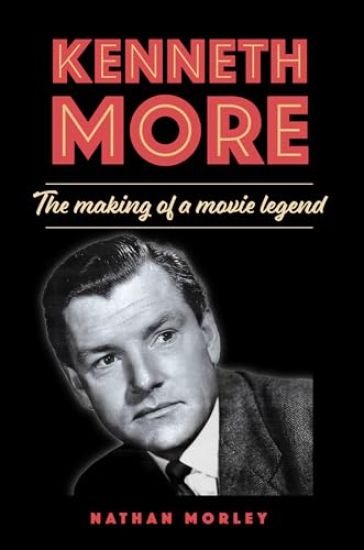
Kenneth More was the living embodiment of British humour, steadfastness and resilience on the film screen and off. Born into a life of wealth in 1914, he fell into show business almost by accident and worked for nearly two decades – including at London’s famous Windmill Theatre – before becoming the icon we know today. After a long, distinguished stint in the Royal Navy during the Second World War, he was ‘discovered’ by Noël Coward and set on the road to fame. What followed was a string of films we have come to know as the most beloved classics of British cinema, such as Genevieve, Reach for the Sky, The 39 Steps, A Night to Remember, Sink the Bismarck! and Scrooge. Throughout the 1950s and 1960s, his private life was almost as exciting as the roles he played. Following a string of affairs and eleven years of marriage, he made national headlines after running off with a young actress. Then, when a public spat with the head of Britain’s biggest movie studio damaged his career, he found a new home in television. On screen, Kenneth More fought some courageous battles, but his bravest fight came when Parkinson’s disease ended his career in the late 1970s. Nathan Morely has produced a fascinating and insightful biography of one of the most iconic and enduring legends of British cinema, with contributions from fellow actors and directors who worked with him. Among these are Martin Jarvis, Jane Asher, Chris Sarandon, Anneke Wills, Susan Penhaligon, Alvin Rakoff, Peter Medak, Barry MacGregor, and many others.

"I used to be an artist; then I became a poet; then a writer. Now when asked, I simply refer to myself as a word processor," Kenneth Goldsmith (born 1961) writes in "Theory." The acclaimed conceptual poet, who is the founder and editor of UbuWeb, a professor of Uncreative Writing at the University of Pennsylvania and the former host of a weekly radio show at WFMU, was also appointed MoMA's very first Poet Laureate in 2013. Goldsmith may be a word processor, but he has also proven to be a highly influential literary figure over the past two decades. His latest publication, "Theory," is a series of 500 texts-from poems to aphoristic thoughts to short stories-published on 500 sheets of paper and gathered unbound as a paper ream. This artist's book is the first of Goldsmith's publications to consolidate his diverse practices-from the radio to the Internet to his "uncreative" writing-in a single volume.

The Kenneth Anderson Omnibus Vol. Iii
Kenneth Anderson
Rupa Publications India Pvt. Ltd
2015
nidottu


John Kenneth Galbraith (1908-2006) was one of America's most famous economists for good reason. From his acerbic analysis of America's "private wealth and public squalor" to his denunciation of the wars in Vietnam and Iraq, Galbraith consistently challenged "conventional wisdom" (a phrase he coined). He did so as a witty commentator on America's political follies and as a versatile author of bestselling books--such as The Affluent Society and The New Industrial State--that warn of the dangers of deregulated markets, corporate greed, and inattention to the costs of our military power. Here, in the first full-length biography of Galbraith and his times, Richard Parker provides not only a nuanced portrait of this extraordinary man, but also an important reinterpretation of twentieth-century public policy and economic practices."Whatever you may think of his ideas, John Kenneth Galbraith has led an extraordinary life. . . . Doing justice to this life story requires an outsize biography, one that not only tells Mr. Galbraith's tale but sets it on the broader canvas of America's political and economic evolution. And Richard Parker's book does just that."--Economist"Parker's book is more than a chronicle of Galbraith's life; it's a history of American politics and policy from FDR through George W. Bush. . . . It will make readers more economically and politically aware."--USA Today "The most readable and instructive biography of the century."--William F. Buckley, National Review"The story of this man's life and work is wonderfully rendered in this magnum opus, and offers an antidote to the public ennui, economic cruelty, and government malfeasance that poison life in America today."--James Carroll, Boston Globe
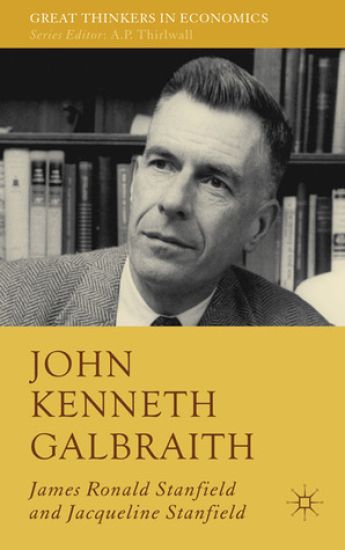
This book examines the life and work of John Kenneth Galbraith, a truly iconic figure in progressive modern liberalism and a seminal influence in the rise of heterodox political economy. It emphasizes his continuing relevance to the current research of today, and to the multifaceted crisis of democratic capitalism.
This book provides an intellectual portrait of John Kenneth Galbraith, an institutional economist who examines the configuration of power by the clusters of mores that comprise institutions. Galbraith proposes an aggressive social democratic policy to achieve social and economic reform. This policy includes explicit recognition that the state must intervene to countervail the power of entrenched political economic interests and to provide generous support of the arts and letters to achieve the affirmation of humanity.
John Kenneth Galbraith: The Economic Legacy
Routledge
2012
muu
One hundred years after his birth, J. K. Galbraith’s The Great Crash 1929 is again on the bestseller lists. And in the current financial and economic tumult, familiar Galbraithian concerns—such as the power and dominance of overweening corporations, national and global poverty, and the careless destruction of the natural environment—once again loom large in the public consciousness.Galbraith’s contemporaries included such towering intellects as Paul Samuelson, Robert Solow, Milton Friedman, Wassily Leontief, Simon Kuznets, James Meade, Nicolas Kaldor, and Joan Robinson. These intellectual giants took Galbraith and his ideas seriously. Today, however, Galbraith remains professionally unpopular, and many economists have either forgotten his contribution, or fail sufficiently to acknowledge their intellectual debt to him.This new four-volume collection from Routledge remedies this failing by highlighting Galbraith’s centrality to the crucial economic debates of the second half of the twentieth century. The collection has been designed to acquaint the user to Galbraith’s economics and his vision of the economic process; to contribute to the long overdue re-evaluation of Galbraith’s place in the study of economics; and to help establish new directions for future research in the Galbraithian tradition.The collection reproduces J. K. Galbraith’s major theoretical economic contributions including: Galbraith’s original—but largely ignored—contribution to the theory of the firm, which shares many similarities with the work of Ronald Coase and Oliver Williamson; his monetary economics (which embodies elements of both Keynes and the new consensus in macroeconomics); and Galbraith’s exploration of financial euphoria, which predates Robert Shiller’s analysis of ‘irrational exuberance’.The set also brings together the critical and professional reactions to American Capitalism, The Affluent Society, The New Industrial State, and Economics and the Public Purpose, with an additional focus on more recent assessments which identify Galbraith’s deeper theoretical contributions and highlight its contemporary relevance.J. K. Galbraith: The Economic Legacy is edited by Stephen P. Dunn, a leading scholar in the field. The collection is fully indexed and has a comprehensive introduction, newly written by the editor, which places the material in its intellectual context. It is an essential work of reference and is destined to be valued by scholars and students as a vital one-stop research resource.