Kirjojen hintavertailu. Mukana 11 699 587 kirjaa ja 12 kauppaa.

Kirjahaku

Etsi kirjoja tekijän nimen, kirjan nimen tai ISBN:n perusteella.

1000 tulosta hakusanalla Lucas Azeredo

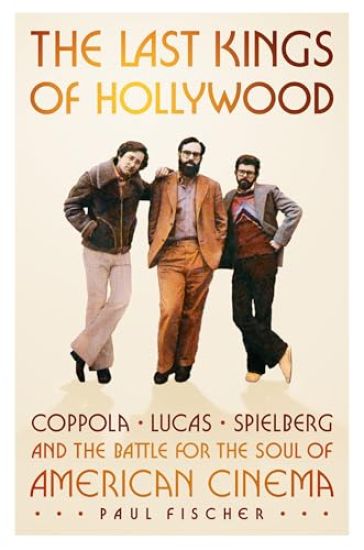
The Last Kings of Hollywood: Coppola, Lucas, Spielberg--And the Battle for the Soul of American Cinema
The untold, intimate story of how three young visionaries--Francis Ford Coppola, George Lucas, and Steven Spielberg--revolutionized American cinema, creating the most iconic films in history while risking everything, redefining friendship, and shaping Hollywood as we know it. In the summer of 1967, as the old Hollywood studio system was dying, an intense, uncompromising young film school graduate named George Lucas walked onto the Warner Bros backlot for his first day working as an assistant to another up-and-coming, largely-unknown filmmaker, a boisterous father of two called Francis Ford Coppola. At the exact same time, across town on the Universal Studios lot, a film-obsessed twenty-year-old from a peripatetic Jewish family, Steven Spielberg, longed to break free from his apprenticeship for the struggling studio and become a film director in his own right. Within a year, the three men would become friends. Spielberg, prioritizing security, got his seven-year contract directing television. Lucas and Coppola, hungry for independence, left Hollywood for San Francisco to found an alternative studio, American Zoetrope, and make films without answering to corporate capitalism. Based on extensive research and hundreds of original interviews with the inner circle of these Hollywood icons, The Last Kings of Hollywood tells the thrilling, dramatic inside story of how, over the next fifteen years, the three filmmakers rivalled and supported each other, fell out and reconciled, and struggled to reinvent popular American cinema. Along the way, Coppola directed The Godfather, then the highest-grossing film of all-time, until Spielberg surpassed it with Jaws -- whose record Lucas broke with Star Wars, which Spielberg surpassed again with E.T. By the early 1980s, they were the richest, best-known filmmakers in the world, each with an empire of their own. The Last Kings of Hollywood is an unprecedented chronicle of their rise, their dreams and demons, their triumphs and their failures -- intimate, extraordinary, and supremely entertaining.
A History of Rehoboth Reformed Church, Lucas Michigan: Celebrating 125 Years of Faithfulness 1890-2015
This small book is a combination of three writings produced over a period of 34 years. I wrote the first part in 1981, covering the years 1890-1952, as a tribute to the church and community in which I had grown up from the late 1940s into the early 1960s. A strong, vivid memory from my childhood was the excitement in the village of Lucas during the summer of 1951 as a new church was built with labor donated from the congregation. I wanted to study and write about how the church had come into being and had developed to the point of constructing a new sanctuary, which after three additional building projects nevertheless remains the architectural nucleus of the church to this day. In 1989, I completed a second part, bringing the story from 1952 through 1988 by way of marking the church's centenary. I have now completed a third part through the year 2014 on the occasion of the 125th anniversary of the church. I have resisted the temptation to combine the three parts into one seamless account. Instead, I have decided to keep the first two parts as they were written in order to preserve the perspective that informed each of them. Combining all into one account would require some editing that, it seemed to me, would compromise aspects of authenticity belonging to each part while also introducing new problems. The most salient irregularity that appears as a result is that the pastorate of Rev. Carl Regnerus is covered in two chapters rather than one, as is the case for the other pastors. One chapter, written in 1989, covers his pastorate prior to the centenary, and one chapter, written in 2015, covers his pastorate after the centenary. I hope that readers will pardon this irregularity and will even be able to appreciate how perspectives obtained from different vantages can enrich our view of the past. One cannot but be struck by the growth and dynamic spirit that has characterized the history of Rehoboth Reformed as evidenced not only by the series of building projects undertaken and completed over the years but even more by the vibrant life of the community that has continued to thrive at this place. Through many vicissitudes, Rehoboth Reformed is still a place where people gather for friendship, comfort, devotion, education, social action, and spiritual refreshment. I believe that by considering the history of the church we can put ourselves into a picture larger than the frame of our personal lives, and that this can show us how to be grateful for those who went before, how to be forgiving and kind to those with whom we live and serve today, and how to nurture the children and young people who will be the church of tomorrow. There are sure to be omissions and mistakes in what I have written. My hope is that future historians will set things right. K. W. Taylor February 2015
An Analysis of Robert E. Lucas Jr.'s Why Doesn't Capital Flow from Rich to Poor Countries?
Robert Lucas is known among economists as one of the most influential macroeconomists of recent times – a reputation founded in no small part on the critical thinking skills displayed in his seminal 1990 paper ‘Why Doesn’t Capital Flow from Rich to Poor Countries?’ Lucas’s paper tackles a puzzle in economic theory that has since come to be known as the ‘Lucas paradox,’ and it deploys the author’s brilliant problem solving skills to explain why such an apparent paradox in fact makes sense. Classical economic theory makes a simple prediction of how capital flows between countries: it should, it states, flow from rich to poor countries, because of the law of diminishing returns on capital. Since poor countries have so little capital invested in them, the returns on new investment should be proportionally far better than investment in rich countries. This should mean that investors seeking new opportunities will invest in poorer countries, making capital consistently flow from rich nations to poorer ones. But, problematically, this is not in fact the case. Having defined the problem, Lucas did what any good problem solver would: he looked critically at the criteria involved, and offered a series of possible solutions. Indeed, in just six pages, he puts forward four hypotheses to explain the paradox’s existence. The popularity of his paper, and the influence it has had, are also greatly magnified by careful reasoning embodied in Lucas’s marshalling of evidence and his explanations of the judgements he has made.
An Analysis of Robert E. Lucas Jr.'s Why Doesn't Capital Flow from Rich to Poor Countries?
Robert Lucas is known among economists as one of the most influential macroeconomists of recent times – a reputation founded in no small part on the critical thinking skills displayed in his seminal 1990 paper ‘Why Doesn’t Capital Flow from Rich to Poor Countries?’ Lucas’s paper tackles a puzzle in economic theory that has since come to be known as the ‘Lucas paradox,’ and it deploys the author’s brilliant problem solving skills to explain why such an apparent paradox in fact makes sense. Classical economic theory makes a simple prediction of how capital flows between countries: it should, it states, flow from rich to poor countries, because of the law of diminishing returns on capital. Since poor countries have so little capital invested in them, the returns on new investment should be proportionally far better than investment in rich countries. This should mean that investors seeking new opportunities will invest in poorer countries, making capital consistently flow from rich nations to poorer ones. But, problematically, this is not in fact the case. Having defined the problem, Lucas did what any good problem solver would: he looked critically at the criteria involved, and offered a series of possible solutions. Indeed, in just six pages, he puts forward four hypotheses to explain the paradox’s existence. The popularity of his paper, and the influence it has had, are also greatly magnified by careful reasoning embodied in Lucas’s marshalling of evidence and his explanations of the judgements he has made.
Familia y poder en el Yucatan colonial: Los Quijano y el asesinato del Gobernador Lucas De Galvez

Familia y poder en el Yucatan colonial: Los Quijano y el asesinato del Gobernador Lucas De Galvez

Jorge Alberto Canto-Alcocer

Createspace Independent Publishing Platform
2017
nidottu
En los ltimos minutos del 22 de junio de 1792, Lucas de G lvez, gobernador, capit n general y primer intendente de Yucat n, expir tras recibir una certera pu alada en el pecho. La mortal herida se produjo cuando su carruaje fue atacado a un centenar de metros de la Casa de Gobierno, justo en el centro de M rida, la capital provincial. A consecuencia del inaudito asesinato -como lo sigue siendo m s de dos siglos despu s, la M rida colonial se caracterizaba por ser una de las ciudades m s tranquilas de la Am rica Hispana-empez un tortuoso, intrincado, apasionante proceso judicial, cuyo estudio nos permite observar con impresionante detalle los conflictos pol ticos, las estrategias econ micas, los logros sociales y parte de la vida cotidiana de este peque o gir n del virreinato de Nueva Espa a en aquellos a os. M ltiples actores, de or genes y posiciones diversas, aparecen durante esta investigaci n. Algunos de manera contundente, otros de forma velada... unos en la c spide de la sociedad, presidiendo o recibiendo homenajes p blicos de grandes fastos, otros luchando silenciosa o ruidosamente en los barrios marginales y en las p tridas c rceles virreinales. Dentro de los muchos matices, sobresale el conflicto, la contradicci n, entre la visi n colonialista de los funcionarios espa oles que intentaban establecer una ambiciosa reforma en los territorios ultramarinos, y las familias criollas, que defend an a ultranza un statu quo conveniente a sus intereses. El proceso judicial sobre el asesinato de Lucas de G lvez concluy , en los primeros a os del siglo XIX, al responsabilizar a un hombre pobre como asesino solitario. Nosotros encontramos otras respuestas, que aqu consignamos, y que nos llevan a identificar a autores intelectuales y materiales del crimen y, en el fondo, a plantearnos una profunda reconsideraci n respecto de la visi n tradicional sobre las relaciones de poder entre la Corona espa ola y las familias criollas iberoamericanas en la dram tica coyuntura de las postrimer as del siglo XVIII, entre los estertores de un mundo medieval que agonizaba y el pujante, incontenible nacimiento de la Modernidad.
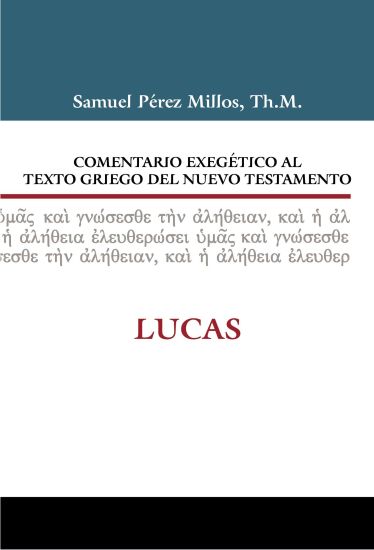
Comentario Exegético al texto griego del N.T. Lucas

Comentario Exegético al texto griego del N.T. Lucas

Samuel Pérez Millos

Vida Publishers
2014
sidottu
Una nueva adici n a la colecci n de Comentarios exeg ticos al texto griego, por el renombrado autor Samuel P rez Millos.Fruto de una larga vida dedicada al estudio, ense anza y exposici n de la Palabra de Dios, M.Th. Samuel P rez Millos nos ofrece con el COMENTARIO EXEG TICO AL TEXTO GRIEGO DEL NUEVO TESTAMENTO una obra incomparable por la calidad y alcance de su contenido. A na en un solo comentario el rigor del an lisis gramatical del texto griego del Nuevo Testamento y las derivaciones pr cticas, doctrinales y teol gicas del mismo. Las 7 caracter sticas principales que re ne este comentario y que hacen del mismo un conjunto de 7 comentarios distintos en uno solo, son las siguientes: T cnico: A cada libro le precede un completo estudio introductorio sobre el autor, fecha, cuestiones cr ticas, tema principal y bosquejo anal tico. Anal tico: Examen gramatical del texto griego con incorporaciones de la correspondiente cr tica textual, cuando se da el caso, analizando todos los elementos de cada vers culo, como verbos, sustantivos, adjetivos, proposiciones, etc. Ling stico: Texto griego interlineal y traducci n interlineal de cada palabra. An lisis del mismo con modos verbales, declinaciones, etc., ofreciendo el significado principal y los complementarios de cada palabra. Exeg tico: Interpretaci n literal de cada t rmino y su significado en el conjunto can nico del Nuevo Testamento. Expositivo: Va exponiendo el texto b blico vers culo a vers culo y extrayendo las ense anzas de cada vers culo, cada pasaje y cada palabra. Did ctico: La ex gesis del texto se ve complementada con una serie de excursus sobre temas doctrinales y pr cticos que precisan de mayor atenci n y detalle. Pr ctico: Aplicaci n a la vida del individuo o de la comunidad de la ense anza doctrinal, teol gica y espiritual derivada de la ex gesis del texto. En suma, un comentario nico, riguroso y pr ctico a la vez, muy til para todo amante y estudioso de la Palabra de Dios. De inter s para los que ya han alcanzado un alto nivel de estudios b blicos y hermen uticos, y enriquecedor para los que se est n iniciando. Pastores y maestros se beneficiar n por igual de esta obra a la hora de preparar con fidelidad y conocimiento sus sermones y clases, gracias a la luz que ofrece la amplia informaci n exeg tica y doctrinal en todos y cada uno de los vers culos del Nuevo Testamento. El lector en general puede recurrir a l en todo momento con la seguridad de hallar una respuesta a sus preguntas sobre el significado de un determinado texto de la Escritura.