Kirjojen hintavertailu. Mukana 12 052 911 kirjaa ja 12 kauppaa.

Kirjahaku

Etsi kirjoja tekijän nimen, kirjan nimen tai ISBN:n perusteella.

1000 tulosta hakusanalla Roberto Gutierrez Laboy

Celestina's Brood

Celestina's Brood

Roberto González Echevarría

Duke University Press
1993
pokkari
Published in 1499 and centered on the figure of a bawd and witch, Fernando de Rojas' dark and disturbing Celestina was destined to become the most suppressed classic in Spanish literary history. Routinely ignored in Spanish letters, the book nonetheless echoes through contemporary Spanish and Latin American literature. This is the phenomenon that Celestina's Brood explores.Roberto González Echevarría, one of the most eminent and influential critics of Hispanic literature writing today, uses Rojas' text as his starting point to offer an exploration of modernity in the Hispanic literary tradition, and of the Baroque as an expression of the modern. His analysis of Celestina reveals the relentless probing of the limits of language and morality that mark the work as the beginning of literary modernity in Spanish, and the start of a tradition distinguished by a penchant for the excesses of the Baroque. González Echevarría pursues this tradition and its meaning through the works of major figures such as Cervantes, Lope de Vega, Calderón de la Barca, Alejo Carpentier, Carlos Fuentes, Gabriel García Márquez, Nicolás Guillén, and Severo Sarduy, as well as through the works of lesser-known authors.By revealing continuities of the Baroque, Celestina's Brood cuts across conventional distinctions between Spanish and Latin American literary traditions to show their profound and previously unimagined affinity.
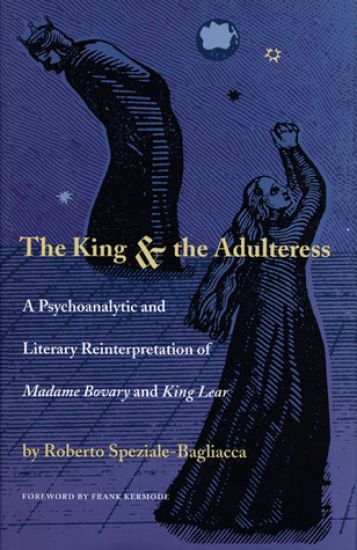
The King and the Adulteress

The King and the Adulteress

Roberto Speziale-Bagliacca

Duke University Press
1998
sidottu
The King and the Adulteress brings together two essays that propose radically revisionary readings of two of the most important literary works in the Western canon, Flaubert’s Madame Bovary and Shakespeare’s King Lear. In offering a new understanding of a deeply sadomasochistic relationship and of an authoritarian pathology, renowned psychoanalyst Roberto Speziale-Bagliacca combines psychoanalysis with literary studies to challenge the conventional judgments of readers and the stereotyped interpretations of literary critics to these masterpieces.Approaching the characters in Bovary and Lear from both an analytic and a critical viewpoint, Speziale-Bagliacca reinterprets many issues and events that involve archetypal figures of modern literary mythology. In fact, he reverses much of the received opinion about them. Charles Bovary, for example, far from being a victim of his wife’s neurotic restlessness or the epitome of a passive imbecile, is a masochist of the highest order who makes a decisive contribution to Emma’s miserable end. Lear, rather than a tragedy involving the sweet Cordelia, noble Kent, and the Fool as good and loyal supporters of an old king driven to madness by his overbearing evil daughters, is precisely the opposite. The sympathetic understanding of the reader should go, Speziale-Bagliacca suggests, also to Regan, Goneril, and Edmund, while the king, whose crisis is interpreted in the light of psychoanalytic findings on depression, finally becomes the true unbeloved "bastard" of the play. Roberto Speziale-Bagliacca is a psychoanalyst and Professor of Psychotherapy at the Medical School of the University of Genoa. He is the author of On the Shoulders of Freud and many other works.
Myth and Archive

Myth and Archive

Roberto González Echevarría

Duke University Press
1998
pokkari
Myth and Archive presents a new theory of the origin and evolution of Latin American literature and the emergence of the modern novel. In this influential, award-winning exploration of Latin American writing from colonial times to the present, Roberto GonzÁlez EchevarrÍa dispenses with traditional literary history to reveal the indebted relationship of the novel to legal, scientific, and anthropological discourses. Providing ways to link literary and nonliterary narratives, GonzÁlez EchevarrÍa examines a variety of archival writings-from the chronicles of the discovery and conquest of the New World to scientific travel narratives and records of criminal confessions-and explores the relationship of these writings to novels by authors such as GarcÍa MÁrquez, Borges, Barnet, Sarmiento, Carpentier, and Garcilaso de la Vega. Moving beyond demonstrating that early forms of creative narrative had their geneses in the sixteenth-century authoritative discourse of the Spanish Empire, GonzÁlez EchevarrÍa shows how this same originating process has been repeated in other key moments in the history of the Latin American narrative. He shows how the discourse of scientific discovery was the model for much nineteenth-century literature, as well as how anthropological writings on the nature of language and myth have come to shape the ideology and form of literature in the twentieth century. This most recent form of Latin American narrative creates its own mythic form through an atavistic return to its legal origins-the archive. This acclaimed book-originally published in 1990-will be of continuing interest to historians, anthropologists, literary theorists, and students of Latin American culture.
A Master on the Periphery of Capitalism

A Master on the Periphery of Capitalism

Roberto Schwarz

Duke University Press
2001
sidottu
A Master on the Periphery of Capitalism is a translation (from the original Portuguese) of Roberto Schwarz’s renowned study of the work of Brazilian novelist Machado de Assis (1839–1908). A leading Brazilian theorist and author of the highly influential notion of “misplaced ideas,” Schwarz focuses his literary and cultural analysis on Machado’s The Posthumous Memoirs of Brás Cubas, which was published in 1880. Writing in the Marxist tradition, Schwarz investigates in particular how social structure gets internalized as literary form, arguing that Machado’s style replicates and reveals the deeply embedded class divisions of nineteenth-century Brazil. Widely acknowledged as the most important novelist to have written in Latin America before 1940, Machado had a surprisingly modern style. Schwarz notes that the unprecedented wit, sarcasm, structural inventiveness, and mercurial changes of tone and subject matter found in The Posthumous Memoirs of Brás Cubas marked a crucial moment in the history of Latin American literature. He argues that Machado’s vanguard narrative reflects the Brazilian owner class and its peculiar status in both national and international contexts, and shows why this novel’s success was no accident. The author was able to confront some of the most prestigious ideologies of the nineteenth century with some uncomfortable truths, not the least of which was that slavery remained the basis of the Brazilian economy.A Master on the Periphery of Capitalism will appeal to those with interests in Latin American literature, nineteenth century history, and Marxist literary theory.
A Master on the Periphery of Capitalism

A Master on the Periphery of Capitalism

Roberto Schwarz

Duke University Press
2001
pokkari
A translation of Roberto Schwarz's study of Machado de Assis's "The Posthumous Memoirs of Bras Cubas". Writing in the Marxist tradition, it examines how social structure gets internalized as literary form, arguing that Machado's style reveals the class divisions of 19th-century Brazil.
Mad Toy

Mad Toy

Roberto Arlt

Duke University Press
2002
sidottu
Roberto Arlt, celebrated in Argentina for his tragicomic, punch-in-the-jaw writing during the 1920s and 1930s, was a forerunner of Latin American “boom” and “postboom” novelists such as Gabriel García Márquez and Isabel Allende. Mad Toy, acclaimed by many as Arlt’s best novel, is set against the chaotic background of Buenos Aires in the early twentieth century. Set in the badlands of adolescence, where acts of theft and betrayal become metaphors for creativity, Mad Toy is equal parts pulp fiction, realism, detective story, expressionist drama, and creative memoir. An immigrant son of a German father and an Italian mother, Arlt as a youth was a school dropout, poor and often hungry. In Mad Toy, he incorporates his personal experience into the lives of his characters. Published in 1926 as El juguete rabioso, the novel follows the adventures of Silvio Astier, a poverty-stricken and frustrated youth who is drawn to gangs and a life of petty crime. As Silvio struggles to bridge the gap between exuberant imagination and the sordid reality around him, he becomes fascinated with weapons, explosives, vandalism, and thievery, despite a desperate desire to rise above his origins. Flavored with a dash of romance, a hint of allegory, and a healthy dose of irony, the novel’s language varies from the cultured idiom of the narrator to the dialects and street slang of the novel’s many colorful characters. Mad Toy has appeared in numerous Spanish editions and has been adapted for the stage and for film. It is the second of Arlt’s novels to be translated into English.
Mad Toy

Mad Toy

Roberto Arlt

Duke University Press
2002
pokkari
Roberto Arlt, celebrated in Argentina for his tragicomic, punch-in-the-jaw writing during the 1920s and 1930s, was a forerunner of Latin American “boom” and “postboom” novelists such as Gabriel García Márquez and Isabel Allende. Mad Toy, acclaimed by many as Arlt’s best novel, is set against the chaotic background of Buenos Aires in the early twentieth century. Set in the badlands of adolescence, where acts of theft and betrayal become metaphors for creativity, Mad Toy is equal parts pulp fiction, realism, detective story, expressionist drama, and creative memoir. An immigrant son of a German father and an Italian mother, Arlt as a youth was a school dropout, poor and often hungry. In Mad Toy, he incorporates his personal experience into the lives of his characters. Published in 1926 as El juguete rabioso, the novel follows the adventures of Silvio Astier, a poverty-stricken and frustrated youth who is drawn to gangs and a life of petty crime. As Silvio struggles to bridge the gap between exuberant imagination and the sordid reality around him, he becomes fascinated with weapons, explosives, vandalism, and thievery, despite a desperate desire to rise above his origins. Flavored with a dash of romance, a hint of allegory, and a healthy dose of irony, the novel’s language varies from the cultured idiom of the narrator to the dialects and street slang of the novel’s many colorful characters. Mad Toy has appeared in numerous Spanish editions and has been adapted for the stage and for film. It is the second of Arlt’s novels to be translated into English.
Europe (in Theory)

Europe (in Theory)

Roberto M. Dainotto

Duke University Press
2007
sidottu
Europe (in Theory) is an innovative analysis of eighteenth- and nineteenth-century ideas about Europe that continue to inform thinking about culture, politics, and identity today. Drawing on insights from subaltern and postcolonial studies, Roberto M. Dainotto deconstructs imperialism not from the so-called periphery but from within Europe itself. He proposes a genealogy of Eurocentrism that accounts for the way modern theories of Europe have marginalized the continent’s own southern region, portraying countries including Greece, Italy, Spain, and Portugal as irrational, corrupt, and clan-based in comparison to the rational, civic-minded nations of northern Europe. Dainotto argues that beginning with Montesquieu’s The Spirit of Laws (1748), Europe not only defined itself against an “Oriental” other but also against elements within its own borders: its South. He locates the roots of Eurocentrism in this disavowal; internalizing the other made it possible to understand and explain Europe without reference to anything beyond its boundaries.Dainotto synthesizes a vast array of literary, philosophical, and historical works by authors from different parts of Europe. He scrutinizes theories that came to dominate thinking about the continent, including Montesquieu’s invention of Europe’s north-south divide, Hegel’s “two Europes,” and Madame de Staël’s idea of opposing European literatures: a modern one from the North, and a pre-modern one from the South. At the same time, Dainotto brings to light counter-narratives written from Europe’s margins, such as the Spanish Jesuit Juan Andrés’s suggestion that the origins of modern European culture were eastern rather than northern and the Italian Orientalist Michele Amari’s assertion that the South was the cradle of a social democracy brought to Europe via Islam.
Europe (in Theory)

Europe (in Theory)

Roberto M. Dainotto

Duke University Press
2007
pokkari
Europe (in Theory) is an innovative analysis of eighteenth- and nineteenth-century ideas about Europe that continue to inform thinking about culture, politics, and identity today. Drawing on insights from subaltern and postcolonial studies, Roberto M. Dainotto deconstructs imperialism not from the so-called periphery but from within Europe itself. He proposes a genealogy of Eurocentrism that accounts for the way modern theories of Europe have marginalized the continent’s own southern region, portraying countries including Greece, Italy, Spain, and Portugal as irrational, corrupt, and clan-based in comparison to the rational, civic-minded nations of northern Europe. Dainotto argues that beginning with Montesquieu’s The Spirit of Laws (1748), Europe not only defined itself against an “Oriental” other but also against elements within its own borders: its South. He locates the roots of Eurocentrism in this disavowal; internalizing the other made it possible to understand and explain Europe without reference to anything beyond its boundaries.Dainotto synthesizes a vast array of literary, philosophical, and historical works by authors from different parts of Europe. He scrutinizes theories that came to dominate thinking about the continent, including Montesquieu’s invention of Europe’s north-south divide, Hegel’s “two Europes,” and Madame de Staël’s idea of opposing European literatures: a modern one from the North, and a pre-modern one from the South. At the same time, Dainotto brings to light counter-narratives written from Europe’s margins, such as the Spanish Jesuit Juan Andrés’s suggestion that the origins of modern European culture were eastern rather than northern and the Italian Orientalist Michele Amari’s assertion that the South was the cradle of a social democracy brought to Europe via Islam.
The Professional Guinea Pig

The Professional Guinea Pig

Roberto Abadie

Duke University Press
2010
sidottu
The Professional Guinea Pig documents the emergence of the professional research subject in Phase I clinical trials testing the safety of drugs in development. Until the mid-1970s Phase I trials were conducted on prisoners. After that practice was outlawed, the pharmaceutical industry needed a replacement population and began to aggressively recruit healthy, paid subjects, some of whom came to depend on the income, earning their living by continuously taking part in these trials. Drawing on ethnographic research among self-identified “professional guinea pigs” in Philadelphia, Roberto Abadie examines their experiences and views on the conduct of the trials and the risks they assume by participating. Some of the research subjects he met had taken part in more than eighty Phase I trials. While the professional guinea pigs tended to believe that most clinical trials pose only a moderate health risk, Abadie contends that the hazards presented by continuous participation, such as exposure to potentially dangerous drug interactions, are discounted or ignored by research subjects in need of money. The risks to professional guinea pigs are also disregarded by the pharmaceutical industry, which has become dependent on the routine participation of experienced research subjects. Arguing that financial incentives compromise the ethical imperative for informed consent to be freely given by clinical-trials subjects, Abadie confirms the need to reform policies regulating the participation of paid subjects in Phase I clinical trials.
The Professional Guinea Pig

The Professional Guinea Pig

Roberto Abadie

Duke University Press
2010
pokkari
The Professional Guinea Pig documents the emergence of the professional research subject in Phase I clinical trials testing the safety of drugs in development. Until the mid-1970s Phase I trials were conducted on prisoners. After that practice was outlawed, the pharmaceutical industry needed a replacement population and began to aggressively recruit healthy, paid subjects, some of whom came to depend on the income, earning their living by continuously taking part in these trials. Drawing on ethnographic research among self-identified “professional guinea pigs” in Philadelphia, Roberto Abadie examines their experiences and views on the conduct of the trials and the risks they assume by participating. Some of the research subjects he met had taken part in more than eighty Phase I trials. While the professional guinea pigs tended to believe that most clinical trials pose only a moderate health risk, Abadie contends that the hazards presented by continuous participation, such as exposure to potentially dangerous drug interactions, are discounted or ignored by research subjects in need of money. The risks to professional guinea pigs are also disregarded by the pharmaceutical industry, which has become dependent on the routine participation of experienced research subjects. Arguing that financial incentives compromise the ethical imperative for informed consent to be freely given by clinical-trials subjects, Abadie confirms the need to reform policies regulating the participation of paid subjects in Phase I clinical trials.
Terms of the Political

Terms of the Political

Roberto Esposito

Fordham University Press
2012
sidottu
Terms of the Political: Community, Immunity, Biopolitics presents a decade of thought about the origins and possibilities of political theory from one of contemporary Italy's most prolific and engaging political theorists, Roberto Esposito. He has coined a number of critical concepts in current debates about the past, present, and future of biopolitics—from his work on the implications of the etymological and philosophical kinship of community (communitas) and immunity (immunitas) to his theorizations of the impolitical and the impersonal. Taking on interlocutors from throughout the Western philosophical tradition, from Aristotle and Augustine to Weil, Arendt, Nancy, Foucault, and Agamben, Esposito announces the eclipse of a modern political lexicon—"freedom," "democracy," "sovereignty," and "law"—that, in its attempt to protect human life, has so often produced its opposite (violence, melancholy, and death). Terms of the Political calls for the opening of political thought toward a resignification of these and other operative terms—such as "community," "immunity," "biopolitics," and "the impersonal"—in ways that affirm rather than negate life. An invaluable introduction to the breadth and rigor of Esposito's thought, the book will also welcome readers already familiar with Esposito's characteristic skill in overturning and breaking open the language of politics.
Terms of the Political

Terms of the Political

Roberto Esposito

Fordham University Press
2012
pokkari
Terms of the Political: Community, Immunity, Biopolitics presents a decade of thought about the origins and possibilities of political theory from one of contemporary Italy's most prolific and engaging political theorists, Roberto Esposito. He has coined a number of critical concepts in current debates about the past, present, and future of biopolitics—from his work on the implications of the etymological and philosophical kinship of community (communitas) and immunity (immunitas) to his theorizations of the impolitical and the impersonal. Taking on interlocutors from throughout the Western philosophical tradition, from Aristotle and Augustine to Weil, Arendt, Nancy, Foucault, and Agamben, Esposito announces the eclipse of a modern political lexicon—"freedom," "democracy," "sovereignty," and "law"—that, in its attempt to protect human life, has so often produced its opposite (violence, melancholy, and death). Terms of the Political calls for the opening of political thought toward a resignification of these and other operative terms—such as "community," "immunity," "biopolitics," and "the impersonal"—in ways that affirm rather than negate life. An invaluable introduction to the breadth and rigor of Esposito's thought, the book will also welcome readers already familiar with Esposito's characteristic skill in overturning and breaking open the language of politics.
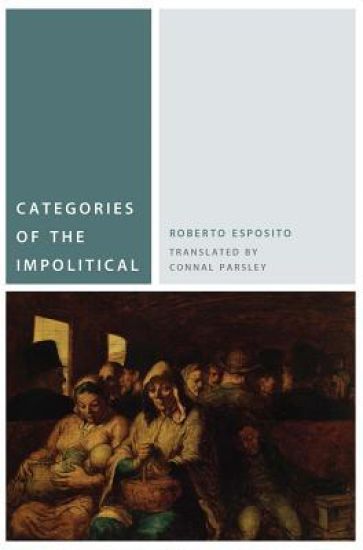
Categories of the Impolitical

Categories of the Impolitical

Roberto Esposito

FORDHAM UNIVERSITY PRESS
2015
sidottu
The notion of the "impolitical" developed in this volume draws its meaning from the exhaustion of modernity's political categories, which have become incapable of giving voice to any genuinely radical perspective. The impolitical is not the opposite of the political but rather its outer limit: the border from which we might glimpse a trajectory away from all forms of political theology and the depoliticizing tendencies of a completed modernity. The book's reconstruction of the impolitical lineage—which is anything but uniform—begins with the extreme conclusions reached by Carl Schmitt and Romano Guardini in their reflections on the political and then moves through a series of encounters between several great twentieth-century texts: from Hannah Arendt's On Revolution to Hermann Broch's The Death of Virgil, to Elias Canetti's Crowds and Power; from Simone Weil's The Need for Roots to Georges Bataille's Sovereignty to Ernst Junger's An der Zeitmauer. The trail forged by this analysis offers a defiant counterpoint to the modern political lexicon, but at the same time a contribution to our understanding of its categories.
Categories of the Impolitical

Categories of the Impolitical

Roberto Esposito

Fordham University Press
2015
pokkari
The notion of the "impolitical" developed in this volume draws its meaning from the exhaustion of modernity's political categories, which have become incapable of giving voice to any genuinely radical perspective. The impolitical is not the opposite of the political but rather its outer limit: the border from which we might glimpse a trajectory away from all forms of political theology and the depoliticizing tendencies of a completed modernity. The book's reconstruction of the impolitical lineage—which is anything but uniform—begins with the extreme conclusions reached by Carl Schmitt and Romano Guardini in their reflections on the political and then moves through a series of encounters between several great twentieth-century texts: from Hannah Arendt's On Revolution to Hermann Broch's The Death of Virgil, to Elias Canetti's Crowds and Power; from Simone Weil's The Need for Roots to Georges Bataille's Sovereignty to Ernst Junger's An der Zeitmauer. The trail forged by this analysis offers a defiant counterpoint to the modern political lexicon, but at the same time a contribution to our understanding of its categories.
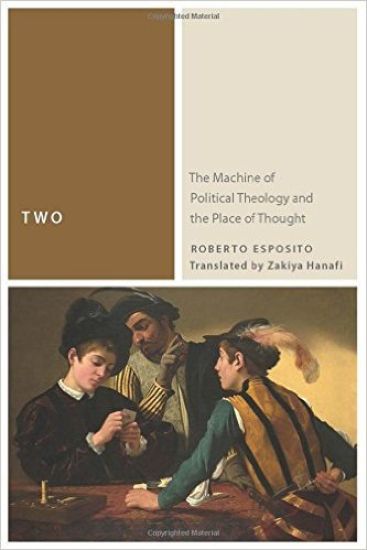
Two

Two

Roberto Esposito

Fordham University Press
2015
sidottu
The debate on "political theology" that ran throughout the twentieth century has reached its end, but the ultimate meaning of the notion continues to evade us. Despite all the attempts to resolve the issue, we still speak its language—we remain in its horizon. The reason for this, says Roberto Esposito, lies in the fact that political theology is neither a concept nor an event; rather, it is the pivot around which the machine of Western civilization has revolved for more than 2,000 years. At its heart stands the juncture between universalism and exclusion, unity and separation: the tendency of the Two to make itself into One by subordinating one part to the domination of the other. All the philosophical and political categories that we use, starting with the Roman and Christian notion of "the person," continue to reproduce this exclusionary dispositif. To take our departure from political theology, then—the task of contemporary philosophy—we must radically revise our conceptual lexicon. Only when thought has been returned to its rightful "place"—connected to the human species as a whole rather than to individuals—will we be able to escape from the machine that has imprisoned our lives for far too long.
Two

Two

Roberto Esposito

Fordham University Press
2015
pokkari
The debate on "political theology" that ran throughout the twentieth century has reached its end, but the ultimate meaning of the notion continues to evade us. Despite all the attempts to resolve the issue, we still speak its language—we remain in its horizon. The reason for this, says Roberto Esposito, lies in the fact that political theology is neither a concept nor an event; rather, it is the pivot around which the machine of Western civilization has revolved for more than 2,000 years. At its heart stands the juncture between universalism and exclusion, unity and separation: the tendency of the Two to make itself into One by subordinating one part to the domination of the other. All the philosophical and political categories that we use, starting with the Roman and Christian notion of "the person," continue to reproduce this exclusionary dispositif. To take our departure from political theology, then—the task of contemporary philosophy—we must radically revise our conceptual lexicon. Only when thought has been returned to its rightful "place"—connected to the human species as a whole rather than to individuals—will we be able to escape from the machine that has imprisoned our lives for far too long.
The Origin of the Political

The Origin of the Political

Roberto Esposito

FORDHAM UNIVERSITY PRESS
2017
sidottu
In this book Roberto Esposito explores the conceptual trajectories of two of the twentieth century's most vital thinkers of the political: Hannah Arendt and Simone Weil. Taking Homer's Iliad—that "great prism through which every gesture has the possibility of becoming public, precisely by being observed by others"— as the common origin and point of departure for our understanding of Western philosophical and political traditions, Esposito examines the foundational relation between war and the political. Drawing actively and extensively on Arendt's and Weil's voluminous writings, but also sparring with thinkers from Marx to Heidegger, The Origin of the Political traverses the relation between polemos and polis, between Greece, Rome, God, force, technicity, evil, and the extension of the Christian imperial tradition, while at the same time delineating the conceptual and hermeneutic ground for the development of Esposito's notion and practice of "the impolitical." In Esposito's account Arendt and Weil emerge "in the inverse of the other's thought, in the shadow of the other's light," to "think what the thought of the other excludes not as something that is foreign, but rather as something that appears unthinkable and, for that very reason, remains to be thought." Moving slowly toward their conceptualizations of love and heroism, Esposito unravels the West's illusory metaphysical dream of peace, obliging us to reevaluate ceaselessly what it means to be responsible in the wake of past and contemporary forms of war.
The Origin of the Political

The Origin of the Political

Roberto Esposito

Fordham University Press
2017
pokkari
In this book Roberto Esposito explores the conceptual trajectories of two of the twentieth century's most vital thinkers of the political: Hannah Arendt and Simone Weil. Taking Homer's Iliad—that "great prism through which every gesture has the possibility of becoming public, precisely by being observed by others"— as the common origin and point of departure for our understanding of Western philosophical and political traditions, Esposito examines the foundational relation between war and the political. Drawing actively and extensively on Arendt's and Weil's voluminous writings, but also sparring with thinkers from Marx to Heidegger, The Origin of the Political traverses the relation between polemos and polis, between Greece, Rome, God, force, technicity, evil, and the extension of the Christian imperial tradition, while at the same time delineating the conceptual and hermeneutic ground for the development of Esposito's notion and practice of "the impolitical." In Esposito's account Arendt and Weil emerge "in the inverse of the other's thought, in the shadow of the other's light," to "think what the thought of the other excludes not as something that is foreign, but rather as something that appears unthinkable and, for that very reason, remains to be thought." Moving slowly toward their conceptualizations of love and heroism, Esposito unravels the West's illusory metaphysical dream of peace, obliging us to reevaluate ceaselessly what it means to be responsible in the wake of past and contemporary forms of war.
Why the Assembly Disbanded

Why the Assembly Disbanded

Roberto Tejada

FORDHAM UNIVERSITY PRESS
2022
pokkari
Pushing the boundaries of Latinx literature and what constitutes a borderlands poetics. Throughout Roberto Tejada's body of work, the renowned poet and celebrated critic has explored themes of Latinx culture, politics, history, language, and ecologies. In his latest collection, Why the Assembly Disbanded, he presents a unique contribution to Latinx letters that reflects on the relations between the United States and Latin America, especially their real and symbolic borderlands. Immersive, postmodern, and philosophical, Why the Assembly Disbanded provides an associative, critical Latinx aesthetic connecting the Mexico–United States borderlands to Latin America's neo-baroque heritage. Migrants, settlers, tourists, and exiles moving across various hemispheric landscapes are featured in these exuberant, capacious, and self-reflexive poems. Tejada relates the ravages of white supremacy in our culture that, together with immigrant precarity, turn home into a place of foreboding and impending eviction, even as a dream-weather makes room at last for scenes of possibility and attainment in the account of human history. The sweeping futuristic vistas open on to narratives of colonial extraction, human displacement, abuses of capitalism, mass media spectacle, the antagonism of language and technical images in the sensorium of urban and digital life-worlds, and the relations of desire encouraged by pictures and words in the economy of attention. Los Angeles and Mexico City figure prominently in poems committed to voicing modes of formation and community in an intersectional reckoning of personhoods prompted in work by artists Betye Saar, Amiri Baraka, Connie Samaras, and Rubén Ortiz Torres. With language given to pageantry, tonal precision, and a hopeful lyric radiance that can accommodate ecstasy and justice, Roberto Tejada's carnivalesque, borderland imagery pushes the boundaries of Latinx literature. World-building by way of reverie, speculation, and retro-futurist tableaux, and with vivid, sometimes violent particularity, his poems enact hallucinatory realities of the hemisphere: an imagination that triangulates history, lyricism, and art as social practice.