Kirjojen hintavertailu. Mukana 12 016 292 kirjaa ja 12 kauppaa.

Kirjahaku

Etsi kirjoja tekijän nimen, kirjan nimen tai ISBN:n perusteella.

1000 tulosta hakusanalla Wayne Mutza

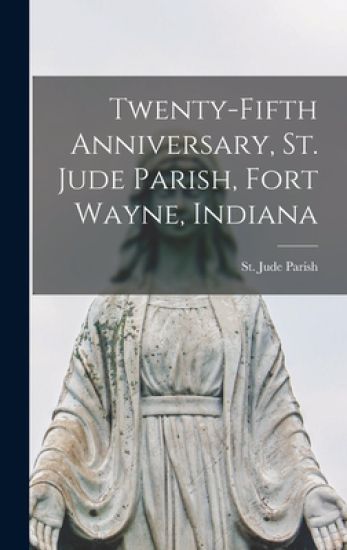
Twenty-fifth Anniversary, St. Jude Parish, Fort Wayne, Indiana

Twenty-fifth Anniversary, St. Jude Parish, Fort Wayne, Indiana

Ind ). St Jude Parish (Fort Wayne

Hassell Street Press
2021
nidottu
This work has been selected by scholars as being culturally important and is part of the knowledge base of civilization as we know it.This work is in the public domain in the United States of America, and possibly other nations. Within the United States, you may freely copy and distribute this work, as no entity (individual or corporate) has a copyright on the body of the work.Scholars believe, and we concur, that this work is important enough to be preserved, reproduced, and made generally available to the public. To ensure a quality reading experience, this work has been proofread and republished using a format that seamlessly blends the original graphical elements with text in an easy-to-read typeface.We appreciate your support of the preservation process, and thank you for being an important part of keeping this knowledge alive and relevant.
Grimes, Cook and Related Families of Wayne County, Tennessee: a Genealogy: Related Families, Johnson, Morris, Montague, 1800-1960
This book delves into the history of the Grimes, Cook, Johnson, Morris, and Montague families in Wayne County, Tennessee, between 1800 and 1960. With detailed genealogical information, it paints a vivid picture of life in this vibrant community during a critical period in American history.This work has been selected by scholars as being culturally important, and is part of the knowledge base of civilization as we know it.This work is in the "public domain in the United States of America, and possibly other nations. Within the United States, you may freely copy and distribute this work, as no entity (individual or corporate) has a copyright on the body of the work.Scholars believe, and we concur, that this work is important enough to be preserved, reproduced, and made generally available to the public. We appreciate your support of the preservation process, and thank you for being an important part of keeping this knowledge alive and relevant.
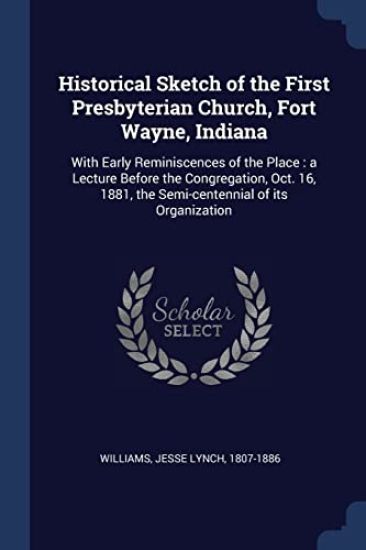
Historical Sketch of the First Presbyterian Church, Fort Wayne, Indiana
This work has been selected by scholars as being culturally important, and is part of the knowledge base of civilization as we know it. This work was reproduced from the original artifact, and remains as true to the original work as possible. Therefore, you will see the original copyright references, library stamps (as most of these works have been housed in our most important libraries around the world), and other notations in the work.This work is in the public domain in the United States of America, and possibly other nations. Within the United States, you may freely copy and distribute this work, as no entity (individual or corporate) has a copyright on the body of the work.As a reproduction of a historical artifact, this work may contain missing or blurred pages, poor pictures, errant marks, etc. Scholars believe, and we concur, that this work is important enough to be preserved, reproduced, and made generally available to the public. We appreciate your support of the preservation process, and thank you for being an important part of keeping this knowledge alive and relevant.
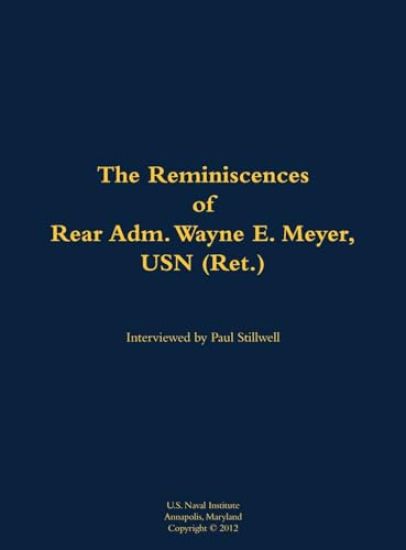
The Reminiscences of Rear Adm. Wayne E. Meyer, USN (Ret.)
Admiral Meyer is known as the “Father of Aegis,” the revolutionary combat system now standard in U.S. Navy surface warships for air and missile defense. Meyer grew up during the Depression on a farm near Brunswick, Missouri. He enlisted in 1943 when he was 17 years old and was commissioned through the Naval Reserve V-12 officer training program at the University of Kansas. His initial assignment as an ensign was to begin his postgraduate education at the Massachusetts Institute of Technology (MIT). His first tours of sea duty were in the destroyer Goodrich (DD-831), 1947–48; the light cruiser Springfield (CL-66), in 1948–49; and the destroyer tender Sierra (AD-18), 1950–51. In 1951–52 he attended Guided Missile School at Fort Bliss, Texas, and from 1952 to 1954 taught at the Nuclear Weapons School in Norfolk, Virginia. After being a student at General Line School, Monterey, California, in 1954–55, Meyer served in 1955–56 as executive officer of the radar picket destroyer escort Strickland (DER-324) and 1956–58 on the staff of Commander Destroyer Force Atlantic Fleet (DesLant). He attended the Naval Postgraduate School, 1958–60, and did further postgraduate work at MIT, 1960–61. His final shipboard tour was in 1961–63 as fire control officer and weapons officer in the guided missile cruiser Galveston (CLG-3). From there he reported to the Surface Missile Systems Project in Washington, D.C., 1963–67, and served 1967–70 at the Navy Surface Missile Systems Engineering Station (NSMSES), Port Hueneme, California. RADM Meyer's longest tenure, 1970–83, was in the Advanced Surface Missile System, which became Aegis. From 1976 to 1983 he was project manager for the Aegis Shipbuilding Project in the Naval Sea Systems Command. His final tour of active duty, 1983–85, was as NavSea-06, Deputy Commander for Weapons and Combat Systems. Following retirement from active naval service, he continued to work in Aegis-related activities.
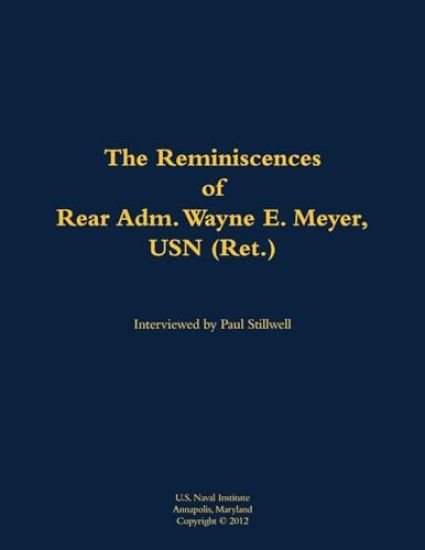
The Reminiscences of Rear Adm. Wayne E. Meyer, USN (Ret.)
Admiral Meyer is known as the “Father of Aegis,” the revolutionary combat system now standard in U.S. Navy surface warships for air and missile defense. Meyer grew up during the Depression on a farm near Brunswick, Missouri. He enlisted in 1943 when he was 17 years old and was commissioned through the Naval Reserve V-12 officer training program at the University of Kansas. His initial assignment as an ensign was to begin his postgraduate education at the Massachusetts Institute of Technology (MIT). His first tours of sea duty were in the destroyer Goodrich (DD-831), 1947–48; the light cruiser Springfield (CL-66), in 1948–49; and the destroyer tender Sierra (AD-18), 1950–51. In 1951–52 he attended Guided Missile School at Fort Bliss, Texas, and from 1952 to 1954 taught at the Nuclear Weapons School in Norfolk, Virginia. After being a student at General Line School, Monterey, California, in 1954–55, Meyer served in 1955–56 as executive officer of the radar picket destroyer escort Strickland (DER-324) and 1956–58 on the staff of Commander Destroyer Force Atlantic Fleet (DesLant). He attended the Naval Postgraduate School, 1958–60, and did further postgraduate work at MIT, 1960–61. His final shipboard tour was in 1961–63 as fire control officer and weapons officer in the guided missile cruiser Galveston (CLG-3). From there he reported to the Surface Missile Systems Project in Washington, D.C., 1963–67, and served 1967–70 at the Navy Surface Missile Systems Engineering Station (NSMSES), Port Hueneme, California. RADM Meyer's longest tenure, 1970–83, was in the Advanced Surface Missile System, which became Aegis. From 1976 to 1983 he was project manager for the Aegis Shipbuilding Project in the Naval Sea Systems Command. His final tour of active duty, 1983–85, was as NavSea-06, Deputy Commander for Weapons and Combat Systems. Following retirement from active naval service, he continued to work in Aegis-related activities.