Kirjojen hintavertailu. Mukana 12 354 896 kirjaa ja 12 kauppaa.

Kirjahaku

Etsi kirjoja tekijän nimen, kirjan nimen tai ISBN:n perusteella.

1000 tulosta hakusanalla Andreas Oppermann

Political Epistemics

Political Epistemics

Andreas Glaeser

University of Chicago Press
2011
nidottu
What does the durability of political institutions have to do with how actors form knowledge about them? Andreas Glaeser investigates this question in the context of a fascinating historical case: socialist East Germany's unexpected self-dissolution in 1989. His analysis builds on extensive in-depth interviews with former secret police officers and the dissidents they tried to control as well as research into the documents both groups produced. In particular, Glaeser analyzes how these two opposing factions' understanding of the socialist project came to change in response to countless everyday experiences. These investigations culminate in answers to two questions: why did the officers not defend socialism by force? And how was the formation of dissident understandings possible in a state that monopolized mass communication and group formation? He also explores why the Stasi, although always well informed about dissident activities, never developed a realistic understanding of the phenomenon of dissidence. Out of this ambitious study, Glaeser extracts two distinct lines of thought. On the one hand he offers an epistemic account of socialism's failure that differs markedly from existing explanations. On the other hand he develops a theory - a sociology of understanding - that shows us how knowledge can appear validated while it is at the same time completely misleading.

The Science of Walking

The Science of Walking

Andreas Mayer

University of Chicago Press
2020
sidottu
The Science of Walking recounts the story of the growing interest and investment of Western scholars, physicians, and writers in the scientific study of an activity that seems utterly trivial in its everyday performance yet essential to our human nature: walking. Most people see walking as a natural and unremarkable activity of daily life, yet the mechanism has long puzzled scientists and doctors, who considered it an elusive, recalcitrant, and even mysterious act. In The Science of Walking, Andreas Mayer provides a history of investigations of the human gait that emerged at the intersection of a variety of disciplines, including physiology, neurology, orthopedic surgery, anthropology, and psychiatry. Looking back at more than a century of locomotion research, Mayer charts, for the first time, the rise of scientific endeavors to control and codify locomotion and analyzes their social, political, and aesthetic ramifications throughout the long nineteenth century. In an engaging narrative that weaves together science and history, Mayer sets the work of the most important representatives of the physiology of locomotion—including Wilhelm and Eduard Weber and Étienne-Jules Marey—in their proper medical, political, and artistic contexts. In tracing the effects of locomotion studies across other cultural domains, Mayer reframes the history of the science of walking and gives us a deeper understanding of human movement.
Contesting Medical Confidentiality

Contesting Medical Confidentiality

Andreas-Holger Maehle

University of Chicago Press
2016
sidottu
Medical confidentiality is an essential cornerstone of effective public health systems, and for centuries societies have struggled to maintain the illusion of absolute privacy. In this age of health databases and increasing connectedness, however, the confidentiality of patient information is rapidly becoming a concern at the forefront of worldwide ethical and political debate. In Contesting Medical Confidentiality, Andreas-Holger Maehle travels back to the origins of this increasingly relevant issue. He offers the first comparative analysis of professional and public debates on medical confidentiality in the United States, Britain, and Germany during the late nineteenth and early twentieth centuries, when traditional medical secrecy first came under pressure from demands of disclosure in the name of public health. Maehle structures his study around three representative questions of the time that remain salient today: Do physicians have a privilege to refuse court orders to reveal confidential patient details? Is there a medical duty to report illegal procedures to the authorities? Should doctors breach confidentiality in order to prevent the spread of disease? Considering these debates through a unique historical perspective, Contesting Medical Confidentiality illuminates the ethical issues and potentially grave consequences that continue to stir up public debate.
Gazing on God

Gazing on God

Andreas Andreopoulos

James Clarke Co Ltd
2013
nidottu
An exposition of Orthodox systematic theology, 'Gazing on God' is written from the point of view of the experience of the faithful, drawing on traditional icons and liturgy. By tracing the depth of some key Christian concepts -salvation, Logos, the Trinity- Andreas Andreopoulos provides a framework for the theology of experience. In the following chapters seven select icons are analyzed, in order to demonstrate the theological ideas and themes that may be revealed by studying Christianity through iconography. The analysis touches on topics such as time (the eternity of God, 'flat' liturgical time), space, the Church as the Body of Christ, and the Trinity. 'Gazing on God' offers to all Christian traditions a demonstration that, while our understanding of the development of Christian views and attitudes is guided by the history of theological ideas, Christianity includes from the beginning a strong dimension of meta-linguistic knowledge, which is expressed in its liturgy, as well as in its symbolism.
Challenges of the Caspian Resource Boom

Challenges of the Caspian Resource Boom

Andreas Heinrich; Heiko Pleines

Palgrave Macmillan
2012
sidottu
A re-conceptualisation of the widely-held concept of the 'resource curse', which contends that resource booms inevitably lead to numerous political, social and economic problems. This book counters that these problems are by no means inevitable, but are rather the direct result of specific policy choices made by actors within particular regimes.
Communicating Europe

Communicating Europe

Andreas Fickers; Pascal Griset

Palgrave Macmillan
2019
sidottu
Since the early years of telegraphy, modernity at large generated and has depended upon technologies of electrical/electronic communication and information circulation: from telephone, radio, and television to the internet. This volume reveals these connecting technologies’ geopolitical importance and their crucial relationships with culture, commerce, and communities. Also the authors critically examine their spatial dimensions and transnational implications – as material objects with particular qualities, as elements in institutional complexes, and as ‘vehicles’ carrying complex symbolic meanings. Through in-depth assessments of critical, as well as mundane, events in the history of communications and information, these analyses will significantly alter conventional perspectives both on communications and on modern European history.
Communicating Europe

Communicating Europe

Andreas Fickers; Pascal Griset

Palgrave Macmillan
2019
nidottu
Since the early years of telegraphy, modernity at large generated and has depended upon technologies of electrical/electronic communication and information circulation: from telephone, radio, and television to the internet. This volume reveals these connecting technologies’ geopolitical importance and their crucial relationships with culture, commerce, and communities. Also the authors critically examine their spatial dimensions and transnational implications – as material objects with particular qualities, as elements in institutional complexes, and as ‘vehicles’ carrying complex symbolic meanings. Through in-depth assessments of critical, as well as mundane, events in the history of communications and information, these analyses will significantly alter conventional perspectives both on communications and on modern European history.
The Art of Courtly Love

The Art of Courtly Love

Andreas Capellanus; Jan M. Ziolkowski

Columbia University Press
2009
sidottu
Marriage is no real excuse for not loving. & nbsp;& nbsp; That which a lover takes against the will of his beloved has no relish. & nbsp;& nbsp; When made public love rarely endures. & nbsp;& nbsp;Love can deny nothing to love.Published in the twelfth century, Andreas Capellanus's canonical The Art of Courtly Love had a major impact on the culture of medieval Europeans and relates centrally to Arthurian romance, troubadour lyric, and other genres. More than just a list of rules and advice, the book has been remarkably influential in modern understandings of the Middle Ages, especially of the phenomena known as courtly love. Is it a time capsule of social laws and customs that prevailed in courts? Or was it a flight of fancy that mocked such etiquette? Debates over its nature and meaning have been unending. Its style and concerns contributed long and significantly to English literature, and for centuries its attitudes and practices reflected and may even have shaped thinking and behavior about love in Western civilization. Renowned medievalist Jan M. Ziolkowski has revised the standard translation of the work from the original Latin, maintaining its lively tone and sophisticated play with character and sentiment. He has also written a foreword highlighting the work's continued relevance and updated the bibliography with new critical sources.
The Art of Courtly Love

The Art of Courtly Love

Andreas Capellanus; Jan M. Ziolkowski

Columbia University Press
2014
nidottu
Marriage is no real excuse for not loving. & nbsp;& nbsp; That which a lover takes against the will of his beloved has no relish. & nbsp;& nbsp; When made public love rarely endures. & nbsp;& nbsp;Love can deny nothing to love.Published in the twelfth century, Andreas Capellanus's canonical The Art of Courtly Love had a major impact on the culture of medieval Europeans and relates centrally to Arthurian romance, troubadour lyric, and other genres. More than just a list of rules and advice, the book has been remarkably influential in modern understandings of the Middle Ages, especially of the phenomena known as courtly love. Is it a time capsule of social laws and customs that prevailed in courts? Or was it a flight of fancy that mocked such etiquette? Debates over its nature and meaning have been unending. Its style and concerns contributed long and significantly to English literature, and for centuries its attitudes and practices reflected and may even have shaped thinking and behavior about love in Western civilization. Renowned medievalist Jan M. Ziolkowski has revised the standard translation of the work from the original Latin, maintaining its lively tone and sophisticated play with character and sentiment. He has also written a foreword highlighting the work's continued relevance and updated the bibliography with new critical sources.
Repertoires of Terrorism

Repertoires of Terrorism

Andreas E. Feldmann

Columbia University Press
2024
sidottu
Why do armed groups employ terrorism in markedly different ways during civil wars? Drawing on more than a decade of fieldwork, Andreas E. Feldmann examines the disparate behavior of actors including guerrilla groups, state security forces, and paramilitaries during Colombia’s long and bloody civil war. Analyzing the varieties of violence in this conflict, he develops a new theory of the dynamics of terrorism in civil wars.Feldmann argues that armed groups’ distinct uses—repertoires—of terrorism arise from their particular organizational identities, the central and enduring attributes that distinguish one faction from other warring parties. He investigates a range of groups that took part in the Colombian conflict over the course of its evolution from ideological to criminal warfare, demonstrating that organizational identity plays a critical role in producing and rationalizing violence. Armed parties employ their unique repertoires as a means of communication to assert their relevance and territorial presence and to differentiate themselves from enemies and rivals. Repertoires of Terrorism is based on an extensive data set covering thousands of incidents, as well as interviews, archival research, and testimony. It sheds new light on both armed groups’ use of violence in Colombia’s civil war and the factors that shape terrorist activity in other conflicts.
Repertoires of Terrorism

Repertoires of Terrorism

Andreas E. Feldmann

Columbia University Press
2024
pokkari
Why do armed groups employ terrorism in markedly different ways during civil wars? Drawing on more than a decade of fieldwork, Andreas E. Feldmann examines the disparate behavior of actors including guerrilla groups, state security forces, and paramilitaries during Colombia’s long and bloody civil war. Analyzing the varieties of violence in this conflict, he develops a new theory of the dynamics of terrorism in civil wars.Feldmann argues that armed groups’ distinct uses—repertoires—of terrorism arise from their particular organizational identities, the central and enduring attributes that distinguish one faction from other warring parties. He investigates a range of groups that took part in the Colombian conflict over the course of its evolution from ideological to criminal warfare, demonstrating that organizational identity plays a critical role in producing and rationalizing violence. Armed parties employ their unique repertoires as a means of communication to assert their relevance and territorial presence and to differentiate themselves from enemies and rivals. Repertoires of Terrorism is based on an extensive data set covering thousands of incidents, as well as interviews, archival research, and testimony. It sheds new light on both armed groups’ use of violence in Colombia’s civil war and the factors that shape terrorist activity in other conflicts.
The Virtual Universe

The Virtual Universe

Andreas Kaplan

Columbia University Press
2026
sidottu
Will we one day inhabit virtual worlds? From the buzz around Second Life in the early 2000s to Mark Zuckerberg’s much-hyped quest for the metaverse, there seems to be a clear pattern. After being touted as revolutionary, virtual worlds fail to meet expectations and fade into obscurity. Yet the dream of an immersive, independent, and interconnected virtual social universe still has the potential to transform the economy, reshape society, and profoundly affect the future of humanity. This book contends that despite shifting trends, the virtual universe remains crucial to the technology of tomorrow—and might arrive sooner than we think. Through vivid examples and detailed case studies, Andreas Kaplan, a pioneering researcher of virtual worlds since the early 2000s, provides a comprehensive examination of the metaverse and its far-reaching implications. He delves into key technologies such as artificial intelligence, blockchain, and extended reality and discusses ethical issues around privacy, identity, and governance. Kaplan examines business models, digital ownership, and corporate strategies alongside applications spanning marketing, research and development, human resources, and supply chain management. The book concludes by contrasting potential futures, from utopian promise (the Petaverse) to dystopian peril (the Metaworse) and everything in between. Written in an engaging, reader-friendly style, The Virtual Universe goes beyond the hype—and the doubting—to uncover the true potential of the metaverse.
The Hair Carpet Weavers

The Hair Carpet Weavers

Andreas Eschbach

Penguin Classics
2020
nidottu
In a distant universe, since the beginning of time, workers have spent their lives weaving intricate carpets from the hair of women and girls. But why? Andreas Eschbach's mysterious, poignant space opera explores the absurdity of work and of life itself.'A novel of ideas that evokes complex emotions through the working out of an intricate and ultimately satisfying plot, with echoes of Gene Wolfe, Ursula K. Le Guin, and Isaac Asimov' The New York Times Book Review
Relational Databases and Distributed Systems
A database is a logically organised collection of related data, generally accessed by a set of programs known as a Database Management System (DBMS), which oversees the creation and use of the database and controls access to the data. The organisation of a database obviates the need to duplicate information to meet the various requirements of different groups of users, and ensures that the data always remains consistent. A large database requires extensive storage facilities. In some organisations and services, databases can be accessed over networks from microcomputers or as videotex. 'Relational' databases and hypertext techniques include extensive and complex cross-reference facilities so that information on related items may be retrieved. Many database programs have been designed to run on micro-computers. Some of these contain computer languages that enable users to change the operation of the database to suit their requirements.
Hellenism Classical & Modern Diaspora

Hellenism Classical & Modern Diaspora

Andreas Sofroniou

Lulu.com
2018
pokkari
The Hellenic Diaspora (Dispersion) is the collective term for the process which began with the accelerated destruction of the captured Greek territories by the Roman Empire. Some Greeks interpret diaspora as exile, others as a positive aspect of Hellenism's ethnic and spiritual destiny, who remained loyal to their faith, ethnicity and homeland. The beheading of Archimedes was the beginning of the brain drain of Greeks to the Middle East, Asia and Northern Africa. The existence of these diaspora communities was also an important factor in the spread of Christianity. By the early Middle Ages Europe was the centre of Hellenic scholarship, but from the time of the Crusaders, anti-orthodoxy and the persecution of Hellenes begun. Eastern Europe welcomed Greek victims of persecution and by the 17th century Eastern Europe had become the diaspora's centre, until the massacres of the 1821 and 1915 by the Ottomans, thus many Greeks migrated to Germany, Britain and the USA.
Mine own Ideology Idealism Politics

Mine own Ideology Idealism Politics

Andreas Sofroniou

Lulu.com
2018
pokkari
Concepts and writings are not timeless and should instead be understood in terms of the historical context in which they developed. Ideology is a political belief-system which explains the world as it currently is and suggests how it should be changed. The term describes social classes, especially that of capitalism or bourgeoisie. Ideology is recognised as the means by which people perceive the social world and consciously subscribe to a political creed. Idealism is a set of views according to which the physical world is dependent upon the mind; we somehow create the world. Idealists are not saying that our experience of the world is other than what it is; simply a collection of 'ideas' that are coherent. Politics is the study and practice of how people are governed. Efforts are made to influence, gain, or wield power at various levels of government, internally and internationally, including dispute resolution, formal elections to the threat or use of outright coercion or force.
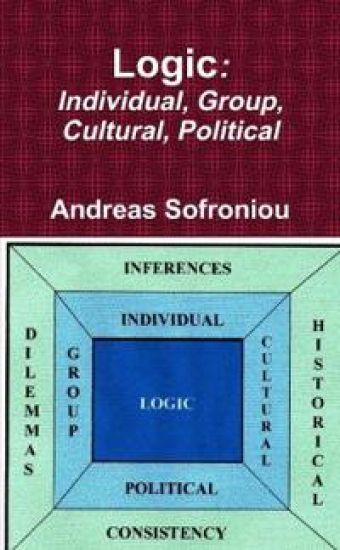
Logic

Logic

Andreas Sofroniou

Lulu.com
2019
pokkari
Logic as a subject includes the study of correct reasoning, especially as it involves the drawing of inferences. This book is concerned with the basic elements and problems of contemporary logic and provides the history of Logic and an overview of its different fields. Theorists have applied the rational choice approach to politics. In these fields it competes especially with explanations in terms of cultural, socialization and adherence to social norms. The theory of Logic and its various references explores possible ways of escaping from such dilemmas.
TECHNOLOGICAL INTEGRATIONS

TECHNOLOGICAL INTEGRATIONS

Andreas Sofroniou

Lulu.com
2019
nidottu
The application of technology and its integrations includes the scientific knowledge to the practical aims of human life or to the change and manipulation of the human environment.Circa 3000 years BC many new technologies were developed; irrigation systems, road networks and wheeled vehicles, a pictographic form of writing and new building techniques.The new ideas and techniques engendered official persecution, but by the mid-17th century the tide of opinion had changed.By the late 17th century, technology essentially meant engineering. During the 19th century science began to create new technologies. This continued into the 20th century with the introduction of computing, Internet, Artificial Intelligence and other services made possible only because of further advances in science.In recent years Western aid has sought to develop appropriate technologies, using local materials and techniques, in partnership with the indigenous peoples.