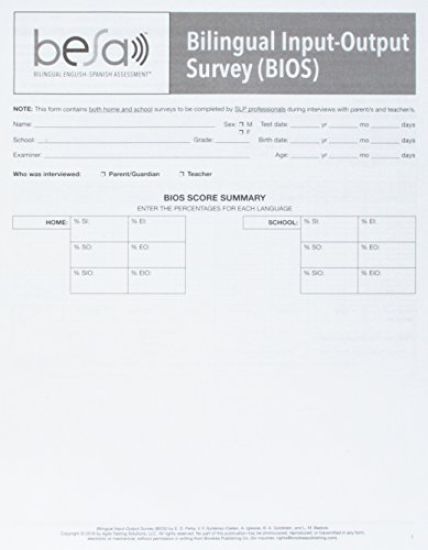
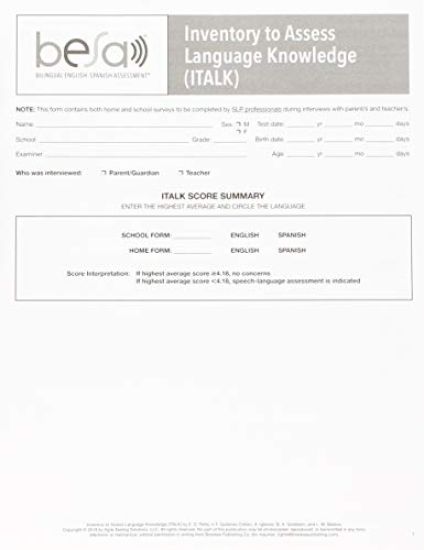
When a young bilingual child experiences language difficulties, it can be hard to tell if those challenges are due to a disorder or just limited exposure to the English language. That's a critical distinction—because while limited language exposure will fix itself over time, a language impairment is a clinical issue that will cause the child difficulties in school without timely and effective intervention.Now there's a valid reliable assessment that specifically responds to the needs of young Spanish-English bilingual children. For use with children ages 4 through 6 years who have varying degrees of bilingualism, the Bilingual English-Spanish Assessment (BESA) was developed to:identify phonological and/or language impairment in bilingual children and English language learners using a standardized protocoldifferentiate between a delay in English language acquisition and a true language disorderdocument children's speech and language strengths and needsmonitor children's progress in both languages and use the information to make decisions about interventionThrough a combination of subtests for students and surveys for teachers and parents, BESA reveals the big picture of a young bilingual child's language development. Comprehensive assessment with BESA includes:3 subtests (in both English and Spanish). These three standardized, norm-referenced subtests address the key domains of morphosyntax, semantics, and phonology. The subtests are administered with children one-on-one in a quiet, well-lit, well-ventilated room free of distractions.2 questionnaires. The SLP gathers more information by interviewing both parents and teachers. Bilingual Input-Output Survey (BIOS): determines Spanish and English use at home and school and pinpoints which language(s) need testingInventory to Assess Language Knowledge (ITALK): identifies the parent's and teacher's perception of the child's performance in each language and highlights areas of possible concernPragmatic activity: This 5- to 10-minute warmup activity, in which children are asked to “help wrap a present” with the examiner, is used to establish rapport with the child and give clinicians an idea of how collaborative and interactive the child will be during the rest of the assessment.BESA Benefits: Valid and reliable. There are very few assessment tools for bilingual children, and even fewer that are valid and reliable. BESA answers the call for a bilingual assessment backed up with solid evidence of validity and reliability. Culturally and linguistically appropriate. BESA subtests are different for each language; the Spanish subtest isn't just a translation of the English one. Dialects were taken into consideration—the norming sample included 17 Spanish dialects and 7 regional dialects for English—and items were developed for each language based on the markers, structure, and culture of that language. Uncovers the full picture of a child's language development.Not only does BESA identify language impairments, it also helps you gauge progress in both languages and document a child's dominant language across different domains of speech and language. This critical information will help you plan interventions and educational programming for bilingual children. Flexible and convenient. You can use each BESA component independently or combine them as part of an assessment battery. Choose which component you want to give—you're not required to administer both the English and Spanish subtests. BESA can also be given over multiple sessions, so you can easily fit it into your schedule. What's in the kit?1 BESA Test Manual 1 BESA Stimulus Book 20 BESA Protocol English Forms 20 BESA Protocol Spanish Forms 20 BIOS Forms 20 ITALK forms
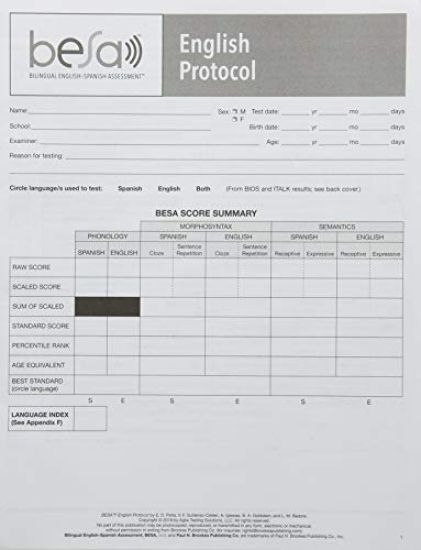
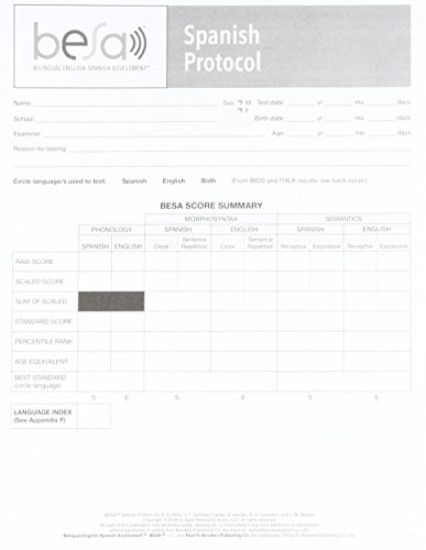
When a young bilingual child experiences language difficulties, it can be hard to tell if those challenges are due to a disorder or just limited exposure to the English language. That's a critical distinction--because while limited language exposure will fix itself over time, a language impairment is a clinical issue that will cause the child difficulties in school without timely and effective intervention. Now there's a valid, reliable assessment that specifically responds to the needs of young Spanish-English bilingual children. For use with children ages 4 through 6 years who have varying degrees of bilingualism, the Bilingual English-Spanish Assessment (BESA) was developed to: - identify phonological and/or language impairment in bilingual children and English language learners using a standardized protocol - differentiate between a delay in English language acquisition and a true language disorder - document children's speech and language strengths and needs - monitor children's progress in both languages and use the information to make decisions about intervention. What's in the kit? - 1 BESA Test Manual - 1 BESA Stimulus Book - 20 BESA Protocol English Forms - 20 BESA Protocol Spanish Forms - 20 BIOS Forms - 20 ITALK forms.
The Bilingual English-Spanish Assessment (BESA) was developed in response to the need for valid, reliable instruments for assessment of speech and language ability, along a continuum, in English-Spanish bilingual children ages 4 through 6 years.The BESA is a comprehensive assessment of a child’s speech and language abilities in English and Spanish. Two ancillary questionnaires (BIOS and ITALK) can be used to document language exposure and use, allowing the examiner to develop a profile of any parent and teacher concerns. BESA subtests address the domains of phonology, morphosyntax, and semantics separately for both Spanish and English. There are three standardized and norm-referenced subtests addressing language ability, and one criterion-referenced activity allowing observation of pragmatic language. Administration time varies depending on whether or not both languages are tested and which subtests are included. Administration takes between one hour (for one language) and two hours (for both languages).The BIOS is typically completed as part of an interview by the examiner. In this survey, parents are asked about the language exposure history of the child. This information helps the examiner know when and in what context each of the child’s two languages were used on a year-to-year basis. In addition, parents and teachers are asked what language the child hears and uses during a typical school day, and during a typical weekend day on an hour-by-hour basis. This information provides clinicians with information about relative use and exposure to each language and can help guide whether to test children in Spanish, English, or both. The parent survey (BIOS-Home) takes 10 to 15 minutes to complete; the teacher survey (BIOS-School) can be completed in 5 to 10 minutes.The ITALK is completed by the examiner as a parent and teacher interview. The ITALK items address relative use of a child’s two languages and five areas of speech and language development in Spanish and English (vocabulary, grammar, sentence production, comprehension, and phonology). Parents and teachers are asked to identify the perceived level of the child's performance in each language. This inventory provides a brief indicator of relative language use. It also provides a description of parent and teacher concern and can be used to guide development of the assessment strategy. Results of the inventory can be used to interpret diagnostic results from BESA or other language tests. The ITALK can be completed in 10 minutes or less.The Pragmatics activity is based on Fey’s (1986) model of assertiveness and responsiveness. In an interactive format, children are asked to “help wrap a present” with the examiner. Through this realistic situation, obligatory contexts are set up to elicit different assertive and responsive acts. The Pragmatics activity utilizes English, Spanish, or both languages together (via code-switching) depending on the child’s preferred language of interaction. The activity should be used to identify children who may encounter difficulties in situations that require the children to be active participants (e.g., classroom). If administered at the beginning of a battery of tests, the Pragmatics activity provides an excellent opportunity to establish rapport with the child and will also provide clinicians with an indication of how collaborative and interactive the child will be during the rest of the assessment. This activity takes 5-10 minutes to complete.The Phonology subtest is a single-word phonological assessment designed primarily to differentially diagnose typical from atypical phonological skills in Spanish-English bilingual children. Analyses are also included that allow the examiner to profile the phonological skills in these children. The assessment includes two measures. The Spanish measure assesses phonological production using 28 Spanish words. The English measure assesses phonological production using 31 English words. The Phonology subtest takes 10 to 15 minutes to administer in each language, depending on the individual child (20 to 30 minutes total).The Morphosyntax subtest employs cloze and sentence repetition tasks to target grammatical morphemes and sentence structures that were predicted to be difficult for children with language impairment in English or Spanish. Forms tested in English include plural –s, possessive –s, past and present tense, third-person singular, progressives, copulas, auxiliary do negatives, and passives, as well as complex verb forms, conjunctions, and embedded prepositions and noun phrases. The English Morphosyntax Subtest has 24 cloze items and 9 sentence repetitions items.Forms tested in Spanish include articles, progressives, clitics, subjunctives, preterite, complex verb forms, and conjunctions. The Spanish Morphosyntax Subtest has 15 cloze items and 10 sentence repetitions items.For each language, a grammatical cloze subscore, a sentence repetition subscore, and a total score that is a composite of those two are derived. The morphosyntax test takes approximately 15 minutes to administer in each language (30 minutes total).The Semantics subtest targets six tasks: analogies, characteristic properties, categorization, functions, linguistic concepts, and similarities and differences. These six item types were based on the literature describing acquisition of semantic breadth and depth in order to tap into how children organize and access their lexical system (Peña, Bedore, & Rappazzo, 2003). The English Semantics subtest has a total of 25 items: 10 receptive and 15 expressive. The Spanish Semantics subtest also has 25 items, 12 receptive and 13 expressive. Scoring allows for code-mixing—giving children credit for a correct response in either language. Subscores are provided for semantics receptive and semantics expressive, as well as a total semantics score for each language. The Semantics subtest takes about 15 minutes to administer in each language (30 minutes total).The BESA is designed to be used with children who speak English, Spanish, or both languages. The BESA subtests are psychometrically sound and yield scaled and standard scores for each of the domain tests (phonology, morphosyntax, and semantics). The questionnaires provide criterion-based guidelines to determine language(s) of testing and to develop an assessment strategy. The tests can be used together for a complete speech and language battery or the examiner may select tests specific to the diagnostic question. Presently, the test is appropriate for children between the ages of 4;0 and 6;11. The BESA can be used (a) to identify language impairment in bilingual and monolingual Latino children, (b) to document progress in speech and language related to intervention, (c) to document the dominant language in each domain including morphosyntax, semantics, and phonology, and (d) in research studies of bilingual children with and without language impairment.The BESA is specifically designed to assess the speech and language of English-Spanish bilingual children’s two languages. The primary use of the BESA is to identify phonological and/or language impairment in bilingual and EL children via a standardized protocol. The objective scores obtained on the BESA across three domains can be used in combination with clinical observations, language samples, as well as with other standardized measures to identify children with speech and/or language impairment. Through use of a combination of BESA subtests, clinicians can document children’s speech and language strengths and needs.A second use of the BESA is to monitor children’s progress in speech and language. After initiation of a speech and language intervention program, children’s progress should be regularly documented. It is recommended that daily probes be used to monitor children’s session-to-session progress. This information should be used to make decisions about the direction of the intervention. The BESA is sensitive to year-to-year changes in children’s speech and language growth and the particular language in which progress is being made. Thus, in addition to the more sensitive measures of daily progress, the BESA can be administered at broader intervals (e.g., annually or semi-annually) to gauge progress in a specific program of intervention, to document continued need for intervention, and to document achievement of treatment goals for exiting services.Documentation of a bilingual’s dominant language is a challenge in school settings. Many children who have exposure to more than one language demonstrate mixed dominance, whereby they perform higher in one language in one domain, but higher in the other language in a different domain. It is therefore important to know what a child’s relative dominance is across different domains of speech and language. This information can be useful for planning intervention, as well as for planning educational programming for bilingual children. Together, the BIOS-Home and BIOS-School provide an objective measure of children’s input and output of Spanish and English. This information helps speech-language pathologists, parents, teachers, and administrators know how much the child hears and uses each language and in what contexts. This information is independent of performance, which can be affected by child characteristics such as language ability. In addition to the BIOS, the Spanish and English standardized test scores can be compared directly for phonology, morphosyntax, and semantics to determine a child’s best language for a particular domain. If children’s standard scores across domains are within 5 points of each other, we consider them to be balanced.There are a number of ways that the BESA subtests can be used in research. ITALK can be used to gain parent and teacher observations about the child’s performance across five domains of speech and language in Spanish and English as part of qualifying data for a study. BIOS can be used to document weekly input and output in Spanish and English as a way of grouping children by language experience and/or by year of first exposure. For bilingual children with language impairment, BIOS provides a measure that is independent of their test performance on speech and language tasks.The three domain subtests can be used together or independently to assess children’s speech and language. These can be used to qualify children for a study or to group children by ability. As of this writing, the authors have conducted and published several studies with the longer, experimental versions of BESA subtests. In addition, researchers across the country have used the experimental versions of BESA in studies of bilingual Spanish-English speakers. Researchers in Spanish-speaking countries are in the process of using the Spanish version of these measures in research studies.
The Bilingual English-Spanish Assessment (BESA) was developed in response to the need for valid, reliable instruments for assessment of speech and language ability, along a continuum, in English-Spanish bilingual children ages 4 through 6 years.The BESA is a comprehensive assessment of a child’s speech and language abilities in English and Spanish. Two ancillary questionnaires (BIOS and ITALK) can be used to document language exposure and use, allowing the examiner to develop a profile of any parent and teacher concerns. BESA subtests address the domains of phonology, morphosyntax, and semantics separately for both Spanish and English. There are three standardized and norm-referenced subtests addressing language ability, and one criterion-referenced activity allowing observation of pragmatic language. Administration time varies depending on whether or not both languages are tested and which subtests are included. Administration takes between one hour (for one language) and two hours (for both languages).The BIOS is typically completed as part of an interview by the examiner. In this survey, parents are asked about the language exposure history of the child. This information helps the examiner know when and in what context each of the child’s two languages were used on a year-to-year basis. In addition, parents and teachers are asked what language the child hears and uses during a typical school day, and during a typical weekend day on an hour-by-hour basis. This information provides clinicians with information about relative use and exposure to each language and can help guide whether to test children in Spanish, English, or both. The parent survey (BIOS-Home) takes 10 to 15 minutes to complete; the teacher survey (BIOS-School) can be completed in 5 to 10 minutes.The ITALK is completed by the examiner as a parent and teacher interview. The ITALK items address relative use of a child’s two languages and five areas of speech and language development in Spanish and English (vocabulary, grammar, sentence production, comprehension, and phonology). Parents and teachers are asked to identify the perceived level of the child's performance in each language. This inventory provides a brief indicator of relative language use. It also provides a description of parent and teacher concern and can be used to guide development of the assessment strategy. Results of the inventory can be used to interpret diagnostic results from BESA or other language tests. The ITALK can be completed in 10 minutes or less.The Pragmatics activity is based on Fey’s (1986) model of assertiveness and responsiveness. In an interactive format, children are asked to “help wrap a present” with the examiner. Through this realistic situation, obligatory contexts are set up to elicit different assertive and responsive acts. The Pragmatics activity utilizes English, Spanish, or both languages together (via code-switching) depending on the child’s preferred language of interaction. The activity should be used to identify children who may encounter difficulties in situations that require the children to be active participants (e.g., classroom). If administered at the beginning of a battery of tests, the Pragmatics activity provides an excellent opportunity to establish rapport with the child and will also provide clinicians with an indication of how collaborative and interactive the child will be during the rest of the assessment. This activity takes 5-10 minutes to complete.The Phonology subtest is a single-word phonological assessment designed primarily to differentially diagnose typical from atypical phonological skills in Spanish-English bilingual children. Analyses are also included that allow the examiner to profile the phonological skills in these children. The assessment includes two measures. The Spanish measure assesses phonological production using 28 Spanish words. The English measure assesses phonological production using 31 English words. The Phonology subtest takes 10 to 15 minutes to administer in each language, depending on the individual child (20 to 30 minutes total).The Morphosyntax subtest employs cloze and sentence repetition tasks to target grammatical morphemes and sentence structures that were predicted to be difficult for children with language impairment in English or Spanish. Forms tested in English include plural –s, possessive –s, past and present tense, third-person singular, progressives, copulas, auxiliary do negatives, and passives, as well as complex verb forms, conjunctions, and embedded prepositions and noun phrases. The English Morphosyntax Subtest has 24 cloze items and 9 sentence repetitions items.Forms tested in Spanish include articles, progressives, clitics, subjunctives, preterite, complex verb forms, and conjunctions. The Spanish Morphosyntax Subtest has 15 cloze items and 10 sentence repetitions items.For each language, a grammatical cloze subscore, a sentence repetition subscore, and a total score that is a composite of those two are derived. The morphosyntax test takes approximately 15 minutes to administer in each language (30 minutes total).The Semantics subtest targets six tasks: analogies, characteristic properties, categorization, functions, linguistic concepts, and similarities and differences. These six item types were based on the literature describing acquisition of semantic breadth and depth in order to tap into how children organize and access their lexical system (Peña, Bedore, & Rappazzo, 2003). The English Semantics subtest has a total of 25 items: 10 receptive and 15 expressive. The Spanish Semantics subtest also has 25 items, 12 receptive and 13 expressive. Scoring allows for code-mixing—giving children credit for a correct response in either language. Subscores are provided for semantics receptive and semantics expressive, as well as a total semantics score for each language. The Semantics subtest takes about 15 minutes to administer in each language (30 minutes total).The BESA is designed to be used with children who speak English, Spanish, or both languages. The BESA subtests are psychometrically sound and yield scaled and standard scores for each of the domain tests (phonology, morphosyntax, and semantics). The questionnaires provide criterion-based guidelines to determine language(s) of testing and to develop an assessment strategy. The tests can be used together for a complete speech and language battery or the examiner may select tests specific to the diagnostic question. Presently, the test is appropriate for children between the ages of 4;0 and 6;11. The BESA can be used (a) to identify language impairment in bilingual and monolingual Latino children, (b) to document progress in speech and language related to intervention, (c) to document the dominant language in each domain including morphosyntax, semantics, and phonology, and (d) in research studies of bilingual children with and without language impairment.The BESA is specifically designed to assess the speech and language of English-Spanish bilingual children’s two languages. The primary use of the BESA is to identify phonological and/or language impairment in bilingual and EL children via a standardized protocol. The objective scores obtained on the BESA across three domains can be used in combination with clinical observations, language samples, as well as with other standardized measures to identify children with speech and/or language impairment. Through use of a combination of BESA subtests, clinicians can document children’s speech and language strengths and needs.A second use of the BESA is to monitor children’s progress in speech and language. After initiation of a speech and language intervention program, children’s progress should be regularly documented. It is recommended that daily probes be used to monitor children’s session-to-session progress. This information should be used to make decisions about the direction of the intervention. The BESA is sensitive to year-to-year changes in children’s speech and language growth and the particular language in which progress is being made. Thus, in addition to the more sensitive measures of daily progress, the BESA can be administered at broader intervals (e.g., annually or semi-annually) to gauge progress in a specific program of intervention, to document continued need for intervention, and to document achievement of treatment goals for exiting services.Documentation of a bilingual’s dominant language is a challenge in school settings. Many children who have exposure to more than one language demonstrate mixed dominance, whereby they perform higher in one language in one domain, but higher in the other language in a different domain. It is therefore important to know what a child’s relative dominance is across different domains of speech and language. This information can be useful for planning intervention, as well as for planning educational programming for bilingual children. Together, the BIOS-Home and BIOS-School provide an objective measure of children’s input and output of Spanish and English. This information helps speech-language pathologists, parents, teachers, and administrators know how much the child hears and uses each language and in what contexts. This information is independent of performance, which can be affected by child characteristics such as language ability. In addition to the BIOS, the Spanish and English standardized test scores can be compared directly for phonology, morphosyntax, and semantics to determine a child’s best language for a particular domain. If children’s standard scores across domains are within 5 points of each other, we consider them to be balanced.There are a number of ways that the BESA subtests can be used in research. ITALK can be used to gain parent and teacher observations about the child’s performance across five domains of speech and language in Spanish and English as part of qualifying data for a study. BIOS can be used to document weekly input and output in Spanish and English as a way of grouping children by language experience and/or by year of first exposure. For bilingual children with language impairment, BIOS provides a measure that is independent of their test performance on speech and language tasks.The three domain subtests can be used together or independently to assess children’s speech and language. These can be used to qualify children for a study or to group children by ability. As of this writing, the authors have conducted and published several studies with the longer, experimental versions of BESA subtests. In addition, researchers across the country have used the experimental versions of BESA in studies of bilingual Spanish-English speakers. Researchers in Spanish-speaking countries are in the process of using the Spanish version of these measures in research studies.
The Bilingual English-Spanish Assessment (BESA) was developed in response to the need for valid, reliable instruments for assessment of speech and language ability, along a continuum, in English-Spanish bilingual children ages 4 through 6 years.The BESA is a comprehensive assessment of a child’s speech and language abilities in English and Spanish. Two ancillary questionnaires (BIOS and ITALK) can be used to document language exposure and use, allowing the examiner to develop a profile of any parent and teacher concerns. BESA subtests address the domains of phonology, morphosyntax, and semantics separately for both Spanish and English. There are three standardized and norm-referenced subtests addressing language ability, and one criterion-referenced activity allowing observation of pragmatic language. Administration time varies depending on whether or not both languages are tested and which subtests are included. Administration takes between one hour (for one language) and two hours (for both languages).The BIOS is typically completed as part of an interview by the examiner. In this survey, parents are asked about the language exposure history of the child. This information helps the examiner know when and in what context each of the child’s two languages were used on a year-to-year basis. In addition, parents and teachers are asked what language the child hears and uses during a typical school day, and during a typical weekend day on an hour-by-hour basis. This information provides clinicians with information about relative use and exposure to each language and can help guide whether to test children in Spanish, English, or both. The parent survey (BIOS-Home) takes 10 to 15 minutes to complete; the teacher survey (BIOS-School) can be completed in 5 to 10 minutes.The ITALK is completed by the examiner as a parent and teacher interview. The ITALK items address relative use of a child’s two languages and five areas of speech and language development in Spanish and English (vocabulary, grammar, sentence production, comprehension, and phonology). Parents and teachers are asked to identify the perceived level of the child's performance in each language. This inventory provides a brief indicator of relative language use. It also provides a description of parent and teacher concern and can be used to guide development of the assessment strategy. Results of the inventory can be used to interpret diagnostic results from BESA or other language tests. The ITALK can be completed in 10 minutes or less.The Pragmatics activity is based on Fey’s (1986) model of assertiveness and responsiveness. In an interactive format, children are asked to “help wrap a present” with the examiner. Through this realistic situation, obligatory contexts are set up to elicit different assertive and responsive acts. The Pragmatics activity utilizes English, Spanish, or both languages together (via code-switching) depending on the child’s preferred language of interaction. The activity should be used to identify children who may encounter difficulties in situations that require the children to be active participants (e.g., classroom). If administered at the beginning of a battery of tests, the Pragmatics activity provides an excellent opportunity to establish rapport with the child and will also provide clinicians with an indication of how collaborative and interactive the child will be during the rest of the assessment. This activity takes 5-10 minutes to complete.The Phonology subtest is a single-word phonological assessment designed primarily to differentially diagnose typical from atypical phonological skills in Spanish-English bilingual children. Analyses are also included that allow the examiner to profile the phonological skills in these children. The assessment includes two measures. The Spanish measure assesses phonological production using 28 Spanish words. The English measure assesses phonological production using 31 English words. The Phonology subtest takes 10 to 15 minutes to administer in each language, depending on the individual child (20 to 30 minutes total).The Morphosyntax subtest employs cloze and sentence repetition tasks to target grammatical morphemes and sentence structures that were predicted to be difficult for children with language impairment in English or Spanish. Forms tested in English include plural –s, possessive –s, past and present tense, third-person singular, progressives, copulas, auxiliary do negatives, and passives, as well as complex verb forms, conjunctions, and embedded prepositions and noun phrases. The English Morphosyntax Subtest has 24 cloze items and 9 sentence repetitions items.Forms tested in Spanish include articles, progressives, clitics, subjunctives, preterite, complex verb forms, and conjunctions. The Spanish Morphosyntax Subtest has 15 cloze items and 10 sentence repetitions items.For each language, a grammatical cloze subscore, a sentence repetition subscore, and a total score that is a composite of those two are derived. The morphosyntax test takes approximately 15 minutes to administer in each language (30 minutes total).The Semantics subtest targets six tasks: analogies, characteristic properties, categorization, functions, linguistic concepts, and similarities and differences. These six item types were based on the literature describing acquisition of semantic breadth and depth in order to tap into how children organize and access their lexical system (Peña, Bedore, & Rappazzo, 2003). The English Semantics subtest has a total of 25 items: 10 receptive and 15 expressive. The Spanish Semantics subtest also has 25 items, 12 receptive and 13 expressive. Scoring allows for code-mixing—giving children credit for a correct response in either language. Subscores are provided for semantics receptive and semantics expressive, as well as a total semantics score for each language. The Semantics subtest takes about 15 minutes to administer in each language (30 minutes total).The BESA is designed to be used with children who speak English, Spanish, or both languages. The BESA subtests are psychometrically sound and yield scaled and standard scores for each of the domain tests (phonology, morphosyntax, and semantics). The questionnaires provide criterion-based guidelines to determine language(s) of testing and to develop an assessment strategy. The tests can be used together for a complete speech and language battery or the examiner may select tests specific to the diagnostic question. Presently, the test is appropriate for children between the ages of 4;0 and 6;11. The BESA can be used (a) to identify language impairment in bilingual and monolingual Latino children, (b) to document progress in speech and language related to intervention, (c) to document the dominant language in each domain including morphosyntax, semantics, and phonology, and (d) in research studies of bilingual children with and without language impairment.The BESA is specifically designed to assess the speech and language of English-Spanish bilingual children’s two languages. The primary use of the BESA is to identify phonological and/or language impairment in bilingual and EL children via a standardized protocol. The objective scores obtained on the BESA across three domains can be used in combination with clinical observations, language samples, as well as with other standardized measures to identify children with speech and/or language impairment. Through use of a combination of BESA subtests, clinicians can document children’s speech and language strengths and needs.A second use of the BESA is to monitor children’s progress in speech and language. After initiation of a speech and language intervention program, children’s progress should be regularly documented. It is recommended that daily probes be used to monitor children’s session-to-session progress. This information should be used to make decisions about the direction of the intervention. The BESA is sensitive to year-to-year changes in children’s speech and language growth and the particular language in which progress is being made. Thus, in addition to the more sensitive measures of daily progress, the BESA can be administered at broader intervals (e.g., annually or semi-annually) to gauge progress in a specific program of intervention, to document continued need for intervention, and to document achievement of treatment goals for exiting services.Documentation of a bilingual’s dominant language is a challenge in school settings. Many children who have exposure to more than one language demonstrate mixed dominance, whereby they perform higher in one language in one domain, but higher in the other language in a different domain. It is therefore important to know what a child’s relative dominance is across different domains of speech and language. This information can be useful for planning intervention, as well as for planning educational programming for bilingual children. Together, the BIOS-Home and BIOS-School provide an objective measure of children’s input and output of Spanish and English. This information helps speech-language pathologists, parents, teachers, and administrators know how much the child hears and uses each language and in what contexts. This information is independent of performance, which can be affected by child characteristics such as language ability. In addition to the BIOS, the Spanish and English standardized test scores can be compared directly for phonology, morphosyntax, and semantics to determine a child’s best language for a particular domain. If children’s standard scores across domains are within 5 points of each other, we consider them to be balanced.There are a number of ways that the BESA subtests can be used in research. ITALK can be used to gain parent and teacher observations about the child’s performance across five domains of speech and language in Spanish and English as part of qualifying data for a study. BIOS can be used to document weekly input and output in Spanish and English as a way of grouping children by language experience and/or by year of first exposure. For bilingual children with language impairment, BIOS provides a measure that is independent of their test performance on speech and language tasks.The three domain subtests can be used together or independently to assess children’s speech and language. These can be used to qualify children for a study or to group children by ability. As of this writing, the authors have conducted and published several studies with the longer, experimental versions of BESA subtests. In addition, researchers across the country have used the experimental versions of BESA in studies of bilingual Spanish-English speakers. Researchers in Spanish-speaking countries are in the process of using the Spanish version of these measures in research studies.
The Bilingual English-Spanish Assessment (BESA) was developed in response to the need for valid, reliable instruments for assessment of speech and language ability, along a continuum, in English-Spanish bilingual children ages 4 through 6 years.The BESA is a comprehensive assessment of a child’s speech and language abilities in English and Spanish. Two ancillary questionnaires (BIOS and ITALK) can be used to document language exposure and use, allowing the examiner to develop a profile of any parent and teacher concerns. BESA subtests address the domains of phonology, morphosyntax, and semantics separately for both Spanish and English. There are three standardized and norm-referenced subtests addressing language ability, and one criterion-referenced activity allowing observation of pragmatic language. Administration time varies depending on whether or not both languages are tested and which subtests are included. Administration takes between one hour (for one language) and two hours (for both languages).The BIOS is typically completed as part of an interview by the examiner. In this survey, parents are asked about the language exposure history of the child. This information helps the examiner know when and in what context each of the child’s two languages were used on a year-to-year basis. In addition, parents and teachers are asked what language the child hears and uses during a typical school day, and during a typical weekend day on an hour-by-hour basis. This information provides clinicians with information about relative use and exposure to each language and can help guide whether to test children in Spanish, English, or both. The parent survey (BIOS-Home) takes 10 to 15 minutes to complete; the teacher survey (BIOS-School) can be completed in 5 to 10 minutes.The ITALK is completed by the examiner as a parent and teacher interview. The ITALK items address relative use of a child’s two languages and five areas of speech and language development in Spanish and English (vocabulary, grammar, sentence production, comprehension, and phonology). Parents and teachers are asked to identify the perceived level of the child's performance in each language. This inventory provides a brief indicator of relative language use. It also provides a description of parent and teacher concern and can be used to guide development of the assessment strategy. Results of the inventory can be used to interpret diagnostic results from BESA or other language tests. The ITALK can be completed in 10 minutes or less.The Pragmatics activity is based on Fey’s (1986) model of assertiveness and responsiveness. In an interactive format, children are asked to “help wrap a present” with the examiner. Through this realistic situation, obligatory contexts are set up to elicit different assertive and responsive acts. The Pragmatics activity utilizes English, Spanish, or both languages together (via code-switching) depending on the child’s preferred language of interaction. The activity should be used to identify children who may encounter difficulties in situations that require the children to be active participants (e.g., classroom). If administered at the beginning of a battery of tests, the Pragmatics activity provides an excellent opportunity to establish rapport with the child and will also provide clinicians with an indication of how collaborative and interactive the child will be during the rest of the assessment. This activity takes 5-10 minutes to complete.The Phonology subtest is a single-word phonological assessment designed primarily to differentially diagnose typical from atypical phonological skills in Spanish-English bilingual children. Analyses are also included that allow the examiner to profile the phonological skills in these children. The assessment includes two measures. The Spanish measure assesses phonological production using 28 Spanish words. The English measure assesses phonological production using 31 English words. The Phonology subtest takes 10 to 15 minutes to administer in each language, depending on the individual child (20 to 30 minutes total).The Morphosyntax subtest employs cloze and sentence repetition tasks to target grammatical morphemes and sentence structures that were predicted to be difficult for children with language impairment in English or Spanish. Forms tested in English include plural –s, possessive –s, past and present tense, third-person singular, progressives, copulas, auxiliary do negatives, and passives, as well as complex verb forms, conjunctions, and embedded prepositions and noun phrases. The English Morphosyntax Subtest has 24 cloze items and 9 sentence repetitions items. Forms tested in Spanish include articles, progressives, clitics, subjunctives, preterite, complex verb forms, and conjunctions. The Spanish Morphosyntax Subtest has 15 cloze items and 10 sentence repetitions items.For each language, a grammatical cloze subscore, a sentence repetition subscore, and a total score that is a composite of those two are derived. The morphosyntax test takes approximately 15 minutes to administer in each language (30 minutes total).The Semantics subtest targets six tasks: analogies, characteristic properties, categorization, functions, linguistic concepts, and similarities and differences. These six item types were based on the literature describing acquisition of semantic breadth and depth in order to tap into how children organize and access their lexical system (Peña, Bedore, & Rappazzo, 2003). The English Semantics subtest has a total of 25 items: 10 receptive and 15 expressive. The Spanish Semantics subtest also has 25 items, 12 receptive and 13 expressive. Scoring allows for code-mixing—giving children credit for a correct response in either language. Subscores are provided for semantics receptive and semantics expressive, as well as a total semantics score for each language. The Semantics subtest takes about 15 minutes to administer in each language (30 minutes total).The BESA is designed to be used with children who speak English, Spanish, or both languages. The BESA subtests are psychometrically sound and yield scaled and standard scores for each of the domain tests (phonology, morphosyntax, and semantics). The questionnaires provide criterion-based guidelines to determine language(s) of testing and to develop an assessment strategy. The tests can be used together for a complete speech and language battery or the examiner may select tests specific to the diagnostic question. Presently, the test is appropriate for children between the ages of 4;0 and 6;11. The BESA can be used (a) to identify language impairment in bilingual and monolingual Latino children, (b) to document progress in speech and language related to intervention, (c) to document the dominant language in each domain including morphosyntax, semantics, and phonology, and (d) in research studies of bilingual children with and without language impairment.The BESA is specifically designed to assess the speech and language of English-Spanish bilingual children’s two languages. The primary use of the BESA is to identify phonological and/or language impairment in bilingual and EL children via a standardized protocol. The objective scores obtained on the BESA across three domains can be used in combination with clinical observations, language samples, as well as with other standardized measures to identify children with speech and/or language impairment. Through use of a combination of BESA subtests, clinicians can document children’s speech and language strengths and needs.A second use of the BESA is to monitor children’s progress in speech and language. After initiation of a speech and language intervention program, children’s progress should be regularly documented. It is recommended that daily probes be used to monitor children’s session-to-session progress. This information should be used to make decisions about the direction of the intervention. The BESA is sensitive to year-to-year changes in children’s speech and language growth and the particular language in which progress is being made. Thus, in addition to the more sensitive measures of daily progress, the BESA can be administered at broader intervals (e.g., annually or semi-annually) to gauge progress in a specific program of intervention, to document continued need for intervention, and to document achievement of treatment goals for exiting services.Documentation of a bilingual’s dominant language is a challenge in school settings. Many children who have exposure to more than one language demonstrate mixed dominance, whereby they perform higher in one language in one domain, but higher in the other language in a different domain. It is therefore important to know what a child’s relative dominance is across different domains of speech and language. This information can be useful for planning intervention, as well as for planning educational programming for bilingual children. Together, the BIOS-Home and BIOS-School provide an objective measure of children’s input and output of Spanish and English. This information helps speech-language pathologists, parents, teachers, and administrators know how much the child hears and uses each language and in what contexts. This information is independent of performance, which can be affected by child characteristics such as language ability. In addition to the BIOS, the Spanish and English standardized test scores can be compared directly for phonology, morphosyntax, and semantics to determine a child’s best language for a particular domain. If children’s standard scores across domains are within 5 points of each other, we consider them to be balanced.There are a number of ways that the BESA subtests can be used in research. ITALK can be used to gain parent and teacher observations about the child’s performance across five domains of speech and language in Spanish and English as part of qualifying data for a study. BIOS can be used to document weekly input and output in Spanish and English as a way of grouping children by language experience and/or by year of first exposure. For bilingual children with language impairment, BIOS provides a measure that is independent of their test performance on speech and language tasks.The three domain subtests can be used together or independently to assess children’s speech and language. These can be used to qualify children for a study or to group children by ability. As of this writing, the authors have conducted and published several studies with the longer, experimental versions of BESA subtests. In addition, researchers across the country have used the experimental versions of BESA in studies of bilingual Spanish-English speakers. Researchers in Spanish-speaking countries are in the process of using the Spanish version of these measures in research studies.
Gary D. Schmidt; Leah Henderson; Pablo Cartaya; Nikki Grimes; Jarrett J. Krosoczka; Remy Lai; Kyle Lukoff; Meg Medina; Daniel Nayeri; Linda Sue Park; Mitali Perkins; Pam Muñoz Ryan; Brian Young; Ibi Zoboi
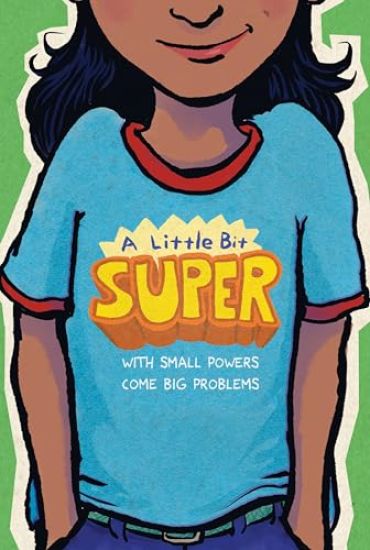
In these hilarious stories by some of the top authors of middle grade fiction today, each young character is coping with a minor superpower—while also discovering their power to change themselves and their community, find their voice, and celebrate what makes them unique.Everyone knows that superheroes are supposed to have awesome powers like strength or invisibility or flight. But what happens when you’re a mostly regular kid . . . who’s just a little bit super?In these hilarious and thought-provoking stories from today’s top middle grade authors, a group of kids are each coping with a recently discovered minor superpower. One can shape-shift—but only part of her body, and only on Mondays. Another can always tell when an avocado is perfectly ripe. One can even hear the thoughts of animals in the pet store—which can be about as heart-tugging as you might imagine. It’s hard enough to be in middle school even without some weird ability, but these kids not only find their way to owning their unique powers and potential, they use them to change things for the better . . . and getting there with them is half the fun!These playful tales prompt readers to consider what their own superpower might be, and how they can use it."Award-winning contributors keep delightfully inclusive and accomplished company in this emotionally grounded, compassionate collection. . . . These are not your run-of-the-mill, cape-and-tights-clad superheroes. These are kids with relatable struggles learning to embrace that quirky bit of themselves that makes them unique." —ALA Booklist (starred review)Written by Pablo Cartaya, Nikki Grimes, Leah Henderson, Jarrett Krosoczka, Remy Lai, Kyle Lukoff, Meg Medina, Daniel Nayeri, Linda Sue Park, Mitali Perkins, Pam Muñoz Ryan, Gary D. Schmidt, Brian Young, and Ibi Zoboi; coedited by Leah Henderson and Gary D. Schmidt.
Bernard D. Rostker; Charles Nemfakos; Henry A. Leonard; Elliot Axelband; Abby Doll; Kimberly N. Hale; Brian McInnis; Richard Mesic; Daniel Tremblay; Roland J. Yardley; Stephanie Young
The swift adoption of unmanned aircraft systems (UASs) and their increasing use in the field have exceeded the capacity of the training infrastructure to sustain training on these systems over the long term. This report develops a general concept for training military forces in employment of UASs and a framework for addressing the training requirements and discusses the limits of existing infrastructure in supporting UAS training.
This is a hands-on, practical guide to general and specific practices in oil palm nurseries to produce healthy, vigorous and uniform plants ready for field planting. There are two nursery stages, pre-nursery and main nursery. The pre-nursery receives both germinated seeds and tissue culture produced plantlets (ramets) which are planted in a relatively small area in which shade and humidity can be controlled. Once young plants are established they are transferred to the main nursery, potted-on and grown on to produce field-ready plants. Good nursery practices, using sustainable approaches where possible, aim to provide high quality planting materials for both commercial production and field trialling. The book covers: Nursery set up - pre-nursery and main nursery Fertilizer programmes Watering Culling Weeding Pests and diseases Pre-field genotypic screening and selection Quarantine nurseries This is an invaluable manual for commercial seed producers, nursery plant producers, commercial plantation companies and plant breeders, as well as researchers in oil palm. It is useful for those starting a career in oil palm production, and as a reference guide for managers and for training purposes.
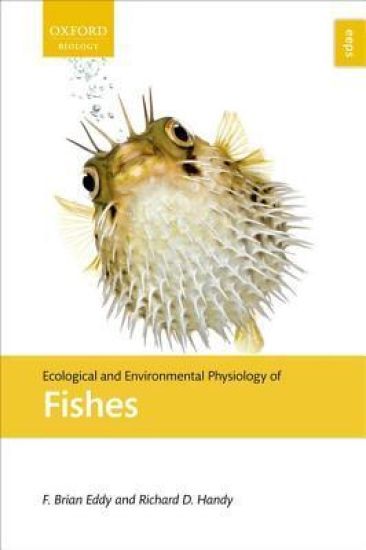
Fishes have evolved to colonise almost every type of aquatic habitat and today they are a hugely diverse group of over 25,000 species. The evolution of this great diversity of species has resulted in a myriad of solutions to the demands posed by the aquatic environment. Ecological and Environmental Physiology of Fishes presents a current and comprehensive overview of fish physiology to demonstrate how living fishes function in their environment. As with other books in the Series, the emphasis is on the unique physiological characteristics of the fish, but with applications to questions of broad relevance in physiological ecology. A preliminary chapter introduces the aquatic environment and gives a general description of fish biology, evolution, and taxonomy. Subsequent sections discuss the particular problems of living in water, life in extreme environments, techniques for studying fish ecophysiology, and future research directions.
Fishes have evolved to colonise almost every type of aquatic habitat and today they are a hugely diverse group of over 25,000 species. The evolution of this great diversity of species has resulted in a myriad of solutions to the demands posed by the aquatic environment. Ecological and Environmental Physiology of Fishes presents a current and comprehensive overview of fish physiology to demonstrate how living fishes function in their environment. As with other books in the Series, the emphasis is on the unique physiological characteristics of the fish, but with applications to questions of broad relevance in physiological ecology. A preliminary chapter introduces the aquatic environment and gives a general description of fish biology, evolution, and taxonomy. Subsequent sections discuss the particular problems of living in water, life in extreme environments, techniques for studying fish ecophysiology, and future research directions.
The Department of Defense conducts an assortment of building partner capacity (BPC) efforts. The needs and existing capabilities of various nations differ, however, as will results. Planning for each BPC effort carefully, assessing progress while the effort is in progress, and assessing results are all important to ensure that it meets U.S. goals and partner expectations. This report presents a framework intended to aid all these steps.
An investing story that provides insights into dealing with your money and finding financial security Making the right investment decisions and executing an effective financial plan can be difficult, especially in today’s markets. But with the right guidance you can achieve this goal. Now, in The Story of Rich, leading wealth manager John David “J.D.” Joyce shows you how. Based on his real-world experiences with investors throughout his successful career, this book offers meaningful advice about financial planning and investing. Designed for those with significant assets who are nearing or recently retired, as well as individuals who have recently come into new money through business or inheritance, The Story of Rich skillfully explains financial planning and investing through a fable of a man who sells a business he’s worked so hard to build, and now finds himself with more money then he’s ever had to deal with. Along the way, this book teaches you about important investment concepts and presents you with tools to consider your options and choose an appropriate investment strategy. Chronicles the fictional story of a recently retired businessman who is worried about making the most of his money now that he's no longer generating regular incomePresents lessons about investing, sometimes through comparisons to topics like marathon running or wine making, in the quest to make sense of fundamental investment conceptsAuthor John David “J.D.” Joyce has been named a Top Financial Advisor by Barron’s in 2009, 2010 and 2011 Engaging and informative, The Story of Rich is the perfect guide for those concerned about protecting their hard-earned money and investing it wisely.