Kirjojen hintavertailu. Mukana 11 699 035 kirjaa ja 12 kauppaa.

Kirjahaku

Etsi kirjoja tekijän nimen, kirjan nimen tai ISBN:n perusteella.

761 tulosta hakusanalla Cherokee Hatcher

Oklahoma Black Cherokees

Oklahoma Black Cherokees

Karen Coody Cooper

History Press
2017
nidottu
Over the generations, Cherokee citizens became a conglomerate people. Early in the nineteenth century, tribal leaders adapted their government to mirror the new American model. While accommodating institutional slavery of black people, they abandoned the Cherokee matrilineal clan structure that once determined their citizenship. The 1851 census revealed a total population nearing 18,000, which included 1,844 slaves and 64 free blacks. What it means to be Cherokee has continued to evolve over the past century, yet the histories assembled here by Ty Wilson, Karen Coody Cooper and other contributing authors reveal a meaningful story of identity and survival.
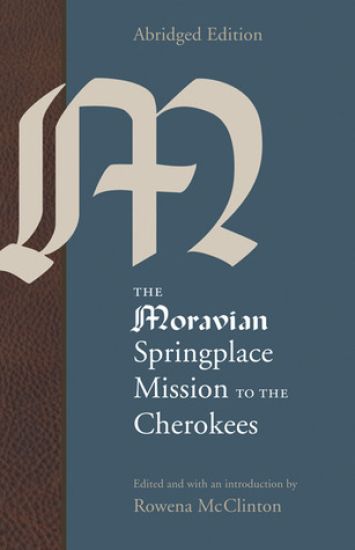
The Moravian Springplace Mission to the Cherokees
In 1801 the Moravians, a Pietist German-speaking group from Central Europe, founded the Springplace Mission at a site in present-day northwestern Georgia. The Moravians remained among the Cherokees for more than thirty years, longer than any other Christian group. John and Anna Rosina Gambold served at the mission from 1805 until Anna's death in 1821. Anna, the principal author of the diaries, chronicles the intimate details of Cherokee daily life for seventeen years. Anna describes mission life and what she heard and saw at Springplace: food preparation and consumption, transactions pertaining to land, Cherokee body ornaments, conjuring, Cherokee law and punishment, Green Corn ceremonies, ball play, and matriarchal and marriage traditions. She similarly recounts stories she heard about rainmaking, the origins of the Cherokee people, and how she herself conversed with curious Cherokees about Christian images and fixtures. She also recalls earthquakes, conversions, notable visitors, annuity distributions, and illnesses. This abridged edition offers selected excerpts from the definitive edition of the Springplace diary, enabling significant themes and events of Cherokee culture and history to emerge. Anna's carefully recorded observations reveal the Cherokees' worldview and allow readers a glimpse into a time of change and upheaval for the tribe.
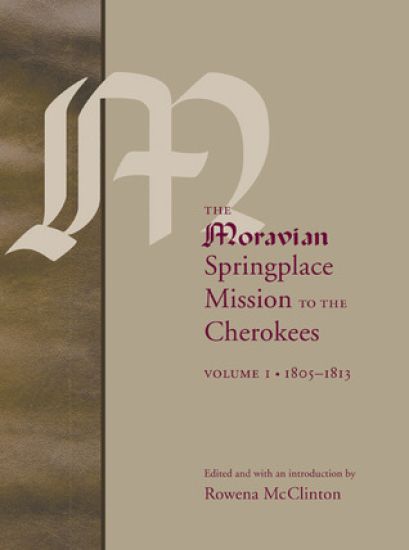
The Moravian Springplace Mission to the Cherokees, 2-volume Set
In 1801 the Moravians, a Pietist German-speaking group from Central Europe, founded the Springplace Mission at a site in present-day northwestern Georgia. The Moravians remained among the Cherokees for more than thirty years, longer than any other Christian group. John and Anna Rosina Gambold served at the mission from 1805 until Anna's death in 1821. The principal author of the diaries, Anna, chronicles the intimate details of Cherokee daily life. This edition of the diary includes the entire text in translation as well as a critical apparatus, contextual introductory material, and extensive notes. Rowena McClinton's translation from German script, an archaic writing convention, makes these primary eyewitness accounts available in English for the first time. These diaries will be of immense value for understanding Cherokee culture and history during the early nineteenth century and missionary efforts in the South during this time. McClinton gained unlimited access to the diaries and other supporting documents for the completion of this project, published with the consent of the Moravian Church of the Southern Province. Volume 1 includes diary entries from 1805–13, a preface, and an introduction. Volume 2 includes diary entries from 1814–21, the editor's epilogue, and a names index and a subject index for both volumes.
Chief Bowles and the Texas Cherokees

Chief Bowles and the Texas Cherokees

Mary Whatley Clarke

University of Oklahoma Press
2003
nidottu
Here is the gripping story of the last stand of Chief Philip Bowles of the Chickamauga Cherokee Indians of Texas. Mary Whatley Clarke sets this tale against the stormy background of Anglo-Cherokee-Mexican relations in early nineteenth-century Texas.The Chickamauga Cherokees from Running Water on the Tennessee River were continually forced to relocate-first to Missouri, then to Arkansas, and finally to Texas. They managed to make a home of their new Texas residence. Then, as has happened many times before and since in Anglo-Indian relations, settlers began to look with increasing desire at the rich Indian lands. The Chickamauga Cherokee had had enough of relocation, and, on a blistering July day in 1839, Chief Bowles and his warriors made a tragic and bloody final stand on the battlefield defending their new Texas home. Their stand resulted in defeat and the dispersal of the Chickamauga Cherokees to far-flung homes on reservations.Could this history have taken a different course? Perhaps not, for, as Mary Whatley Clarke observes, the Cherokee had become ""a red island in a white sea,"" and it seems inevitable that the Anglo-American would submerge that island.
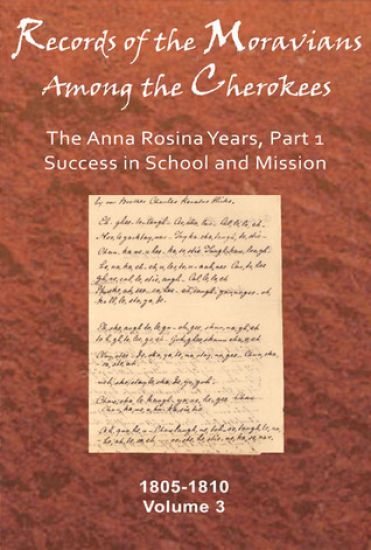
Records of the Moravians Among the Cherokees
Using original diaries, minutes, reports, and correspondence in the Moravian Archives in North Carolina, the Records of the Moravians among the Cherokees series provides a rare account of daily life among the Cherokees throughout the nineteenth century. Although written by missionaries, the records provide keen insight into Cherokee culture, society, and customs.Volume 3, spanning the years 1805 to 1810, chronicles the arrival of John and Anna Rosina Gambold to the mission. Anna Rosina proved dedicated to the education of Cherokee children, and the mission took on a new life and character. The Gambolds soon won the people's affection and respect, and Chief Chuleoa, who at first opposed the mission, became their friend. These years also witnessed the tragic death of James Vann, the Moravians' benefactor among the Cherokees, and the mission's first successful baptism of a Cherokee into the Moravian Church.
Records of the Moravians Among the Cherokees
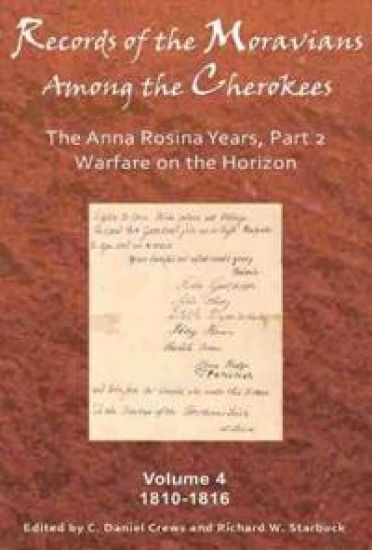
Using original diaries, minutes, reports, and correspondence in the Moravian Archives in North Carolina, the Records of the Moravians among the Cherokees series provides a rare account of daily life among the Cherokees throughout the nineteenth century. Although written by missionaries, the records provide keen insight into Cherokee culture, society, and customs.Volume 4 continues the story through 1816, when earthquakes ushered in a period of upheaval--from the Cherokees' involvement in the Creek War, to M tis battles in Canada, to Napoleon's conquests in Europe. Meanwhile, the little Moravian mission of Springplace added new members, including Charles Hicks, soon to be elected Second Principal Chief of the Cherokee Nation, while Anna and her husband continued work with their Cherokee students.
Records of the Moravians Among the Cherokees
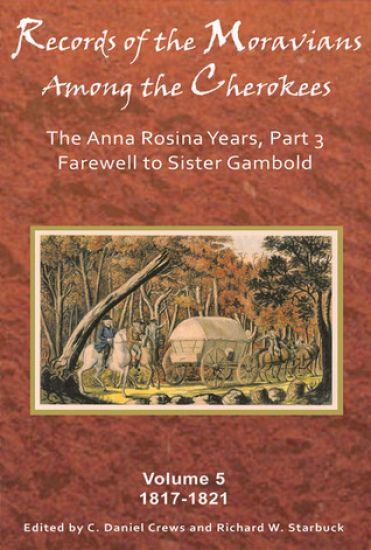
Must they be removed? Or can they remain in their ancestral land?That is the great question confronting the Cherokee Nation and forming the backdrop to volume 5 of Records of the Moravians among the Cherokees. Subtitled The Anna Rosina Years, Part 3: Farewell to Sister Gambold, volume 5 spans the years 1817 to 1821, years of great change within the Cherokee Nation and the end of an era at the Moravians' Springplace mission. Increasingly the Cherokees see the need to adopt new ways. Long gone is the hunter-gatherer way of life, supplanted by farming for livelihood. A new town, soon to be called New Echota, is begun as the "permanent seat of government," and Abraham Steiner, the Moravians' "Apostle to the Cherokees," is invited to consecrate the council house. And throughout the Nation an awakening has begun, as more and more Cherokees open their hearts to the preaching of missionaries among them.At the Moravians' little Springplace mission, Br. John and Sr. Anna Rosina Gambold have toiled since 1805 and have only two converts for all their labor. But now they too share in the awakening, and a second station, at Oochgeelogy, is proposed. The Springplace school also prospers, and Sr. Gambold sees four of her "brown pupils" go to Cornwall in Connecticut for further education to be-come the next generation of leaders of the Cherokee Nation.But then tragedy strikes. Margaret Ann Scott Crutchfield -- Sr. Peggy, widow of the notorious Chief James Vann -- the "first-fruit" of the Cherokee Nation at Springplace, passes away. And then it's Sr. Gambold's turn, and like her husband John, we are left to stand weeping at the grave of our "unforgettable Anna Rosel."With major financial support from the Cherokee Nation and the Eastern Band of the Cherokees, Records: Cherokees will next turn to the series of volumes subtitled March to Removal.
Records of the Moravians Among the Cherokees
The ominous subtitle, March to Removal, opens a new series of Records of the Moravians Among the Cherokees that will take us up to 1838 and the tragic Trail of Tears. Volume 6 covers the years 1821-1824. Despite the loss of teacher Anna Rosina Gambold, the Moravians open a second mission station near Oochgeelogy Creek, thirty miles south of Springplace, their first station. Meanwhile, confident of its future, the Cherokee Nation sets about building a civilization of its own with a national capital, legislature, code of laws, and diplomatic negotiations with Washington. Now, all the Cherokee Nation needs is a syllabary to write its own language--a goal that will be achieved during the time period covered in volume 7 of Records of the Moravians Among the Cherokees. Records of the Moravians Among the Cherokees uses original diaries, minutes, reports, and correspondence in the Moravian Archives in North Carolina to provide a firsthand account of daily life among the Cherokee throughout the nineteenth century. Though written by missionaries from their perspective, these records provide much insight into Cherokee culture, society, customs, and personalities.
Records of the Moravians Among the Cherokees
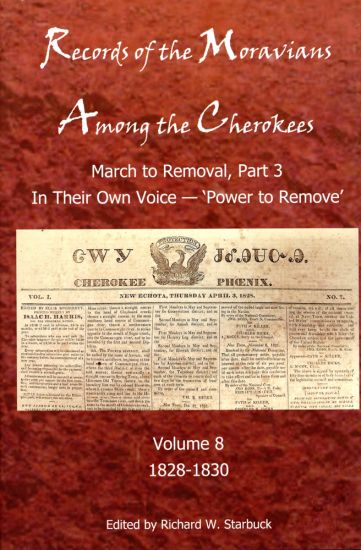
Volume 7 of Records of the Moravians Among the Cherokees covers only three years, 1825-1827, but its pages are packed with discovery, struggle, sadness. The Cherokee Nation adopts a new means of communication, Sequoyah's syllabary--"invented by an Indian," our Br. Johann Renatus Schmidt writes, who "has no formal education." As long as the Cherokees cling to their land, which the state of Georgia is increasingly certain it owns, diplomatic pushing will grow to military shoving. Then 1827 fulfills volume 7's subtitle of Death in the Land and Mission with the passing of the old guard, first old principal chief Pathkiller, then his successor, our Br. Charles Renatus Hicks, and finally our dear missionary Br. John Gambold himself. That leaves the door open for new leadership to step in with volume 8, covering the years 1828-1830. Records of the Moravians Among the Cherokees uses original diaries, minutes, reports, and correspondence in the Moravian Archives in North Carolina to provide a firsthand account of daily life among the Cherokees in the nineteenth century. Though written by missionaries from their perspective, these records give much insight into Cherokee culture, society, customs, and personalities.
Records of the Moravians Among the Cherokees
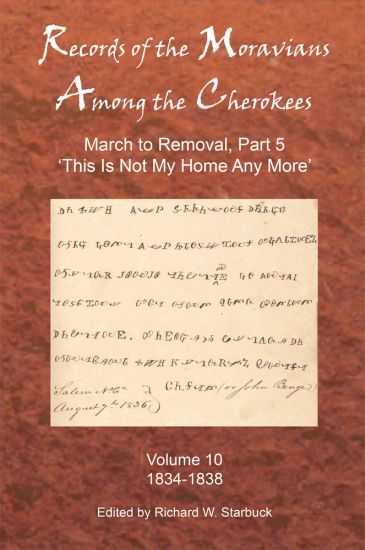
Volume 10 of Records of the Moravians Among the Cherokees, 1834-1838, concludes the subtitle series March to Removal leading up to the Trail of Tears. The State of Georgia and the United States press forward toward their common goal, Georgia for white citizens only and America east of the Mississippi swept clean of Indians. After years of negotiations, treaties, enactments, and lawsuits, the Treaty of New Echota, signed late December 1835 by a handful of Cherokee head men, seals the fate of the Cherokee Nation east of the Mississippi. The Cherokees are now a homeless people in their ancient homeland. And the Moravian Church's missionaries, through mission diaries, reports, and letters, record the events as they hear, read, and eyewitness them, "heart freezing scenes of injustice, deception, oppression, & force, of which this Nation is the victim," missionary Henry Clauder writes April 1837. As forced removal increases, "forts" are built to hold up to 200 Indians each, even at the Moravians' beloved Springplace mission. Herded into the forts like cattle, many succumb to camp diseases. As the deadline for departure approaches, John Ross, president of the Cherokee Nation, wins a concession from the Army's Gen. Winfield Scott. Instead of soldiers, Cherokees will conduct the 13 "detachments" of about 1,000 Indians each. And the Moravian missionaries make their own hard decision. With winter coming on, they depart on the 800-mile journey to Arkansas before Br. George Hicks can start his detachment with a number of Moravian mission families.