It is well known and researched, that deprivation of oxygen to the brain can quickly result in irreversible damage and death. What is less well known, is that some vertebrate species are exceptionally tolerant of brain hypoxia. The Brain Without Oxygen: Causes of failure - Physiological and molecular mechanisms for survival, Third edition, discusses the mechanisms of brain hypoxia tolerance in these exceptional vertebrates, which include diving marine mammals, high altitude dwellers and the hibernating mammal. Special attention is given to the extraordinary adaptations that allow a few turtle and fish species to tolerate months of brain anoxia. This third, fully updated edition addresses the potential of these animal models as targets for human clinical intervention. Perhaps the most interesting of these, are those involved in the suppression of metabolic activities to new set points well below their normoxic minima or maintenance levels. This volume will be valuable reading for researchers in physiology, medicine and general biological sciences, and of great importance to pharmaceutical companies researching novel models for stroke and brain ischemia.
The main intention of this book is to give an impression of the state-of-the-art in system-level memory management (data transfer and storage) related issues for complex data-dominated real-time signal and data processing applications. The material is based on research at IMEC in this area in the period 1989- 1997. In order to deal with the stringent timing requirements and the data dominated characteristics of this domain, we have adopted a target architecture style and a systematic methodology to make the exploration and optimization of such systems feasible. Our approach is also very heavily application driven which is illustrated by several realistic demonstrators, partly used as red-thread examples in the book. Moreover, the book addresses only the steps above the traditional high-level synthesis (scheduling and allocation) or compilation (traditional or ILP oriented) tasks. The latter are mainly focussed on scalar or scalar stream operations and data where the internal structure of the complex data types is not exploited, in contrast to the approaches discussed here. The proposed methodologies are largely independent of the level of programmability in the data-path and controller so they are valuable for the realisation of both hardware and software systems. Our target domain consists of signal and data processing systems which deal with large amounts of data.
The monograph is devoted to modern methods of calculation and the designing of devices of vortical type providing realisation of effective processes of division and mass transfer. In the book the designs of vortical devices are considered, the available experimental material on research of de-dusters is systematised. Interaction of structure of current of a liquid and gas with design parameter of the device is revealed, the generalised characteristics of hydrodynamics of streams are offered. The extensive experimental material on regimes of movement of a liquid film in the device as empirical dependencies is generalised. Methods of calculation of efficiency mass transfer in devices of the vortical type, taking into account aerohydrodynamical laws of stream of gas and a liquid are offered. Results of the work can be used development and designing of vortical devices for processes for dust separation.
Nanotechnologies development in various directions of science and engineering represents one of the most high-priority problems of modern science. One of such directions is the development and research of polymer nanocomposites with filler from nanoparticles and nanotubes possessing the increased strength and flame-resistance. In the last decade in the world literature a large amount of works have appeared which are dedicated both to technological and fundamental problems of polymer nanocomposites creation. The main part of these works adduced studies of polymer nanocomposites structure and properties, in which as filler organoclays with particles size of nanometre scale (for example, Na+-montmorillonite) were applied as a filler. Key studies in this field mainly use various kinds of modifications of large micromechanical models, created at one time for the description of polymer composites properties in general. These modifications are cumbersome enough, and mainly use complex computer technologies and although with their help convincing enough results were obtained, one should pay attention on their narrowness. In present quite many classes of polymer nanocomposites are obtained, having different reinforcement mechanisms, but the general ones in the sense, that these mechanisms are realised at the expense of introduction in polymer matrix particles of nanometre sizes. As it is known, the main peculiarity of such particles is a sharply increased polymer-filler contact area in comparison with usual fillers of micron scale size, that gives maximum reinforcement effect at small nanofiller contents. Hence it follows, that the main research object in the given case should be interfacial phenomena on polymer matrix-filler boundary, to which Academician Lipatov pointed as long as 40 years ago. Another important postulate is the fractal nature of nanoparticles structure, defining the mentioned above interfacial interactions level. The two postulates mentioned would be the main at the structure and properties of polymer nanocomposites analysis in the present monograph. At the same time the authors do not exlude the application of other model representations, for example, of the mentioned above micromechanical models.The purpose of the present monograph is the research of structure-properties relationships, defining a polymer nanocomposites reinforcement mechanism, for seven different classes of these materials. For these tasks solution the modern physical conceptions: synergetics of solid body, cluster model of polymers amorphous state structure, percolation theory are used.
This book is prepared in the form of a ready reckoner comprising different aspects of domestic cat. It covers origin and domestication of cat, anatomy and physiology, cat breeds (Indian) and their specialties, diet and feeding, health and diseases, toxicology, medicine, reproduction, care and management of cats and interesting facts about cats. The information in this book is from different standard textbooks in a concise form. Hope it will be an asset to cat lovers and others concerned with cats.
It is well known and researched, that deprivation of oxygen to the brain can quickly result in irreversible damage and death. What is less well known, is that some vertebrate species are exceptionally tolerant of brain hypoxia. The Brain Without Oxygen: Causes of failure - Physiological and molecular mechanisms for survival, Third edition, discusses the mechanisms of brain hypoxia tolerance in these exceptional vertebrates, which include diving marine mammals, high altitude dwellers and the hibernating mammal. Special attention is given to the extraordinary adaptations that allow a few turtle and fish species to tolerate months of brain anoxia. This third, fully updated edition addresses the potential of these animal models as targets for human clinical intervention. Perhaps the most interesting of these, are those involved in the suppression of metabolic activities to new set points well below their normoxic minima or maintenance levels. This volume will be valuable reading for researchers in physiology, medicine and general biological sciences, and of great importance to pharmaceutical companies researching novel models for stroke and brain ischemia.
Now in full color, Maxillofacial Surgery, 3rd Edition covers the entire specialty of maxillofacial surgery, including craniofacial deformity, oral surgery, trauma, and oncology. Unlike other OMFS texts where the contributors are singly boarded in oral surgery, this richly illustrated text boasts OMFS contributors who are all dual boarded in both oral surgery and medicine. Thoroughly updated with evidence-based content, it addresses the advances in technology and procedures providing oral and maxillofacial surgeons with new and exciting treatment options. And with print and digital formats, it is easy to use in any setting. Authoritative guidance on oral and maxillofacial surgery by internationally recognized experts in the field. 2,800 illustrations, including radiographs and full color artwork and clinical photos, provide clinicians and OMS residents with a clear visual guide to diagnoses, key concepts, and surgical techniques, as well as examples of preoperative and postoperative results. A multidisciplinary approach reflects the best practices in the disciplines of oral and maxillofacial surgery, head and neck surgery, plastic surgery, and otolaryngology. Covers contemporary techniques and technological advances at the forefront of maxillofacial surgery. Evidence-based content supports the newest, most up-to-date diagnostic and therapeutic options available for a wide variety of clinical problems. Key Points and Pitfalls boxes clearly identify the most important information, as well as potential problem areas that can arise when treating patients. Available in print and digital formats that can be easily accessed via mobile tablets and smart phones in any setting, making it perfect for the modern student of surgery. NEW! Full-color images clearly depict pathologies, concepts, and procedures. EXPANDED and UPDATED! Expanded from 82 to 111 chapters with thoroughly revised content that reflects current information and advances in OMS, so clinicians and students can depend on this text as their go-to resource on oral maxillofacial surgery. NEW! 29 new state-of-the-art chapters covering new topics, including the salivary glands, thyroid and parathyroid glands, tissue engineering, navigational surgery, 3D modeling, and lasers in OMFS. NEW! Two new editors, Professors Brennan and Schliephake, and new section editors and contributors have helped bring advances in the field of oral and maxillofacial surgery and offer a fresh perspective. UPDATED! Expanded chapter on cancer keeps you in the know.
Photochemical reactions are the main class of chemical processes. These processes provide for life on Earth, since due to photochemical processes, plants absorb carbon oxide from the atmosphere changing them into the "meal" for all creatures on Earth. Together with "good" photochemical processes there are some "bad" as well. This book is about photodestruction and light stabilisation and is devoted to these processes. For example, the heterochain polymers. They are the main class of large-tonnage polymers, which are used for manning a great variety of polymer and composite materials (including nanocomposites).
Cellulose and its derivatives -- cellulose acetate -- are renewed polymers, that, together with the whole complex of valuable and indispensable properties, defines continuous growth of their production. Acetate fibres differ from cellulose fibres in light and thermooxidative stability, as the presence of ester groups decreases stability of molecular structure, owing to which destructive processes begin at much lower temperatures and weak energy effects. Since macromolecules of cellulose acetate are constructed on the basis of cellulose then mechanism of photodestruction of these polymers may be considered as general. The most important energetic factor, which photodestruction of cellulose and its derivatives depend on, is intensity of irradiation and wave length. Destruction of cellulose and its derivatives under atmospheric conditions, proceeding as a result of photochemical reaction, on the whole takes place under the action of ultraviolet rays with ?=200-360 nm. Since cellulose contains three types of chromophore groups -- hydroxyl, acetate and semiacetate and also aldehyde -- then it is considered that light absorption in the region of 250-300 nm is caused just by them. At the same time some authors, bringing the possibility of light absorption by acetal chromophore in question, have put forward the supposition that photochemically active centres in cellulose materials, containing carboxyl and hydroxyl groups, may be molecular complexes between these groups, connected by the system of hydrogen bounds with definite energy of interaction. Disproportion of intermolecular bonds, providing fixation of excited state in cellulose matrix takes place in such complexes at their excitation. Thus, there are many different hypotheses, often contradicting each other, about the effect of chromophore groups on light absorption by cellulose. There are many data about the nature of free-radical particles, being formed at irradiation of cellulose by ultraviolet light. Since, being formed products of phototransformation are highly mobile and easily undergo further transformations, method of electron-paramagnetic resonance (ESP) is one of the most effective for these particles identification. Critical analysis of a great number of works on EPR spectra interpretation is quite fully given in surveys. More than 20 different radicals are being formed at ultraviolet irradiation as a result of break of practically all bonds C-C; C-H; C-O. Main types of macroradicals, with indication of atom and groups of atoms after removal of which these macroradicals are formed, are presented in scheme 1. of this book.
Dieser Buchtitel ist Teil des Digitalisierungsprojekts Springer Book Archives mit Publikationen, die seit den Anfängen des Verlags von 1842 erschienen sind. Der Verlag stellt mit diesem Archiv Quellen für die historische wie auch die disziplingeschichtliche Forschung zur Verfügung, die jeweils im historischen Kontext betrachtet werden müssen. Dieser Titel erschien in der Zeit vor 1945 und wird daher in seiner zeittypischen politisch-ideologischen Ausrichtung vom Verlag nicht beworben.
The Hauptvermutung is the conjecture that any two triangulations of a poly hedron are combinatorially equivalent. The conjecture was formulated at the turn of the century, and until its resolution was a central problem of topology. Initially, it was verified for low-dimensional polyhedra, and it might have been expected that furt her development of high-dimensional topology would lead to a verification in all dimensions. However, in 1961 Milnor constructed high-dimensional polyhedra with combinatorially inequivalent triangulations, disproving the Hauptvermutung in general. These polyhedra were not manifolds, leaving open the Hauptvermu tung for manifolds. The development of surgery theory led to the disproof of the high-dimensional manifold Hauptvermutung in the late 1960's. Unfortunately, the published record of the manifold Hauptvermutung has been incomplete, as was forcefully pointed out by Novikov in his lecture at the Browder 60th birthday conference held at Princeton in March 1994. This volume brings together the original 1967 papers of Casson and Sulli van, and the 1968/1972 'Princeton notes on the Hauptvermutung' of Armstrong, Rourke and Cooke, making this work physically accessible. These papers include several other results which have become part of the folklore but of which proofs have never been published. My own contribution is intended to serve as an intro duction to the Hauptvermutung, and also to give an account of some more recent developments in the area. In preparing the original papers for publication, only minimal changes of punctuation etc.
The Hauptvermutung is the conjecture that any two triangulations of a poly hedron are combinatorially equivalent. The conjecture was formulated at the turn of the century, and until its resolution was a central problem of topology. Initially, it was verified for low-dimensional polyhedra, and it might have been expected that furt her development of high-dimensional topology would lead to a verification in all dimensions. However, in 1961 Milnor constructed high-dimensional polyhedra with combinatorially inequivalent triangulations, disproving the Hauptvermutung in general. These polyhedra were not manifolds, leaving open the Hauptvermu tung for manifolds. The development of surgery theory led to the disproof of the high-dimensional manifold Hauptvermutung in the late 1960's. Unfortunately, the published record of the manifold Hauptvermutung has been incomplete, as was forcefully pointed out by Novikov in his lecture at the Browder 60th birthday conference held at Princeton in March 1994. This volume brings together the original 1967 papers of Casson and Sulli van, and the 1968/1972 'Princeton notes on the Hauptvermutung' of Armstrong, Rourke and Cooke, making this work physically accessible. These papers include several other results which have become part of the folklore but of which proofs have never been published. My own contribution is intended to serve as an intro duction to the Hauptvermutung, and also to give an account of some more recent developments in the area. In preparing the original papers for publication, only minimal changes of punctuation etc.
The Encyclopedia of Uralic Mythologies offers a comparative base for study of the roots and present forms of Finno-Ugrian and Samoyedic mythologies and ethnic religions. The peoples speaking the Uralic languages are indigenous peoples of Northern Eurasia in the territory extending from Fennoscandia to Taimyr Peninsula. Along with their complicated histories and cultural differencies, Uralicgroups have maintained and created original religious and mythological traditions, where traces of archaic religious systems, e.g. shamanism, animal ceremonialism and astral mythology, merged with ancient foreign influences and more recent religions.Khanty Mythology is the second volume of the series. The forthcoming Mansi and Selkup volumes have already been completed in Russian.Mythology is understood in broad sense, including not only myths proper but also information about religious beliefs, connected rituals, the sphere of magic and its specialists. A list of literature, an index of mythical concepts and names are included in each volume. The central part of the books is to be the explanatory and etymological dictionary of mythological terms for the tradition concerned.
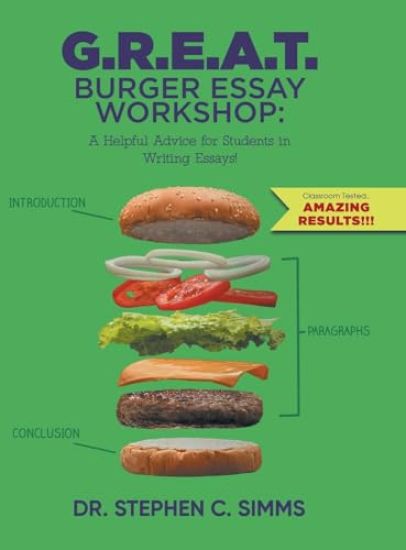
In his first classroom, he noticed that many students did not know where to begin; or how to effectively draft an essay paragraph. Also, there was a palpable fear that many would not pass the state's mandatory writing exam. So, he devised this color-coded, easy-to-use guide to help students understand the building blocks needed for vivid, imaginative writings. The results proved remarkable after reviewing grammar through 50 bellringers, incorporating several Introduction types and Conclusion techniques. As a result, students were armed with Style, expressive Voice, and vivid Imagery. The astonishing results were 97%, 98%, and 100% passing rates on the FCAT during three consecutive years of use. GREAT BURGER can work for any teacher or a student just as well when implemented faithfully.DR. STEPHEN C. SIMMS is a five-time author who has spent over 20 years educating students. He's proudly served diverse student demographics as a college math tutor, substitute teacher, and for eight years as a full-time secondary English teacher. His hobbies are practicing piano and guitar, playing Putt-Putt with his wife and sons, and creating new concepts to help others succeed DR. SIMMS' undergraduate degree is in Secondary English Education, while his master's and Ph. D are in Business Administration and Organizational Leadership, respectively. Prior titles include: Beat the Gionni's: An Italian American Family's Struggle During the U.S. Housing Collapse (2015) and Geo-Shifting: Social Cause Games (2012) at amazon.com. He enjoys simplifying complex concepts so that they are approachable to 'everyday people.' He also educates others beyond the classroom by offering lower-cost mini-courses at www.platconcept.com for lower-to-middle hardworking folks who want to improve their lives. He sells self-improvement packets for Investing, Weight Loss, Musicians, Inventors, and Authors on this webstore. It is from his own personal experiences that DR. SIMMS assists others to reach their own goals, and he claims this is what keeps him young and motivated