Kirjojen hintavertailu. Mukana 12 365 317 kirjaa ja 12 kauppaa.

Kirjahaku

Etsi kirjoja tekijän nimen, kirjan nimen tai ISBN:n perusteella.

1000 tulosta hakusanalla Gerard A Maugin

Why Not Socialism?

Why Not Socialism?

Gerald A. Cohen

PRINCETON UNIVERSITY PRESS
2009
sidottu
Is socialism desirable? Is it even possible? In this concise book, one of the world's leading political philosophers presents with clarity and wit a compelling moral case for socialism and argues that the obstacles in its way are exaggerated. There are times, G. A. Cohen notes, when we all behave like socialists. On a camping trip, for example, campers wouldn't dream of charging each other to use a soccer ball or for fish that they happened to catch. Campers do not give merely to get, but relate to each other in a spirit of equality and community. Would such socialist norms be desirable across society as a whole? Why not? Whole societies may differ from camping trips, but it is still attractive when people treat each other with the equal regard that such trips exhibit. But, however desirable it may be, many claim that socialism is impossible. Cohen writes that the biggest obstacle to socialism isn't, as often argued, intractable human selfishness--it's rather the lack of obvious means to harness the human generosity that is there. Lacking those means, we rely on the market. But there are many ways of confining the sway of the market: there are desirable changes that can move us toward a socialist society in which, to quote Albert Einstein, humanity has "overcome and advanced beyond the predatory stage of human development."
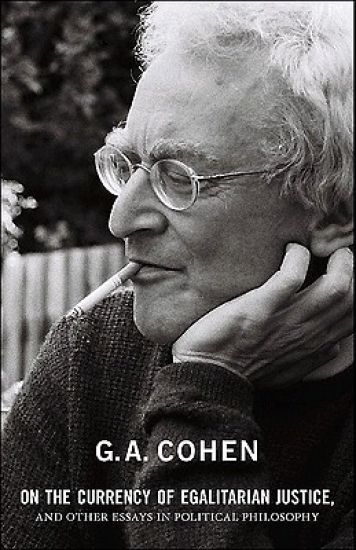
On the Currency of Egalitarian Justice, and Other Essays in Political Philosophy
G. A. Cohen was one of the most gifted, influential, and progressive voices in contemporary political philosophy. At the time of his death in 2009, he had plans to bring together a number of his most significant papers. This is the first of three volumes to realize those plans. Drawing on three decades of work, it contains previously uncollected articles that have shaped many of the central debates in political philosophy, as well as papers published here for the first time. In these pieces, Cohen asks what egalitarians have most reason to equalize, he considers the relationship between freedom and property, and he reflects upon ideal theory and political practice. Included here are classic essays such as "Equality of What?" and "Capitalism, Freedom, and the Proletariat," along with more recent contributions such as "Fairness and Legitimacy in Justice," "Freedom and Money," and the previously unpublished "How to Do Political Philosophy." On ample display throughout are the clarity, rigor, conviction, and wit for which Cohen was renowned. Together, these essays demonstrate how his work provides a powerful account of liberty and equality to the left of Ronald Dworkin, John Rawls, Amartya Sen, and Isaiah Berlin.
Finding Oneself in the Other

Finding Oneself in the Other

Gerald A. Cohen

Princeton University Press
2012
sidottu
This is the second of three volumes of posthumously collected writings of G. A. Cohen, who was one of the leading, and most progressive, figures in contemporary political philosophy. This volume brings together some of Cohen's most personal philosophical and nonphilosophical essays, many of them previously unpublished. Rich in first-person narration, insight, and humor, these pieces vividly demonstrate why Thomas Nagel described Cohen as a "wonderful raconteur." The nonphilosophical highlight of the book is Cohen's remarkable account of his first trip to India, which includes unforgettable vignettes of encounters with strangers and reflections on poverty and begging. Other biographical pieces include his valedictory lecture at Oxford, in which he describes his philosophical development and offers his impressions of other philosophers, and "Isaiah's Marx, and Mine," a tribute to his mentor Isaiah Berlin. Other essays address such topics as the truth in "small-c conservatism," who can and can't condemn terrorists, and the essence of bullshit. A recurring theme is finding completion in relation to the world of other human beings. Engaging, perceptive, and empathetic, these writings reveal a more personal side of one of the most influential philosophers of our time.
Finding Oneself in the Other

Finding Oneself in the Other

Gerald A. Cohen

Princeton University Press
2012
pokkari
This is the second of three volumes of posthumously collected writings of G. A. Cohen, who was one of the leading, and most progressive, figures in contemporary political philosophy. This volume brings together some of Cohen's most personal philosophical and nonphilosophical essays, many of them previously unpublished. Rich in first-person narration, insight, and humor, these pieces vividly demonstrate why Thomas Nagel described Cohen as a "wonderful raconteur." The nonphilosophical highlight of the book is Cohen's remarkable account of his first trip to India, which includes unforgettable vignettes of encounters with strangers and reflections on poverty and begging. Other biographical pieces include his valedictory lecture at Oxford, in which he describes his philosophical development and offers his impressions of other philosophers, and "Isaiah's Marx, and Mine," a tribute to his mentor Isaiah Berlin. Other essays address such topics as the truth in "small-c conservatism," who can and can't condemn terrorists, and the essence of bullshit. A recurring theme is finding completion in relation to the world of other human beings. Engaging, perceptive, and empathetic, these writings reveal a more personal side of one of the most influential philosophers of our time.
Planning and Social Science

Planning and Social Science

Gerald A. Gutenschwager

University Press of America
2004
nidottu
In the 20th century, planning evolved from a design-based activity to a scientific one. Planning, the only legitimate voice in applied social science, now seeks to free itself from the "autistic" vocabulary of positivism and neo-classical economics. To further this quest, author Gerald A. Gutenschwager examines the philosophical basis for alternative paradigms currently used in social science and suggests new approaches to a more humanistic theory of planning. The primary goal of this book is to give philosophical depth to planning discourse, not only by examining its scientific pedigree, but also by seeking to extend its horizons into more humanistic directions, by touching upon sociodramatic and even social psychological questions largely unattended in this discourse.
Public Places

Public Places

Gerald A. Danzer

AltaMira Press,U.S.
1987
nidottu
The American people have come to expect that certain public buildings—like state capitols, county courthouses, and historic landmarks—will have brief historical sketches to enrich visits to them. This book will help individuals develop such guides. Readers will also gain an awareness of the significance of public places in the life of a community. Public Places is Volume 3 in The Nearby History Series.
The Development of the Idea of History in Antiquity

The Development of the Idea of History in Antiquity

Gerald A. Press

McGill-Queen's University Press
2003
sidottu
An extensive scholarly literature, written in the past century holds that in ancient Greek and Roman thought history is understood as circular and repetitive - a consequence of their anti-temporal metaphysics - in contrast with Judaeo-Christian thought, which sees history as linear and unique - a consequence of their messianic and hence radically temporal theology. Gerald Press presents a more general view - that the Graeco-Roman and Judaeo-Christian cultures were fundamentally alien and opposed cultural forces and that, therefore, Christianity's victory over paganism included the replacement or supersession of one intellectual world by another - and then shows that, contrary to this view, there was substantial continuity between "pagan" and Christian ideas of history in antiquity, rather than a striking opposition between cyclic and linear patterns. He finds that the foundation of the Christian view of history as goal-directed lies in the rhetorical rather than the theological motives of early Christian writers.
Alaska Politics and Government

Alaska Politics and Government

Gerald A. McBeath; Thomas A. Morehouse

University of Nebraska Press
1994
sidottu
Alaska is the largest and one of the least populated of the fifty states - extremes that create a unique government. Tied together by tiny airports and vast pipelines, the state features abundant natural resources and a remoteness that make it one of the last outposts of the United States, a role that Alaskans savour. Gerald A. McBeath and Thomas A. Morehouse examine Alaska's character and the forces shaping it. Underlying their descriptions are the themes of independence, dependence, and the search for sustainable economic development. While independence and individualism are well-known attributes of Alaskans and their political process, their experience has also been coloured by dependency. Alaska was the last region in the New World colonized by Westerners. It was not organized as a territory until 1912 and did not achieve statehood until 1959, evolving in only one generation from a territory with a weak government to a wealthy state with a powerful system of state and local government. McBeath and Morehouse describe the workings of Alaska's government: the executive, legislative, and judicial branches, as well as the state's relations with the federal government. The ongoing pattern of federal control and Alaskans' sporadically virulent response to it are emblematic of the tensions between dependence on federal policies and the struggle for equal influence with the other forty-nine states. Geographic barriers, impeding transportation and communication, have left Alaska's regions, communities, and people separated from one another and from the outside. Yet, as "Alaska Politics and Government" demonstrates, the ability to deal with Alaska's future challenges is found in the vibrant and resilient character of its land and its people. Gerald A. McBeath is a professor of political science at the University of Alaska-Fairbanks. Thomas A. Morehouse is a professor of political science in the Institute of Social and Economic Research and the School of Public Affairs at the University of Alaska-Anchorage.
Alaska Politics and Government

Alaska Politics and Government

Gerald A. McBeath; Thomas A. Morehouse

University of Nebraska Press
1994
pokkari
Alaska is the largest and one of the least populated of the fifty states—extremes that create a unique government. Tied together by tiny airports and vast pipelines, the state features abundant natural resources and a remoteness that make it one of the last outposts of the United States, a role that Alaskans savor. Gerald A. McBeath and Thomas A. Morehouse examine Alaska's character and the forces shaping it. Underlying their descriptions are the themes of independence, dependence, and the search for sustainable economic development. While independence and individualism are well-known attributes of Alaskans and their political process, their experience has also been colored by dependency. Alaska was the last region in the New World colonized by Westerners. It was not organized as a territory until 1912 and did not achieve statehood until 1959, evolving in only one generation from a territory with a weak government to a wealthy state with a powerful system of state and local government.McBeath and Morehouse describe the workings of Alaska's government: the executive, legislative, and judicial branches, as well as the state's relations with the federal government. The ongoing pattern of federal control and Alaskans' sporadically virulent response to it are emblematic of the tensions between dependence on federal policies and the struggle for equal influence with the other forty-nine states.Geographic barriers, impeding transportation and communication, have left Alaska's regions, communities, and people separated from one another and from the outside. Yet, as Alaska Politics and Government demonstrates, the ability to deal with Alaska's future challenges is found in the vibrant and resilient character of its land and its people.
Catholic Identity or Identities?

Catholic Identity or Identities?

Gerald A. Arbuckle

Liturgical Press
2013
pokkari
How can Catholic leaders effectively train and form members of our institutions in the Gospel values that are the ultimate foundation of Catholic identities?Internationally recognized author, educator, and facilitator Gerald A. Arbuckle argues that it is time to acknowledge that the programs and processes used in the past are inadequate to our postmodern age. The systems previously used to educate the staffs of our hospitals, universities, schools, and other institutions rarely succeed today. Although didactic teaching and discursive learning have their place, they cannot be the primary method for forming identities.Catholic Identity or Identities? will assist a wide range of people- bishops, theologians, pastoral workers, institutional leaders and staffs, and more-in their various ministries. Arbuckle draws on several disciplines, including Scripture, theology, and history, but in particular cultural anthropology, to explain the importance of refounding adult formation for Catholic ministries and the practical ways to achieve it.
Culture, Inculturation, and Theologians

Culture, Inculturation, and Theologians

Gerald A. Arbuckle

Liturgical Press
2010
pokkari
The split between the Gospel and culture is without doubt the drama of our time," wrote Paul VI in 1975. Since that time there has been an increasingly urgent awareness that inculturation is an indispensable task of the church. But inculturation, the dialogue between church and cultures, demands first of all that we who would enter into the dialogue understand what "culture" itself means and what dialogue entails. To that end, cultural anthropologist Father Gerald Arbuckle gives us this important volume.He traces the history of the development of the concept of culture, and the too-often negative, rarely positive effects of encounters between church and culture. He explores how Jesus Christ approached the cultures of his time, and outlines the current treatment of culture and inculturation in church documents and in Catholic theology. He shows that modest progress in understanding has recently staled, and there are even forces working to turn that progress into regress. He concludes with a description of inculturation as it needs to happen 'and a sharp critique of those who resist. With a sense of prophetic hope, Arbuckle seeks to help us bridge the lamentable split between Gospel and culture, the drama that continues to unfold in our time.
Fundamentalism at Home and Abroad

Fundamentalism at Home and Abroad

Gerald A. Arbuckle

Liturgical Press
2017
pokkari
For most people, fundamentalism in the modern world has become synonymous with a radical form of Islam, but fundamentalism in many shapes and forms is also very much present in Western societies. Yes, fundamentalist economic, political, nationalistic, and religious movements are aplenty in the West. Using the lens of cultural anthropology, Gerald A. Arbuckle examines fundamentalist attitudes and movements in this book, exploring why they arise and how readers can constructively respond to them.
People, Space and Time

People, Space and Time

Gerald A. Danzer; Lawrence W. McBride

University Press of America
1986
sidottu
Uses the Chicago metropolitan area as a model to help students research, study and learn about their own communities. The curriculum materials developed in this volume provide students with a methodology for doing community studies. Teachers may select materials from eight units and adapt them for particular classroom needs. Co-published with the Chicago Metro History Fair. Winner of the American Historical Association's 1987 James Harvey Robinson Prize.
Shadow Distance

Shadow Distance

Gerald A. Vizenor

Wesleyan University Press
1994
nidottu
Author of The Heirs of Columbus, Hotline Healers, Interior Landscapes, Crossbloods, and numerous other works, Gerald Vizenor is one of the century's most important and prolific Native American writers. Drawing on the best work of an acclaimed career, Shadow Distance: A Gerald Vizenor Reader reveals the wide range of his imagination and the evolution of his central themes. This compelling collection includes not only selections from Vizenor's innovative fiction, but also poetry, autobiography, essays, journalism, and the previously unpublished screenplay"Harold of Orange," winner of the Film-in-the-Cities national screenwriting competition. Whether focusing on Native American tricksters or legal and financial claims of tribal sovereignty, Vizenor continually underscores the diversities of modern traditions, the mixed ethnicity that characterizes those who claim Native American origin, and cultural permeability of an increasingly commercial, global world. A. Robert Lee of the University of Kent at Canterbury, England, provides a lucid introduction to this writer whose"radically self-aware and contemporary satiric tricksterism . . . as easily invokes Jabés, Barthes, Lyotard, or Foucault as bear ceremonial, ghost dance, or dream-catcher."
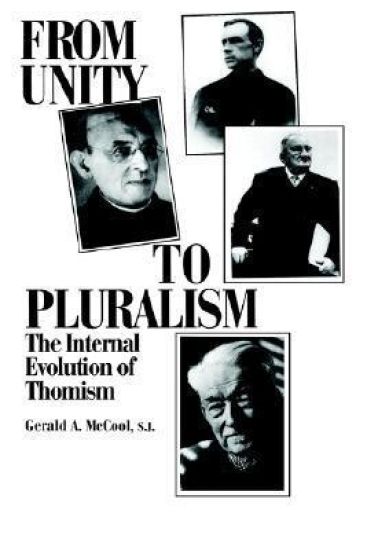
From Unity to Pluralism

From Unity to Pluralism

Gerald A. McCool

Fordham University Press
1992
sidottu
Through an in-depth study of four key figures – Pierre Rousselot, Joseph Marechal, Jacques Maritain, and Etienne Gilson – From Unity to Pluralism traces the evolution of Thomism in the first half of the twentieth century. Through their work, Thomisism encountered contemporary thought and rediscovered its authentic roots, and the ideal of a univocal, unitary doctrine of Scholastic truth embodied in the unambiguous teachings of Thomas Aquinas, which had inspired the Thomist revival at the end of the nineteenth century, gradually gave way. The result is the emergence of pluralism within the system itself and the independent development of the theologies of Karl Rahner and Bernard Lonergan.
From Unity to Pluralism

From Unity to Pluralism

Gerald A. McCool

Fordham University Press
1999
pokkari
Through an in-depth study of four key figures – Pierre Rousselot, Joseph Marechal, Jacques Maritain, and Etienne Gilson – From Unity to Pluralism traces the evolution of Thomism in the first half of the twentieth century. Through their work, Thomisism encountered contemporary thought and rediscovered its authentic roots, and the ideal of a univocal, unitary doctrine of Scholastic truth embodied in the unambiguous teachings of Thomas Aquinas, which had inspired the Thomist revival at the end of the nineteenth century, gradually gave way. The result is the emergence of pluralism within the system itself and the independent development of the theologies of Karl Rahner and Bernard Lonergan.
Nineteenth Century Scholasticism

Nineteenth Century Scholasticism

Gerald A. McCool

Fordham University Press
1999
pokkari
Nineteenth-Century Scholasticism provides a careful historical account of the scholastic polemic against the "new" Catholic philosophies and theologies that arose in Europe throughout the 19th century. This read begins with an examination of Ontologism, Traditionalism, and the theologies of Hermes, Gunther, and the Tubingen School - the adversaries against whom the scholastics directed their fire - and then transitions to review the philosophies and theologies of Liberatore and Kleutgen, the scholastic theoreticians who orchestrated the polemic. From the account of its polemic with rival theologians, a vivid picture of nineteenth-century scholasticism's vision of itself as the one philosophy capable of structuring a Catholic theology, its adversary relationship to other theologies, and its confidence in its own ability to integrate Catholic culture and solve contemporary social problems emerges.