Kirjojen hintavertailu. Mukana 12 016 292 kirjaa ja 12 kauppaa.

Kirjahaku

Etsi kirjoja tekijän nimen, kirjan nimen tai ISBN:n perusteella.

1000 tulosta hakusanalla Kenneth Stevenson

Copyright, Fair Use, and the Challenge for Universities

Copyright, Fair Use, and the Challenge for Universities

Kenneth D. Crews

University of Chicago Press
1993
sidottu
The lawsuit against "Kinko's Copies" for copyright infringement has exposed the confusion and heightened the fear of liability surrounding copyright issues in colleges and universities. This volume offers an explanation of copyright and the ambiguous concept of "fair use" as they affect and are affected by higher education. Kenneth D. Crews surveys the copyright policies of 98 American research universities. His analysis reveals a variety of ways in which universities have responded to and how they could better manage-the conflicting goals of copyright policies: avoiding infringements while promoting lawful uses that serve teaching and research. He explains in detail the background of copyright law and congressional guidelines affecting familiar uses of photocopies, videotapes, software, and reserve rooms. Crews concludes that most universities are overly conservative in their interpretation of copyright and law often neglect their own interests, adding unnecessary costs and obstacles, to the lawful dissemination of information. He provides an explanation of copyright law and policy and how it can better serve higher education.
The Rules of the Global Game

The Rules of the Global Game

Kenneth W. Dam

University of Chicago Press
2001
sidottu
In The Rules of the Global Game Kenneth W. Dam provides, in clear and practical language, a comprehensive examination that helps non-economists make sense of the forces that shape U.S. international monetary policies. Elucidating both the internal structures and external ramifications of global economics, this book can be read with pleasure and profit by layperson and economist alike. It allows readers to go beyond the headlines to understand the policies that shape our economy and thus our lives.
The Rules of the Global Game

The Rules of the Global Game

Kenneth W. Dam

University of Chicago Press
2004
nidottu
In The Rules of the Global Game Kenneth W. Dam provides, in clear and practical language, a comprehensive examination that helps non-economists make sense of the forces that shape U.S. international monetary policies. Elucidating both the internal structures and external ramifications of global economics, this book can be read with pleasure and profit by layperson and economist alike. It allows readers to go beyond the headlines to understand the policies that shape our economy and thus our lives.
Classic Rough News

Classic Rough News

Kenneth Fields

University of Chicago Press
2005
sidottu
With a half-dozen books of poetry published to date, Kenneth Fields distills some forty years of teaching and writing about poetry into Classic Rough News, a collection of fresh sonnets and sonnet-like lyrics that attests to both Fields's skills as a writer and the inexhaustible possibilities of the form. Classic Rough News follows a skeptical, cosmopolitan, intelligent, poetic presence aware that its carefully constructed veneer could crumble at any moment. In poems that mine interior dialogue for the discovery of great truths, Fields conveys feelings of awkwardness, incompleteness, conflict, and insanity - all in finely crafted verse. Ironic and skeptical, the voice in these poems records the flux of the mind, ruefully acknowledging how easy it is to deceive oneself with mixed emotions. Fully mature and unconcerned about impressions, Classic Rough News is grounded in erudition and humor, revealing how tradition and talent can push one another in unexpected directions.
Classic Rough News

Classic Rough News

Kenneth Fields

University of Chicago Press
2005
nidottu
With a half-dozen books of poetry published to date, Kenneth Fields distills some forty years of teaching and writing about poetry into Classic Rough News, a collection of fresh sonnets and sonnet-like lyrics that attests to both Fields's skills as a writer and the inexhaustible possibilities of the form. Classic Rough News follows a skeptical, cosmopolitan, intelligent, poetic presence aware that its carefully constructed veneer could crumble at any moment. In poems that mine interior dialogue for the discovery of great truths, Fields conveys feelings of awkwardness, incompleteness, conflict, and insanity - all in finely crafted verse. Ironic and skeptical, the voice in these poems records the flux of the mind, ruefully acknowledging how easy it is to deceive oneself with mixed emotions. Fully mature and unconcerned about impressions, Classic Rough News is grounded in erudition and humor, revealing how tradition and talent can push one another in unexpected directions.
Leo Strauss and the Rediscovery of Maimonides

Leo Strauss and the Rediscovery of Maimonides

Kenneth Hart Green

University of Chicago Press
2013
sidottu
In "Leo Strauss and the Rediscovery of Maimonides", Kenneth Hart Green explores the critical role played by Maimonides in shaping Leo Strauss' thought. In uncovering the esoteric tradition employed in Maimonides' Guide of the Perplexed, Strauss made the radical realization that other ancient and medieval philosophers might be concealing their true thoughts through literary artifice. Maimonides and al-Farabi, he saw, allowed their message to be altered by dogmatic considerations only to the extent required by moral and political imperatives and were in fact avid advocates for enlightenment. Strauss also revealed Maimonides' potential relevance to contemporary concerns, especially his paradoxical conviction that one must confront the conflict between reason and revelation rather than resolve it. An invaluable companion to Green's comprehensive collection of Strauss' writings on Maimonides, this volume shows how Strauss confronted the commonly accepted approaches to the medieval philosopher, resulting in both a new understanding of Maimonides and a new depth and direction for his own thought. It will be welcomed by anyone engaged with the work of either philosopher.
Puppet

Puppet

Kenneth Gross

University of Chicago Press
2011
sidottu
The puppet can entertain or terrify, evoke the innocence of childhood, or become a magical entity, able to negotiate with ghosts and gods. Puppets are often creepy things, inanimate while also full of spirit, alive with gesture and voice. In this haunting and beautiful book, Kenneth Gross takes us on a meditative journey through the world of puppet theater, exploring the mysterious fascination of these unsettling objects. Engaging particular aspects of the puppet, from its blunt grotesquerie to its talent for metamorphosis, Gross teases out their meanings, showing us the puppet in the guise of angel, seducer, demon, and destroyer. On a global tour of puppets onstage, he takes us to the raucous Punch and Judy show, the sacred shadow theater of Bali, and experimental theaters in the United States and Europe where puppets enact everything from Shakespearean tragedy to surrealist fables of discovery and loss. At the same time, he explores the puppet in poetry and fiction-including Collodi's cruel, wooden Pinocchio; puppetlike characters in Dickens and Kafka; Rilke's innocent puppet-angels; and the dark puppeteering of Philip Roth's Micky Sabbath - as well as in the work of artists such as Joseph Cornell and Paul Klee. A lovely, expressive book about re-seeing what we know, or what we think we know, "Puppet" evokes the startling power of puppets as mirrors of the uncanny in art and life.
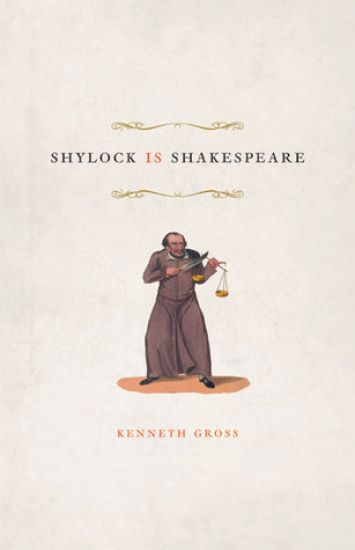
Shylock Is Shakespeare

Shylock Is Shakespeare

Kenneth Gross

University of Chicago Press
2006
sidottu
Shylock, the Jewish moneylender in The Merchant of Venice who famously demands a pound of flesh as security for a loan to his antisemitic tormentors, is one of Shakespeare’s most complex and idiosyncratic characters. With his unsettling eloquence and his varying voices of protest, play, rage, and refusal, Shylock remains a source of perennial fascination. What explains the strange and enduring force of this character, so unlike that of any other in Shakespeare’s plays? Kenneth Gross posits that the figure of Shylock is so powerful because he is the voice of Shakespeare himself. Marvelously speculative and articulate, Gross’s book argues that Shylock is a breakthrough for Shakespeare the playwright, an early realization of the Bard’s power to create dramatic voices that speak for hidden, unconscious, even inhuman impulses—characters larger than the plays that contain them and ready to escape the author’s control. Shylock is also a mask for Shakespeare’s own need, rage, vulnerability, and generosity, giving form to Shakespeare’s ambition as an author and his uncertain bond with the audience. Gross’s vision of Shylock as Shakespeare’s covert double leads to a probing analysis of the character’s peculiar isolation, ambivalence, opacity, and dark humor. Addressing the broader resonance of Shylock, both historical and artistic, Gross examines the character’s hold on later readers and writers, including Heinrich Heine and Philip Roth, suggesting that Shylock mirrors the ambiguous states of Jewishness in modernity. A bravura critical performance, Shylock Is Shakespeare will fascinate readers with its range of reference, its union of rigor and play, and its conjectural—even fictive—means of coming to terms with the question of Shylock, ultimately taking readers to the very heart of Shakespeare’s humanizing genius.
Shakespeare's Noise

Shakespeare's Noise

Kenneth Gross

University of Chicago Press
2001
sidottu
Kenneth Gross explores Shakespeare's deep fascination with dangerous and disorderly forms of speaking--especially rumor, slander, insult, vituperation, and curse--and through them offers a vision of the work of words in his plays. Coriolanus's taunts or Lear's curses force us to think not just about how Shakespeare's characters speak, but also about how they hear, overhear, and mishear what is spoken, how rumor becomes tragic knowledge for Hamlet, or opens Othello to fantastic jealousies. Gross also shows how Shakespeare's preoccupation with "noisy" speech echoed and transformed a broader cultural obsession with the perils of rumor, slander, and libel in Renaissance England.
Shakespeare's Noise

Shakespeare's Noise

Kenneth Gross

University of Chicago Press
2001
nidottu
Kenneth Gross explores Shakespeare's deep fascination with dangerous and disorderly forms of speaking--especially rumor, slander, insult, vituperation, and curse--and through them offers a vision of the work of words in his plays. Coriolanus's taunts or Lear's curses force us to think not just about how Shakespeare's characters speak, but also about how they hear, overhear, and mishear what is spoken, how rumor becomes tragic knowledge for Hamlet, or opens Othello to fantastic jealousies. Gross also shows how Shakespeare's preoccupation with "noisy" speech echoed and transformed a broader cultural obsession with the perils of rumor, slander, and libel in Renaissance England.
Rule Breaking and Political Imagination

Rule Breaking and Political Imagination

Kenneth A. Shepsle

University of Chicago Press
2017
sidottu
Imagination may be thought of as a 'work-around.' It is a resourceful tactic to 'undo' a rule by creating a path around it without necessarily defying it...Transgression, on the other hand, is rule breaking. There is no pretense of reinterpretation; it is defiance pure and simple. Whether imagination or disobedience is the source, constraints need not constrain, ties need not bind. So writes Kenneth A. Shepsle in his introduction to Rule Breaking and Political Imagination. Institutions are thought to channel the choices of individual actors. But what about when they do not? Throughout history, leaders and politicians have used imagination and transgression to break with constraints upon their agency. Shepsle ranges from ancient Rome to the United States Senate, and from Lyndon B. Johnson to the British House of Commons. He also explores rule breaking in less formal contexts, such as vigilantism in the Old West and the CIA's actions in the wake of 9/11. Entertaining and thought-provoking, Rule Breaking and Political Imagination will prompt a reassessment of the nature of institutions and remind us of the critical role of political mavericks.
Rule Breaking and Political Imagination

Rule Breaking and Political Imagination

Kenneth A. Shepsle

University of Chicago Press
2017
nidottu
Imagination may be thought of as a 'work-around.' It is a resourceful tactic to 'undo' a rule by creating a path around it without necessarily defying it...Transgression, on the other hand, is rule breaking. There is no pretense of reinterpretation; it is defiance pure and simple. Whether imagination or disobedience is the source, constraints need not constrain, ties need not bind. So writes Kenneth A. Shepsle in his introduction to Rule Breaking and Political Imagination. Institutions are thought to channel the choices of individual actors. But what about when they do not? Throughout history, leaders and politicians have used imagination and transgression to break with constraints upon their agency. Shepsle ranges from ancient Rome to the United States Senate, and from Lyndon B. Johnson to the British House of Commons. He also explores rule breaking in less formal contexts, such as vigilantism in the Old West and the CIA's actions in the wake of 9/11. Entertaining and thought-provoking, Rule Breaking and Political Imagination will prompt a reassessment of the nature of institutions and remind us of the critical role of political mavericks.
The Air-Line to Seattle

The Air-Line to Seattle

Kenneth S. Lynn

University of Chicago Press
1984
nidottu
In this controversial, wide-ranging, and fearlessly candid book, Kenneth S. Lynn argues that too many of our current commentators on the American past are out of touch with historical reality. His targets range from the currently fashionable but fantastic idea that the Declaration of Independence derives from a communitarian rather than individualistic philosophy to misinterpretations of the lives of Emerson, Walter Lippmann, Hemingway, and Max Perkins. In each case Lynn reveals the tendency of literary and intellectual historians to impose precooked formulas upon the evidence they profess to study.
The Star-Crossed Stone

The Star-Crossed Stone

Kenneth J. McNamara

University of Chicago Press
2010
sidottu
Throughout the four hundred thousand years that humanity has been collecting fossils, sea urchin fossils - or echinoids - have continually been among the most prized, from the Paleolithic era, when they decorated flint axes, to today, when paleobiologists study them for clues to the earth's history. In "The Star-Crossed Stone", Kenneth J. McNamara, an expert on fossil echinoids, takes readers on an incredible fossil hunt, with stops in history, paleontology, folklore, mythology, art, religion, and much more. Beginning with prehistoric times, when urchin fossils were used as jewelry, McNamara reveals how the fossil crept into the religious and cultural lives of societies around the world - the roots of the familiar five-pointed star, for example, can be traced to the pattern found on urchins. But McNamara's vision is even broader than that: using our knowledge of early habits of fossil collecting, he explores the evolution of the human mind itself, drawing striking conclusions about humanity's earliest appreciation of beauty and the first stirrings of artistic expression. Along the way, the fossil becomes a nexus through which we meet brilliant eccentrics and visionary archaeologists and develop new insights into topics as seemingly disparate as hieroglyphics, "Beowulf", and even church organs. An idiosyncratic celebration of science, nature, and human ingenuity, "The Star-Crossed Stone" is as charming and unforgettable as the fossil at its heart.
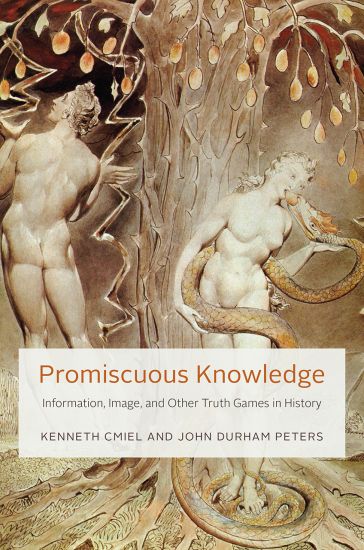
Promiscuous Knowledge

Promiscuous Knowledge

Kenneth Cmiel; John Durham Peters

University of Chicago Press
2019
sidottu
Sergey Brin, a cofounder of Google, once compared the perfect search engine to the "mind of God." As the modern face of promiscuous knowledge, however, Google's divine omniscience traffics indifferently in news, maps, weather, and porn. This book, begun by the late Kenneth Cmiel and completed by his close friend John Durham Peters, provides a genealogy of the information age from its early origins up to the reign of Google. It examines how we think about fact, image, and knowledge, centering on the different ways that claims of truth are complicated when they pass to a larger public. To explore these ideas, Cmiel and Peters focus on three main time periods--the late nineteenth century, 1925 to 1945, and 1975 to 2000, with constant reference to the present. Cmiel's original text examines the collapse he saw in the growing gulf between politics and aesthetics in postmodern architecture, the distancing of images from everyday life in magical realist cinema, the waning support for national betterment through taxation, and the inability of a single presentational strategy to contain the social whole. Peters brings Cmiel's study into the present moment, providing the backstory to current controversies over filter-bubbles, echo chambers, and "fake news." A hybrid work from two innovative thinkers, Promiscuous Knowledge is an enlightening contribution to our understanding of the internet and the profuse visual culture of our time.
Discovery and Explanation in Biology and Medicine

Discovery and Explanation in Biology and Medicine

Kenneth F. Schaffner

University of Chicago Press
1994
sidottu
Kenneth F. Schaffner compares the practice of biological and medical research and shows how traditional topics in philosophy of science--such as the nature of theories and of explanation--can illuminate the life sciences. While Schaffner pays some attention to the conceptual questions of evolutionary biology, his chief focus is on the examples that immunology, human genetics, neuroscience, and internal medicine provide for examinations of the way scientists develop, examine, test, and apply theories. Although traditional philosophy of science has regarded scientific discovery--the questions of creativity in science--as a subject for psychological rather than philosophical study, Schaffner argues that recent work in cognitive science and artificial intelligence enables researchers to rationally analyze the nature of discovery. As a philosopher of science who holds an M.D., he has examined biomedical work from the inside and uses detailed examples from the entire range of the life sciences to support the semantic approach to scientific theories, addressing whether there are "laws" in the life sciences as there are in the physical sciences. Schaffner's novel use of philosophical tools to deal with scientific research in all of its complexity provides a distinctive angle on basic questions of scientific evaluation and explanation.
Discovery and Explanation in Biology and Medicine

Discovery and Explanation in Biology and Medicine

Kenneth F. Schaffner

University of Chicago Press
1994
nidottu
Kenneth F. Schaffner compares the practice of biological and medical research and shows how traditional topics in philosophy of science—such as the nature of theories and of explanation—can illuminate the life sciences. While Schaffner pays some attention to the conceptual questions of evolutionary biology, his chief focus is on the examples that immunology, human genetics, neuroscience, and internal medicine provide for examinations of the way scientists develop, examine, test, and apply theories. Although traditional philosophy of science has regarded scientific discovery—the questions of creativity in science—as a subject for psychological rather than philosophical study, Schaffner argues that recent work in cognitive science and artificial intelligence enables researchers to rationally analyze the nature of discovery. As a philosopher of science who holds an M.D., he has examined biomedical work from the inside and uses detailed examples from the entire range of the life sciences to support the semantic approach to scientific theories, addressing whether there are "laws" in the life sciences as there are in the physical sciences. Schaffner's novel use of philosophical tools to deal with scientific research in all of its complexity provides a distinctive angle on basic questions of scientific evaluation and explanation.
Children of Alcoholics

Children of Alcoholics

Kenneth J. Sher

University of Chicago Press
1991
sidottu
This study offers a comprehensive, critical look at what is known and not known about children of alcoholics, and also constructs a model for assessing existing theory and introducing new methodological rigor into this field.
Dangerous Children

Dangerous Children

Kenneth Gross

THE UNIVERSITY OF CHICAGO PRESS
2022
sidottu
Gross explores our complex fascination with uncanny children in works of fiction. Ranging from Victorian to modern works—Lewis Carroll’s Alice in Wonderland, Carlo Collodi’s Pinocchio, Henry James’s What Maisie Knew, J. M. Barrie’s Peter and Wendy, Franz Kafka’s “The Cares of a Family Man,” Richard Hughes’s A High Wind in Jamaica, Elizabeth Bowen’s The Death of the Heart, and Vladimir Nabokov’s Lolita—Kenneth Gross’s book delves into stories that center around the figure of a strange and dangerous child. Whether written for adults or child readers, or both at once, these stories all show us odd, even frightening visions of innocence. We see these children’s uncanny powers of speech, knowledge, and play, as well as their nonsense and violence. And, in the tales, these child-lives keep changing shape. These are children who are often endangered as much as dangerous, haunted as well as haunting. They speak for lost and unknown childhoods. In looking at these narratives, Gross traces the reader’s thrill of companionship with these unpredictable, often solitary creatures—children curious about the adult world, who while not accommodating its rules, fall into ever more troubling conversations with adult fears and desires. This book asks how such imaginary children, objects of wonder, challenge our ways of seeing the world, our measures of innocence and experience, and our understanding of time and memory.