Kirjojen hintavertailu. Mukana 11 627 220 kirjaa ja 12 kauppaa.

Kirjahaku

Etsi kirjoja tekijän nimen, kirjan nimen tai ISBN:n perusteella.

1000 tulosta hakusanalla Matthew Alan Gaumer

Culture and Anarchy: An Essay in Political and Social Criticism (1894) By: Matthew Arnold
"Matthew Arnold (24 December 1822 - 15 April 1888) was an English poet and cultural critic who worked as an inspector of schools.... In 1852, Arnold published his second volume of poems, Empedocles on Etna, and Other Poems. In 1853, he published Poems: A New Edition, a selection from the two earlier volumes famously excluding "Empedocles on Etna", but adding new poems, "Sohrab and Rustum" and "The Scholar Gipsy". In 1854, Poems: Second Series appeared; also a selection, it included the new poem, "Balder Dead". Arnold was elected Professor of Poetry at Oxford in 1857. He was the first to deliver his lectures in English rather than Latin. He was re-elected in 1862. On Translating Homer (1861) and the initial thoughts that Arnold would transform into Culture and Anarchy were among the fruits of the Oxford lectures. In 1859, he conducted the first of three trips to the continent at the behest of parliament to study European educational practices. He self-published The Popular Education of France (1861), the introduction to which was later published under the title "Democracy" (1879).
Matthew Commentary: Origins of the Natural Laws of Human Behavior

Matthew Commentary: Origins of the Natural Laws of Human Behavior

H. L. Heckel III

Createspace Independent Publishing Platform
2017
nidottu
According to biology and Darwin, for a species to have survived in nature, each individual must be able to react positively to its environment. If that is the way we are made, shouldn't each individual do this best, so that they maximize their quality of life, given their situation? If we are designed by God, wouldn't there be rules on how to do this and wouldn't he have given us these rules? This commentary proposes that Jesus gave humans the Natural Laws of Human Behavior and these maximize the individual's quality of life given their situation. Biology and the social sciences are used to explain why these rules maximize the individual's quality of life, thus proving they are natural laws (and thus giving a scientific proof that Jesus is God). This is a teaching approach to explain the benefit of what Jesus taught. Each set of verses with the words of Jesus is followed with one or more explanations, so that this book can be read as a whole or just particular verses with their comments. There is mention of spirituality in this commentary, but generally it is to point out that if we have scientifically proven Jesus is God, then all the spiritual references have to be true. The author was born in 1945. His mother was a religion major and his father had a PhD in chemistry and did not believe in "superstition". The author majored in political science and earned his living as a computer applications programmer and systems analyst. He is the author of Man and Security.
Matthew Yancey

Matthew Yancey

Morris Fenris

Independently Published
2017
pokkari
A Western romance readers can't put down.If you enjoy engaging characters, heart-wrenching twists and turns, and fast-paced action, then you will love this novel.As the child of a Mexican father and a Cherokee mother, Goldenstar Mendoza has known the stigma of being called "Half-breed" since childhood. As an adult, selling her parents' stock of homemade commodities in 1861 San Francisco, she has dealt with being shunned by women; and with being intimidated and harassed by men.This is very apparent with Franklin Bower, a wealthy rancher who has set his sights on installing Star at his Condor Ranch. He wants her, and he doesn't care how he gets her.While Star has detractors, she also has defenders: close friend Frances Goddard, and her brother, William, sheriff of San Francisco. Also a new friend, Sarah Coleman, governess for five-year-old Rob Yancey and housekeeper for his widowed father, Matthew.Recently, Texas Ranger Matt and his son had arrived in San Francisco to attend the wedding of his brother, John, and stayed on at the request of Sheriff Goddard. Matt can't help being attracted to beautiful Star, and she to him.Their dinner together with the Goddards and a walk home afterward results in a setback to their fledgling relationship, however, when Matt overplays his hand. A quick good-night kiss turns into serious lovemaking.Stunned by her own response, agitated by his advances-as if, given her background, she were just one more floozy to be taken advantage of-she flees inside and refuses to hear his apologies.Eventually, defeated, frustrated, he heads for home. Tomorrow, when both have cooled down, he will try again.Tomorrow sets up a whole different mix of problems.At mid-morning, Franklin Bower arrives. By revealing that he holds a secret about Adsila Mendoza, Star's mother, and will use it to have her jailed, he blackmails the girl into leaving with him for the Condor.There, he forces his former bedmate, Raquel, to tend his new lady. Despite the servant's resentment, she and Star bond when she eventually reveals that she, too, has been blackmailed; her brother, Benito, was taken as a slave to work in Bower's silver mine.Star allows him to drag her back to the bedroom. Just as he is ready for his seduction, she whips the hunting knife out and slashes him, twice. Roaring, bleeding, he starts toward her, only to collapse on the floor: Raquel has cracked him over the head.While they are able to escape, Bower comes back to life far sooner than they had expected; he and his cowboys hunt them down. No more messing around. This time, Star will be sold to Suarez, a bandito leader.Meanwhile, Matt and Frances, all unknowing of the danger Star is in, have paid a visit to her mother, finding out the facts of Adsila's past and Star's disappearance.Back in town, Matt loads up his horse and heads south, tracking the bandito leader to his lair. He is able to rescue Star, and they flee, but the gang follows. The pair is forced to hole up in a shack and battle it out, guns blazing. During one quiet interim, Matt admits his love for her, and she for him.In the middle of another barrage, help arrives: Sheriff Goddard and his posse. Loose ends are tied up on the scene; others later on, with a side trip to the Condor to rescue Raquel and find that Bower had been killed by his outlaw compatriot.Another longer trip, with more lawmen, to the Sierra Nevada silver mine, frees the slaves and reunites Benito with his sister.Matt returns wounded, but not too badly to wed his bride a few weeks later, in a ceremony for which all the Yancey brothers have gathered.♥♥♥For a page-turning Western romance you DEFINITELY can't put down, read this book today.♥♥♥
Matthew and Empire

Matthew and Empire

Warren Carter

Continuum International Publishing Group - Trinity
2001
nidottu
Although New Testament scholars have examined Paul's writings and their relationship to the Roman empire and its imperial policies and writings, they have focused little attention on ways in which the Gospels were influenced by that imperialism. In Matthew and Empire, Warren Carter argues that Matthew's Gospel protests Roman imperialism by asserting that God's purposes and will are performed not by the empire and emperor but by Jesus and his community of disciples. Matthew and Empire makes the claim for reading Matthew in this way against the almost exclusive emphasis on the relationship with the synagogue that has long been a staple of Matthean criticism. Carter establishes Matthew's imperial context by examining Roman imperial ideology and material presence in Antioch, the traditional provenance for Matthew. He argues that Matthean Christology, which presents Jesus as God's agent, is shaped by claims and protests against those claims that the emperor and empire are agents of God. In successive chapters Carter pays particular attention to the Gospel's central irony, namely that in depicting God's ways and purposes, the Gospel employs the very imperial framework that it resists. Matthew and Empire challenges traditional readings of Matthew and Empire encourages fresh perspectives in Matthean scholarship. Warren Carter is Pherigo Professor of New Testament at Saint Paul School of Theology and author of Matthew and the Margins: A Socio-Political and Religious Reading.
Matthew J. Perry

Matthew J. Perry

University of South Carolina Press
2004
sidottu
Matthew J. Perry: The Man, His Times, and His Legacy chronicles the life and accomplishments of the attorney who led the struggle for desegregation in South Carolina, served as a primary legal advocate in the national civil rights movement, and became South Carolina's first African American U.S. District Court judge. In this volume, scholars of the civil rights era, fellow civil rights activists, jurists, attorneys, a governor, and an award-winning photojournalist join together to produce a multilayered biography of Matthew J. Perry. Collectively they bring to light the remarkable achievements of a man well known in his home state but sometimes obscured on the national stage by the shadows of Thurgood Marshall, J. Waties Waring, and Charles Hamilton Houston. This volume tells the story of Perry's life, including his humble beginnings in Columbia, his service to the nation during wartime, his remarkable career as a creator of positive social change, and, finally, his achievements as a respected member of the federal judiciary. The contributors describe Perry's courage, skills as an orator, quick legal mind, and genteel nature. They set his story in the turbulent civil-rights-era South, revealing how broad social, historical, and legal issues affected Perry's life and shaped the trajectory of his activist and professional life. The volume underscores how Perry enabled his home state to escape from Jim Crow's clutches with much less turmoil than many of its neighbors. Published in concert with the dedication of the Matthew J. Perry, Jr. United States Courthouse in Columbia, South Carolina, this life story portrays an esteemed juror whose grace and resiliency led South Carolina into the twentieth century.
Matthew Pillsbury
Matthew Pillsbury: City Stages offers a paean to the craft and visionary potential of large- format, black-and-white photography as well as to the vibrancy of the cultural landscape at a transitional moment—a moment in which our very relationship to that landscape is increas - ingly mediated by omnipresent screens. Over the past decade, Pillsbury has built several extensive bodies of work—Screen Lives, Hours, and City Stages—that deal with different facets of contemporary metropolitan life and the passage of time. Working with black-and-white 8-by-10 film and long exposures, Pillsbury captures a range of psychologically charged experiences in the urban environment, from isolation—tuned into the omnipresent screens of our tablets, laptops, televisions, and phones—to crowded museums, parades, cathedrals, and even protests. Working primarily in New York but with forays to Paris, London, Venice, and other sites, the precise and concrete rendering of cityscapes, iconic landmarks, and interior spaces in his images provides a stage-like setting for the performance of human activity. Thanks to the extended exposures—some as long as an hour—the actions of both individuals and crowds are blurred and transformed into pure gesture and energy. As writer Karl E. Johnson comments on the work, “For Pillsbury, the act of seeing appears to double as a performance, if no more than the performance of life enacted in various spaces and timeframes.” This monograph gathers for the first time selections from all three bodies of work, and spans ten years of the artist’s output.
Correspondence of Matthew Parker, Archbishop of Canterbury
The Parker Society was the London-based Anglican society that printed in fifty-four volumes the works of the leading English Reformers of the sixteenth century. It was formed in 1840 and disbanded in 1855 when its work was completed. Named after Matthew Parker -- the first Elizabethan Archbishop of Canterbury, who was known as a great collector of books -- the stimulus for the foundation of the society was provided by the Tractarian movement, led by John Henry Newman and Edward B. Pusey. Some members of this movement spoke disparagingly of the English Reformation, and so some members of the Church of England felt the need to make available in an attractive form the works of the leaders of that Reformation.
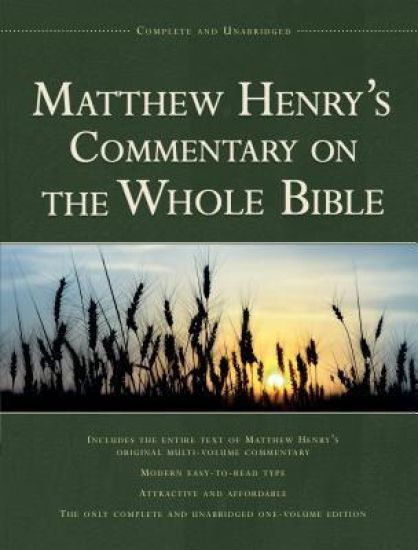
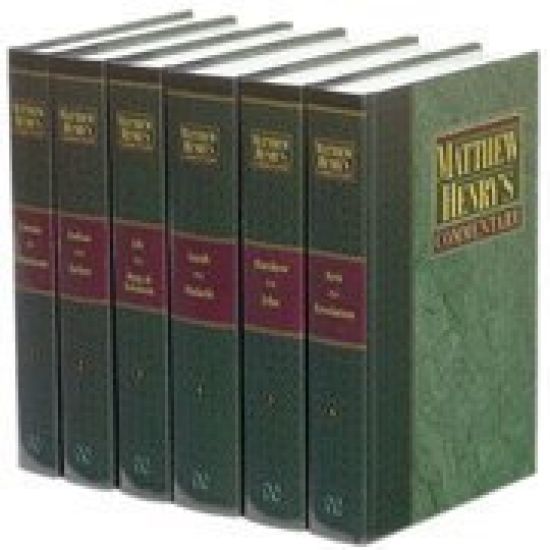
Matthew Henry's Commentary on the Whole Bible

Matthew Henry's Commentary on the Whole Bible

Michael Henry

Hendrickson Publishers Inc
2008
sidottu
This is the only complete and unabridged one-volume edition of Matthew Henry's famous work.Now, this classic volume has been re-typset and features a slimmer and handier trim size and an attractive new cover."First among the mighty (commentaries) for general usefulness we are bound to mention the man whose name is a household word, Matthew Henry. He is the most pious and pithy, sound and sensible, suggestive and sober, terse and trustworthy . . . he is deeply spiritual, heavenly, profitable; finding good matter in every text, and from all deducting the most practical and judicious lessons . . . It is the Christian's companion, suitable to everybody, instructive to all."--Charles H. SpurgeonFrom Genesis to Revelation, Matthew Henry successfully combines practical application, devotional insight, and scholarship on the entire Bible. Henry has profound insights on the content, message and nature of God's divine revelation. Perfect for all readers of the Bible who want a convenient, comprehensive commentary.- Includes the entire text of Matthew Henry's original multi-volume commentary- Modern easy-to-read type- Portable- Attractive and affordable
Matthew Henry's Commentary on the Whole Bible, Complete 6-Volume Set

Matthew Henry's Commentary on the Whole Bible, Complete 6-Volume Set

Professor Matthew Henry

Hendrickson Publishers Inc
2009
sidottu
The Most Popular Commentary Ever Written in a Modern, Easy-to-Read Edition."First among the mighty (commentaries) for general usefulness we are bound to mention the man whose name is a household word, Matthew Henry. He is the most pious and pithy, sound and sensible, suggestive and sober, terse and trustworthy . . . he is deeply spiritual, heavenly, profitable; finding good matter in every text, and from all deducting the most practical and judicious lessons . . . It is the Christian's companion, suitable to everybody, instructive to all."--Charles H. SpurgeonFrom Genesis to Revelation, Matthew Henry successfully combines practical application, devotional insight, and scholarship on the entire Bible. Henry has profound insights on the content, message and nature of God's divine revelation. Perfect for all readers of the Bible who want a comprehensive commentary.- Modern easy-to-read modern type with Scripture passages in bold- Complete and unabridged in 6 volumes- Includes The Life of Matthew Henry by J. B. Williams- Entirely faithful to the original
Matthew -- Journible The 17:18 Series

Matthew -- Journible The 17:18 Series

Robert J. Wynalda

Reformation Heritage Books
2014
sidottu
Why the 17:18 series? In Deuteronomy 17, Moses is leaving final instructions concerning the future of Israel. As a prophet of God, Moses foretells of when Israel will place a king over the nation (v. 14). In verse 18, the king is commanded to not simply acquire a copy of the law (the entire book of Deuteronomy) from the "scroll publishing house," but to hand write his own copy of the law. Thirty-four hundred years later, educators are "discovering" that students that physically write out their notes by hand have a much greater retention rate than simply hearing or visually reading the information. Apparently, God knew this to be true of the kings of Israel also. From such understanding came the conception of this series of books.
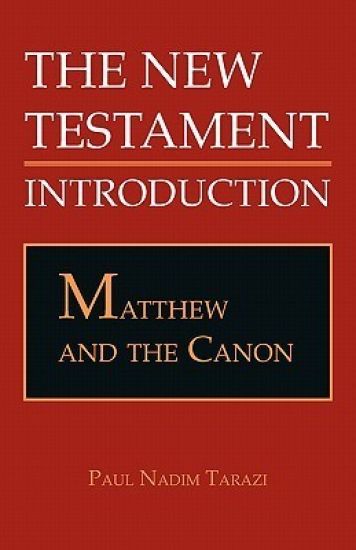
Matthew and the Canon

Matthew and the Canon

Paul Nadim Tarazi

Ocabs Press
2009
pokkari
This is the fourth and final volume of Fr. Tarazi's New Testament introduction tetralogy. In addition to his exegesis on the Book of Matthew, Fr. Tarazi discusses the formation of the New Testament canon and the Gospel of Matthew, which he argues was intentionally written as the closing book within this canon."Fr. Tarazi's application of his investigative, creative, kerygmatic, canon exegesis has generated a manuscript filled with unique interpretations and bold positions on the Gospel according to Matthew and on the New Testament canon."John Fotopoulos, Ph.D.Associate Professor of New Testament and Early Christian LiteratureSaint Mary's College, Notre Dame"Matthew and the Canon is the crowning achievement of the New Testament series...As in the preceding volumes, Tarazi does not offer a conventional introduction to Matthew, but rather comments on each pericope with precise exegetical notes. By doing this, Tarazi allows his reader to be introduced to the Gospel text, rather than to the latest theories of modern criticism."Daniel Alberto AyuchAssociate Professor of New TestamentUniversity of Balamand The V. Rev. Dr. Paul Nadim Tarazi is Professor of Biblical Studies and Languages at St. Vladimir's Orthodox Theological Seminary. He is the author of three previously published volumes to the New Testament introduction series, a three-volume introduction to the Old Testament, Galatians: A Commentary, and 1 Thessalonians: A Commentary. His audio bible commentaries on the books of the New Testament are available online through The Orthodox Center for the Advancement of Biblical Studies (OCABS).
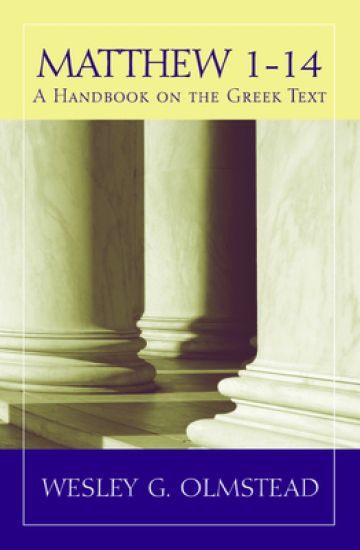
Matthew 1-14

Matthew 1-14

Wesley G. Olmstead

Baylor University Press
2019
nidottu
In Matthew 1-14: A Handbook on the Greek Text Wesley Olmstead provides a foundational analysis of the Greek text of Matthew 1-14. The analysis is distinguished by the detailed yet comprehensive attention paid to the text. Olmstead's analysis is a convenient pedagogical and reference tool that explains the form and syntax of the biblical text, offers guidance for deciding between competing semantic analyses, engages important text-critical debates, and addresses questions relating to the Greek text that are frequently overlooked or ignored by standard commentaries. Beyond serving as a succinct and accessible analytic key, Matthew 1-14 also reflects the most up-to-date advances in scholarship on Greek grammar and linguistics. This handbook proves itself an indispensable tool for anyone committed to a deep reading of the biblical text.