Kirjojen hintavertailu. Mukana 11 985 645 kirjaa ja 12 kauppaa.

Kirjahaku

Etsi kirjoja tekijän nimen, kirjan nimen tai ISBN:n perusteella.

1000 tulosta hakusanalla Meta Lander

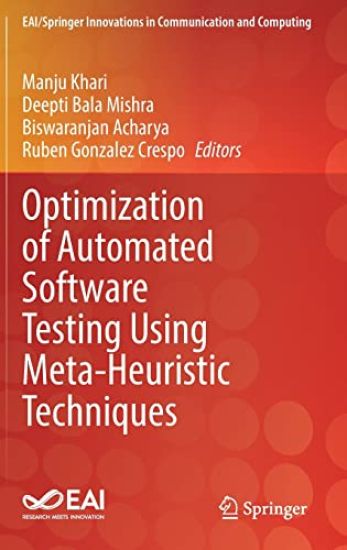
Optimization of Automated Software Testing Using Meta-Heuristic Techniques
This book provides awareness of different evolutionary methods used for automatic generation and optimization of test data in the field of software testing. While the book highlights on the foundations of software testing techniques, it also focuses on contemporary topics for research and development. This book covers the automated process of testing in different levels like unit level, integration level, performance level, evaluation of testing strategies, testing in security level, optimizing test cases using various algorithms, and controlling and monitoring the testing process etc. This book aids young researchers in the field of optimization of automated software testing, provides academics with knowledge on the emerging field of AI in software development, and supports universities, research centers, and industries in new projects using AI in software testing.?Supports the advancement in the artificial intelligence used in software development;Advances knowledge on artificial intelligence based metaheuristic approach in software testing;Encourages innovation in traditional software testing field using recent artificial intelligence.·
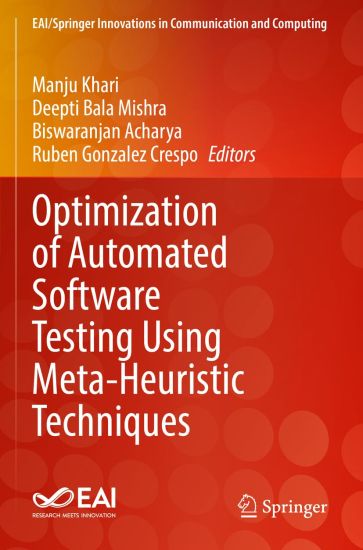
Optimization of Automated Software Testing Using Meta-Heuristic Techniques
This book provides awareness of different evolutionary methods used for automatic generation and optimization of test data in the field of software testing. While the book highlights on the foundations of software testing techniques, it also focuses on contemporary topics for research and development. This book covers the automated process of testing in different levels like unit level, integration level, performance level, evaluation of testing strategies, testing in security level, optimizing test cases using various algorithms, and controlling and monitoring the testing process etc. This book aids young researchers in the field of optimization of automated software testing, provides academics with knowledge on the emerging field of AI in software development, and supports universities, research centers, and industries in new projects using AI in software testing.?Supports the advancement in the artificial intelligence used in software development;Advances knowledge on artificial intelligence based metaheuristic approach in software testing;Encourages innovation in traditional software testing field using recent artificial intelligence.·
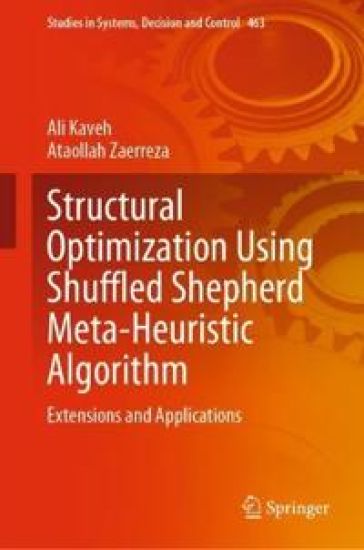
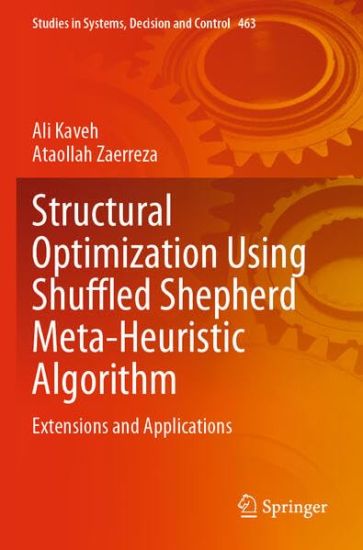
Structural Optimization Using Shuffled Shepherd Meta-Heuristic Algorithm

Structural Optimization Using Shuffled Shepherd Meta-Heuristic Algorithm

Ali Kaveh; Ataollah Zaerreza

Springer International Publishing AG
2023
sidottu
This book presents the so-called Shuffled Shepherd Optimization Algorithm (SSOA), a recently developed meta-heuristic algorithm by authors. There is always limitations on the resources to be used in the construction. Some of the resources used in the buildings are also detrimental to the environment. For example, the cement utilized in making concrete emits carbon dioxide, which contributes to the global warming. Hence, the engineers should employ resources efficiently and avoid the waste. In the traditional optimal design methods, the number of trials and errors used by the designer is limited, so there is no guarantee that the optimal design can be found for structures. Hence, the deigning method should be changed, and the computational algorithms should be employed in the optimum design problems. The gradient-based method and meta-heuristic algorithms are the two different types of methods used to find the optimal solution. The gradient-based methods require gradientinformation. Also, these can easily be trapped in the local optima in the nonlinear and complex problems. Therefore, to overcome these issues, meta-heuristic algorithms are developed. These algorithms are simple and can get out of the local optimum by easy means. However, a single meta-heuristic algorithm cannot find the optimum results in all types of optimization problems. Thus, civil engineers develop different meta-heuristic algorithms for their optimization problems. Different applications of the SSOA are provided. The simplified and enhanced versions of the SSOA are also developed and efficiently applied to various optimization problems in structures. Another special feature of this book consists of the use of graph theoretical force method as analysis tool, in place of traditional displacement approach. This has reduced the computational time to a great extent, especially for those structures having smaller DSI compared to the DKI. New framework is also developed for reliability-based design of frame structures. The algorithms are clearly stated such that they can simply be implemented and utilized in practice and research.
Structural Optimization Using Shuffled Shepherd Meta-Heuristic Algorithm

Structural Optimization Using Shuffled Shepherd Meta-Heuristic Algorithm

Ali Kaveh; Ataollah Zaerreza

Springer International Publishing AG
2024
nidottu
This book presents the so-called Shuffled Shepherd Optimization Algorithm (SSOA), a recently developed meta-heuristic algorithm by authors. There is always limitations on the resources to be used in the construction. Some of the resources used in the buildings are also detrimental to the environment. For example, the cement utilized in making concrete emits carbon dioxide, which contributes to the global warming. Hence, the engineers should employ resources efficiently and avoid the waste. In the traditional optimal design methods, the number of trials and errors used by the designer is limited, so there is no guarantee that the optimal design can be found for structures. Hence, the deigning method should be changed, and the computational algorithms should be employed in the optimum design problems. The gradient-based method and meta-heuristic algorithms are the two different types of methods used to find the optimal solution. The gradient-based methods require gradientinformation. Also, these can easily be trapped in the local optima in the nonlinear and complex problems. Therefore, to overcome these issues, meta-heuristic algorithms are developed. These algorithms are simple and can get out of the local optimum by easy means. However, a single meta-heuristic algorithm cannot find the optimum results in all types of optimization problems. Thus, civil engineers develop different meta-heuristic algorithms for their optimization problems. Different applications of the SSOA are provided. The simplified and enhanced versions of the SSOA are also developed and efficiently applied to various optimization problems in structures. Another special feature of this book consists of the use of graph theoretical force method as analysis tool, in place of traditional displacement approach. This has reduced the computational time to a great extent, especially for those structures having smaller DSI compared to the DKI. New framework is also developed for reliability-based design of frame structures. The algorithms are clearly stated such that they can simply be implemented and utilized in practice and research.
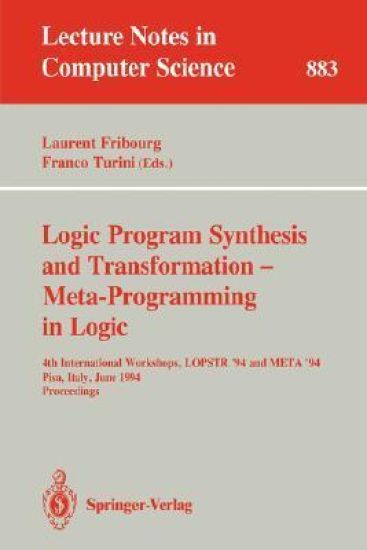
Logic Program Synthesis and Transformation - Meta-Programming in Logic

Logic Program Synthesis and Transformation - Meta-Programming in Logic

Springer-Verlag Berlin and Heidelberg GmbH Co. K
1994
nidottu
This volume constitutes the combined proceedings of the 4th International Workshops on Logic Program Synthesis and Transformation (LOPSTR '94) and on Meta-Programming (META '94), held jointly in Pisa, Italy in June 1994.This book includes thoroughly revised versions of the best papers presented at both workshops. The main topics addressed by the META papers are language extensions in support of meta-logic, semantics of meta-logic, implementation of meta-logic features, performance of meta-logic, and several applicational aspects. The LOPSTR papers are devoted to unfolding/folding, partial deduction, proofs as programs, inductive logic programming, automated program verification, specification and programming methodologies.