Kirjojen hintavertailu. Mukana 12 016 292 kirjaa ja 12 kauppaa.

Kirjahaku

Etsi kirjoja tekijän nimen, kirjan nimen tai ISBN:n perusteella.

890 tulosta hakusanalla Michaelangelo Rodriguez

The Drawing School for Little Masters and Misses

The Drawing School for Little Masters and Misses

Michael Angelo

Gale Ecco, Print Editions
2018
sidottu
The 18th century was a wealth of knowledge, exploration and rapidly growing technology and expanding record-keeping made possible by advances in the printing press. In its determination to preserve the century of revolution, Gale initiated a revolution of its own: digitization of epic proportions to preserve these invaluable works in the largest archive of its kind. Now for the first time these high-quality digital copies of original 18th century manuscripts are available in print, making them highly accessible to libraries, undergraduate students, and independent scholars.The eighteenth-century fascination with Greek and Roman antiquity followed the systematic excavation of the ruins at Pompeii and Herculaneum in southern Italy; and after 1750 a neoclassical style dominated all artistic fields. The titles here trace developments in mostly English-language works on painting, sculpture, architecture, music, theater, and other disciplines. Instructional works on musical instruments, catalogs of art objects, comic operas, and more are also included. ++++The below data was compiled from various identification fields in the bibliographic record of this title. This data is provided as an additional tool in helping to insure edition identification: ++++British LibraryT089124Michael Angelo is a pseudonym. The titlepage is engraved.London: printed for T. Carnan, 1774. 4],106p., plate: ill., port.; 18
The Drawing School for Little Masters and Misses

The Drawing School for Little Masters and Misses

Michael Angelo

Gale Ecco, Print Editions
2018
sidottu
The 18th century was a wealth of knowledge, exploration and rapidly growing technology and expanding record-keeping made possible by advances in the printing press. In its determination to preserve the century of revolution, Gale initiated a revolution of its own: digitization of epic proportions to preserve these invaluable works in the largest archive of its kind. Now for the first time these high-quality digital copies of original 18th century manuscripts are available in print, making them highly accessible to libraries, undergraduate students, and independent scholars.The eighteenth-century fascination with Greek and Roman antiquity followed the systematic excavation of the ruins at Pompeii and Herculaneum in southern Italy; and after 1750 a neoclassical style dominated all artistic fields. The titles here trace developments in mostly English-language works on painting, sculpture, architecture, music, theater, and other disciplines. Instructional works on musical instruments, catalogs of art objects, comic operas, and more are also included. ++++The below data was compiled from various identification fields in the bibliographic record of this title. This data is provided as an additional tool in helping to insure edition identification: ++++Harvard University Houghton LibraryN007812Michael Angelo is a pseudonym. Sometimes attributed to Richard Johnson. The titlepage is engraved.London: printed for T. Carnan, 1777. 2],108p., plate: ill., port.; 24
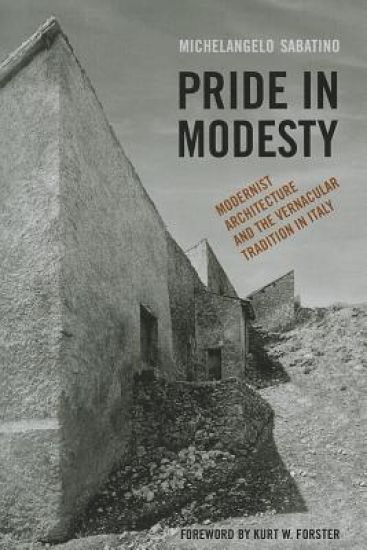
Pride in Modesty

Pride in Modesty

Michelangelo Sabatino

University of Toronto Press
2011
pokkari
Following Italy's unification in 1861, architects, artists, politicians, and literati engaged in volatile debates over the pursuit of national and regional identity. Growing industrialization and urbanization across the country contrasted with the rediscovery of traditionally built forms and objects created by the agrarian peasantry. Pride in Modesty argues that these ordinary, often anonymous, everyday things inspired and transformed Italian art and architecture from the 1920s through the 1970s. Through in-depth examinations of texts, drawings, and buildings, Michelangelo Sabatino finds that the folk traditions of the pre-industrial countryside have provided formal, practical, and poetic inspiration directly affecting both design and construction practices over a period of sixty years and a number of different political regimes. This surprising continuity allows Sabatino to reject the division of Italian history into sharply delimited periods such as Fascist Interwar and Democratic Postwar and to instead emphasize the long, continuous process that transformed pastoral and urban ideals into a new, modernist Italy.