Kirjojen hintavertailu. Mukana 11 717 486 kirjaa ja 12 kauppaa.

Kirjahaku

Etsi kirjoja tekijän nimen, kirjan nimen tai ISBN:n perusteella.

1000 tulosta hakusanalla Neil Christopher

The Neuropsychology of Anxiety

The Neuropsychology of Anxiety

Neil McNaughton; Jeffrey A. Gray

Oxford University Press
2024
sidottu
The Neuropsychology of Anxiety first appeared in 1982 as the first volume in the Oxford Psychology Series, and it quickly established itself as a classic work in the psychology and neuroscience literature. It presented an innovative, and at times controversial, theory of anxiety and the brain systems, especially the septo-hippocampal system, that subserve it. This completely updated and revised third edition provides a further updated theory of septo hippocampal function combined with an improved understanding of anxiety. The book includes a new chapter on prefrontal cortex integrating frontal and hippocampal views of anxiety, as well as an extensively modified chapter on personality providing a new basis for further developments of Reinforcement Sensitivity Theory. In addition, numerous figures have been fully updated and converted to colour to support the text. This book is essential for postgraduate students and researchers in experimental psychology and neuroscience, as well as for all clinical psychologists and psychiatrists.
Asymmetric Killing

Asymmetric Killing

Neil C. Renic

Oxford University Press
2020
sidottu
This book offers an engaging and historically informed account of the moral challenge of radically asymmetric violence -- warfare conducted by one party in the near-complete absence of physical risk, across the full scope of a conflict zone. What role does physical risk and material threat play in the justifications for killing in war? And crucially, is there a point at which battlefield violence becomes so one-directional as to undermine the moral basis for its use? In order to answers these questions, Asymmetric Killing delves into the morally contested terrain of the warrior ethos and Just War Tradition, locating the historical and contemporary role of reciprocal risk within both. This book also engages two historical episodes of battlefield asymmetry, military sniping and manned aerial bombing. Both modes of violence generated an imbalance of risk between opponents so profound as to call into question their permissibility. These now-resolved controversies will then be contrasted with the UAV-exclusive violence of the United States, robotic killing conducted in the absence of a significant military ground presence in conflict theatres such as Pakistan, Yemen, and Somalia. As will be revealed, the radical asymmetry of this latter case is distinct, undermining reciprocal risk at the structural level of war. Beyond its more resolvable tension with the warrior ethos, UAV-exclusive violence represents a fundamental challenge to the very coherence of the moral justifications for killing in war.
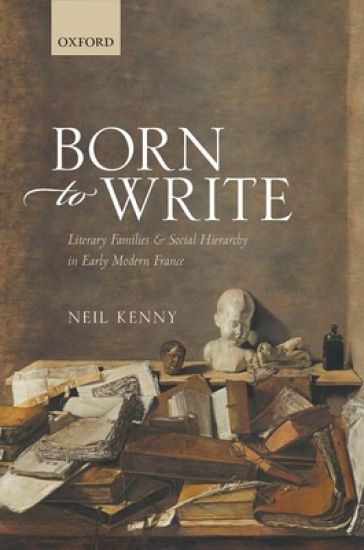
Born to Write

Born to Write

Neil Kenny

Oxford University Press
2020
sidottu
It is easy to forget how deeply embedded in social hierarchy was the literature and learning that has come down to us from the early modern European world. From fiction to philosophy, from poetry to history, works of all kinds emerged from and through the social hierarchy that was a fundamental fact of everyday life. Paying attention to it changes how we might understand and interpret the works themselves, whether canonical and familiar or largely forgotten. But a second, related fact is much overlooked too: works also often emanated from families, not just from individuals. Families were driving forces in the production--that is, in the composing, editing, translating, or publishing--of countless works. Relatives collaborated with each other, edited each other, or continued the unfinished works of deceased family members; some imitated or were inspired by the works of long-dead relatives. The reason why this second fact (about families) is connected to the first (about social hierarchy) is that families were in the period a basic social medium through which social status was claimed, maintained, threatened, or lost. So producing literary works was one of the many ways in which families claimed their place in the social world. The process was however often fraught, difficult, or disappointing. If families created works as a form of socio-cultural legacy that might continue to benefit their future members, not all members benefited equally; women sometimes produced or claimed the legacy for themselves, but they were often sidelined from it. Relatives sometimes disagreed bitterly about family history, identity (not least religious), and so about the picture of themselves and their family that they wished to project more widely in society through their written works, whether printed or manuscript. So although family was a fundamental social medium out of which so many works emerged, that process could be conflictual as well as harmonious. The intertwined role of family and social hierarchy within literary production is explored in this book through the case of France, from the late fifteenth to the mid-seventeenth century. Some families are studied here in detail, such as that of the most widely read French poet of the age, Clément Marot. But the extent of this phenomenon is quantified too: some two hundred families are identified as each containing more than one literary producer, and in the case of one family an extraordinary twenty-seven.
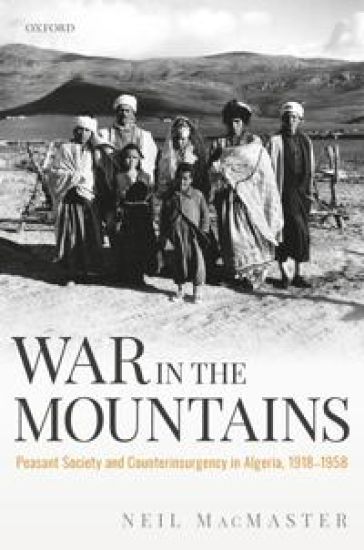
War in the Mountains

War in the Mountains

Neil Macmaster

Oxford University Press
2020
sidottu
The role of the peasantry during the Algerian War of Independence (1954-1962) has long been neglected by historians, in part because they have been viewed as a 'primitive' mass devoid of political consciousness. War in the Mountains: Peasant Society and Counterinsurgency in Algeria, 1918-1958 challenges this conventional understanding by tracing the ability of the peasant community to sustain an autonomous political culture through family, clan, and village assemblies. The long-established system of indirect rule by which the colonial state controlled and policed the vast mountainous interior of Algeria began to break down after the 1920s. War in the Mountains explains how competing guerrilla forces and the French military sought to harness djemâas as part of a hearts-and-minds strategy. Djemâas formed a pole of opposition to the patron-client relations of the rural élites, with clandestine urban-rural networks emerging that prepared the way for armed resistance and a system of rebel governance. Contrary to accepted historical analysis suggesting that rural society was massively uprooted and dislocated, War in the Mountains demonstrates that the peasantry demonstrated a high level of social cohesion and resistance based on powerful family and kin networks.
Evolution

Evolution

Neil Ingram; Sylvia Hixson Andrews; Jane Still

Oxford University Press
2021
nidottu
Written primarily for 16-19 year old students, this concise introduction to evolution traces the history of the emergence of life, contextualising the development of evolutionary thought and discussing the implications of evolutionary processes on modern-day genomics, biochemistry and ecology. The primer aims to extend students' knowledge and inspire them to take their school-level learning further. It explores topics that are familiar from the curriculum and also introduces new ideas, giving students a first taste of the study of biology beyond school-level and demonstrating how concepts frequently encountered at school are relevant to and applied in current research. This is the ideal text to support students who are considering making the transition from studying biology at school to university. Digital formats and resources The book is available for students and institutions to purchase in a variety of formats, and is supported by online resources: · The e-book offers a mobile experience and convenient access along with functionality tools, navigation features, and links that offer extra learning support: www.oxfordtextbooks.co.uk/ebooks · Online resources include multiple choice questions for students to check their understanding, and, for registered adopters, figures and tables from the book
Practical Expressivism

Practical Expressivism

Neil Sinclair

Oxford University Press
2021
sidottu
What is morality? In Practical Expressivism, Neil Sinclair argues that morality is a purely natural interpersonal co-ordination device, whereby human beings express their attitudes in order to influence the attitudes and actions of others. The ultimate goal of these expressions is to find acceptable ways of living together. This 'expressivist' model for understanding morality faces well-known challenges concerning 'saving the appearances' of morality, because morality presents itself to us as a practice of objective discovery, not pure expression. This book demonstrates how a properly developed expressivist view can overcome this objection, by showing that even if moral practice is fundamentally expressive, it can still come to possess those features that make it appear objective (features such as talk and thought of moral disagreement, truth and belief, and the applicability of logical notions to moral sentences). The key to this development is to emphasise the unique and intricate practical role that morality plays in our lives. Practical expressivism is also practical in the further sense that it provides repeatable patterns that expressivists can deploy in coming to understand the apparently objective features of morality.
Constitutional and Administrative Law

Constitutional and Administrative Law

Neil Parpworth

Oxford University Press
2025
nidottu
A concise and easy-to-read text that goes straight to the heart of public law. Constitutional and Administrative Law guides readers through the key principles of public law, examining significant cases and recent developments along the way. Broad coverage is presented in a concise and easy-to-read format, accompanied by chapter summaries and self-test questions, making this title a must for undergraduates of all levels. Key features - Concise and approachable writing style that allows students to easily understand the foundations of public law - Debate is introduced through short extracts and brief summaries which get to the heart of key issues - Self-test questions develop students' understanding of the subject - Extensive further reading suggestions enable students to supplement their knowledge and widen their understanding New to this Edition - Thoroughly updated to cover all the latest developments in public law, including the Dissolution and Calling of Parliament Act 2022, the Senedd Cymru (Members and Elections) Acts 2024, and the effect of the proposed House of Lords (Hereditary Peers) - Analysis of the separation of powers implications of the Post Office scandal and the Safety of Rwanda (Asylum and Immigration) Act 2024 - Consideration of the significance of the Northern Ireland Protocol/Windsor Framework Agreement and the further legal challenge brought against it in Allister v Secretary of State for Northern Ireland (2023) - Updated coverage of police powers and public order, including the new powers of suspicionless stop and search under s 11 of the Public Order Act 2023, and the amendments made to police powers relating to public processions and public assemblies (under the Public Order Act 1986) by the Police, Crime, Sentencing and Courts Act 2022 Digital formats and resources The thirteenth edition is available for students and institutions to purchase in a variety of formats: the e-book and Law Trove offer a mobile experience and convenient access along with functionality tools and navigation features. For more information about e-books, please visit www.oxfordtextbooks.co.uk/ebooks
Law's Sources

Law's Sources

Neil Duxbury

Oxford University Press
2025
sidottu
Law has sources - sources of actual law, and sources of information and opinion about law. Familiarity with these so-called primary and secondary sources is integral to law-application, and to making the strongest case possible for how particular laws should be interpreted and understood. Yet law's sources raise thorny questions. Are the norms that courts enforce as law always attributable to primary sources? Can a bright-line distinction be drawn between what judges apply as law and what they rely on when interpreting what they apply? When, and how, do secondary sources get upgraded to acquire primary status? Do some sources have neither primary nor secondary status? How is scholarship used as a secondary source? Law's Sources considers these and other questions, not simply as matters of legal theory but as aspects of judicial decision-making and practical legal reasoning. Chapter 1 traces the historical conceptualization of legal sources as criteria of legal validity. Chapter 2 examines laws as norms and sources. Chapter 3 considers the tenacity of the 'sources thesis'. Chapters 4 and 5 defend the distinction between primary and secondary sources and examine instances in which secondary sources are made to function like primary sources of law. Chapter 6 considers the legal status of Restatement provisions in US courts and how Restatements are sometimes treated as binding authority. Chapter 7 examines the complexities concerning the identification of applicable law by law-enforcing officials. Chapter 8 considers how judges view and utilize scholarship as epistemic and persuasive authority.
Rabelais and the Social Order

Rabelais and the Social Order

Neil Kenny

Oxford University Press
2026
sidottu
This book asks two questions. The first question concerns one of the greatest figures of world literature: François Rabelais. What do his sixteenth-century fictions communicate about the power relations that shape what social groups do (or refrain from doing) to each other--killing, wounding, dismembering, having sex with, feeding, depriving of food, protecting, healing, commanding, obeying, ruling, serving, honouring, swallowing, humiliating, scaring, and so on? The second question is more general: how does a literary writer communicate to readers (whether about relations between social groups or anything else), even to readers who are separated from the writer by vast swaths of time and place? By considering afresh the first question, the book contributes to recent cognitively inflected answers to the second. Part I provides a reading of the social order across all five books of the Rabelaisian fictional chronicles. They communicate a profound preoccupation both with the need for a rank-based, hierarchical, social order and yet also with the comic and disquieting vulnerabilities or impossibilities of that social order-or rather of social orders in the plural, since the narrative lurches from the warring kingdoms of the early books (Pantagruel and Gargantua) to the strangely organized island societies of the fourth and fifth books. In the middle (third) book, an extravagant character (Panurge) plans to insert himself, by becoming a paterfamilias, in the whole system of renewing the social order through legitimate procreation and inheritance. Part II changes gear: it analyses readings of the social order in Rabelais's fiction that have been offered over the past millennium and that often introduce rather different terms (such as 'class' or 'revolution'). The journey takes in Aldous Huxley, Gustave Flaubert, Ernest Renan, Primo Levi, and many more. Have these remarkably varied and often conflicting readings been produced by certain core communicative processes? And did those processes also produce, with different results, the reading offered in Part I? A cognitive approach helps readers understand how literature can afford rich and embodied thinking which is, by definition, constant re-thinking--both from one reader to the next, and from one page to the next.
Shakespeare and the Origins of English

Shakespeare and the Origins of English

Neil Rhodes

Oxford University Press
2007
nidottu
What existed before there was a subject known as English? How did English eventually come about? Focusing specifically on Shakespeare's role in the origins of the subject, Neil Rhodes addresses the evolution of English from the early modern period up to the late eighteenth century. He deals with the kinds of literary and educational practices that would have formed Shakespeare's experience and shaped his work and traces the origins of English in certain aspects of the educational regime that existed before English literature became an established part of the curriculum. Rhodes then presents Shakespeare both as a product of Renaissance rhetorical teaching and as an agent of the transformation of English in the eighteenth century into the subject that emerged as the modern study of English. By transferring terms from contemporary disciplines, such as 'media studies' and 'creative writing', or the technology of computing, to earlier cultural contexts Rhodes aims both to invite further reflection on the nature of the practices themselves, and also to offer new ways of thinking about their relationship to the discipline of English. Shakespeare and the Origins of English attempts not only an explanation of where English came from, but suggests how some of the things that we do now in the name of 'English' might usefully be understood in a wider historical perspective. By extending our view of its past, we may achieve a clearer view of its future.
Pattern in Corporate Evolution

Pattern in Corporate Evolution

Neil M. Kay

Oxford University Press
2000
nidottu
Questions relating to the existence and nature of firms have become major issues in economics in recent years. In this major new work, Neil Kay provides original explanations for many individual phenomena in this area. The analysis is set in the context of an integrative framework for analysing the boundaries and structure of the firm. The book analyses the firm as a complex system in which links composed of shared resources constitute basic building blocks. The evolution of the firm from simple beginnings to complex system is then studied in a number of areas, including vertical integration, diversification, multi- national enterprise, joint venture, alliance, network, and internal organization. Neil Kay's analysis advances current theories of the firm and will be essential reading for students and academics in the areas of business economics, strategic management, and organization theory.
English Civil Procedure

English Civil Procedure

Neil Andrews

Oxford University Press
2003
sidottu
This is a systematic and analytical account of the new system of civil procedure and justice in England and Wales. The book is both comprehensive and detailed, focusing in particular on the fundamental principles that underlie the post-Woolf system. These include the principles set out in the Woolf reforms themselves, principles relating to civil justice derived from the Human Rights Act and ECHR, and older common law principles that continue to apply. This book will provide a much-needed commentary to the Civil Procedure Rules.
Shakespeare and the Origins of English

Shakespeare and the Origins of English

Neil Rhodes

Oxford University Press
2004
sidottu
What existed before there was a subject known as English? How did English eventually come about? Focusing specifically on Shakespeare's role in the origins of the subject, Rhodes addresses the evolution of English from the early modern period up to the late eighteenth century. He deals with the kinds of literary and educational practices that would have formed Shakespeare's experience and shaped his work and traces the origins of English in certain aspects of the educational regime that existed before English literature became an established part of the curriculum. Rhodes then presents Shakespeare both as a product of Renaissance rhetorical teaching and as an agent of the transformation of rhetoric in the eighteenth century into the subject that emerged as the modern study of English. By transferring terms from contemporary disciplines, such as 'media studies' and 'creative writing', or the technology of computing, to earlier cultural contexts Rhodes aims both to invite further reflection on the nature of the practices themselves, and also to offer new ways of thinking about their relationship to the discipline of English. Shakespeare and the Origins of English attempts not only an explanation of where English came from, but suggests how some of the things that we do now in the name of 'English' might usefully be understood in a wider historical perspective. By extending our view of its past, we may achieve a clearer view of its future.
The Taming of the True

The Taming of the True

Neil Tennant

Clarendon Press
2002
nidottu
The Taming of the True poses a broad challenge to the realist views of meaning and truth that have been prominent in recent philosophy. Neil Tennant starts with a careful critical survey of the realism debate, guiding the reader through its complexities; he then presents a sustained defence of the anti-realist view that every truth is knowable in principle, and that grasp of meaning must be able to be made manifest. Sceptical arguments for the indeterminacy or non-factuality of meaning are countered; and the much-maligned notion of analyticity is reinvestigated and rehabilitated. Tennant goes on to show that an effective logical system can be based on his anti-realist view; the logical system that he advocates is justified as a body of analytic truths and inferential principles. Having laid the foundations for global semantic anti-realism, Tennant moves to the world of empirical understanding, and gives an account of the cognitive credentials of natural scientific discourse. He shows that the same canon of constructive and relevant inference suffices both for intuitionistic mathematics and for empirical science. This is an ambitious and contentious book which aims to reform not only theory of meaning, but our deductive practices across a broad range of discourses.
Questioning Sovereignty

Questioning Sovereignty

Neil MacCormick

Oxford University Press
2002
nidottu
This is a controversial work of applied legal theory, addressing urgent contemporary questions about law and the State, about the character of the UK as a state, and about the juridical character of the European Union in its relationship with the Member States of the Union.
Random Justice

Random Justice

Neil Duxbury

Oxford University Press
2002
nidottu
Chance inevitably plays a role in law but it is not often that we consciously try to import an element of randomness into a legal process. Random Justice: On Lotteries and Legal Decision-Making explores the potential for the use of lotteries in social, and particularly legal, decision-making contexts. Utilizing a variety of disciplines and materials, Neil Duxbury considers in detail the history, advantages, and drawbacks of deciding issues of social significance by lot and argues that the value of the lottery as a legal decision-making device has generally been underestimated. The very fact that there exists widespread resistance to the use of lotteries for legal decision-making purposes betrays a commonly held belief that legal processes are generally more important than are legal outcomes. Where, owing to the existence of indeterminacy, the process of reasoning is likely to be excessively protracted and the reasons provided strongly contestable, the most cost-efficient and impartial decision-making strategy may well be recourse to lot. Aversion to this strategy, while generally understandable, is not necessarily rational. Yet in law, as Professor Duxbury demonstrates, reason is generally valued more highly than is rationality. The lottery is often conceived to be a decision-making device that operates in isolation. Yet lotteries can frequently and profitably be incorporated into other decision-frameworks. The book concludes by controversially considering how lotteries might be so incorporated and also advances the thesis that it may sometimes be sensible to require that adjudication takes place in the shadow of a lottery.
Bail in Criminal Proceedings

Bail in Criminal Proceedings

Neil Corre; David Wolchover

Oxford University Press
2004
sidottu
The question of bail arises every time a case is adjourned and the accused is remanded. This key text provides a uniquely comprehensive account of the law, practice, and procedure governing bail at every stage in an action from the police station to the House of Lords. It includes the relevant legislation and procedural rules, case law, and also offers guidance on ethics as well as research findings in this area. This new edition has been completely updated to take account of major changes introduced by the forthcoming Criminal Justice Act.
New State Spaces

New State Spaces

Neil Brenner

Oxford University Press
2004
sidottu
In this synthetic, interdisciplinary work, Neil Brenner develops a new interpretation of the transformation of statehood under contemporary globalizing capitalism. Whereas most analysts of the emergent, post-Westphalian world order have focused on supranational and national institutional realignments, 'New State Spaces' shows that strategic subnational spaces, such as cities and city-regions, represent essential arenas in which states are being transformed. Brenner traces the transformation of urban governance in western Europe during the last four decades and, on this basis, argues that inherited geographies of state power are being fundamentally rescaled. Through a combination of theory construction, historical analysis and cross-national case studies of urban policy change, 'New State Spaces' provides an innovative analysis of the new formations of state power that are currently emerging. This is a mature and sophisticated analysis by a major young scholar
New State Spaces

New State Spaces

Neil Brenner

Oxford University Press
2004
nidottu
Neil Brenner has in the past few years made a major impact on the ways in which we understand the changing political geographies of the modern state. Simultaneously analyzing the restructuring of urban governance and the transformation of national states under globalizing capitalism, 'New State Spaces' is a mature and sophisticated analysis of broad interdisciplinary interest, making this a highly significant contribution to the subject.
Frederick Pollock and the English Juristic Tradition

Frederick Pollock and the English Juristic Tradition

Neil Duxbury

Oxford University Press
2004
sidottu
Frederick Pollock and the English Juristic Tradition provides the first detailed historical account of one of England's great jurists. Until the later decades of the twentieth century, law developed little as an academic discipline in England. One exceptional period of intellectual growth, however, was the late-Victorian era, when a number of brilliant and now celebrated jurists produced works and devised projects which had a crucial impact on the development of English legal thought. Among this band of jurists was the great legal treatise writer, historian, and editor, Frederick Pollock. Compared with many of his contemporaries, however, Pollock has been largely overlooked by modern legal historians. Drawing upon a vast array of sources, Neil Duxbury offers a detailed picture of this enigmatic figure, examining Pollock's career, jurisprudence, philosophy of the common law, treatise writing, and editorial initiatives, and shows that Pollock's contribution to the development of English law and juristic inquiry is both complex and crucial.