Kirjojen hintavertailu. Mukana 11 539 785 kirjaa ja 12 kauppaa.

Kirjahaku

Etsi kirjoja tekijän nimen, kirjan nimen tai ISBN:n perusteella.

1000 tulosta hakusanalla Thilo

Tailored Functional Oxide Nanomaterials
Tailored Functional Oxide Nanomaterials A comprehensive exploration of the preparation and application of metal oxide nanomaterials Tailored Functional Oxide Nanomaterials: From Design to Multi-Purpose Applications delivers a one-of-a-kind discussion of the fundamentals and key applications of metal oxide nanomaterials. The book explores everything from their preparation to the mastering of their characteristics in an interdisciplinary view. The distinguished authors address theoretical research and advanced technological utilizations, illustrating key issues for the understanding and real-world end-uses of the most important class of inorganic materials. The interplay between the design, preparation, chemico-physical characterization, and functional behaviors of metal oxide nanomaterials in a variety of fields is presented. Up-to-date work and knowledge on these materials is also described, with fulsome summaries of important applications that are relevant to researchers pursuing safety, sustainability, and energy end-uses. Readers will also find: A thorough introduction to vapor phase growth of metal oxide thin films and nanostructuresComprehensive explorations of addressing complex transition metal oxides at the nanoscale, including bottom-up syntheses of nano-objects and propertiesPractical discussions of nanosized oxides supported on mats of carbon nanotubes, including synthesis strategies and performances of Ti/CNT systemsIn-depth examinations of computational approaches to the study of oxide nanomaterials and nanoporous oxides Perfect for materials scientists, inorganic chemists, physicists, catalytic chemists, and chemical engineers, Tailored Functional Oxide Nanomaterials will also earn a place in the libraries of solid-state chemists.
Tailored Light 1

Tailored Light 1

Reinhart Poprawe; Konstantin Boucke; Dieter Hoffman

Springer-Verlag Berlin and Heidelberg GmbH Co. K
2018
sidottu
The Laser world consists basically of two areas, which are necessary and in many cases also sufficient for effective innovation: The right laser for the right application. For the individual application that means the determination of optimized process parameters in terms of laser power, peak power/ intensity, focus geometry and dimension, pulse length, pulse repetition rate and wavelength to name only the six most important ones. Once these parameters are identified, the corresponding Laser has to be selected on the basis of commercial availability. Obviously there is no such thing than "One Laser for all". The situation is rather comparable with electrical power, were depending on the demand of the application in terms of voltage, current and time corresponding power supplies need to be tailored, however, with the difference that in the case of the Laser the variety of parameters is even higher, thus the technology is more complex but on the other hand much more flexible in terms optimizing the source to the application. As a consequence it is suggested to generate two volumes on Lasers and Applications named "Tailored Light".
Tailored Light 2

Tailored Light 2

Springer-Verlag Berlin and Heidelberg GmbH Co. K
2016
nidottu
The present book covers the application technology of lasers, focusing more on the vast range of processes than on individual applications, in order to motivate and enable future innovations. The physical basics are presented in the first half of the book. The following examination of application categories and their processes is documented by experts from their practical points of view but always refers back to the underlying physical principles. In this way, readers are free to choose their own individual level of depth in understanding this globally relevant field of innovation.
Tailored Light 1

Tailored Light 1

Reinhart Poprawe; Konstantin Boucke; Dieter Hoffman

Springer-Verlag Berlin and Heidelberg GmbH Co. K
2018
nidottu
The Laser world consists basically of two areas, which are necessary and in many cases also sufficient for effective innovation: The right laser for the right application. For the individual application that means the determination of optimized process parameters in terms of laser power, peak power/ intensity, focus geometry and dimension, pulse length, pulse repetition rate and wavelength to name only the six most important ones. Once these parameters are identified, the corresponding Laser has to be selected on the basis of commercial availability. Obviously there is no such thing than "One Laser for all". The situation is rather comparable with electrical power, were depending on the demand of the application in terms of voltage, current and time corresponding power supplies need to be tailored, however, with the difference that in the case of the Laser the variety of parameters is even higher, thus the technology is more complex but on the other hand much more flexible in terms optimizing the source to the application. As a consequence it is suggested to generate two volumes on Lasers and Applications named "Tailored Light".
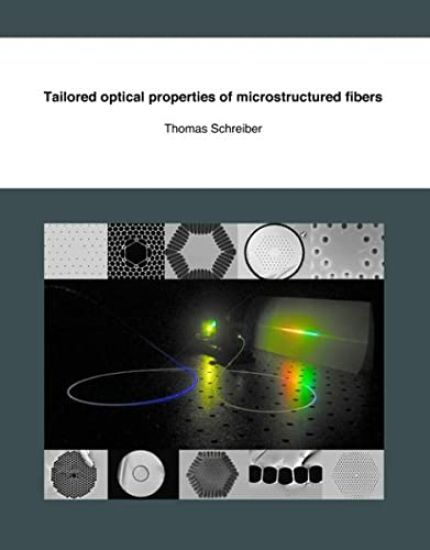
Tailored optical properties of microstructured fibers

Tailored optical properties of microstructured fibers

Thomas Schreiber

BoD - Books on Demand
2006
sidottu
This thesis discusses the fundamental optical properties of microstructured fibers. In particular, given here is an analysis of the effective nonlinearity, the extended dispersion profile, and the polarisation control. Also investigated are the implications on pulse propagation. Studied here in great detail are the enhancement of nonlinear effects and the tailoring of the dispersion in highly nonlinear fibers. It is shown how these properties effect the propagation of short optical pulses. Numerical simulations and experimental investigations identify the underlying effects of soliton formation and dispersive cross-phase modulation. Furthermore, the reduced effective nonlinearity is analysed in photonic bandgap fibers as well as solid-core single-mode large-mode-area (LMA) fibers. As a result, the freedom in the design of microstructured fibers can be used to reduce nonlinear effects by three orders of magnitude. Specifically, the advantages of these LMA fibers have been transferred to double-clad Yb-doped microstructured fibers, which serve as a gain medium for lasers and amplifiers. The last topic concerns polarisation control in microstructured fibers with reduced nonlinearity. The herein developed polarising fiber design applied to laser and amplifier systems shows superior performance compared to conventional step index fibers.
Tailored Metal Catalysts

Tailored Metal Catalysts

Kluwer Academic Publishers
1985
sidottu
Well tailored metal catalysts are catalysts of the new generation resulting from scientific development at the boundary between homogeneous and hetero- geneous chemistry. The main factors involved in making tailored metal catalysts are not those of traditional impregnation in which the chemistry is in general unknown and ill-defined, or of simple ion exchange which involves long-range forces with little control on the local structure through definite and special bond direction. Tailored Metal Catalysts thus has a rather different emphasis from normal review publications in the field of catalysis. Here we concentrate more on the distinct surface chemistry and catalytic properties of important established materials with well-characterized active structures or precursors, although at the same time providing a systematic presentation of relevant data. Many pioneering works have been undertaken in the field of tailored metal catalysts since the early research on polymer-attached homogeneous metal complexes by the British Petroleum Company Ltd. and the Mobil Oil Corpora- tion around 1969; transition metal complexes attached on polymers by Grubbs (1971), Heinemann (1971), Manassen (1971), Pittman (1971), Bursian et al. (1972), Kagan (1973), Bailar (1974); transition metal complexes attached on inorganic oxides by Allum et al. (1972), Ballard (1973), Candlin and Thomas (1974), Murrell (1974), Yermakov (1974); metal carbonyls/polymers by Moffat (1970); metal carbonyls/inorganic oxides by Parkyns (1965), Davie et al. (1969), Banks et al. (1969), Howe (1973), Burwell (1975); metal carbonyl clusters/ polymers by Colhnan (1972); metal carbonyl clusters/inorganic oxides by Robertson and Webb (1974), Anderson (1974), Smith et al. (1975).
Tailored Polymers and Applications

Tailored Polymers and Applications

VSP International Science Publishers
2000
sidottu
This book contains a selection of papers presented at APME '99 ( Third International Symposium on Advanced Polymers via Macromolecular Engineering --- Colonial Williamsburg, VA, USA, July/August 1999). The book focuses on the synthesis of targeted polymers with specific properties using macromolecular architecture. Various controlled polymerization techniques such as ionic, metathesis and recently developed 'living'/controlled polymerization and some of their combinations are covered. Polymers with different topologies such as block and graft copolymers, hyper branched polymers, heteroarm polymers, dentrimers, segmented networks and supramolecular systems are presented with emphasis on the special characteristics that influence their amphiphilic, liquid crystalline, complexation, thermo- and photosensitive and catalytic properties. The uses of such macromolecular structures in various fields such as surface modifiers, catalysts and coating and biomedical applications are also discussed.