Kirjojen hintavertailu. Mukana 12 016 292 kirjaa ja 12 kauppaa.

Kirjahaku

Etsi kirjoja tekijän nimen, kirjan nimen tai ISBN:n perusteella.

1000 tulosta hakusanalla Alain Goetzmann

The Food Industries of Europe in the Nineteenth and Twentieth Centuries
The industrialization of food preservation and processing has been a dramatic development across Europe during modern times. This book sets out its story from the beginning of the nineteenth century when preservation of food from one harvest to another was essential to prevent hunger and even famine. Population growth and urbanization depended upon a break out from the ’biological ancien regime’ in which hunger was an ever-present threat. The application of mass production techniques by the food industries was essential to the modernization of Europe. From the mid-nineteenth century the development of food industries followed a marked regional pattern. After an initial growth in north-west Europe, the spread towards south-east Europe was slowed by social, cultural and political constraints. This was notable in the post-Second World War era. The picture of change in this volume is presented by case studies of countries ranging from the United Kingdom in the west to Romania in the east. All illustrate the role of food industries in creating new products that expanded the traditional cereal-based diet of pre-industrial Europe. Industrially preserved and processed foods provided new flavours and appetizing novelties which led to brand names recognized by consumers everywhere. Product marketing and advertising became fundamental to modern food retailing so that Europe’s largest food producers, Danone, Nestlé and Unilever, are numbered amongst the world’s biggest companies.
The Expert Consumer

The Expert Consumer

Alain Chatriot; Marie-Emmanuelle Chessel

Routledge
2017
nidottu
Recent work has focused on the politics of consumption and its manifestation in a number of situations. This volume extends these debates, providing a tighter focus and contributing to a noticeable gap in the field that numerous scholars are beginning to turn towards: that is, organizations of consumers themselves who have chosen to speak for all consumers and similar such bodies of experts which act on behalf of consumers. The volume is fortunate in drawing upon a number of scholars who are about to publish major works on the subject, but who are happy to provide summary versions of their work for the volume. The book pays particular attention to specific moments in consumer mobilization and expertise, capturing the range of types of expert consumers across the twentieth century, from ethical consumer groups at the beginning, to intellectuals, housewives, economists and public officials. It addresses questions on the nature of consumer organizing, which bodies can speak for consumers, whether one consumer voice can ever be identified and the relationship between consumption and citizenship. Overview pieces demonstrate the larger narratives involved in the study of the expert consumer, whilst more comparative essays set out the nature of transatlantic exchanges. Other contributions point to the similarities across seemingly different consumption regimes, while case studies of specific organisations and key historical moments draw out the particularities of consumer expertise.
Urban Development and New Towns in the Third World
First published in 1999, this volume examines India and Bombay, countries which represent some of the world’s most dramatic examples of rapid urban growth. One of the strategies frequently adopted by the Indian authorities to cope with this urban growth is the development of new towns, such as New Bombay, which is India’s largest and most significant urban planning experience since Independence. The New Bombay model, based on a specific planning and financing strategy, is considered highly successful and so is increasingly being copied and implemented in other urban areas of India. This volume makes the first independent evaluation of New Bombay and sets it in a wider Third World urban development context. As well as analysing the processes of physical and economic growth, the volume also examines the process of social development and, in particular, the consequences of this planning concept for the urban poor.
Urban Development and New Towns in the Third World
First published in 1999, this volume examines India and Bombay, countries which represent some of the world’s most dramatic examples of rapid urban growth. One of the strategies frequently adopted by the Indian authorities to cope with this urban growth is the development of new towns, such as New Bombay, which is India’s largest and most significant urban planning experience since Independence. The New Bombay model, based on a specific planning and financing strategy, is considered highly successful and so is increasingly being copied and implemented in other urban areas of India. This volume makes the first independent evaluation of New Bombay and sets it in a wider Third World urban development context. As well as analysing the processes of physical and economic growth, the volume also examines the process of social development and, in particular, the consequences of this planning concept for the urban poor.
The Academic System in American Society
Although the period of student protests of the 1960s and 1970s has long passed, Alain Touraine argues, in this wide-ranging and vigorous essay, that the period's problems remain with us. Higher degrees have become less and less valuable on the labor market and the demand for academic reform has become more intense. Community colleges still try to provide equal educational opportunities for the poor and the minorities, without much success. And the university has not yet resolved the conflict between being the home of impartial inquiry and research and serving constituent interests.Touraine views American higher education as a system within a definite, though changing, social context. He compares U.S. student movements with those of other countries. He is skeptical about the way Americans view the relationships between the university and what he regards as the ruling forces of the society, between knowledge and power, between production and education. He offers no facile solutions, but he presents an exciting, nontraditional analysis of the social and political forces that have shaped the modern history of higher education.In the new introduction, Clark Kerr contrasts his own views as an American observer to those of Touraine as a French intellectual. He asserts that the family, not higher education, is the most important "school" in the process of reproducing society. Kerr places more emphasis than does Touraine on the labor market, on the production functions (training of skills and advancing technology) of the vast nonelite segments of American higher education, on the long-term impacts of science in changing society, and on scholarly criticism in affecting transformations, and places less emphasis on sporadic political protests by faculty and students.He agrees with Touraine however, in his two great themes: (1) that you cannot understand the academic system unless you first understand society; and (2) that the rise of the university must be understood to understand modern society, where "knowledge is power." This volume will be important to all those interested in higher education, whether as participants or observers.
Understanding Federalism and Federation

Understanding Federalism and Federation

Alain-G. Gagnon; Soeren Keil

Routledge
2017
nidottu
Based on a variety of contemporary debates on federal theory Understanding Federalism and Federation honours Michael Burgess’ contribution to the study of these topics through a selection of approaches, theories, debates and interpretations. Gathering contributors from diverse subfields to synthesize current debates it offers a snapshot of the immense range of current research on federalism and federation. Leading authors debate key issues such as American federalism, Canada and the role of Quebec, the latest insights into comparative federalism and federation, the European Union as a federal project and the analysis of constitutional courts in federal systems. Different theoretical and empirical fields and perspectives are brought together, synthesizing major findings and addressing emerging issues and these topics are analysed through multiple lenses to provide new insights, original approaches and much-needed theoretical and empirical data on federalism and federation.
The ECHR and Human Rights Theory

The ECHR and Human Rights Theory

Alain Zysset

Routledge
2016
sidottu
The European Convention of Human Rights (ECHR) has been relatively neglected in the field of normative human rights theory. This book aims to bridge the gap between human rights theory and the practice of the ECHR. In order to do so, it tests the two overarching approaches in human rights theory literature: the ethical and the political, against the practice of the ECHR ‘system’. The book also addresses the history of the ECHR and the European Court of Human Rights (ECtHR) as an international legal and political institution.The book offers a democratic defence of the authority of the ECtHR. It illustrates how a conception of democracy – more specifically, the egalitarian argument for democracy developed by Thomas Christiano on the domestic level – can illuminate the reasoning of the Court, including the allocation of the margin of appreciation on a significant number of issues. Alain Zysset argues that the justification of the authority of the ECtHR – its prominent status in the domestic legal orders – reinforces the democratic process within States Parties, thereby consolidating our status as political equals in those legal and political orders.
Organized Crime, Prison and Post-Soviet Societies

Organized Crime, Prison and Post-Soviet Societies

Alain Touraine; Anton Oleinik

Routledge
2019
nidottu
This title was first published in 2003. The "Red Mafia" in Russia have become the subject of increasing international interest and considerable misinterpretation. After well-received editions in Russian, French and Italian, Anton Oleinik's study of Russian prisons, in which he explores the social roots of organized crime in post-Soviet societies, is now published in English. This English edition includes a postscript on the Moscow terrorist crisis of 2002. Oleinik's analysis reveals prison society as a mirror of broader Russian society - characterized by the absence of the state as an organizer of social practices. He builds on this to make a central distinction between two types of societies - the modern "large" society and the "small" society, like Russia, that has only been partially modernized, and in which the world of everyday life, experiences and relationships remains entirely separated from the official aims of modernization and efficiency. Oleinik is interested in the void between these two separate worlds, a void he sees being filled in Russia by the Mafia.
Organized Crime, Prison and Post-Soviet Societies

Organized Crime, Prison and Post-Soviet Societies

Alain Touraine; Anton Oleinik

Routledge
2017
sidottu
This title was first published in 2003. The "Red Mafia" in Russia have become the subject of increasing international interest and considerable misinterpretation. After well-received editions in Russian, French and Italian, Anton Oleinik's study of Russian prisons, in which he explores the social roots of organized crime in post-Soviet societies, is now published in English. This English edition includes a postscript on the Moscow terrorist crisis of 2002. Oleinik's analysis reveals prison society as a mirror of broader Russian society - characterized by the absence of the state as an organizer of social practices. He builds on this to make a central distinction between two types of societies - the modern "large" society and the "small" society, like Russia, that has only been partially modernized, and in which the world of everyday life, experiences and relationships remains entirely separated from the official aims of modernization and efficiency. Oleinik is interested in the void between these two separate worlds, a void he sees being filled in Russia by the Mafia.
Kinship, Honour and Money in Rural Pakistan
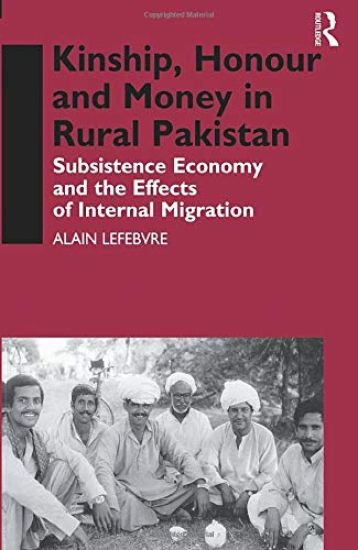
International migration is favoured by the governments of many poorer countries despite often well-publicized abuses affecting individual migrant workers. Not only is local unemployment reduced but also it is expected that the migrants will learn new skills, with many even becoming entrepreneurs on their return home. Meantime they are seen as a source of foreign remittances, providing needed capital for economic development. Such is the attitude in Pakistan from where thousands of migrant workers leave every year for the Gulf states especially.An anthropological study approaching this issue from a local (village) level, this book focuses on two areas of the Punjab. Describing the historical passage of rural life from pre-colonial times to the present, it shows how the rural economy of the Punjab was not transformed by the green revolution - on the contrary, it is still a subsistence economy. The resulting poverty combined with Pakistan's labour-market policies forces many Punjabi men to seek work abroad, in turn bringing changes to the economic role of the women left behind. Remittances from abroad have brought further changes on the economic and social life of the villages but not, as expected, to bring economic development let alone capital or entrepreneurialism to the area.