Kirjojen hintavertailu. Mukana 12 016 292 kirjaa ja 12 kauppaa.

Kirjahaku

Etsi kirjoja tekijän nimen, kirjan nimen tai ISBN:n perusteella.

1000 tulosta hakusanalla Arthur Harduin

Arthur Ashe

Arthur Ashe

Raymond Arsenault

Simon Schuster
2019
pokkari
A NEW YORK TIMES NOTABLE BOOK A “thoroughly captivating biography” (The San Francisco Chronicle) of American icon Arthur Ashe—the Jackie Robinson of men’s tennis—a pioneering athlete who, after breaking the color barrier, went on to become an influential civil rights activist and public intellectual.Born in Richmond, Virginia, in 1943, by the age of eleven, Arthur Ashe was one of the state’s most talented black tennis players. He became the first African American to play for the US Davis Cup team in 1963, and two years later he won the NCAA singles championship. In 1968, he rose to a number one national ranking. Turning professional in 1969, he soon became one of the world’s most successful tennis stars, winning the Australian Open in 1970 and Wimbledon in 1975. After retiring in 1980, he served four years as the US Davis Cup captain and was inducted into the International Tennis Hall of Fame in 1985. In this “deep, detailed, thoughtful chronicle” (The New York Times Book Review), Raymond Arsenault chronicles Ashe’s rise to stardom on the court. But much of the book explores his off-court career as a human rights activist, philanthropist, broadcaster, writer, businessman, and celebrity. In the 1970s and 1980s, Ashe gained renown as an advocate for sportsmanship, education, racial equality, and the elimination of apartheid in South Africa. But from 1979 on, he was forced to deal with a serious heart condition that led to multiple surgeries and blood transfusions, one of which left him HIV-positive. After devoting the last ten months of his life to AIDS activism, Ashe died in February 1993 at the age of forty-nine, leaving an inspiring legacy of dignity, integrity, and active citizenship. Based on prodigious research, including more than one hundred interviews, Arthur Ashe puts Ashe in the context of both his time and the long struggle of African-American athletes seeking equal opportunity and respect, and “will serve as the standard work on Ashe for some time” (Library Journal, starred review).
Arthur of England

Arthur of England

Christopher Dean

UNIVERSITY OF TORONTO PRESS
1987
pokkari
Today, popular imagination peoples the Middle Ages with damsels in distress and knights riding to their rescue. Of such knights, King Arthur and his companions are the most celebrated. It is certainly true that this is the time when the Arthurian story took shape and Arthurian literature flourished, and that most medieval historians included him in their histories of Britain, though some did so with a considerable degree of scepticism. But how widely was this literature known in its own day? How much credence did people generally place in this king who supposedly once ruled England? To answer these questions, Christopher Dean looks at medieval and Renaissance Arthurian literature in detail, and also examines contemporary chronicles and histories, chivalric theory and practice, popular myths and legends, folk-lore and place-names. The result is to show dramatically that Arthur was not at all as well known as popular belief today fancies. As a historical figure he was early discredited; had it not been for his artificial revival by the Tudor monarchy and the furor caused by the attack upon him by the 'foreigner' Polydore Vergil, which incensed many patriotic Englishmen, his credibility might have disappeared much sooner than it did. Except for Malory's work, medieval Arthurian literature, which often exists in no more than single manuscripts, did not have large audiences. And after 1500, only Edmund Spenser and Thomas Hughes attempted to write seriously on Arthurian themes. Among the ordinary citizens of England, Arthur was hardly known at all, any popular knowledge of him being almost entirely restricted to Wales, Devon, and Cornwall. Elsewhere in Britain the much more familiar figure was Robin Hood. For all the strength of the Arthurian legend as the ultimate medieval knight, he is essentially a modern hero.
Arthur Ransome on the Broads

Arthur Ransome on the Broads

Roger Wardale

Amberley Publishing
2013
nidottu
In Arthur Ransome on the Broads Roger Wardale tells the inside story of the two classic children's novels, Coot Club and The Big Six, that stemmed from the eight holidays that Ransome and his wife spent cruising in hired craft on the Norfolk Broads in the 1930s. Drawing freely upon Ransome's sailing log, his diaries and those of his wife, an intimate portrait emerges of the iconic children's author on holiday, as well as a unique picture of the Norfolk Broads at a crucial point in their transition from the wilderness that he loved to a watery playground. Using Ransome's working notes and letters it has been possible to trace the trials and tribulations of the development of the plot of Coot Club - a book that his publisher had to drag from him in order to catch the Christmas market. By way of contrast, Ransome's masterly tale of detection, The Big Six, gave him lots of fun in the creation - once he had settled on the crime. This beautifully illustrated book should appeal to all Ransome enthusiasts, those who have sailed on the Broads at some time or other and local historians.
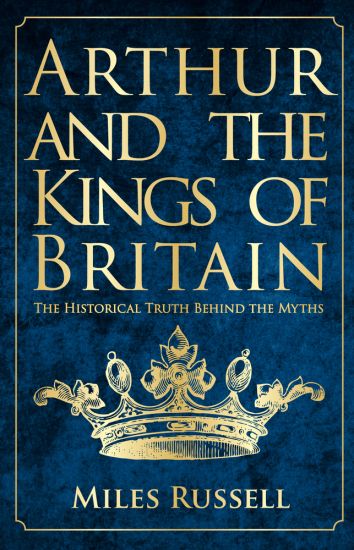
Arthur and the Kings of Britain

Arthur and the Kings of Britain

Miles Russell

Amberley Publishing
2018
pokkari
Written in 1136 by Geoffrey of Monmouth, the Historia Regum Britanniae (History of the Kings of Britain) purported to chronicle the British monarchy from the arrival of the Trojan Brutus, grandson of Aeneas, through to the seventh century AD. The Historia was a medieval best-seller, and copies spread across the whole of western Europe. It was the first work to outline the story of King Arthur. The Historia has long been dismissed as an unreliable piece of medieval propaganda. A new examination of the text, however, shows that it is very much more than that. Miles Russell explains how individual elements can be traced back to the first century BC, a time when Britain was making first contact with Rome. Geoffrey of Monmouth’s skill was to weave these early traditions together with material culled from post-Roman sources in order to create a national epic. In doing so, he also created King Arthur, a composite character whose real origins and context are explained here. This important work establishes Geoffrey of Monmouth as no mere peddler of historical fiction, but as the man who preserved the earliest foundation myths of Britain. It is time to re-evaluate the Historia Regum Britanniaeand shine a new light into the so-called ‘Dark Ages’.