
Kirjahaku
Etsi kirjoja tekijän nimen, kirjan nimen tai ISBN:n perusteella.
1000 tulosta hakusanalla Dylan Howard

How to Enjoy Guitar with Just 3 Chords: Including Songs by Bob Dylan, Weezer, the Beatles, Bob Marley, Nirvana & Many More
David Harrison
Hal Leonard Publishing Corporation
2019
nidottu
(Guitar Educational). Did you know that thousands of popular songs can be played using nothing but three chords? This book will teach you just three simple chords that can be used to play every song included in this collection. Add the customized strum patterns for each song and you'll be well on your way to playing the guitar 19 songs are included: Beverly Hills (Weezer) * Blowin' in the Wind (Bob Dylan) * Coat of Many Colors (Dolly Parton) * I Still Haven't Found What I'm Looking For (U2) * Leaving on a Jet Plane (John Denver) * Love Me Do (The Beatles) * Sweet Home Alabama (Lynyrd Skynyrd) * The Tide Is High (Blondie) * What I Got (Sublime) * and more.
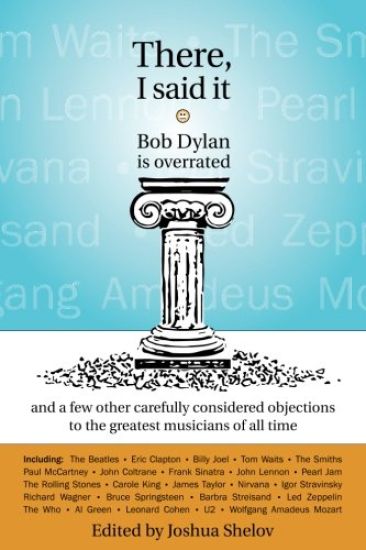
There, I Said It: Bob Dylan Is Overrated: and a few other carefully considered objections to the greatest musicians of all time
Greg Raskin; Henry Tenney; Cebra Graves
Createspace Independent Publishing Platform
2016
nidottu
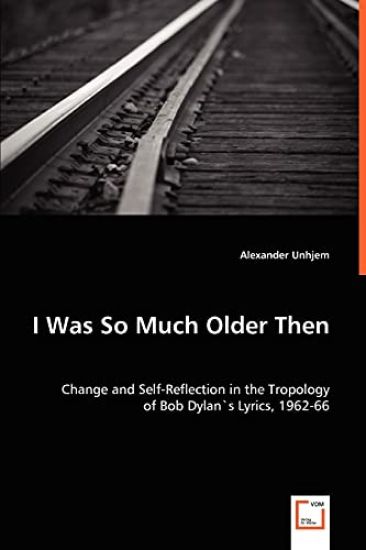
I Was So Much Older Then - Change and Self-Reflection in the Tropology of Bob Dylan's Lyrics, 1962-66
Alexander Unhjem
VDM Verlag Dr. Mueller E.K.
2008
pokkari
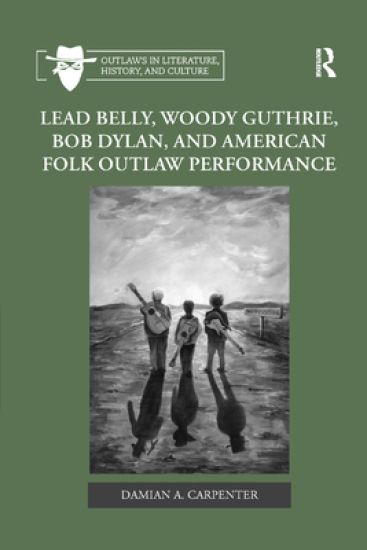
Lead Belly, Woody Guthrie, Bob Dylan, and American Folk Outlaw Performance
Damian A. Carpenter
Routledge
2019
nidottu
With its appeal predicated upon what civilized society rejects, there has always been something hidden in plain sight when it comes to the outlaw figure as cultural myth. Damian A. Carpenter traverses the unsettled outlaw territory that is simultaneously a part of and apart from settled American society by examining outlaw myth, performance, and perception over time. Since the late nineteenth century, the outlaw voice has been most prominent in folk performance, the result being a cultural persona invested in an outlaw tradition that conflates the historic, folkloric, and social in a cultural act. Focusing on the works and guises of Lead Belly, Woody Guthrie, and Bob Dylan, Carpenter goes beyond the outlaw figure’s heroic associations and expands on its historical (Jesse James, Billy the Kid), folk (John Henry, Stagolee), and social (tramps, hoboes) forms. He argues that all three performers represent a culturally disruptive force, whether it be the bad outlaw that Lead Belly represented to an urban bourgeoisie audience, the good outlaw that Guthrie shaped to reflect the social concerns of marginalized people, or the honest outlaw that Dylan offered audiences who responded to him as a promoter of clear-sighted self-evaluation. As Carpenter shows, the outlaw and the law as located in society are interdependent in terms of definition. His study provides an in-depth look at the outlaw figure’s self-reflexive commentary and critique of both performer and society that reflects the times in which they played their outlaw roles.
God Knows, Everything is Broken: The Great (Gnostic) Americana Songbook of Bob Dylan
Aubrey L. Glazer
Independently Published
2019
nidottu
Lead Belly, Woody Guthrie, Bob Dylan, and American Folk Outlaw Performance
Damian A. Carpenter
Routledge
2017
sidottu
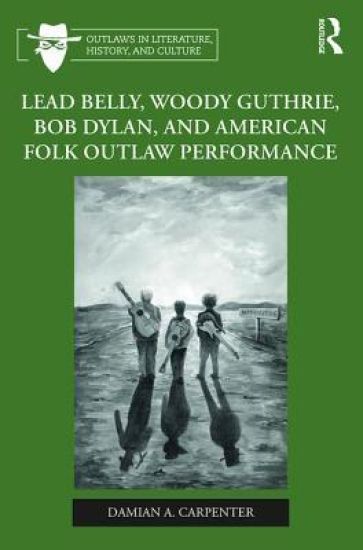
With its appeal predicated upon what civilized society rejects, there has always been something hidden in plain sight when it comes to the outlaw figure as cultural myth. Damian A. Carpenter traverses the unsettled outlaw territory that is simultaneously a part of and apart from settled American society by examining outlaw myth, performance, and perception over time. Since the late nineteenth century, the outlaw voice has been most prominent in folk performance, the result being a cultural persona invested in an outlaw tradition that conflates the historic, folkloric, and social in a cultural act. Focusing on the works and guises of Lead Belly, Woody Guthrie, and Bob Dylan, Carpenter goes beyond the outlaw figure’s heroic associations and expands on its historical (Jesse James, Billy the Kid), folk (John Henry, Stagolee), and social (tramps, hoboes) forms. He argues that all three performers represent a culturally disruptive force, whether it be the bad outlaw that Lead Belly represented to an urban bourgeoisie audience, the good outlaw that Guthrie shaped to reflect the social concerns of marginalized people, or the honest outlaw that Dylan offered audiences who responded to him as a promoter of clear-sighted self-evaluation. As Carpenter shows, the outlaw and the law as located in society are interdependent in terms of definition. His study provides an in-depth look at the outlaw figure’s self-reflexive commentary and critique of both performer and society that reflects the times in which they played their outlaw roles.
The Literary Genius of Lil Wayne: The case for Lil Wayne to be counted among Shakespeare and Dylan
Kreston Kent
Createspace Independent Publishing Platform
2014
nidottu
"Reading this book is like looking in the mirror...Much love for Professor Kreston Kent " -Lil Wayne. #1 Bestseller on Amazon Rap category and iBooks Music category. Called a "thorough and incisive proof of Lil Wayne's genius" by critics, the book shows that Wayne's lyrics have more in common with Shakespeare's and Dylan's than with other rappers'. The 4th Edition includes Tha Carter V and Dedication 6; Lil Wayne's own reaction to the book; analysis of data from a Finnish university's computer rap algorithm, similarities between Wayne and Lincoln as writers, a definitive ranking of Wayne's albums and mixtapes.
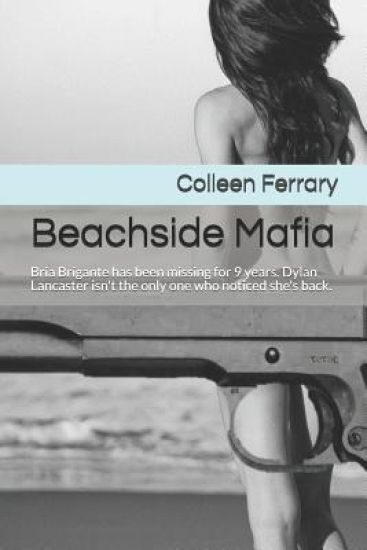
Beachside Mafia: Bria Brigante has been missing for 9 years. Dylan Lancaster isn't the only one who noticed she's back.
Colleen Ferrary
Independently Published
2019
nidottu
Benedetto "Papa" Brigante ruled the largest crime family in New York. After he was killed, his fortune and his seventeen-year-old daughter went missing. How can the heir to the nation's largest crime family disappear? When Bria Brigante emerges nine years later, she is far from the mafia princess the crime world expected. Bria Brigante finds herself desperate and alone. It is there she must depend on what her father taught her to stay alive. Could the answers lie in the pages of the blank journal Papa gave her before he was killed? In Devon, the smart trust-fund kid trying to prove something to himself and his father? Or in the handsome stranger who befriends her on the beach? Or, is Bria Brigante far more like her father than anyone would have expected?

A Darker Shade of Pale. A Backdrop to Bob Dylan.
Wilfrid Mellers
Travis and Emery Music Bookshop
2010
pokkari
Andy Warhol's "Superstar" Edie Segdwick. The True Heroine of Bob Dylan's "Blonde on Blonde"?
Margarete Suppes
Grin Publishing
2016
pokkari
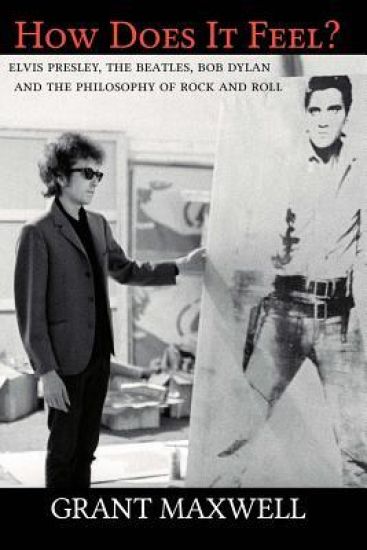
How Does It Feel?: Elvis Presley, the Beatles, Bob Dylan, and the Philosophy of Rock and Roll
Grant Maxwell
Persistent Press
2015
nidottu

Shenandoah, V5, No. 2: Dylan Thomas Number is a literary journal edited by Raymond D. Smith Jr. This issue is dedicated to the Welsh poet Dylan Thomas and includes a collection of his works, as well as critical essays and reviews about his writing. The journal features contributions from a variety of writers and scholars, exploring the themes, style, and impact of Thomas's poetry. This book is a valuable resource for anyone interested in the life and work of Dylan Thomas, as well as the broader literary and cultural context in which he wrote.Contributors Include Russell Kirk, Emilie Glen, David Horne And Others.This scarce antiquarian book is a facsimile reprint of the old original and may contain some imperfections such as library marks and notations. Because we believe this work is culturally important, we have made it available as part of our commitment for protecting, preserving, and promoting the world's literature in affordable, high quality, modern editions, that are true to their original work.

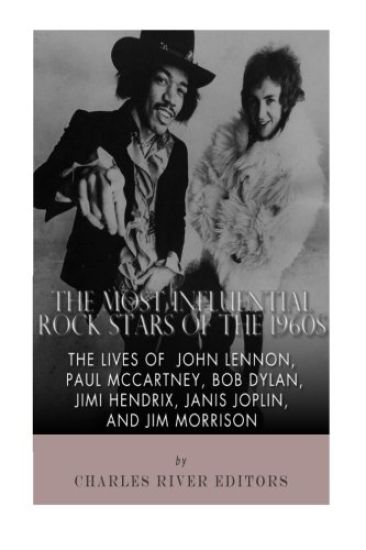
The Most Influential Rock Stars of the 1960s: The Lives of John Lennon, Paul McCartney, Bob Dylan, Jimi Hendrix, Janis Joplin, and Jim Morrison
Charles River
Createspace Independent Publishing Platform
2014
nidottu
*Includes pictures *Includes the rock stars' quotes about their lives and careers *Includes an introduction and bibliography for each one In 1964, girls all across the United States filled venues, almost literally screamed their heads off, and fainted en masse. Almost from the second they played the first note, The Beatles would be hit with the resounding screams, which made it impossible for them to even hear themselves sing. When they made their American debut on The Ed Sullivan Show in early 1964, they were greeted by young fans who whipped themselves up into such a frenzy that some of them fainted. Beatlemania had struck North America, creating a musical and pop culture phenomenon unlike anything the world had ever seen. At the center of it all was John Lennon and Paul McCartney, the principal songwriting duo who were instrumental in creating the soundtrack of the 1960s, while producing some of the world's most timeless classics. Together with George Harrison and Ringo Starr, Lennon and McCartney propelled The Beatles to unprecedented heights, sparking Beatlemania on two sides of the Atlantic and experimenting with their sound in ways that revolutionized rock and inspired bands across various musical genres. In the space of just a few years, Bob Dylan, born Robert Allen Zimmerman, rose from the obscurity of a small Minnesota town to a position of royalty atop the folk music landscape of the 1960s, with a universal esteem and status on a par with Elvis Presley and The Beatles. In the 1960s, "Blowin' in the Wind" and "The Times They Are A' Changing" "became anthems of the anti-war and civil rights movements," but long after the transition from the '50s to the late '60s and '70s was accomplished, the initially baffling young folk singer who appeared out of nowhere was awarded a special Pulitzer Prize for "his profound impact on popular music, and American culture, marked by lyrical compositions of extraordinary poetic power." Over the span of his career, he has received Grammy Awards, Golden Globes, Academy Award Oscars, and he has been inducted into the Rock & Roll Hall of Fame, the Minnesota Music Hall of Fame, the Nashville Songwriters Hall of Fame, and the Songwriters Hall of Fame, not to mention the Pulitzer Prize and Presidential Medal of Freedom. It is rare in the world of music for a general consensus to form over who was the best at anything. Many would call The Beatles the greatest rock band, but it's easy to find strongly opinionated dissenters. However, when it came to playing a guitar and laying the soundtrack for the psychedelic era, just about everyone agrees there was Jimi Hendrix (1942-1970) and then there was everyone else. Anyone arguing otherwise either never heard his music or saw him perform. In fact, Jimi Hendrix is one of the few musicians known primarily for his sound and what he could do with a guitar than for his discography. Dubbed by many as the "First Lady" or "Queen" of Rock & Roll, Joplin both invented and installed the "rock mama paradigm" into the American rock consciousness, a patriarchal and fraternal industry that, much like the societal traits it protested, restricted women to a narrow and conservative criteria for entrance. With only a very few kindred spirits, such as Grace Slick of Jefferson Airplane, "she pioneered a new range of expression for white women." In the mid-1960s, an era on the cusp of change from the musical and social norms of the previous decade, the emergence of Jim Morrison, the charismatic poet/musician of The Doors, helped to transform the subgenre of rock n' roll as a stylistic flavor to the full-fledged institution of Rock Music. Morrison accomplished this transformation by avoiding membership in any of the known categories of modern rock music during the age of protest, but at the same time, he became the general symbol of anti-authoritarianism for his generation and the next.
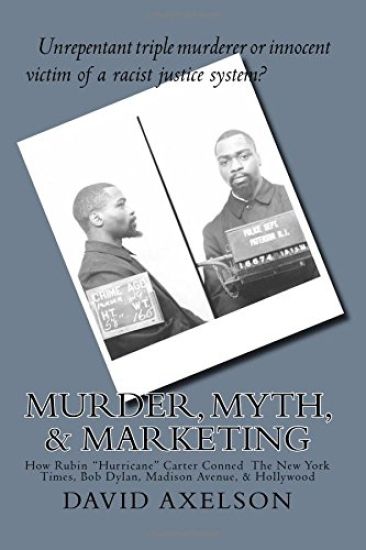
Murder, Myth, & Marketing: How Rubin "Hurricane" Carter Conned The New York Times, Bob Dylan, Madison Avenue, & Hollywood
David R. Axelson
Createspace Independent Publishing Platform
2017
nidottu
Murder, Myth, & Marketing is the exhaustively-researched story of how convicted triple murderer and ex-boxer Rubin "Hurricane" Carter convinced the New York Times, Madison Avenue, Bob Dylan, and Hollywood that he was an innocent man wrongfully convicted.

Vom grapevine zum Fahrschein. Übersetzung in der deutschsprachigen Popularmusik am Beispiel der Lieder von Elvis Presley, Bob Dylan, Juanes und anderen
Claudia Neudecker
Ibidem-Verlag
2008
nidottu

När rocken kom till Ullevi : 80-talskonserterna med Stones, Bowie, Dylan och Springsteen
Richard Ohlsson
Solvändan Förlag
2022
sidottu
40 år har passerat sedan de där junikvällarna då Mick Jagger och kompani, tillsammans med drygt 112 000 i publiken, inledde vad som med tiden skulle komma att bli en tradition. Under årens lopp har en lång rad världsartister och svenska stjärnor passerat revy på Ullevis scen. Den här bokens fokus ligger på 1980-talets legendariska spelningar med Stones, Bowie, Dylan och Springsteen. Men den berättar också historien om hur en hastigt uppritad karta över Skandinavien lade grunden för dessa konserter, som inte bara påverkades av utan också påverkade sin samtid. Det som började med dåvarande EMA-Telstars Thomas Johansson på en restaurang i New Orleans för mer än 40 år sedan är idag en institution, och det här är historien om hur det började.

Here, Evans shows how the 'placebo effect' works scientifically, and how thoughts and feelings work on our brain cells and affect our chemical make-up. He discusses how this study can provide a means of efficiently bridging the gap between mainstream and alternative medicine.