Kirjojen hintavertailu. Mukana 11 244 527 kirjaa ja 12 kauppaa.

Kirjahaku

Etsi kirjoja tekijän nimen, kirjan nimen tai ISBN:n perusteella.

1000 tulosta hakusanalla Edith Beale

Five Children and It (1902). By: Edith Nesbit, illustrated By: H. R. Millar: children's book

Five Children and It (1902). By: Edith Nesbit, illustrated By: H. R. Millar: children's book

H. R. Millar; Edith Nesbit

Createspace Independent Publishing Platform
2017
nidottu
Five Children and It is a children's novel by English author E. Nesbit. Plot: Like Nesbit's The Railway Children, the story begins when a group of children move from London to the countryside of Kent. The five children - Cyril, Anthea, Robert, Jane, and their baby brother, known as the Lamb - are playing in a gravel pit when they uncover a rather grumpy, ugly, and occasionally malevolent Psammead or sand-fairy, who has the ability to grant wishes. He persuades the children to take one wish each day to be shared among them, with the caveat that the wishes will turn to stone at sunset. This, apparently, used to be the rule in the Stone Age, when all that children wished for was food, the bones of which then became fossils. The five children's first wish is to be "as beautiful as the day". The wish ends at sunset and its effects simply vanish, leading the Psammead to observe that some wishes are too fanciful to be changed to stone. All the wishes go comically wrong. The children wish to be beautiful, but the servants do not recognise them and shut them out of the house. They wish to be rich, then find themselves with a gravel-pit full of gold spade guineas that no shop will accept as they are no longer in circulation, so they can't buy anything. A wish for wings seems to be going well, but at sunset the children find themselves stuck on top of a church bell tower with no way down, getting them into trouble with the gamekeeper who must take them home (though this wish has the happy side-effect of introducing the gamekeeper to the children's housemaid, who later marries him). Robert is bullied by the baker's boy, then wishes that he was bigger - whereupon he becomes eleven feet tall, and the other children show him at a travelling fair for coins. They also wish themselves into a castle, only to learn that it is being besieged, while a wish to meet real Red Indians ends with the children nearly being scalped.............. Edith Nesbit (married name Edith Bland; 15 August 1858 - 4 May 1924) was an English author and poet; she published her books for children under the name of E. Nesbit. She wrote or collaborated on more than 60 books of children's literature. She was also a political activist and co-founded the Fabian Society, a socialist organisation later affiliated to the Labour Party. Nesbit was born in 1858 at 38 Lower Kennington Lane in Kennington, Surrey (now part of Greater London), the daughter of an agricultural chemist, John Collis Nesbit, who died in March 1862, before her fourth birthday. Her sister Mary's ill health meant that the family travelled around for some years, living variously in Brighton, Buckinghamshire, France (Dieppe, Rouen, Paris, Tours, Poitiers, Angoul me, Bordeaux, Arcachon, Pau, Bagn res-de-Bigorre, and Dinan in Brittany), Spain and Germany, before settling for three years at Halstead Hall in Halstead in north-west Kent, a location which later inspired The Railway Children (this distinction has also been claimed by the Derbyshire town of New Mills). At eighteen, Nesbit met the bank clerk Hubert Bland in 1877. Seven months pregnant, she married Bland on 22 April 1880, though she did not immediately live with him, as Bland initially continued to live with his mother. Their marriage was a stormy one. Early on Nesbit discovered that another woman believed she was Hubert's fiancee and had also borne him a child.... Harold Robert Millar (1869 - 1942) was a prominent and prolific Scottish graphic artist and illustrator of the late nineteenth and early twentieth centuries.
The Enchanted Castle (1907). By: Edith Nesbit, illustrated By: H. R. Millar: Children's fantasy novel, WITH 47 ILLUSTATIONS By: H. R. Millar (1869 - 1
The Enchanted Castle is a children's fantasy novel by Edith Nesbit first published in 1907. PLOT: The enchanted castle of the title is a country estate in the West Country seen through the eyes of three children, Gerald, James and Kathleen, who discover it while exploring during the school holidays. The lake, groves and marble statues, with white towers and turrets in the distance, make a fairy-tale setting, and then in the middle of the maze in the rose garden they find a sleeping fairy-tale princess. The "princess" tells them that the castle is full of magic, and they almost believe her. She shows them the treasures of the castle, including a magic ring she says is a ring of invisibility, but when it actually turns her invisible she panics and admits that she is the housekeeper's niece, Mabel, and was just play-acting. The children soon discover that the ring has other magical powers. 1] The Enchanted Castle was written for both children and adults. It combines descriptions of the imaginative play of children, reminiscent of The Story of the Treasure Seekers, with a magic more muted than in her major fantasies such as The Story of the Amulet. Edith Nesbit (married name Edith Bland; 15 August 1858 - 4 May 1924) was an English author and poet; she published her books for children under the name of E. Nesbit. She wrote or collaborated on more than 60 books of children's literature. She was also a political activist and co-founded the Fabian Society, a socialist organisation later affiliated to the Labour Party. Nesbit was born in 1858 at 38 Lower Kennington Lane in Kennington, Surrey (now part of Greater London), the daughter of an agricultural chemist, John Collis Nesbit, who died in March 1862, before her fourth birthday. Her sister Mary's ill health meant that the family travelled around for some years, living variously in Brighton, Buckinghamshire, France (Dieppe, Rouen, Paris, Tours, Poitiers, Angoul me, Bordeaux, Arcachon, Pau, Bagn res-de-Bigorre, and Dinan in Brittany), Spain and Germany, before settling for three years at Halstead Hall in Halstead in north-west Kent, a location which later inspired The Railway Children (this distinction has also been claimed by the Derbyshire town of New Mills). At eighteen, Nesbit met the bank clerk Hubert Bland in 1877. Seven months pregnant, she married Bland on 22 April 1880, though she did not immediately live with him, as Bland initially continued to live with his mother. Their marriage was a stormy one. Early on Nesbit discovered that another woman believed she was Hubert's fiancee and had also borne him a child. A more serious blow came later when she discovered that her good friend, Alice Hoatson, was pregnant with Hubert's child. She had previously agreed to adopt Hoatson's child and allow Hoatson to live with her as their housekeeper. After she discovered the truth, they quarrelled violently and she suggested that Hoatson and the baby should leave; her husband threatened to leave Edith if she disowned the baby and its mother. Hoatson remained with them as a housekeeper and secretary and became pregnant by Bland again 13 years later. Edith again adopted Hoatson's child. Nesbit's children were Paul Bland (1880-1940), to whom The Railway Children was dedicated; Iris Bland (1881-1950s); Fabian Bland (1885-1900); Rosamund Bland (1886-1950), to whom The Book of Dragons was dedicated; and John Bland (1898-1971) to whom The House of Arden was dedicated. Her son Fabian died aged 15 after a tonsil operation; Nesbit dedicated a number of books to him: Five Children and It and its sequels, as well as The Story of the Treasure Seekers and its sequels. Nesbit's adopted daughter Rosamund collaborated with her on the book Cat Tales.... Harold Robert Millar (1869 - 1942) was a prominent and prolific Scottish graphic artist and illustrator of the late nineteenth and early twentieth centuries. He is best known for his illustrations of children's books and fantasy literature.
My Lady, Rich and Fair: The Story of Edith Swannhesa

My Lady, Rich and Fair: The Story of Edith Swannhesa

Margaret Carradus

Independently Published
2017
nidottu
In the Eleventh Century England was a bright jewel on the edge of the continent; wealthy, sophisticated and desired by all who knew of it. The constant threat of invasion hovered over the Earls and Thegns who bent their knee to its king. Everyone wanted their slice of power and they guarded it with guile and ruthlessness. Their stories are told, in the Chronicles and sagas, names known to every schoolchild; Edward the Confessor, King Harold and William The Conqueror. But what of the women? What of those shadowy figures who flit across the pages of history, just beyond the reach of knowing? Without the strength, wealth and connections of these wives history might have been so different. And how can anyone understand the minds of the great lords whose lives collided so shatteringly in 1066 without a little insight into the women who supported them through it all. None of these women is more difficult to know than Edith Swannhesa, handfasted wife to Harold of Wessex and one of the most beautiful women in England. She stands in history's shadow, only in the spotlight on the terrible killing feild of Hastings, where she alone had to identify the fallen body of the man she must have shared so much of her life with, mother to his children and condemned by the victors to be reviled as nothing more than his mistress. The only other tantalising glimpse of her is as the possible founder of the Shrine of Walsingham. She must have been a woman of wealth and power in her own right, and a perfect partner for a great Earl from a large and troublesome clan. Theirs is a love story; long standing and tragic in its ending but much more than that. It is the story of the status of women in Anglo Saxon England, when women held wealth and land in their own right and had the freedom to decide and manage their own futures. Edith must have made her own choices, must have decided to stay with Harold whichever way the tides of politics washed them: even when he married another to try to keep the nation together. Such a woman would be strong, independent, fierce, loving, generous of spirit and brave enough to give up all she held dear for the safety of the nation and its king. This is the story of how her tale might have woven itself, using what little is known of her and the family she and Harold were part of. It is the story of a land in fear for the future and a king willing to gamble everything he had to keep England safe. It is the story of Edith Swannhesa and her love, Harold ll of England
Néridah. Le Château de la Reine Edith

Néridah. Le Château de la Reine Edith

Wilfrid De Fonvielle

Hachette Livre - BNF
2016
pokkari
Neridah. Le chateau de la Reine Edith / par Wilfrid de Fonvielle; ouvrage illustre de 40 vignettes dessinees par SahibDate de l'edition originale: 1879Collection: Bibliotheque rose illustreeCe livre est la reproduction fidele d'une oeuvre publiee avant 1920 et fait partie d'une collection de livres reimprimes a la demande editee par Hachette Livre, dans le cadre d'un partenariat avec la Bibliotheque nationale de France, offrant l'opportunite d'acceder a des ouvrages anciens et souvent rares issus des fonds patrimoniaux de la BnF.Les oeuvres faisant partie de cette collection ont ete numerisees par la BnF et sont presentes sur Gallica, sa bibliotheque numerique.En entreprenant de redonner vie a ces ouvrages au travers d'une collection de livres reimprimes a la demande, nous leur donnons la possibilite de rencontrer un public elargi et participons a la transmission de connaissances et de savoirs parfois difficilement accessibles.Nous avons cherche a concilier la reproduction fidele d'un livre ancien a partir de sa version numerisee avec le souci d'un confort de lecture optimal. Nous esperons que les ouvrages de cette nouvelle collection vous apporteront entiere satisfaction.Pour plus d'informations, rendez-vous sur www.hachettebnf.fr
Spirit, Expression and Community in the Philosophy of Edith Stein

Spirit, Expression and Community in the Philosophy of Edith Stein

Michaela Sobrak-Seaton

Springer International Publishing AG
2025
sidottu
This book examines and elucidates the concept of spirit in Stein’s philosophical work, particularly the role it plays in her philosophical anthropology and her understanding of intersubjectivity and community. Although she draws from and synthesizes the ideas of thinkers such as Husserl, Dilthey, and Conrad-Martius, Stein’s approach is distinctive and uniquely suited to comprehensively addressing these topics and questions. Despite the significance of the notion of spirit, however, very little Stein scholarship focuses directly on examining it, and there has never been an attempt to trace its development over the whole of Stein’s corpus. This book fills this lacuna by undertaking a comprehensive study of Stein’s understanding of spirit. The author argues that the key to understanding Stein’s notion of spirit is to understand it as expressive, and in so doing to recognize expression as a fundamental characteristic of the human person. This view of the person as expressive provides an understanding of the person as an embodied being that lives in the world and shares it with other embodied beings, but in this very living and sharing, moves beyond the material bounds of embodiment and constitutes the world as a world of meaning and value. The notion of expression is not only crucial to making sense of Stein’s own account of spirit, but furthermore, provides a way of understanding the person as inextricably bound up in community without compromising the individual. In going out toward others in spiritual expression, one not only forms community with the other; one also becomes more oneself. Thus, Stein’s understanding of spirit as fundamentally expressive helps make sense of what it means to be an individual human being and what it means to be a part of the human community. This volume appeals to students and scholars working in phenomenology.
Feminidad y maternidad. Un diálogo entre Edith Stein y Élisabeth Badinter
Puedo ser feliz siendo madre? Si elijo mi profesi n o mis metas personales por encima de la maternidad me sentir plena como mujer? Inquietudes como estas asaltan el coraz n femenino. La capacidad de acoger y gestar la vida es sin duda un don que cuestiona, desaf a y pone a las mujeres en la dif cil tarea de decidir sobre el rumbo de su existencia. Este libro presenta un di logo filos fico entre dos pensadoras que reflexionaron en torno al tema. La primera de ellas es Elisabeth Badinter, una intelectual francesa apasionada por el Siglo de las Luces, referente del feminismo franc s contempor neo. La escritora comprende la maternidad como una nueva forma de esclavitud y el instinto maternal como un mito que carga a la mujer de obligaciones exteriormente impuestas. La segunda es Edith Stein, una intelectual alemana de la primera mitad del siglo XX, jud a conversa al cristianismo, monja carmelita descalza, santa de la Iglesia Cat lica. La autora se pregunta a la luz de la fe en Cristo el significado de ser mujer para afirmar que en el n cleo de la feminidad se encuentra la maternidad. El enriquecedor di logo entre estas mujeres intelectuales muestra que la resoluci n de las cuestiones propias del coraz n femenino abarca temas tan complejos como la fundamentaci n de la realidad, el significado de ser humano, el sentido de la libertad, el origen de la diferencia.
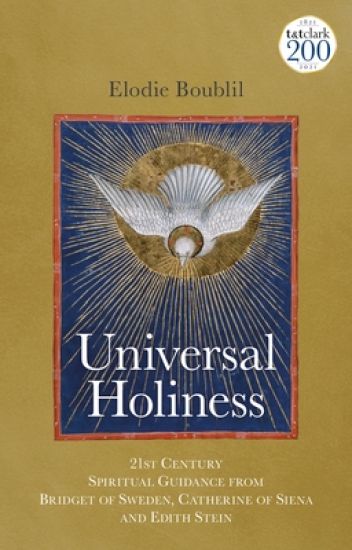
Universal Holiness: 21st Century Spiritual Guidance from Bridget of Sweden, Catherine of Siena and Edith Stein
This is the first publication in English providing a profound and detailed understanding of the spirituality of Saint Bridget of Sweden, Saint Catherine of Siena and Edith Stein (Saint Teresa Benedict of the Cross). Philosopher Elodie Boublil reflects on the feminine theology of these saints to show its relevance for today's world and the Church. Beyond their European anchorage, the testimony of these three women is a 'proclamation of hope'. They bear witness to Christ-Way (Bridget from Sweden), Truth (Catherine of Siena) and Life (Edith Stein/Teresa Benedict of the Cross)-and to the Holy Spirit which shaped their hearts. Through their lives and teachings the co-patronesses of Europe remind us of the urgent necessity to reopen a path to interiority to better serve others, showing thereby the unity of contemplation and action. These women embodied the 'culture of the encounter' and the spirit of fraternity that Pope Francis calls for and the universal call to holiness made by the Vatican II Council.
Universal Holiness: 21st Century Spiritual Guidance from Bridget of Sweden, Catherine of Siena and Edith Stein
This is the first publication in English providing a profound and detailed understanding of the spirituality of Saint Bridget of Sweden, Saint Catherine of Siena and Edith Stein (Saint Teresa Benedict of the Cross). Philosopher Elodie Boublil reflects on the feminine theology of these saints to show its relevance for today's world and the Church. Beyond their European anchorage, the testimony of these three women is a 'proclamation of hope'. They bear witness to Christ-Way (Bridget from Sweden), Truth (Catherine of Siena) and Life (Edith Stein/Teresa Benedict of the Cross)-and to the Holy Spirit which shaped their hearts. Through their lives and teachings the co-patronesses of Europe remind us of the urgent necessity to reopen a path to interiority to better serve others, showing thereby the unity of contemplation and action. These women embodied the 'culture of the encounter' and the spirit of fraternity that Pope Francis calls for and the universal call to holiness made by the Vatican II Council.
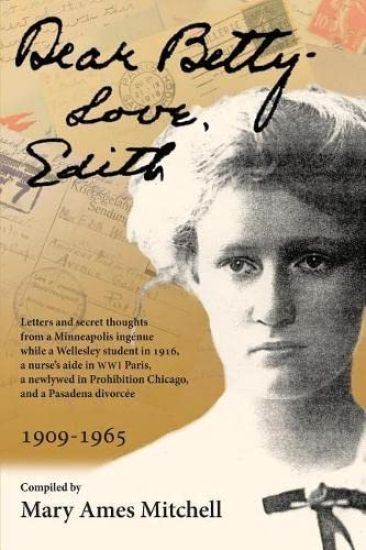
Dear Betty, Love, Edith

Dear Betty, Love, Edith

Mary Ames Mitchell

Peach Plum Press
2017
pokkari
When Mary Ames Mitchell researched her genealogy, she learned that letters her grandmother Edith wrote to her first cousin Betty had been saved for five decades in an old attic in St. Paul, Minnesota. Edith began her correspondence in 1909 after Betty left the Twin Cities to study in Boston at Miss Winsor's finishing school. Later, during WWI, the cousins worked together for the American Fund for French Wounded in Paris. Edith wrote her last letter weeks before her premature death in California in 1965 - when Mary was fourteen.Learning that her grandmother had fought alcoholism, Mary wanted desperately to know why a successful and bright woman became so unhappy. Touched and fascinated by her grandmother's candid and tender descriptions of being a teenager, Ivy league college student, nurses aide, and Chicago socialite, Mary lovingly transcribed the letters and published them as Dear Betty, Love, Edith, so her cousins and brothers could read them, too. In the process of piecing together the historical background, Mary collaborated with Betty's ninety-plus-year-old daughters, Leila and Kitty, who contributed their own rich memories.
The Scholar and the Cross; the Life and Work of Edith Stein
This work has been selected by scholars as being culturally important and is part of the knowledge base of civilization as we know it.This work is in the public domain in the United States of America, and possibly other nations. Within the United States, you may freely copy and distribute this work, as no entity (individual or corporate) has a copyright on the body of the work.Scholars believe, and we concur, that this work is important enough to be preserved, reproduced, and made generally available to the public. To ensure a quality reading experience, this work has been proofread and republished using a format that seamlessly blends the original graphical elements with text in an easy-to-read typeface.We appreciate your support of the preservation process, and thank you for being an important part of keeping this knowledge alive and relevant.
Her Own Counsel. by the Author of 'Dr. Edith Romney' [I.E. Anne Elliot], Etc.

Her Own Counsel. by the Author of 'Dr. Edith Romney' [I.E. Anne Elliot], Etc.

Anne Elliot

British Library, Historical Print Editions
2011
pokkari
Title: Her own Counsel. By the author of 'Dr. Edith Romney' i.e. Anne Elliot], etc.Publisher: British Library, Historical Print EditionsThe British Library is the national library of the United Kingdom. It is one of the world's largest research libraries holding over 150 million items in all known languages and formats: books, journals, newspapers, sound recordings, patents, maps, stamps, prints and much more. Its collections include around 14 million books, along with substantial additional collections of manuscripts and historical items dating back as far as 300 BC.The GENERAL HISTORICAL collection includes books from the British Library digitised by Microsoft. This varied collection includes material that gives readers a 19th century view of the world. Topics include health, education, economics, agriculture, environment, technology, culture, politics, labour and industry, mining, penal policy, and social order. ++++The below data was compiled from various identification fields in the bibliographic record of this title. This data is provided as an additional tool in helping to insure edition identification: ++++ British Library Anonymous; Elliot, Anne; 1889. 3 vol.; 8 . 012639.g.7.
No, no me arrepiento de nada: Vida y canciones de Edith Piaf

No, no me arrepiento de nada: Vida y canciones de Edith Piaf

Lazaro Droznes

Createspace Independent Publishing Platform
2013
nidottu
Edith Piaf es uno de los mitos m s perdurables de la m sica francesa y mundial. Nacida literalmente en la calle, desarroll una carrera de cantante y compositora que la llev a ser una figura mundial de excepcional relevancia. Este espect culo es una recreaci n de los hist ricos recitales del Olimpia intercalado por historias y an cdotas de su vida que reflejan su profundo amor por la m sica, por la vida y por los hombres. Vivi su vida siempre en los l mites, desafiando todo y arriesgando todo. Vivi como cant forzando su peque o cuerpo al extremo de sus posibilidades. Y de nada se arrepinti .
Songs of the North Woods as sung by O.J. Abbott and collected by Edith Fowke

Songs of the North Woods as sung by O.J. Abbott and collected by Edith Fowke

Laszlo Vikà r; Jeanette Panagapka

University of Calgary Press
2004
nidottu
Edith Fowke (1913-1996) was a renowned Canadian folklorist, folk song collector, researcher, writer, and teacher who during her long career recorded nearly two thousand songs. Awarded the Order of Canada in 1978 and named a Fellow of the Royal Society of Canada in 1983, Fowke's legacy is recognized by folk singers and scholars alike as the most comprehensive work in its field. Producing radio programs for the CBC throughout the 1950s and 1960s, she was responsible for discovering such eminent singers as LaRena Clark, Tom Brandon, and O. J. Abbott. O. J. Abbott was one of Fowke's most prolific singers, as she collected and recorded over 120 of his songs, 66 of them transcribed for this collection. The songs, mostly of Irish origin, were popular among settlers to the Ottawa valley and in the lumber camps of northern Ontario in the late 1800s. Born in England in 1872, Abbott worked throughout Ontario and Quebec in lumber camps before settling in Hull, Quebec. He recorded numerous records for the Folkways label and performed with such folk heroes as The Travellers, Ian and Sylvia, and Pete Seeger. Songs of the North Woods as sung by O.J. Abbott and collected by Edith Fowke includes a detailed musical analysis that outlines the meter, scale, and range of each song, an index that indicates where each song can be found on the original source tapes, and extensive field notes, interviews, and recording details.