Kirjojen hintavertailu. Mukana 11 238 005 kirjaa ja 12 kauppaa.

Kirjahaku

Etsi kirjoja tekijän nimen, kirjan nimen tai ISBN:n perusteella.

1000 tulosta hakusanalla Edwin Colbert

The Religious History Of America

The Religious History Of America

Edwin S Gaustad; Leigh Schmidt

HarperOne
2004
nidottu
Ranging from the early colonial period to the present day, a revised edition of the classic text covers the religious dimensions of American history, offering increased discussion of African American and Native American religious life, Eastern religions, and spiritual seeking. Reprint.
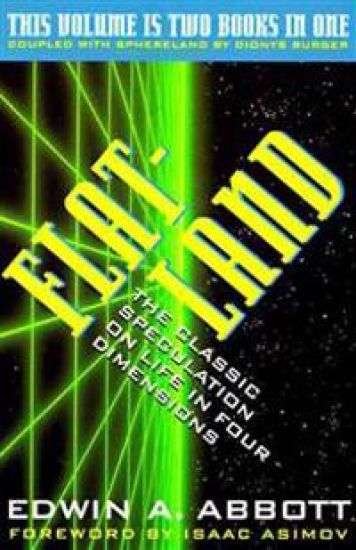
Flatland / Sphereland

Flatland / Sphereland

Edwin A. Abbott; Dionys Burger; Isaac Asimov

HarperReference
1994
nidottu
In the first work, A. Square meets a tragic fate when he dares to inform the inhabitants of his two-dimensional universe that there is a third and fourth dimension, and in the second work, an inhabitant of a two-dimensional world discovers curved surfaces.
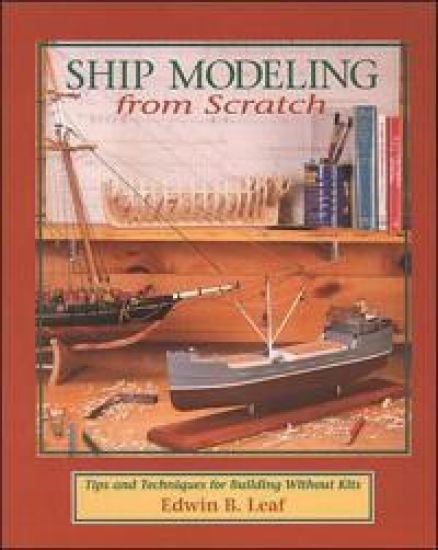
Ship Modeling from Scratch: Tips and Techniques for Building Without Kits
Building a model from a kit is an excellent way to develop your modeling skills. But once you've mastered the basics, where do you go? If you're looking for a challenge, you move on to scratchbuilding. And that can be imposing: With a kit, you worked with someone else's plans, materials, and building instructions. Scratchbuilding makes you master of your own fate. You do the research, choose the subject, the scale, the material. The choices are limited only by your enthusiasm.Edwin B. Leaf scratchbuilt his first model--a Baltimore clipper--nearly fifty years ago, and he's been refining and building on his skills ever since. In Ship Modeling from Scratch he lays out the principles--from concept to construction to display--on which scratchbuilding is based. In clear, concise language complemented by detailed illustrations he tells how to interpret existing drawings or create your own, what materials to choose, what tools to buy, and what techniques to use to build everything from plank-on-frame, plank-on-bulkhead, or modern steel hulls to creating sharp and properly scaled details--paint to portholes.Building a model from scratch is a singular pursuit that requires patience, confidence, and ingenuity. With Ship Modeling from Scratch open on your workbench, you have your own private tutor guiding you through the troublespots.
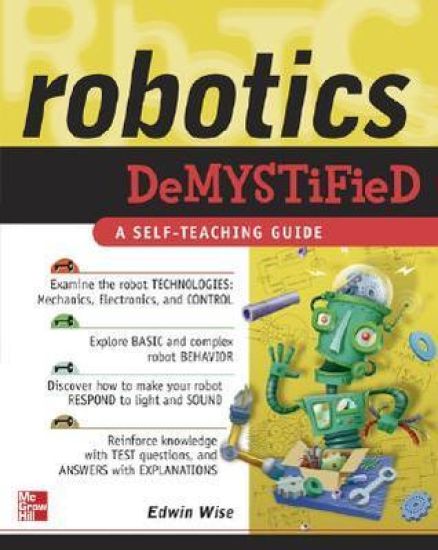
Robotics Demystified

Robotics Demystified

Edwin Wise

McGraw-Hill Professional
2004
nidottu
Publisher's Note: Products purchased from Third Party sellers are not guaranteed by the publisher for quality, authenticity, or access to any online entitlements included with the product.YOU DON'T NEED ARTIFICIAL INTELLIGENCE TO LEARN ROBOTICS!Now anyone with an interest in robotics can gain a deeper understanding -- without formal training, unlimited time, or a genius IQ. In Robotics Demystified, expert robot builder and author Edwin Wise provides an effective and totally painless way to learn about the technologies used to build robots!With Robotics Demystified, you master the subject one simple step at a time -- at your own speed. This unique self-teaching guide offers problems at the end of each chapter to reinforce what you have learned.This fast and entertaining self-teaching course makes if fun and easy to learn about robots. Get ready to:Learn essential electronics, mechanics, and programming concepts, one step at a timeEvaluate your progress with self-test questionsDiscover the ins and outs of mobile, industrial, and research 'botsFind out how to make your robot sense and thinkSo if you're looking for an enjoyable route into robotics, let Robotics Demystified be your shortcut!
Advanced Marine Electrics and Electronics Troubleshooting

Advanced Marine Electrics and Electronics Troubleshooting

Edwin Sherman

International Marine Publishing Co
2007
sidottu
SAVE TIME AND MONEY WITH THIS STATE-OF-THE-ART GUIDE TO THE LATEST, MOST ADVANCED DIAGNOSTIC EQUIPMENT AND TECHNIQUES“Ed Sherman is one of America’s great teachers and communicators of marine technology.”--Tim Murphy, Executive Editor, Cruising WorldWhether you are a marine electronics professional or a boatowner, Advanced Marine Electrics and Electronics Troubleshooting helps you understand the new, more powerful methods of troubleshooting marine electrical and electronic systems. A modern boat’s sophisticated installations and networked electronics can stretch the traditional diagnostic methods based on trouble lights and multimeters past their useful limits. This book will show you how to:Use microprocessor-based diagnostic tools and techniques from the automotive and communications sectors, adapted for boats for the first timeDiagnose the most difficult AC and DC problemsProtect communications and navigation electronics from interference and lightningSeek out and eliminate stray-current sources and galvanic corrosion
Powerboater's Guide to Electrical Systems, Second Edition

Powerboater's Guide to Electrical Systems, Second Edition

Edwin Sherman

International Marine Publishing Co
2007
sidottu
Understand, troubleshoot, repair, and upgrade your boat’s electrical systemsFrustrated by the high cost of basic electrical work but nervous about tackling such projects yourself? Get sound advice and guidance from author Ed Sherman, who wrote and teaches the American Boat & Yacht Council’s certification program for electrical technicians. In Powerboater’s Guide to Electrical Systems, he combines basic theory with step-by-step directions for troubleshooting problems, making repairs, and installing new equipment. Learn to Draw up a wiring diagram for your boat Locate and identify wiring and circuit components Select and use a multimeter Choose and maintain battery and marine ignition systems Troubleshoot starting, charging, and instrument problems Install DC and AC marine accessories, equipment, and electronics “Ed Sherman's nationally recognized expertise in electrical systems in boats makes him a natural choice to train and certify marine electricians. . . . He believes, as I do, that doing it right the first time will surely enhance your boating experience.”--C. T. “Skip” Moyer III, Past President, American Boat & Yacht Council
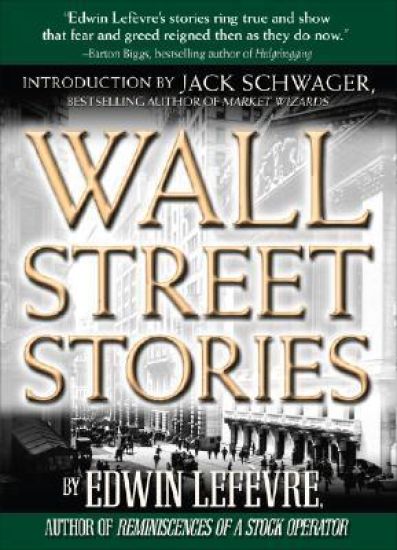
Wall Street Stories: Introduction by Jack Schwager

Wall Street Stories: Introduction by Jack Schwager

Edwin Lefevre

McGraw-Hill Professional
2008
sidottu
“Lefèvre provided me with a goal when I wrote my first Market Wizards book… to write a book that would emulate the spirit of Lefèvre's work in maintaining truth and relevance many years after it was written.”-from the Foreword by Jack SchwagerThe book that launched Edwin Lefèvre's literary career, Wall Street Stories is considered by many to be his most memorable work, second only to Reminiscences of a Stock Operator, his classic fictionalization of the life of Jesse Livermore. Published to great critical acclaim in 1901, Wall Street Stories is a literary romp through the habits and customs of Wall Street. Like all of Lefèvre's fiction it is firmly rooted in the facts as he knew them both as a top financial journalist and a successful investor, and, as was his style, many of the fictional characters in the stories are thinly-veiled portraits of well-known Wall Street personalities such as James R. Keene, Elverton R. Chapman, Roswell Pettibone Flower, and Daniel Drew-names as familiar to the public in their day as Warren Buffet, George Soros, and Julian Robertson are today.But the charm of the eight tales in Wall Street Stories isn't just in their ability to convey a sense of life in a bygone era. It comes from the timeless insights they offer into human nature warped in the crucible of the stock market. Each of these witty tales of still resonate with poignancy and simple authority.
Flatland

Flatland

Edwin Abbott

Penguin Classics
1999
pokkari
A 'romance of many dimensions' that has fascinated generations of readers with its clever blend of social satire and mathematical theory, the Penguin Classics edition of Edwin A. Abbott's Flatland introduction by Alan Lightman.A work that continues to pose provocative questions about perception and reality, Flatland is a brilliant parody of Victorian society where all existence is limited to length and breadth - its inhabitants unable even to imagine a third dimension. The amiable narrator, A Square, provides an overview of this fantastic world - its physics and metaphysics, its history, customs and religious beliefs. But when a strange visitor mysteriously appears and transports the incredulous Flatlander to the Land of Three Dimensions, his world view is forever shattered.Written more than a century ago, Flatland conceals within its brilliant parody of Victorian society speculations about the universe that resonate in Einstein's theory of relativity as well as the current 'string-theory' of nature.Edwin A. Abbott (1838-1926) was a leading scholar and theologian of the Victorian era.If you enjoyed Flatland you may like H.G. Wells's The Sleeper Awakes, also available in Penguin Classics.
The Penguin History Of Latin America

The Penguin History Of Latin America

Edwin Williamson

Penguin Books Ltd
2009
pokkari
Now fully updated to 2009, this acclaimed history of Latin America tells its turbulent story from Columbus to Chavez. Beginning with the Spanish and Portugese conquests of the New World, it takes in centuries of upheaval, revolution and modernization up to the present day, looking in detail at Argentina, Mexico, Brazil, Chile and Cuba, and gives an overview of the cultural developments that have made Latin America a source of fascination for the world. 'A first-rate work of history ... His cool, scholarly gaze and synthesizing intelligence demystify a part of the world peculiarly prone to myth-making ... This book covers an enormous amount of ground, geographically and culturally' Tony Gould, Independent on Sunday
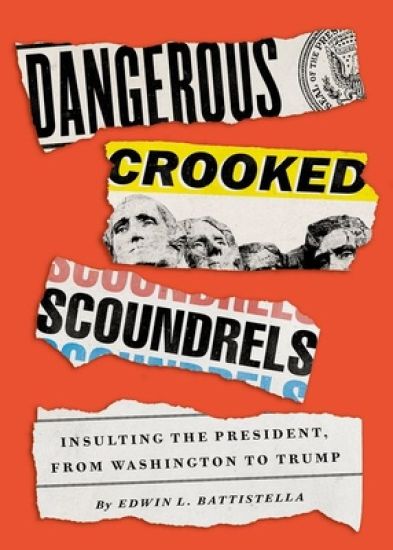
Dangerous Crooked Scoundrels

Dangerous Crooked Scoundrels

Edwin L. Battistella

Oxford University Press Inc
2020
sidottu
Insulting the president is an American tradition. From Washington to Trump, presidents have been called "lazy," "feeble," "pusillanimous," and more. Our leaders have been derided as "ignoramuses," "idiots," "morons," and "fatheads," and have been compared to all manner of animals--worms and whales and hyenas, sad jellyfish, strutting crows, lap dogs, reptiles, and monkeys. Political insults tell us what we value in our leaders by showing how we devalue them. In Dangerous Crooked Scoundrels, linguist Edwin Battistella collects over five hundred insults aimed at American presidents. Covering the broad sweep of American history, he puts insults in their place-the political and cultural context of their times. Along the way, Battistella illustrates the recurring themes of political insults: too little intellect or too much, inconsistency or obstinacy, worthlessness, weakness, dishonesty, sexual impropriety, appearance, and more. The kinds of insults we use suggest what our culture finds most hurtful, and reveal society's changing prejudices as well as its most enduring ones. How we insult presidents and how they react tells us about the presidents, but it also tells us about our nation's politics. Readers discover how the style of insults evolves in different historical periods: gone are "apostate," "mountebank," "flathead," and "doughface." Say hello to "moron," "jerk," "asshole," and "flip-flopper." Dangerous Crooked Scoundrels covers the broad sweep of American history, from the founder's debates over the nature of government to world wars and culture wars and social media. Whatever your politics, you'll find Dangerous Crooked Scoundrels an invaluable source of invigorating invective-and a healthy perspective on today's political climate.
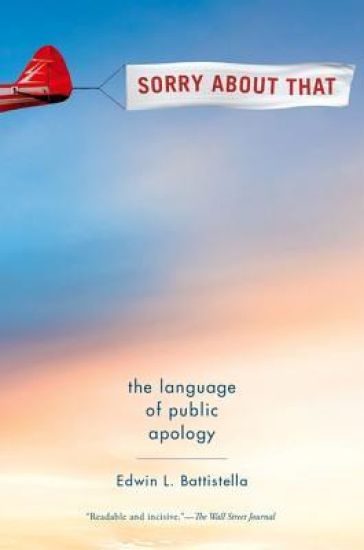
Sorry About That

Sorry About That

Edwin L. Battistella

Oxford University Press Inc
2016
nidottu
People do bad things. They misspeak, mislead, and misbehave. They lie, cheat, steal, and kill. Often, afterward, they apologize. But what makes a successful apology? Why does Joe Biden's 2007 apology for referring to Barack Obama as "articulate and bright" succeed, whereas Mel Gibson's 2006 apology for his anti-Semitic tirade fails? Naturally, the effectiveness of an apology depends on the language used, as well as the conditions under which we offer our regrets. In Sorry About That, linguist Edwin Battistella analyzes the public apologies of presidents, politicians, entertainers, and businessmen, situating the apology within American popular culture. Battistella offers the fascinating stories behind these apologies alongside his own analysis of the language used in each. He uses these examples to demonstrate the ways in which language creates sincere or insincere apologies, why we choose to apologize or don't, and how our efforts to say we are sorry succeed or fail. Each chapter expands on a central concept or distinction that explains part of the apology process. Battistella covers over fifty memorable apologies from McDonald's, Martha Stewart, Oprah Winfrey, Jane Fonda, Bill Clinton, and many more. Moving back and forth between examples and concepts, Battistella connects actual apologies with the broader social, ethical, and linguistic principles behind them. Readers will come away from the book better consumers of apologies - and better apologizers as well.
Organizational Ethics and the Good Life

Organizational Ethics and the Good Life

Edwin M. Hartman

Oxford University Press Inc
1997
nidottu
Edwin Hartman argues that ethical priciples should not derive from abstract theory, but from the real world of experience in organizations. He explains how ethical principles derive from what workers learn in their communities (firms), and that an ethical firm is one that creates the good life for the workers who contribute to its mission. His aproach is based on the Aristotelian tradition of refined common sense, from recent work on collective action problems in organizations, and from social contract theory.
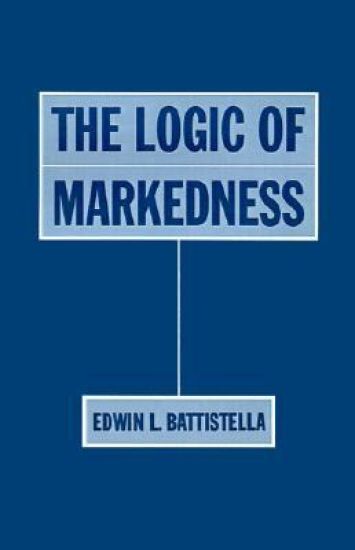
The Logic of Markedness

The Logic of Markedness

Edwin L. Battistella

Oxford University Press Inc
1997
sidottu
Theories of language espoused by linguists during much of this century have assumed that there is a hierarchy to the elements of language such that certain constructions, rules, and features are unmarked while others are marked; "play" for example, is unmarked or neutral, while "played" or "player" is marked. This opposition, referred to as markedness, is one of the concepts which both Chomskyan generative grammar and Jakobsonian structuralism appear to share, yet which each tradition has treated differently. Battistella studies the historical development of the concept of markedness in the Prague School structuralism of Roman Jakobson, its importation into generative linguistics, and its subsequent development within Chomsky's Principles and Parameters framework. He traces how structuralist and generative linguistics have drawn on and expanded the notion of markedness, both as a means of characterizing linguistic constructs and as a theory of the innate language faculty.
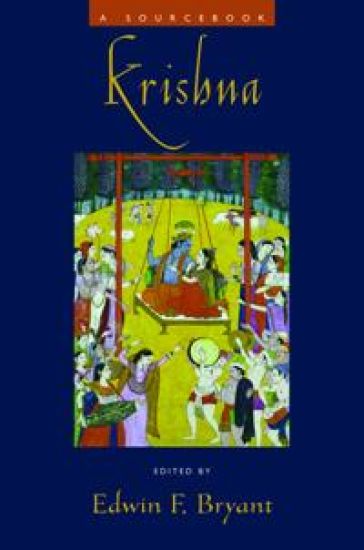
Krishna

Krishna

Edwin F. Bryant

Oxford University Press Inc
2007
nidottu
In the West Krishna is primarily known as the speaker of the Bhagavad Gita. But it is the stories of Krishna's childhood and his later exploits that have provided some of the most important and widespread sources of religious narrative in the Hindu religious landscape. This volume brings together new translations of representative samples of Krishna religious literature from a variety of genres -- classical, popular, regional, sectarian, poetic, literary, and philosophical.
Proclaim Liberty Throughout All the Land

Proclaim Liberty Throughout All the Land

Edwin S. Gaustad

Oxford University Press Inc
2003
nidottu
Should prayer be allowed in public schools? Should biology be taught according to Darwin or to the book of Genesis? Why is polygamy against the law? These are just a few of the questions that touch our lives directly and emerge out of the separation of church and state. In this volume, one of the most distinguished scholars of American religious history traces the complicated relationship of church and state from the early colonial period, through the unique American experiment in religious liberty after the Revolution, to the ongoing debate over religious issues in our schools and communities. Edwin Gaustad relates entertaining and edifying accounts of headline-grabbing court trials involving polygamy, witchcraft, and church taxation. He quotes moving passages from the speeches and writings of American Presidents and Supreme Court justices to prove that, to paraphrase Michelangelo, 'religious liberty is made up of a series of trifles, but religious liberty is no trifle'. General Editors: Jon Butler and Harry S. Stout, both at Yale University Religion in American Life explores the evolution, character, and dynamics of religion in America from 1500 to the present day. Written by distinguished religious historians, these books weave together the varying stories that compose the religious fabric of the United States, from Puritanism to alternative religious practices. Primary source material coupled with handsome illustrations and lucid text make these books essential in any exploration of Americas diverse nature. Each book includes a chronology, suggestions for further reading, and index.
The Quest for the Origins of Vedic Culture

The Quest for the Origins of Vedic Culture

Edwin Bryant

Oxford University Press Inc
2003
nidottu
Western scholars have argued that Indian civilization was the joint product of an invading Indo-European people--the "Indo-Aryans"--and indigenous non-Indo European peoples. Although Indian scholars reject this European reconstruction of their country's history, Western scholarship gives little heed to their argument. In this book, Edwin Bryant explores the nature and origins of this fascinating debate.
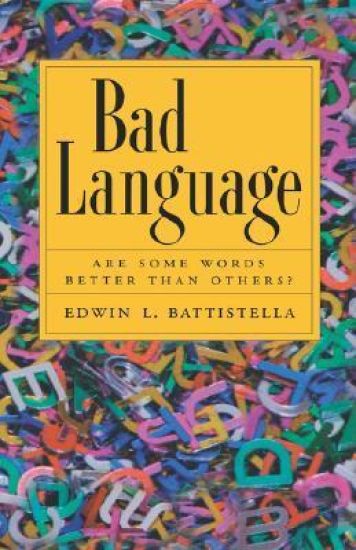
Bad Language

Bad Language

Edwin L. Battistella

Oxford University Press Inc
2005
sidottu
Is today's language at an all-time low? Are pronunciations like "cawfee" and "chawklit" bad English? Is slang like "my bad" or "hook up" improper? Is it incorrect to mix English and Spanish, as in "Yo quiero Taco Bell"? Can you write "Who do you trust?" rather than "Whom do you trust?" Linguist Edwin Battistella takes a hard look at traditional notions of bad language, arguing that they are often based in sterile conventionality. Examining grammar and style, cursing, slang, and political correctness, regional and ethnic dialects, and foreign accents and language mixing, Battistella discusses the strong feelings evoked by language variation, from objections to the pronunciation NU-cu-lar to complaints about bilingual education. He explains the natural desire for uniformity in writing and speaking and traces the association of mainstream norms to ideas about refinement, intelligence, education, character, national unity and political values. Battistella argues that none of these qualities is inherently connected to language. It is tempting but wrong, Battistella argues, to think of slang, dialects and nonstandard grammar as simply breaking the rules of good English. Instead, we should view language as made up of alternative forms of orderliness adopted by speakers depending on their purpose. Thus we can study the structure and context of nonstandard language in order to illuminate and enrich traditional forms of language, and make policy decisions based on an informed engagement. Re-examining longstanding and heated debates, Bad Language will appeal to a wide spectrum of readers engaged and interested in the debate over what constitutes "proper" language.
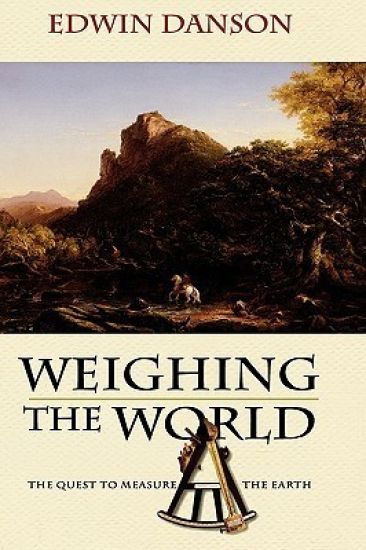
Weighing the World

Weighing the World

Edwin Danson

Oxford University Press Inc
2006
sidottu
Weighing the World is a revealing behind-the-scenes look at the scientific events leading to modern map making, written by one of the world's master surveyors. Edwin Danson, using a similar approach to his earlier best seller, "Drawing the Line: How Mason and Dixon Surveyed the Most Important Border in America" (Wiley, 2000) takes us on a journey telling the story of this experiment that has not been written about in over two hundred years. National jealousies, commercial and political rivalry were the underlying causes for many of the eighteenth century's wars but war also provided the stimulus for much commercial effort and scientific innovation. Armies equipped with the latest weaponry marched about the countryside, led by generals with only the vaguest of maps at their disposal. At the start of the century there were no maps, anywhere in the world. While there were plenty of atlases and sketch maps of countries, regions and districts, with few exceptions they were imperfect renditions in nature. No one knew, with any certainty the shape of the earth or what lay beneath its surface. Was it hollow or was it solid? Were the Andes the highest mountain on the Earth or was it the peak of Tenerife? Was the Earth a perfect sphere or was it slightly squashed as Sir Isaac Newton prophesized? Just how did you accurately measure the planet? The answers to these and other questions about the nature of the Earth, answers we now take for granted, were complete mysteries. Danson presents the stories of the scientists and scholars that had to scale the Andes, cut through tropical forests and how they handled the hardships they faced in the attempt to revolutionize our understanding of the planet.