Kirjojen hintavertailu. Mukana 11 717 486 kirjaa ja 12 kauppaa.

Kirjahaku

Etsi kirjoja tekijän nimen, kirjan nimen tai ISBN:n perusteella.

1000 tulosta hakusanalla Erika Singer
Youth, Crime, and Justice

Youth, Crime, and Justice

Erika Gebo; Carolyn Boyes-Watson

Rowman Littlefield
2017
sidottu
Youth, Crime, and Justice is a comprehensive introduction to juvenile justice through a unique case-study approach. Each chapter opens with an engaging case, followed by an explanatory chapter that teaches core concepts, key terms, and critical issues. This accessible textbook covers the historical evolution of the core institutions charged with the socialization, guidance, and regulation of children and youth in the modern era, including the family, schools, communities, child welfare, and the juvenile justice system. Adopting a life course perspective, the book examines the changing legal, social, and political landscape of childhood and adolescence in America. The authors take an intersectional focus, examining the dynamics of race, ethnicity, class, gender, sexuality, power, and privilege. The book discusses the juvenile justice system, including police, courts, corrections, and recent community innovations, in relation to the latest research on positive youth development and best practices. A complimentary Instructor’s Manual and Test Bank are available, as well as an open-access Companion Website for students that includes interactive flashcards and other learning material. Visit http://textbooks.rowman.com/gebo or email [email protected] for more information.
Youth, Crime, and Justice

Youth, Crime, and Justice

Erika Gebo; Carolyn Boyes-Watson

Rowman Littlefield
2017
nidottu
Youth, Crime, and Justice is a comprehensive introduction to juvenile justice through a unique case-study approach. Each chapter opens with an engaging case, followed by an explanatory chapter that teaches core concepts, key terms, and critical issues. This accessible textbook covers the historical evolution of the core institutions charged with the socialization, guidance, and regulation of children and youth in the modern era, including the family, schools, communities, child welfare, and the juvenile justice system. Adopting a life course perspective, the book examines the changing legal, social, and political landscape of childhood and adolescence in America. The authors take an intersectional focus, examining the dynamics of race, ethnicity, class, gender, sexuality, power, and privilege. The book discusses the juvenile justice system, including police, courts, corrections, and recent community innovations, in relation to the latest research on positive youth development and best practices. A complimentary Instructor’s Manual and Test Bank are available, as well as an open-access Companion Website for students that includes interactive flashcards and other learning material. Visit http://textbooks.rowman.com/gebo or email [email protected] for more information.
Prison Food in America

Prison Food in America

Erika Camplin

Rowman Littlefield
2016
sidottu
America seems presently fascinated by prison culture and the inner workings of what happens behind clinked doors. With TV shows creating binge-watchers of us all, and celebrities piquing public interest as they end up behind bars, Americans seem to enjoy a good gawk at prison life. Each year, more than 1.3 million visitors still trek out to Alcatraz Island, one of the most famous prisons in the world. And why shouldn’t they be curious about prison? We as a nation currently incarcerate more people per capita than any other country, and our prisons are notoriously rough, violent, and overcrowded. At the same time, we love our food, take pictures of it, post it socially, and discuss our foodie favorites. Rarely do we consider the food experiences of those for whom sustenance is more difficult to obtain, particularly those incarcerated, where choice and access is severely limited. Prison food is often everything to prisoners. It is the only marker of time throughout the day. Food becomes commerce in the microeconomies behind prison walls. It is often the only source of pleasure in a monotonous routine. It creates sites of community when prisoners ban together to create recipes, but also becomes a site of discord when issues surrounding fairness and equity arise in the chow hall. Prison Food in America offers a high-level snapshot of the fare offered behind bars, its general guidelines and regulations, fascinating stories about prisoners and food, and the remarkable and varied ways food plays a role in the fabric of prison culture.
Facing Eugenics

Facing Eugenics

Erika Dyck

University of Toronto Press
2013
pokkari
Facing Eugenics is a social history of sexual sterilization operations in twentieth-century Canada. Looking at real-life experiences of men and women who, either coercively or voluntarily, participated in the largest legal eugenics program in Canada, it considers the impact of successive legal policies and medical practices on shaping our understanding of contemporary reproductive rights. The book also provides deep insights into the broader implications of medical experimentation, institutionalization, and health care in North America. Erika Dyck uses a range of historical evidence, including medical files, court testimony, and personal records to place mental health and intelligence at the centre of discussions regarding reproductive fitness. Examining acts of resistance alongside heavy-handed decisions to sterilize people considered “unfit,” Facing Eugenics illuminates how reproductive rights fit into a broader discussion of what constitutes civil liberties, modern feminism, and contemporary psychiatric survivor and disability activism.
Erasmus As a Translator of the Classics

Erasmus As a Translator of the Classics

Erika Rummel

University of Toronto Press
1985
pokkari
This first full-length study of Erasmus’ translations of classical literature examines his approach to translation and, more generally, his role as a transmitter of the classics. It traces in chronological order the progress of his Greek studies and the publication history of his translations from Greek into Latin; these included selections from the works of Libanius, Euripides, Plutarch, Lucian, Galen, Isocrates and Xenophon. It also illustrates Erasmus’ methods with appropriate examples from his own texts and from those of his predecessors and contemporaries. In so doing it provides an overview of the state of Greek literature in the Renaissance. Erasmus shifted from literal translation to a more liberal approach – a change in attitude that was accompanied by a redefinition of his role as translator. In his early work he had pursued private goals, regarding his versions from secular authors as private pieces for his magnum opus, the New Testament. In later years his approach became more reader-oriented. He saw his work in terms of a service to scholarship – making Greek literature accessible to Latin readers and acting as their guide to classical thought. He was concerned not only with the mechanics of conveying the factual contents and literary qualities of the original, but also with the applicability of its moral content to Christian philosophy. This book includes a chapter on Erasmus’ New Testament version; by allowing a fuller evaluation of Erasmus’ contribution to philology, this subject adds an important dimension to the book. Erasmus’ translations of Greek texts reflect two concerns that dominated his life. As an educator he wanted to see classical philology firmly established in the curriculum of schools; as a Christian humanist he wanted to convince biblical scholars that it was an indispensable tool of their profession.
Facing Eugenics

Facing Eugenics

Erika Dyck

University of Toronto Press
2013
sidottu
Facing Eugenics is a social history of sexual sterilization operations in twentieth-century Canada. Looking at real-life experiences of men and women who, either coercively or voluntarily, participated in the largest legal eugenics program in Canada, it considers the impact of successive legal policies and medical practices on shaping our understanding of contemporary reproductive rights. The book also provides deep insights into the broader implications of medical experimentation, institutionalization, and health care in North America. Erika Dyck uses a range of historical evidence, including medical files, court testimony, and personal records to place mental health and intelligence at the centre of discussions regarding reproductive fitness. Examining acts of resistance alongside heavy-handed decisions to sterilize people considered “unfit,” Facing Eugenics illuminates how reproductive rights fit into a broader discussion of what constitutes civil liberties, modern feminism, and contemporary psychiatric survivor and disability activism.
To The Other Side

To The Other Side

Erika Meza

Hachette Children's Group
2023
sidottu
*Winner of Best Picture Book at the Diverse Book Award 2024*A powerful and timely story, exploring the journey of two young refugee children in search of safety. Perfect for opening up conversations about conflict and war, encouraging empathy and understanding. A young boy and his older sister have left home to play a game. To win, she tells him, they must travel across endless lands together and make it to the finish line.Children they meet along the way imagine what might be waiting for them across the border: A spotted dog? Ice cream! Or maybe a new school. But the journey is difficult, and the monsters are more real than they imagined.And when it no longer feels like a game, the two children must still find a way to forge ahead, and reach the other side.Beautifully brought to life by author-illustrator Erika Meza, this is a symbolic and emotionally rich picture book about the spirit and strength it takes to leave your home behind. Shortlisted for the Yoto Carnegie Medal, the Jhalek Prize, the Diverse Book Awards, the Inclusive Books for Children Award and the Little Rebels Award, and selected by Empathy Lab for The 2024 Read for Empathy Collection.
To The Other Side

To The Other Side

Erika Meza

Hachette Children's Group
2023
pokkari
*Winner of Best Picture Book at the Diverse Book Award 2024*'A thoughtful, profound, important book' Irish Independent'A realistic but hopeful look at two children's emigration' Publishers WeeklyPowerful and timely, To The Other Side explores the journey of two young refugee children in search of safety. Perfect for opening up conversations about conflict and war, encouraging empathy and understanding.A young boy and his older sister have left home to play a game. To win, she tells him, they must travel across endless lands together and make it to the finish line.Each child imagines what might be waiting for them across the border: A spotted dog? Ice cream! Or maybe a new school. But the journey is difficult, and the monsters are more real than they imagined.And when it no longer feels like a game, the two children must still find a way to forge ahead, and reach the other side.A stunning, symbolic and emotionally rich picture book about the spirit and strength it takes to leave your home behind. Beautifully brought to life by award-winning author-illustrator Erika Meza.Shortlisted for the Yoto Carnegie Medal, the Jhalek Prize, the Diverse Book Awards, the Inclusive Books for Children Award and the Little Rebels Award, and selected by Empathy Lab for The 2024 Read for Empathy Collection.Praise'One of the best picture books I've read in recent memory' Steve Antony'Perceptive and exquisitely illustrated' Flavia Z. Drago'Beautiful. Beautifully illustrated. Beautifully told' Jarvis 'An incredible book' Mark Bradley'Simply impeccable' Steven Lenton'An instant classic' Celine Kiernan
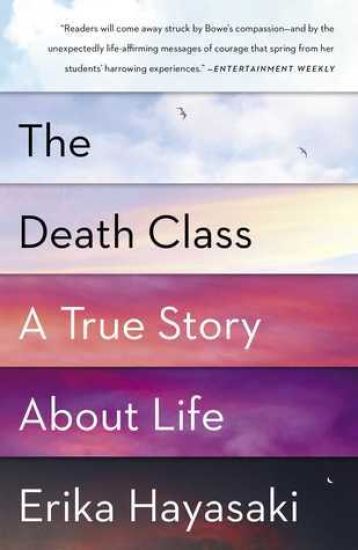
The Death Class: A True Story about Life

The Death Class: A True Story about Life

Erika Hayasaki

SIMON SCHUSTER
2014
nidottu
The poignant, "powerful" (The Boston Globe) look at how to appreciate life from an extraordinary professor who teaches about death: "Poetic passages and assorted revelations you'll likely not forget" (Chicago Tribune). Why does a college course on death have a three-year waiting list? When nurse Norma Bowe decided to teach a course on death at a college in New Jersey, she never expected it to be popular. But year after year students crowd into her classroom, and the reason is clear: Norma's "death class" is really about how to make the most of what poet Mary Oliver famously called our "one wild and precious life." Under the guise of discussions about last wills and last breaths and visits to cemeteries and crematoriums, Norma teaches her students to find grace in one another. In The Death Class, award-winning journalist Erika Hayasaki followed Norma for more than four years, showing how she steers four extraordinary students from their tormented families and neighborhoods toward happiness: she rescues one young woman from her suicidal mother, helps a young man manage his schizophrenic brother, and inspires another to leave his gang life behind. Through this unorthodox class on death, Norma helps kids who are barely hanging on to understand not only the value of their own lives, but also the secret of fulfillment: to throw yourself into helping others. Hayasaki's expert reporting and literary prose bring Norma's wisdom out of the classroom, transforming it into an inspiring lesson for all. In the end, Norma's very own life--and how she lives it--is the lecture that sticks. "Readers will come away struck by Bowe's compassion--and by the unexpectedly life-affirming messages of courage that spring from her students' harrowing experiences" (Entertainment Weekly).