
Kirjahaku
Etsi kirjoja tekijän nimen, kirjan nimen tai ISBN:n perusteella.
1000 tulosta hakusanalla Ernest T. Stringer


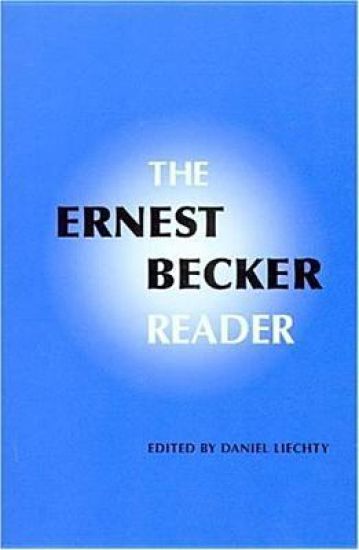
The Ernest Becker Reader
University of Washington Press
2004
pokkari
Ernest Becker (1924-1974) was an astute observer of society and human behavior during America's turbulent 1960s and 1970s. Trained in social anthropology and driven by a transcending curiosity about human motivations, Becker doggedly pursued his basic research question, "What makes people act the way they do?" Dissatisfied with what he saw as narrowly fragmented methods in the contemporary social sciences and impelled by a belief that humankind more than ever needed a disciplined, rational, and empirically based understanding of itself, Becker slowly created a powerful interdisciplinary vision of the human sciences, one in which each discipline is rooted in a basic truth concerning the human condition. That truth became an integral part of Becker's emerging social science. Almost inadvertently, he outlined a perspective on human motivations that is perhaps the most broadly interdisciplinary to date. His perspective traverses not only the biological, psychological, and social sciences but also the humanities and educational, political, and religious studies.Ernest Becker is best known for the books written in the last few years before his death from cancer, including the highly praised Pulitzer Prize-winning volume The Denial of Death (1974) and Escape from Evil (1975). These late works, however, were built on a distinguished body of earlier books, essays, and reviews. The power and strength of Becker's ideas are fully present in his early works, which underlie his later contributions and give direction for interpreting the development of his ideas.Although Ernest Becker's life and career were cut short, his major writings have remained continually in print and have captured the interest of subsequent generations of readers. The Ernest Becker Reader makes available for the first time in one volume much of Becker's early work and thus places his later work in proper context. It is a major contribution to the ongoing interest in Becker's ideas.
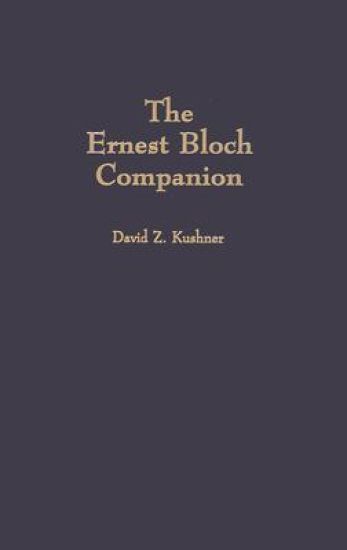
The evolution of Ernest Bloch's music is traced throughout his travels in Europe and America. A complete picture of Bloch emerges from this integrated study of his life and his music. The opening biographical chapter provides a brief, personal history from which Bloch's career and many interests follow, including his pursuits in photography. The biographical information provides the framework for addressing the Jewish Question, a common focus of Bloch's work. Bloch emerges, from this multifaceted study, as a composer whose music must be examined within both its Jewish heritage and in a larger, universal context.Musicians, scholars, and Bloch enthusiasts will welcome this volume examining Ernest Bloch's life, career and major works which are enhanced throughout by musical examples. Bloch's professional development is easily traced through the chronological organization of the book.
Sir Ernest Satow's Private Letters - Volume II, The Satow-Gubbins Correspondence (1908-1927) and Satow's Letters to Hon. H. Marsham (1894-1907)
Ian Ruxton (ed.)
Lulu.com
2019
nidottu
This volume consists mainly of letters exchanged between Sir Ernest Satow (1843-1929) and his former subordinate John Harington Gubbins (1852-1929) in their retirement, from 1906 to 1927.There are also some letters from Satow to the Japanese art collector and businessman the Hon. Henry Marsham (1845-1908) in the period 1894-1907. An expert foreword by Dr. J.E. Hoare, formerly of HM Diplomatic Service and a teaching fellow at SOAS, is included. Volume I consists of Satow's correspondence with William George Aston and Frederick Victor Dickins, and is mainly on Japanology. Volume III consists of Satow's correspondence with Lord Reay, on international law and the social, political and economic situation in Europe and the UK before, during and after World War One.
Sir Ernest Satow's Private Letters - Volume III, The Satow-Reay Correspondence (1907-1921)
Ian Ruxton (ed.)
Lulu.com
2020
nidottu
This is the third volume in a series of private letters written by Sir Ernest Satow (1843-1929) to his close friends. Volume One comprises his letters to Japanologists William George Aston and Frederick Victor Dickins. Volume Two consists mainly of letters to and from John Harington Gubbins who had worked under Satow in Japan. In this third volume Satow mainly discusses international law (law of the sea in wartime, Versailles peace treaty etc.) and the current political situation in the UK and Europe, a far cry from his East Asian focus on Japan which monopolised Volume One, and was still evident in Volume Two. (Lord Reay had no experience of Japan in his distinguished career.) The expert foreword is by Dr. J.E. Hoare, formerly of H.M. Diplomatic Service and a Teaching Fellow at S.O.A.S.
This definitive collection of short stories by one of America's greatest writers and a Nobel Prize-winner is organized in chronological sequence and features a preface by the author himself. Reprint. 12,000 first printing.
As a conductor, organist, pianist, composer, educator, writer, administrator, and musical statesman, Sir Ernest MacMillan stands as a towering figure in Canada's musical history. His role in the development of music in Canada from the beginning of this century to 1970 was pivotal. He conducted the Toronto Symphony Orchestra for twenty-five years, and the Toronto Mendelssohn Choir for fifteen . He was principal of the Toronto (now Royal) Conservatory of Music and dean of the University of Toronto's Faculty of Music. He founded the Canadian Music Council, and the Canadian Music Centre, and was a founding member of the Canada Council. He was also the first president of the Composers, Authors, and Publishers Association of Canada (CAPAC). Ezra Schabas provides not only the first detailed biography of MacMillan, but also a frank, richly detailed and handsomely illustrated account of the Canadian music scene. He tells of MacMillan's rise in Canada, from his early years as a church organist to his international successes as a guest conductor; from his internment in a German prison camp to the knighthood conferred on him by King George V. As Robertson Davies said of MacMillan, 'It is on the achievements of such men that the culture of a country rests. Their work is not education, but revelation, and there is always about it something of prophetic splendour.'
The John Cogburn Family / by Lewellyn Ernest Cogburn.
Lewellyn Ernest Cogburn
Hassell Street Press
2021
nidottu
This work has been selected by scholars as being culturally important and is part of the knowledge base of civilization as we know it.This work is in the public domain in the United States of America, and possibly other nations. Within the United States, you may freely copy and distribute this work, as no entity (individual or corporate) has a copyright on the body of the work.Scholars believe, and we concur, that this work is important enough to be preserved, reproduced, and made generally available to the public. To ensure a quality reading experience, this work has been proofread and republished using a format that seamlessly blends the original graphical elements with text in an easy-to-read typeface.We appreciate your support of the preservation process, and thank you for being an important part of keeping this knowledge alive and relevant.

Persons and Events: Reminiscences of Ludwig Ernest Fuerbringer
Ludwig Ernest Fuerbringer
Literary Licensing, LLC
2012
nidottu