A 1928 graduate of the Naval Academy, Admiral Keith spent much of his active career in battleships and destroyers such as the USS Utah (BB-31), Arizona (BB-39), Overton (DD-239), and Aylwin (DD-355). He was the commanding officer of the destroyer USS Nicholas (DD-449) during combat in the Pacific in World War II. A substantial part of the memoir recounts his command of the battleship USS Missouri (BB-63) in 1954. He spent three tours on the staff of the Naval Academy, including duty as Commandant of Midshipmen in the mid-1950s. As a flag officer, he commanded the naval base at Subic Bay, the Pacific Fleet Cruiser-Destroyer Force, and the First Fleet.
A 1928 graduate of the Naval Academy, Admiral Keith spent much of his active career in battleships and destroyers such as the USS Utah (BB-31), Arizona (BB-39), Overton (DD-239), and Aylwin (DD-355). He was the commanding officer of the destroyer USS Nicholas (DD-449) during combat in the Pacific in World War II. A substantial part of the memoir recounts his command of the battleship USS Missouri (BB-63) in 1954. He spent three tours on the staff of the Naval Academy, including duty as Commandant of Midshipmen in the mid-1950s. As a flag officer, he commanded the naval base at Subic Bay, the Pacific Fleet Cruiser-Destroyer Force, and the First Fleet.
Memorials of the Hon. Ion Keith-Falconer, M.A. - Late Lord's Almoner's Professor of Arabic in the University of Cambridge, and Missionary to the Mohammedans of Southern Arabia. Sixth Edition is an unchanged, high-quality reprint of the original edition of 1890. Hansebooks is editor of the literature on different topic areas such as research and science, travel and expeditions, cooking and nutrition, medicine, and other genres. As a publisher we focus on the preservation of historical literature. Many works of historical writers and scientists are available today as antiques only. Hansebooks newly publishes these books and contributes to the preservation of literature which has become rare and historical knowledge for the future.
Mildred at Roselands; A Sequel to Mildred Keith by Martha Finley has been regarded as significant work throughout human history, and in order to ensure that this work is never lost, we have taken steps to ensure its preservation by republishing this book in a contemporary format for both current and future generations. This entire book has been retyped, redesigned, and reformatted. Since these books are not made from scanned copies, the text is readable and clear.
Title: History of the Mortified Lands of Edinaich, in the Parish of Keith, etc.Publisher: British Library, Historical Print EditionsThe British Library is the national library of the United Kingdom. It is one of the world's largest research libraries holding over 150 million items in all known languages and formats: books, journals, newspapers, sound recordings, patents, maps, stamps, prints and much more. Its collections include around 14 million books, along with substantial additional collections of manuscripts and historical items dating back as far as 300 BC.The HISTORY OF BRITAIN & IRELAND collection includes books from the British Library digitised by Microsoft. As well as historical works, this collection includes geographies, travelogues, and titles covering periods of competition and cooperation among the people of Great Britain and Ireland. Works also explore the countries' relations with France, Germany, the Low Countries, Denmark, and Scandinavia. ++++The below data was compiled from various identification fields in the bibliographic record of this title. This data is provided as an additional tool in helping to insure edition identification: ++++ British Library Lawrence, James; 1884. 75 p.; 8 . 10369.d.25.
Title: His Double Self; or, the Transformation of Keith Winstanley.Publisher: British Library, Historical Print EditionsThe British Library is the national library of the United Kingdom. It is one of the world's largest research libraries holding over 150 million items in all known languages and formats: books, journals, newspapers, sound recordings, patents, maps, stamps, prints and much more. Its collections include around 14 million books, along with substantial additional collections of manuscripts and historical items dating back as far as 300 BC.The GENERAL HISTORICAL collection includes books from the British Library digitised by Microsoft. This varied collection includes material that gives readers a 19th century view of the world. Topics include health, education, economics, agriculture, environment, technology, culture, politics, labour and industry, mining, penal policy, and social order. ++++The below data was compiled from various identification fields in the bibliographic record of this title. This data is provided as an additional tool in helping to insure edition identification: ++++ British Library Curtis, E.; 1897. 283 p.; 8 . 012626.l.39.
The 18th century was a wealth of knowledge, exploration and rapidly growing technology and expanding record-keeping made possible by advances in the printing press. In its determination to preserve the century of revolution, Gale initiated a revolution of its own: digitization of epic proportions to preserve these invaluable works in the largest archive of its kind. Now for the first time these high-quality digital copies of original 18th century manuscripts are available in print, making them highly accessible to libraries, undergraduate students, and independent scholars.This collection reveals the history of English common law and Empire law in a vastly changing world of British expansion. Dominating the legal field is the Commentaries of the Law of England by Sir William Blackstone, which first appeared in 1765. Reference works such as almanacs and catalogues continue to educate us by revealing the day-to-day workings of society.++++The below data was compiled from various identification fields in the bibliographic record of this title. This data is provided as an additional tool in helping to insure edition identification: ++++British LibraryT121535Pp.xvii-xx misnumbered xviii-xxi. The text is continuous according to the list of contents. With a final leaf containing an announcement of a royal pardon to the convicts.London, 1766. xxi i.e.xx],2,9-54, 2]p.; 8
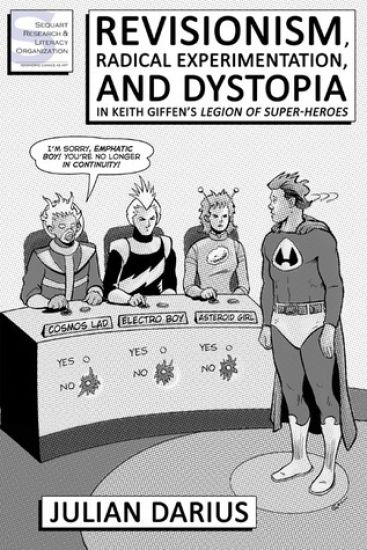
No other run divides Legion of Super-Hero fans like Keith Giffen's. To detractors, it dismantled everything good about the series.In this short book, Dr. Julian Darius argues that Giffen's run offered an ambitious and unprecedented response to the growing maturity of super-hero comics - one that, far from trashing Legion history, actually respected it.From Sequart Organization.
Orthodoxy (1908) is a book by G. K. Chesterton that has become a classic of Christian apologetics. Chesterton considered this book a companion to his other work, Heretics, writing it expressly in response to G.S. Street's criticism of the earlier work, "that he was not going to bother about his theology until I had really stated mine".In the book's preface Chesterton states the purpose is to "attempt an explanation, not of whether the Christian faith can be believed, but of how he personally has come to believe it." In it, Chesterton presents an original view of Christian religion. He sees it as the answer to natural human needs, the "answer to a riddle" in his own words, and not simply as an arbitrary truth received from somewhere outside the boundaries of human experience. The book was written when Chesterton was an Anglican. He converted to Catholicism 14 years later. Chesterton chose the title, Orthodoxy, to focus instead on the plainness of the Apostles' Creed, though he admitted the general sound of the title was "a thinnish sort of thing". Chesterton (The Man Who Knew Too Much) capped his brilliant literary career with this exploration of "right thinking," and how it led to his acceptance of the Christian faith. Although this is a very personal account of his conversion, Chesterton makes it clear he came to a rational decision based upon his scholarly examination of Christianity's arguments, intending to provide a "positive" companion to the previous Heretics.... Gilbert Keith Chesterton, KC*SG (29 May 1874 - 14 June 1936), better known as G. K. Chesterton, was an English writer, poet, philosopher, dramatist, journalist, orator, lay theologian, biographer, and literary and art critic. Chesterton is often referred to as the "prince of paradox."Time magazine has observed of his writing style: "Whenever possible Chesterton made his points with popular sayings, proverbs, allegories-first carefully turning them inside out." Chesterton is well known for his fictional priest-detective Father Brown, and for his reasoned apologetics. Even some of those who disagree with him have recognized the wide appeal of such works as Orthodoxy and The Everlasting Man.Chesterton, as a political thinker, cast aspersions on both Progressivism and Conservatism, saying, "The whole modern world has divided itself into Conservatives and Progressives. The business of Progressives is to go on making mistakes. The business of the Conservatives is to prevent the mistakes from being corrected."Chesterton routinely referred to himself as an "orthodox" Christian, and came to identify this position more and more with Catholicism, eventually converting to Catholicism from High Church Anglicanism. George Bernard Shaw, Chesterton's "friendly enemy" according to Time, said of him, "He was a man of colossal genius." Biographers have identified him as a successor to such Victorian authors as Matthew Arnold, Thomas Carlyle, Cardinal John Henry Newman, and John Ruski
Characters Stories 1.The Tremendous Adventures of Major Brown 2.The Painful Fall of a Great Reputation 3.The Awful Reason of the Vicar's Visit 4.The Singular Speculation of the House-Agent 5.The Noticeable Conduct of Professor Chadd 6.The Eccentric Seclusion of the Old Lady The Club of Queer Trades is a collection of stories by G. K. Chesterton first published in 1905.Each story in the collection is centered on a person who is making his living by some novel and extraordinary means (a "queer trade", using the word "queer" in the sense of "peculiar"). To gain admittance one must have invented a unique means of earning a living and the subsequent trade being the main source of income.