Kirjojen hintavertailu. Mukana 11 238 005 kirjaa ja 12 kauppaa.

Kirjahaku

Etsi kirjoja tekijän nimen, kirjan nimen tai ISBN:n perusteella.

1000 tulosta hakusanalla Kenneth Graham Duffield

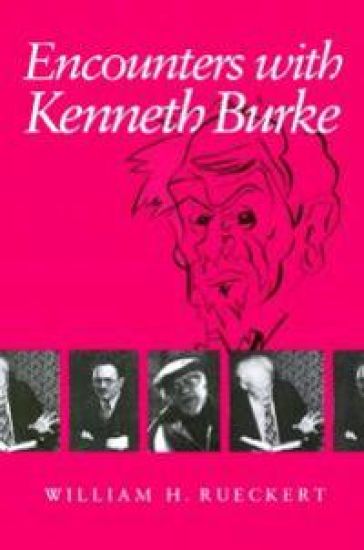
Encounters with Kenneth Burke

Encounters with Kenneth Burke

William H. Rueckert

University of Illinois Press
1994
nidottu
William H. Rueckert's landmark 1963 study, Kenneth Burke and the Drama of Human Relations, is often credited with bringing the field of Burke studies into existence. Here, Rueckert has gathered his "encounters" with Burke over the past thirty years--brieft talks, position papers, rethinking and reformation of earlier ideas, and detailed analyses of individual texts--into one volume that offers readers the best of Burkean criticism.
The Films of Kenneth Branagh

The Films of Kenneth Branagh

Samuel Crowl

Praeger Publishers Inc
2006
sidottu
Between the release of Henry V in 1989 and Love's Labour's Lost in 2000, Kenneth Branagh directed eight major films in a wide variety of genres, ranging from film noir to horror to comedy, and continually startled audiences around the world with his audacious and energetic film style. Initially following in the footsteps of Orson Welles and Laurence Olivier, Branagh has placed himself among the small collection of actors who have transformed themselves into award-winning directors as well. In this, the first comprehensive English-language treatment of Branagh's feature films, Crowl delves deeply into the work of this bold artist, demonstrating the means by which Branagh manages to produce films that appeal to the general public even while treating texts and themes that are traditionally relegated to the realms of academic institutions and high art. As with Branagh's own work, readers cannot help but be entertained.
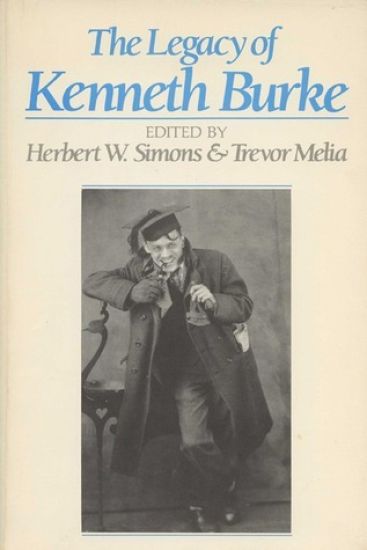
The Legacy of Kenneth Burke

The Legacy of Kenneth Burke

University of Wisconsin Press
1989
nidottu
Capturing the lively modernist milieu of Kenneth Burke s early career in Greenwich Village, where Burke arrived in 1915 fresh from high school in Pittsburgh, this book discovers him as an intellectual apprentice conversing with the moderns. Burke found himself in the midst of an avant-garde peopled by Malcolm Cowley, Marianne Moore, Jean Toomer, Katherine Anne Porter, William Carlos Williams, Allen Tate, Hart Crane, Alfred Stieglitz, and a host of other fascinating figures. Burke himself, who died in 1993 at the age of 96, has been hailed as America s most brilliant and suggestive critic and the most significant theorist of rhetoric since Cicero. Many schools of thought have claimed him as their own, but Burke has defied classification and indeed has often been considered a solitary, eccentric genius immune to intellectual fashions. But Burke s formative work of the 1920s, when he first defined himself and his work in the context of the modernist conversation, has gone relatively unexamined. Here we see Burke living and working with the crowd of poets, painters, and dramatists affiliated with Others magazine, Stieglitz s 291 gallery, and Eugene O Neill s Provincetown Players; the leftists associated with the magazines The Masses and Seven Arts; the Dadaists; and the modernist writers working on literary journals like The Dial, where Burke in his capacity as an associate editor saw T. S. Eliot s The Wasteland into print for the first time and provided other editorial services for Thomas Mann, e.e. cummings, Ezra Pound, and many other writers of note. Burke also met the iconoclasts of the older generation represented by Theodore Dreiser and H. L. Mencken, the New Humanists, and the literary nationalists who founded Contact and The New Republic. Jack Selzer shows how Burke s own early poems, fiction, and essays emerged from and contributed to the modernist conversation in Greenwich Village. He draws on a wonderfully rich array of letters between Burke and his modernist friends and on the memoirs of his associates to create a vibrant portrait of the young Burke s transformation from aesthete to social critic."
1916 - 1918 Letters to Kenneth McAffee Ralston
A packet of letters sent to son on the farm from family during World War 1. Especially touching to learn about his mother's life during a war when her oldest son was away in the trenches of France. And then learn about her son's hospital stay as a result of a gas attack by the enemy. At the same time, her mother, was stricken to bed and slowly dying. During this time the influenza epidemic was affecting family and friends. Often her husband was away all week in the Northwood's of Wisconsin working as a railway surveyor. Yet, there is no word of discouragement or complaint by her.
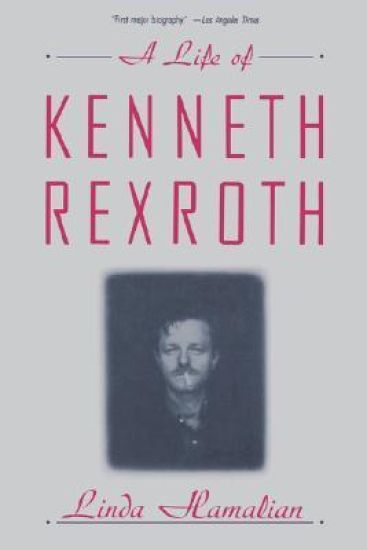
A Life of Kenneth Rexroth

A Life of Kenneth Rexroth

Linda Hamalian

WW Norton Co
1993
nidottu
A poet and activist, Kenneth Rexroth is a central figure in the San Francisco literary renaissance. But his nature and love poetry have left their mark on several generations of modern poets, from Beats to Denise Levertov, Carolyn Forché, and Jessica Hagedorn. A complex person, Rexroth was a self-taught man of great knowledge, a consummate storyteller, a man who could be thoroughly charming one day and who could take your head off the next. In the definitive and only biography, Linda Hamalian explores Rexroth’s life and work in all their depth.
The Legacy of John Kenneth Galbraith
When John Kenneth Galbraith passed away on April 29, 2006, the economics profession lost one of its true giants. And this is not just because Galbraith was an imposing figure at 6 feet, 9 inches tall. Throughout his life, Galbraith advised Presidents, made important professional contributions to the discipline of economics, and also tried to explain economic ideas to the general public. This volume pays tribute to Galbraith’s life and career by explaining some of his major contributions to the canon of economic ideas. The papers describe the series of unique contributions that Galbraith made in many different areas. He was a founder of the Post Keynesian view of money, and a proponent of the Post Keynesian view that price controls were necessary to deal with the problem of inflation in a modern economy where large firms already control prices and prices are not determined by the market. He promulgated the view that firms manipulate individual preferences and tastes, through advertising and other means of persuasion, and he drew out the economic implications of this view. He was a student of financial frauds and euphoria, and a forerunner of the Post Keynesian/Minskean view of finance and how financial markets really work. This book was published as a special issue of the Review of Political Economy.
Essays in Honor of Kenneth J. Arrow: Volume 1, Social Choice and Public Decision Making
Professor Kenneth J. Arrow is one of the most distinguished economic theorists. He has played a major role in shaping the subject and is honoured by the publication of three volumes of essays on economic theory. Each volume deals with a different area of economic theory. The books include contributions by some of the best economic theorists from the United States, Japan, Israel and Europe.
Essays in Honor of Kenneth J. Arrow: Volume 2, Equilibrium Analysis
Professor Kenneth J. Arrow is one of the most distinguished economic theorists. He has played a major role in shaping the subject and is honoured by the publication of three volumes of essays on economic theory. Each volume deals with a different area of economic theory. The books include contributions by some of the best economic theorists from the United Stated, Japan, Israel and Europe. This second volume is entitled Equilibrium Analysis and is divided into sections on general equilibrium and on the microfoundations of macroeconomics.
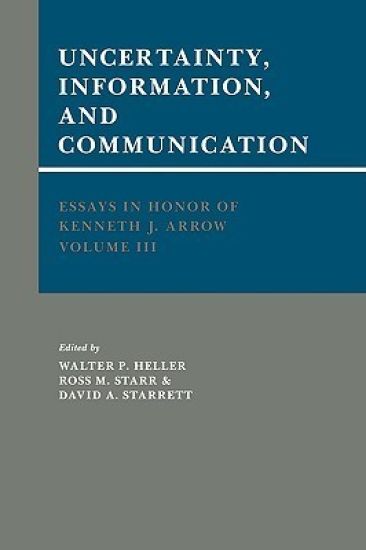
Essays in Honor of Kenneth J. Arrow: Volume 3, Uncertainty, Information, and Communication
Professor Kenneth J. Arrow is one of the most distinguished economic theorists. He has played a major role in shaping the subject and is honoured by the publication of three volumes of essays on economic theory. Each volume deals with a different area of economic theory. The books include contributions by some of the best economic theorists from the United Stated, Japan, Israel and Europe. This third volume is entitled Uncertainty, Information, and Communication.
Essays in Honor of Kenneth J. Arrow: Volume 1, Social Choice and Public Decision Making
Professor Kenneth J. Arrow is one of the most distinguished economic theorists. He has played a major role in shaping the subject and is honoured by the publication of three volumes of essays on economic theory. Each volume deals with a different area of economic theory. The books include contributions by some of the best economic theorists from the United States, Japan, Israel and Europe.
Essays in Honor of Kenneth J. Arrow: Volume 2, Equilibrium Analysis
Professor Kenneth J. Arrow is one of the most distinguished economic theorists. He has played a major role in shaping the subject and is honoured by the publication of three volumes of essays on economic theory. Each volume deals with a different area of economic theory. The books include contributions by some of the best economic theorists from the United Stated, Japan, Israel and Europe. This second volume is entitled Equilibrium Analysis and is divided into sections on general equilibrium and on the microfoundations of macroeconomics.
Essays in Honor of Kenneth J. Arrow: Volume 3, Uncertainty, Information, and Communication
Professor Kenneth J. Arrow is one of the most distinguished economic theorists. He has played a major role in shaping the subject and is honoured by the publication of three volumes of essays on economic theory. Each volume deals with a different area of economic theory. The books include contributions by some of the best economic theorists from the United Stated, Japan, Israel and Europe. This third volume is entitled Uncertainty, Information, and Communication.
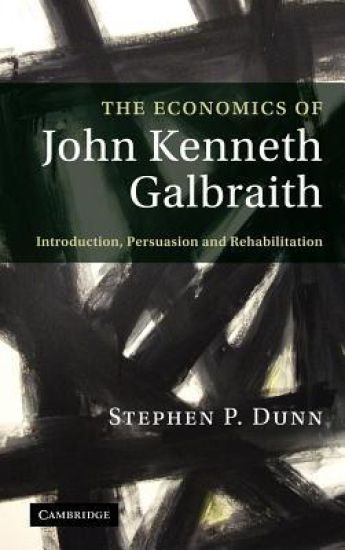
The Economics of John Kenneth Galbraith

The Economics of John Kenneth Galbraith

Stephen P. Dunn

Cambridge University Press
2010
sidottu
The recent financial crisis has once again seen John Kenneth Galbraith return to the bestseller lists. Yet, despite the continued popular success of his works, Galbraith's contribution to economic theory is rarely recognized by today's economists. This book redresses the balance by providing an introductory and sympathetic discussion of Galbraith's theoretical contributions, introducing the reader to his economics and his broader vision of the economic process. The book highlights and explains key features of Galbraith's economic thought, including his penetrating critique of society, his distinctive methodology, his specific brand of Keynesianism and his original - but largely ignored - contribution to the theory of the firm. It also presents, for the first time, a detailed examination of Galbraith's monetary economics and revisits his analysis of financial euphoria. This unique work seeks to rehabilitate Galbraith's contribution, setting out several directions for possible future research in the Galbraithian tradition.
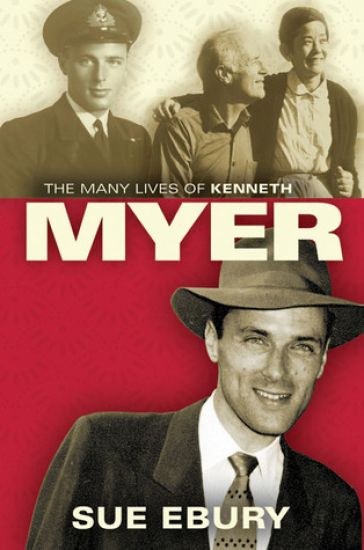
The Many Lives Of Kenneth Myer

The Many Lives Of Kenneth Myer

Sue Ebury

The Miegunyah Press
2008
pokkari
When Kenneth Baillieu Myer's father fell dead on the footpath in 1934, Ken's life changed in that instant. As the elder son of the Jewish immigrant retailing genius, Sidney Baevski Myer, who went from pedlar to philanthropist millionaire in fifteen years, Ken was immediately acknowledged as head of the family at 13 years old. Groomed by his ambitious mother to lead the Myer empire, Ken with his brother oversaw Myer's failure as a major retailing force and sold it to Coles.This biography is about money: making it, giving it and its responsibilities. It explores immigration, assimilation, anti-Semitism and acculturation in twentieth-century Australia. With 'Nugget' Coombs as his mentor, Ken gave away his fortune and founded modern philanthropy in Australia. He spoke, read and wrote Japanese. Visionary and romantic, he was depressive and driven, charming one moment, icy the next; unpretentious, generous, a passionate conservationist and, above all, unconventional. For sinking a Japanese submarine and a German U-boat during the war, he was awarded a DSC and mentioned in dispatches. Happiest when finally free of Myer, he died with his Japanese wife in a plane crash in Alaska in 1992.
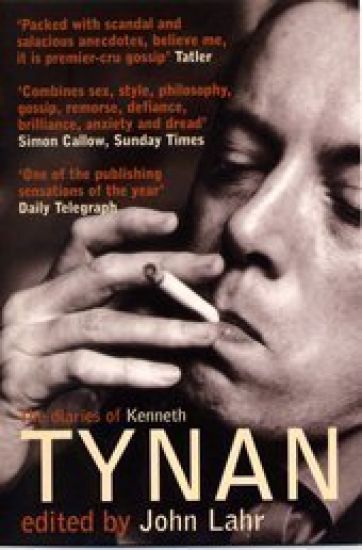
The Diaries of Kenneth Tynan

The Diaries of Kenneth Tynan

John Lahr; Kenneth Tynan

Bloomsbury Publishing PLC
2002
pokkari
Critic Kenneth Tynan, the impresario who created "Oh Calcutta", was also an eccentric and connoisseur of cuisine, wine, literature and women. His diaries record a judicious blend of aesthetics, theatre lore, love, marriage, sex and politics.
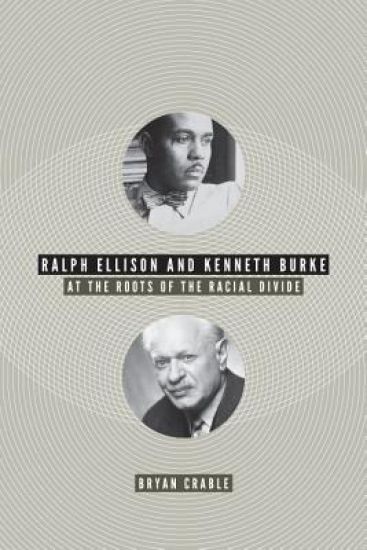
Ralph Ellison and Kenneth Burke

Ralph Ellison and Kenneth Burke

Bryan Crable

University of Virginia Press
2011
sidottu
Ralph Ellison and Kenneth Burke focuses on the little-known but important friendship between two canonical American writers. The story of this fifty-year friendship, however, is more than literary biography; Bryan Crable argues that the Burke-Ellison relationship can be interpreted as a microcosm of the American ""racial divide."" Through examination of published writings and unpublished correspondence, he reconstructs the dialogue between Burke and Ellison about race that shaped some of their most important works, including Burke's A Rhetoric of Motives and Ellison's Invisible Man. In addition, the book connects this dialogue to changes in American discourse about race. Crable shows that these two men were deeply connected, intellectually and personally, but the social division between white and black Americans produced hesitation, embarrassment, mystery, and estrangement where Ellison and Burke might otherwise have found unity. By using Ellison's non fiction and Burke's rhetorical theory to articulate a new vocabulary of race, the author concludes not with a simplistic ""healing"" of the divide but with a challenge to embrace the responsibility inherent to our social order.
Ralph Ellison and Kenneth Burke

Ralph Ellison and Kenneth Burke

Bryan Crable

University of Virginia Press
2011
nidottu
Ralph Ellison and Kenneth Burke focuses on the little-known but important friendship between two canonical American writers. The story of this fifty-year friendship, however, is more than literary biography; Bryan Crable argues that the Burke-Ellison relationship can be interpreted as a microcosm of the American ""racial divide."" Through examination of published writings and unpublished correspondence, he reconstructs the dialogue between Burke and Ellison about race that shaped some of their most important works, including Burke's A Rhetoric of Motives and Ellison's Invisible Man. In addition, the book connects this dialogue to changes in American discourse about race. Crable shows that these two men were deeply connected, intellectually and personally, but the social division between white and black Americans produced hesitation, embarrassment, mystery, and estrangement where Ellison and Burke might otherwise have found unity. By using Ellison's non fiction and Burke's rhetorical theory to articulate a new vocabulary of race, the author concludes not with a simplistic ""healing"" of the divide but with a challenge to embrace the responsibility inherent to our social order.