Kirjojen hintavertailu. Mukana 12 016 620 kirjaa ja 12 kauppaa.

Kirjahaku

Etsi kirjoja tekijän nimen, kirjan nimen tai ISBN:n perusteella.

1000 tulosta hakusanalla Sandra Dinter

A Guide to Early Years Practice

A Guide to Early Years Practice

Sandra Smidt

Routledge
2007
nidottu
This is a practical, accessible guide to early years practice. The author examines current theories about how children learn best and focuses on how we can support and extend the learning of young children. This fully revised edition discusses Birth to Three Matters, the new Childcare Bill and the development of children's centres, and has additional focus on the Foundation Stage ProfilePacked full with case studies, the book offers:practical advice on how to successfully involve parents as equal partners in the education of their children guidance to ensure that the activities and support offered to young children will promote learning across a broad and balanced Early Years curriculum a focus on special needs, multiculturalism and multilingualism, play and culture, and the importance of interactions with adults and with peers. Essential reading for students on Early Years courses, this book is also invaluable for practitioners, who can use this text as the starting point for developing their own methods within the frameworks of statutory documents relating to Early Years education.
Supporting Multilingual Learners in the Early Years
Shortlisted for the Nasen Book that supports SEN and Disability Issues Award 2008Are children who are exposed to more than one language from birth at an advantage or a disadvantage when starting school?Supporting Multilingual Learners in the Early Years examines the theoretical, ideological and practical issues involved in the education of children speaking two or more languages coming to settings which are predominantly monolingual. The book examines current research and thinking about the advantages and disadvantages of being multilingual and tackles complex topics such as: what being multilingual implies in terms of prior learning and why this matters in educationthe importance of respect for diversity and encouraging children to be proud of their language and culturepractical ways to help young children acquire English ways of working with parents who themselves have little or no English the differences and difficulties involved in a child learning an additional language so early on in their livesstrategies for exploring the learning of multilingual learners and a review of the resources and activities that could help.Sandra Smidt views multilingualism as a cognitive advantage and shows how Early Years practitioners can use interactive styles of learning to focus on the benefit that the many cultures and languages in the classroom can bring to children’s learning and development.Written in a highly accessible tone, this book offers practitioners a mix of practical case studies and examples in which theory is embedded and its importance explained. Students of early childhood education will also appreciate the author's carefully structured approach to the topic, as she includes summary boxes, glossaries and points for reflection in each chapter.
Supporting Multilingual Learners in the Early Years
Shortlisted for the Nasen Book that supports SEN and Disability Issues Award 2008Are children who are exposed to more than one language from birth at an advantage or a disadvantage when starting school?Supporting Multilingual Learners in the Early Years examines the theoretical, ideological and practical issues involved in the education of children speaking two or more languages coming to settings which are predominantly monolingual. The book examines current research and thinking about the advantages and disadvantages of being multilingual and tackles complex topics such as: what being multilingual implies in terms of prior learning and why this matters in educationthe importance of respect for diversity and encouraging children to be proud of their language and culturepractical ways to help young children acquire English ways of working with parents who themselves have little or no English the differences and difficulties involved in a child learning an additional language so early on in their livesstrategies for exploring the learning of multilingual learners and a review of the resources and activities that could help.Sandra Smidt views multilingualism as a cognitive advantage and shows how Early Years practitioners can use interactive styles of learning to focus on the benefit that the many cultures and languages in the classroom can bring to children’s learning and development.Written in a highly accessible tone, this book offers practitioners a mix of practical case studies and examples in which theory is embedded and its importance explained. Students of early childhood education will also appreciate the author's carefully structured approach to the topic, as she includes summary boxes, glossaries and points for reflection in each chapter.
Re-Envisioning Global Development

Re-Envisioning Global Development

Sandra Halperin

Routledge
2013
sidottu
Re-Envisioning Global Development offers an original conceptualisation of capitalist development from its origins to the present day.Most approaches to understanding contemporary development assume that industrial capitalism was achieved through a process of nationally organised economic growth, and that in recent years its organisation has become increasingly trans-local or global. However, Halperin shows that nationally organised economic growth has rarely been the case – it has only recently come to characterise a few countries and for only a few decades. This innovative text elaborates an alternative ontology and way of thinking about global development during the last two centuries – one linked, not to nations and regions, but to a set of essentially trans-national relations and connections. It argues that capitalist development has, everywhere and from the start, involved—not whole nations or societies–but only sectors or geographical areas within states. By bringing this aspect of historically ‘normal’ capitalist development into clearer focus, the book clarifies the specific conditions and circumstances that enabled European economies to pursue a more broad-based development following World War II, and what prevented a similar outcome in the contemporary ‘third world’. It also clarifies the nature, spatial extent, and circumstances of current globalising trends. Wide-ranging and provocative, this book is required reading for advanced level students and scholars in development studies, development economics and political science.
Re-Envisioning Global Development

Re-Envisioning Global Development

Sandra Halperin

Routledge
2013
nidottu
Re-Envisioning Global Development offers an original conceptualisation of capitalist development from its origins to the present day.Most approaches to understanding contemporary development assume that industrial capitalism was achieved through a process of nationally organised economic growth, and that in recent years its organisation has become increasingly trans-local or global. However, Halperin shows that nationally organised economic growth has rarely been the case – it has only recently come to characterise a few countries and for only a few decades. This innovative text elaborates an alternative ontology and way of thinking about global development during the last two centuries – one linked, not to nations and regions, but to a set of essentially trans-national relations and connections. It argues that capitalist development has, everywhere and from the start, involved—not whole nations or societies–but only sectors or geographical areas within states. By bringing this aspect of historically ‘normal’ capitalist development into clearer focus, the book clarifies the specific conditions and circumstances that enabled European economies to pursue a more broad-based development following World War II, and what prevented a similar outcome in the contemporary ‘third world’. It also clarifies the nature, spatial extent, and circumstances of current globalising trends. Wide-ranging and provocative, this book is required reading for advanced level students and scholars in development studies, development economics and political science.
Planning for the Early Years Foundation Stage
The Practical Guidance in the Early Years Foundation Stage series will assist practitioners in the smooth and successful implementation of the Early Years Foundation Stage.Each book gives clear and detailed explanations of each aspect of Learning and Development and encourages readers to consider each area within its broadest context to expand and develop their own knowledge and good practice.Practical ideas and activities for all age groups are offered along with a wealth of expertise of how elements from the practice guidance can be implemented within all early years settings. The books include suggestions for the innovative use of everyday ressources, popular books and stories.Planning for the Early Years Foundation Stage complements the six Learning area books in this series by explaining the basis of clear planning and how it links to careful observation and assessment. Useful examples are provided throughout, Planning across the Early Years Foundation Stage will raise awareness of what is needed within early years settings, explain the who, when and whys of observation, assessment and planning, and making useful links to each of the other books in the series.
Planning for the Early Years Foundation Stage
The Practical Guidance in the Early Years Foundation Stage series will assist practitioners in the smooth and successful implementation of the Early Years Foundation Stage.Each book gives clear and detailed explanations of each aspect of Learning and Development and encourages readers to consider each area within its broadest context to expand and develop their own knowledge and good practice.Practical ideas and activities for all age groups are offered along with a wealth of expertise of how elements from the practice guidance can be implemented within all early years settings. The books include suggestions for the innovative use of everyday ressources, popular books and stories.Planning for the Early Years Foundation Stage complements the six Learning area books in this series by explaining the basis of clear planning and how it links to careful observation and assessment. Useful examples are provided throughout, Planning across the Early Years Foundation Stage will raise awareness of what is needed within early years settings, explain the who, when and whys of observation, assessment and planning, and making useful links to each of the other books in the series.
Introducing Vygotsky

Introducing Vygotsky

Sandra Smidt

Routledge
2008
sidottu
Sandra Smidt takes the reader on a journey through the key concepts of Lev Vygotsky, one of the twentieth century’s most influential theorists in the field of early education. His ground-breaking principles of early learning and teaching are unpicked here using every-day language, and critical links between his fascinating ideas are revealed.Introducing Vygotsky is an invaluable companion for anyone involved with children in the early years. The introduction of Vygotsky’s key concepts is followed by discussion of the implications of these for teaching and learning. Each chapter also includes a useful glossary of terms.This accessible text is illustrated throughout with examples drawn from real-life early years settings and the concepts discussed include: mediation and memoryculture and cultural toolsmental functionslanguage, concepts and thinkingactivity theoryplay and meaning.Essential reading for all those interested in or working with children, Introducing Vygotsky emphasises the social nature of learning and examines the importance of issues such as culture, history, language, and symbols in learning.
Introducing Vygotsky

Introducing Vygotsky

Sandra Smidt

Routledge
2008
nidottu
Sandra Smidt takes the reader on a journey through the key concepts of Lev Vygotsky, one of the twentieth century’s most influential theorists in the field of early education. His ground-breaking principles of early learning and teaching are unpicked here using every-day language, and critical links between his fascinating ideas are revealed.Introducing Vygotsky is an invaluable companion for anyone involved with children in the early years. The introduction of Vygotsky’s key concepts is followed by discussion of the implications of these for teaching and learning. Each chapter also includes a useful glossary of terms.This accessible text is illustrated throughout with examples drawn from real-life early years settings and the concepts discussed include: mediation and memoryculture and cultural toolsmental functionslanguage, concepts and thinkingactivity theoryplay and meaning.Essential reading for all those interested in or working with children, Introducing Vygotsky emphasises the social nature of learning and examines the importance of issues such as culture, history, language, and symbols in learning.
The 1940 Tokyo Games: The Missing Olympics
By representing their experience of modernity as different from the West in their respective Olympic Games, Asian nations reveal much about the ambitions and anxieties of being an Asian host in the continuing western Olympic hegemony. This original work explores the encounter between ‘the East and the West’ by analyzing the deliberate self-presentational cultural diplomacy historically required of Asian Olympic hosts.Exploring the relationship between Modern Asia and the Olympic Games, it focuses on the forgotten history of the 1940 Tokyo Olympics to reveal the complex and fascinating encounter between Japan and the world in the 1930s. The book is the first full account of this encounter and draws substantially on Japanese sources hitherto unknown in the English-speaking world. It argues that this encounter sets the scene and the tone for later Asian involvement in the Olympic Movement. It includes chapters on:Imperial Commemoration and Diplomacy the Japanese Fascist Olympicsthe Event, Japanese Stylethe Spectre of 1940 in Later Asian Olympics.This work fills a gap in the literature, and provides an original addition to the history of Japanese culture, Asian cultures and the Olympic Movement.This book is a special issue of The International Journal of the History of Sport.
Introducing Malaguzzi

Introducing Malaguzzi

Sandra Smidt

Routledge
2012
sidottu
Loris Malaguzzi is recognised as the founder of the extraordinary programmes of preschool education that developed after the war in Reggio Emilia, Italy. Deeply embedded in the cultures and communities they serve, these unique preschools have justifiably become famous throughout the world.In this accessible and engaging text, Sandra Smidt examines how Malaguzzi’s philosophy developed out of his personal experiences of growing up in post-fascist Italy. His ideas are explored and illustrated throughout by examples relating to everyday early years practice. The key themes explored include: relationships — the importance of relationships, culture and contexts to learning within any setting and beyond; transparency — the importance of listening and documentation to understanding and sharing learning; questioning — inviting children to not only answer questions but raise them, allowing them to be equal partners in all learning situations; creativity — finding ways of enabling children to use all the expressive languages they can find to express and share their ideas; equity and fairness — involving the community in all decision-making and discussions, to ensure that early childhood education is accessible and relevant to all children. This book will be of benefit to all those working with young children and essential reading for students on early childhood education programmes.
Introducing Malaguzzi

Introducing Malaguzzi

Sandra Smidt

Routledge
2012
nidottu
Loris Malaguzzi is recognised as the founder of the extraordinary programmes of preschool education that developed after the war in Reggio Emilia, Italy. Deeply embedded in the cultures and communities they serve, these unique preschools have justifiably become famous throughout the world.In this accessible and engaging text, Sandra Smidt examines how Malaguzzi’s philosophy developed out of his personal experiences of growing up in post-fascist Italy. His ideas are explored and illustrated throughout by examples relating to everyday early years practice. The key themes explored include: relationships — the importance of relationships, culture and contexts to learning within any setting and beyond; transparency — the importance of listening and documentation to understanding and sharing learning; questioning — inviting children to not only answer questions but raise them, allowing them to be equal partners in all learning situations; creativity — finding ways of enabling children to use all the expressive languages they can find to express and share their ideas; equity and fairness — involving the community in all decision-making and discussions, to ensure that early childhood education is accessible and relevant to all children. This book will be of benefit to all those working with young children and essential reading for students on early childhood education programmes.
Playing to Learn

Playing to Learn

Sandra Smidt

Routledge
2010
sidottu
Sandra Smidt sets out to explain what play is and why it is so important as one of the key ways of learning, particularly - but not solely - for young children. She argues that all play is purposeful, and can only truly considered to be play when the child has chosen what to do, where and how to do it.Using case studies drawn from all over the world, Smidt challenges some of the prevailing myths relating to play and pays close attention to what it is that early years professionals need to do to interpet the play, understand its purpose for the child and sometimes extend it. Attention is paid to the close links that play has with creativity, and the author also highlights the importance of being able to explain to colleagues, parents and even those in government, why play matters so much in terms of learning and development.This book will be of interest to anyone involved in early years’ education.
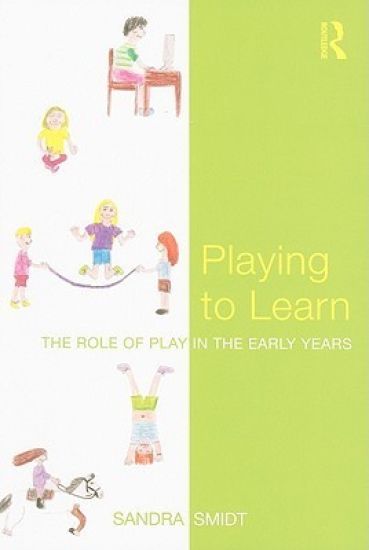
Playing to Learn

Playing to Learn

Sandra Smidt

Routledge
2010
nidottu
Sandra Smidt sets out to explain what play is and why it is so important as one of the key ways of learning, particularly - but not solely - for young children. She argues that all play is purposeful, and can only truly considered to be play when the child has chosen what to do, where and how to do it.Using case studies drawn from all over the world, Smidt challenges some of the prevailing myths relating to play and pays close attention to what it is that early years professionals need to do to interpet the play, understand its purpose for the child and sometimes extend it. Attention is paid to the close links that play has with creativity, and the author also highlights the importance of being able to explain to colleagues, parents and even those in government, why play matters so much in terms of learning and development.This book will be of interest to anyone involved in early years’ education.
Assessing Learning in the Primary Classroom
Why is assessment so important in the teaching-learning process?How should we assess pupils in the primary classroom? Assessing Learning in the Primary Classroom is an accessible introduction to the concepts critical to a professional understanding of this vital aspect of a teacher’s role. It comprehensively considers the principles underpinning effective assessment, the different forms it can take and the different purposes it serves, both within and beyond the classroom.Linking the latest research and theory with examples of assessment in the classroom, it considers key issues such as: Why we assess How we assess How we ensure quality in assessment: validity and reliability Assessment internal and external to the school Statutory assessment throughout the primary school Local, national and international assessment Using assessment results in pupil, teacher, school and system evaluationAssessing Learning in the Primary Classroom is for all students undertaking their PGCE, those working at masters level, and experienced teachers who wish to broaden their understanding of both the value and pitfalls of educational assessment.
Assessing Learning in the Primary Classroom
Why is assessment so important in the teaching-learning process?How should we assess pupils in the primary classroom? Assessing Learning in the Primary Classroom is an accessible introduction to the concepts critical to a professional understanding of this vital aspect of a teacher’s role. It comprehensively considers the principles underpinning effective assessment, the different forms it can take and the different purposes it serves, both within and beyond the classroom.Linking the latest research and theory with examples of assessment in the classroom, it considers key issues such as: Why we assess How we assess How we ensure quality in assessment: validity and reliability Assessment internal and external to the school Statutory assessment throughout the primary school Local, national and international assessment Using assessment results in pupil, teacher, school and system evaluationAssessing Learning in the Primary Classroom is for all students undertaking their PGCE, those working at masters level, and experienced teachers who wish to broaden their understanding of both the value and pitfalls of educational assessment.
Introducing Bruner

Introducing Bruner

Sandra Smidt

Routledge
2011
sidottu
Sandra Smidt takes the reader on a journey through the key concepts of Jerome Bruner, a significant figure in the field of early education whose work has spanned almost a century. His wide-ranging and innovative principles of early learning and teaching are unpicked here using everyday language and the links between his ideas and those of other key thinkers of the twentieth and twenty-first centuries are revealed.Introducing Bruner is the companion volume to Introducing Vygotsky and is an invaluable work for anyone involved with children in the early years. The introduction of Bruner's key concepts is followed by discussion of the implications of these for teaching and learning. This accessible text is illustrated throughout with examples drawn from real-life early years settings and the concepts discussed include: how children acquire language how children come to make sense of their world through narrative the significance of play to learning the importance of culture and context the role of memory what should children be taught: the spiral curriculum how should children be taught: scaffolding and interaction.The book also looks, crucially, at what those working or involved with young children can learn from Bruner, and includes a helpful glossary of terminology. This fascinating insight in to the life and work of a key figure in early years education is essential reading for anyone concerned with the learning and development of young children.
Introducing Bruner

Introducing Bruner

Sandra Smidt

Routledge
2011
nidottu
Sandra Smidt takes the reader on a journey through the key concepts of Jerome Bruner, a significant figure in the field of early education whose work has spanned almost a century. His wide-ranging and innovative principles of early learning and teaching are unpicked here using everyday language and the links between his ideas and those of other key thinkers of the twentieth and twenty-first centuries are revealed.Introducing Bruner is the companion volume to Introducing Vygotsky and is an invaluable work for anyone involved with children in the early years. The introduction of Bruner's key concepts is followed by discussion of the implications of these for teaching and learning. This accessible text is illustrated throughout with examples drawn from real-life early years settings and the concepts discussed include: how children acquire language how children come to make sense of their world through narrative the significance of play to learning the importance of culture and context the role of memory what should children be taught: the spiral curriculum how should children be taught: scaffolding and interaction.The book also looks, crucially, at what those working or involved with young children can learn from Bruner, and includes a helpful glossary of terminology. This fascinating insight in to the life and work of a key figure in early years education is essential reading for anyone concerned with the learning and development of young children.
Contradictions of Archaeological Theory
Is current archaeological theory stuck at an impasse?Sandra Wallace argues that archaeological theory has become mired as a result of logical and ontological contradictions. By showing that these contradictions are a result of common underlying philosophical assumptions and fallacies this book is able to show how a fresh approach to this discipline is necessary to resolve them, even if this requires re-examining some of the tenants of orthodox archaeology.This fresh approach is achieved by using Critical Realism as an "under labourer" to philosophically evaluate archaeological theory. Starting by assessing the historical impact of philosophy on the discipline and then looking at the current relationship between archaeology and the ontology of the material this book facilitates the construction of discipline specific theory by archaeologists. The result is an approach to archaeology that allows both students and practitioners to free themselves from endemic contradictions and re-discover their approach to archaeological theory.
Contradictions of Terrorism

Contradictions of Terrorism

Sandra Walklate; Gabe Mythen

Routledge
2014
sidottu
Over the last fifteen years there has been a significant growth in literature dealing with terrorism. Nevertheless, scholars within mainstream criminology have only recently begun to grapple with the problem of terrorism in a sustained fashion. In this provocative book the authors provide both an exposition of the contradictions that have emerged around the regulation of terrorism and an incisive analysis of the questions that the management of terrorism poses for the discipline.Focusing primarily on the processes and practices that have emerged in the United States and the United Kingdom, the book provides a critical account of the political construction, mediation and regulation of terrorist threat since the events of 9/11. The authors explore the ways in which new institutional modes of risk assessment based on the principle of pre-emption have impacted on individuals targeted by them. Noting the dilemmas produced by the pre-emptive turn, the authors also elucidate more recent moves to develop the idea of resilience in counter-terrorism and security policy. This book will be suitable for academics and students interested in political violence, terrorism, geopolitics and risk, as well as for practitioners and experts working in the security industries.