Kirjojen hintavertailu. Mukana 12 016 292 kirjaa ja 12 kauppaa.

Kirjahaku

Etsi kirjoja tekijän nimen, kirjan nimen tai ISBN:n perusteella.

1000 tulosta hakusanalla Andreas Herrmann

International Litigation and the Quest for Reasonableness
This is an innovative and provocative book by one of America's leading writers on private and public international law. Practitioners as well as students and scholars will be fascinated by the author's distillation of a lifetime of experience as a lawyer, arbitrator, government official, and teacher in presenting recent developments in litigation of controversies across national boundaries.
Trade and Environment Law in the European Community
This book offers the most up to date and comprehensive overview yet published of the European Community legal mechanisms and rules concerning the relationship between the establishment of the Single European Market and the development of international European and domestic environmental law. The author outlines the legal mechanisms of the EC Treaty and shows how they seek to create a balance between economic and environmental interests. Part one elaborates on the EC Treaty's principles governing the relationship bewteen the Single European Market and domestic environmental policy instruments. Besides the rules governing the free movement of goods (Articles 9, 12, 30-36), including the rules applicable to environmental taces (Article 95), it gives an overview of the EC's policies in the fields of green-state aids (Articles 92 etc) and competeition policies. Part two looks in detail at the harmonization of European environment related policy both for the creation of the Common/Single European Market and the development of a genuine European Environmental policy. It also looks closely at related areas such as agriculture, transport, the common commercial policy, external relations and the all important area of international environmental treaties.
The States System of Europe, 1640-1990

The States System of Europe, 1640-1990

Andreas Osiander

Clarendon Press
1994
sidottu
A novel analysis of the evolution of the states system of Europe since the mid-seventeenth century. Andreas Osiander looks at the four major European peace congresses: Munster and Osnabrück (1644-48), Utrecht (1712-15), Vienna (1814-15), and Paris (1919-20) and shows how a prevailing consensus on certain structural concepts–such as the balance of power or national self-determination–has influenced the evolution of the system and determined its stability or lack of stability. He argues that the structure of the international system is neither a given quantity nor determined primarily by conflict between international actors, but essentially the result of a general agreement expressed in `consensus principles'; these influence the identity of the international actors, their relative status, and the distribution of populations and territories between them. His approach provides a more plausible analysis of international relations and the causes of conflict than traditional theories. He concludes his study with a review of the period since 1920 in the light of his findings.
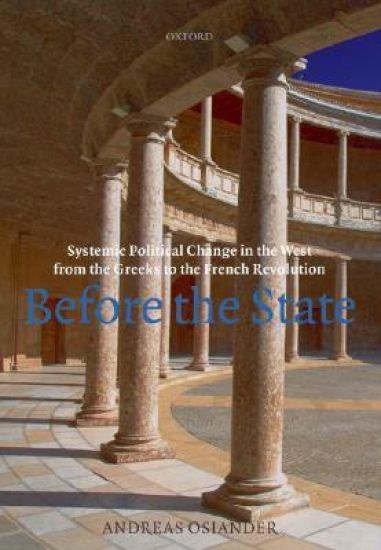
Before the State

Before the State

Andreas Osiander

Oxford University Press
2007
sidottu
The idea that society, or civilisation, is predicated on the "state" is a projection of present-day political ideology into the past. Nothing akin to what we call the "state" existed before the 19th century: it is a recent invention and the assumption that it is timeless, necessary for society, is simply part of its legitimating myth. The development, over the past three millennia, of the political structures of western civilisation is shown here to have been a succession of individual, unrepeatable stages: what links them is not that every period re-enacts the "state" in a different guise - that is, re-enacts the same basic pattern - but that one period-specific pattern evolves into the next in a path-dependent process. Treating western civilisation as a single political system, the book charts systemic structural change from the origins of western civilisation in the pre-christian Greek world to about 1800, when the onset of industrialisation began to create the conditions in which the state as we know it could function. It explains structural change in terms of both the political ideas of each period and in terms of the material constraints and opportunities (e.g. ecological and technological factors) that impacted on those ideas and which constitute a major cause of change. However, although material factors are important, ultimately it is the ideas that count - and indeed the words with which they were communicated when they were current: since political structures only exist in people´ s heads, to understand past political structures it is imperative to deal with them literally on their own terms, to take those terms seriously. Relabelling or redefining political units (for example by calling them "states" or equating them with "states") when those who lived (in) them thought of them as something else entirely imposes a false uniformity on the past. The dead will not object because they cannot: this book tries to make their voices heard again, through the texts that they left but whose political terminology, and often whose finer points, are commonly ignored in an unconscious effort to make the past fit our standard state-centric political paradigm.
Radiation Trapping in Atomic Vapours

Radiation Trapping in Atomic Vapours

Andreas F. Molisch; Bernhard P. Oehry

Clarendon Press
1998
sidottu
Radiation from spectral lines can be absorbed and re- emitted many times in atomic vapours before it reaches the boundaries of the container encasing the vapour. This effect is known as radiation trapping. It plays an important role practically everywhere where atomic vapours occur, e.g. in spectroscopy, in gas lasers, in atomic line filters, in the determination of atomic lifetimes, in measurements of atomic interaction potentials, and in electric discharge lamps. This book for the first time assembles all the information necessary for a treatment of practical problems, emphasizing both physical insights and mathematical methods. After an introduction that reviews resonance radiation and collisional processes in atomic vapours, physical effects and mathematical methods for various types of problems (e.g. with or without saturation, particle diffusion, reflecting cell walls, etc.) are explained in detail. The last part of the book describes the applications of these methods to a variety of practical problems like cross-section measurements or the design of discharge lamps.
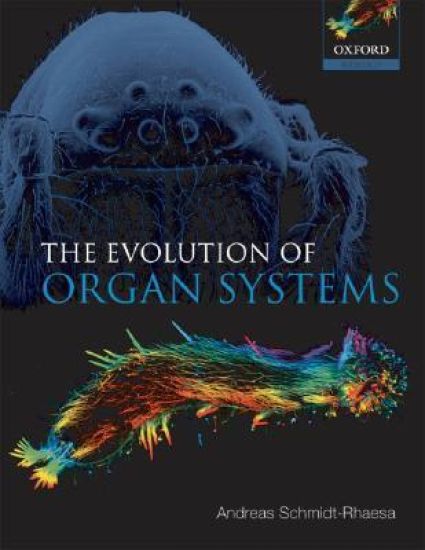
The Evolution of Organ Systems

The Evolution of Organ Systems

Andreas Schmidt-Rhaesa

Oxford University Press
2007
sidottu
Systematics has developed rapidly during the past two decades. A multitude of new methods and contributions from a diversity of biological fields including molecular genetics and developmental biology have provided a wealth of phylogenetic hypotheses, some confirming traditional views others contradicting them. Despite such inconsistencies, it is now possible to recognize robust regions of a 'tree of life' and also to identify problematic areas which have yet to be resolved. This is the first book to apply the current state of phylogeny to an evolutionary interpretation of animal organ systems and body architecture, providing alternative theories in those cases of continuing controversy. Organs do not appear suddenly during evolution; instead they are composed of far simpler structures. In some cases it is even possible to trace particular molecules or physiological pathways as far back as pre-animal history. What emerges is a fascinating picture, showing how animals have combined ancestral and new elements in novel ways to form constantly changing responses to environmental requirements. The Evolution of Organ Systems starts with a general overview of current animal phylogeny, followed by review of general body organization including symmetry, anteroposterior axis, dorsoventral axis, germ layers, segmentation, and skeletons. Subsequent chapters then provide a detailed description of the individual organ systems themselves - integument, musculature, nervous system, sensory organs, body cavities, excretory system, circulatory system, respiratory system, intestinal system, gonads and gametes. Generously illustrated throughout, this accessible text is suitable for both upper level undergraduate and graduate students taking courses in animal evolution, organogenesis, animal anatomy, zoology and systematics. It will also be a valuable reference tool for those professional researchers in these fields requiring an authoritative, balanced and up-to-date overview of the topic.
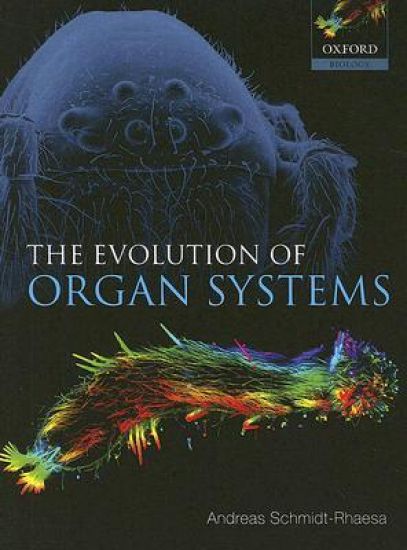
The Evolution of Organ Systems

The Evolution of Organ Systems

Andreas Schmidt-Rhaesa

Oxford University Press
2007
nidottu
Systematics has developed rapidly during the past two decades. A multitude of new methods and contributions from a diversity of biological fields including molecular genetics and developmental biology have provided a wealth of phylogenetic hypotheses, some confirming traditional views others contradicting them. Despite such inconsistencies, it is now possible to recognize robust regions of a 'tree of life' and also to identify problematic areas which have yet to be resolved. This is the first book to apply the current state of phylogeny to an evolutionary interpretation of animal organ systems and body architecture, providing alternative theories in those cases of continuing controversy. Organs do not appear suddenly during evolution; instead they are composed of far simpler structures. In some cases it is even possible to trace particular molecules or physiological pathways as far back as pre-animal history. What emerges is a fascinating picture, showing how animals have combined ancestral and new elements in novel ways to form constantly changing responses to environmental requirements. The Evolution of Organ Systems starts with a general overview of current animal phylogeny, followed by review of general body organization including symmetry, anteroposterior axis, dorsoventral axis, germ layers, segmentation, and skeletons. Subsequent chapters then provide a detailed description of the individual organ systems themselves - integument, musculature, nervous system, sensory organs, body cavities, excretory system, circulatory system, respiratory system, intestinal system, gonads and gametes. Generously illustrated throughout, this accessible text is suitable for both upper level undergraduate and graduate students taking courses in animal evolution, organogenesis, animal anatomy, zoology and systematics. It will also be a valuable reference tool for those professional researchers in these fields requiring an authoritative, balanced and up-to-date overview of the topic.

Stage, Stake, and Scaffold

Stage, Stake, and Scaffold

Andreas Höfele

Oxford University Press
2014
nidottu
The powerful exchanges between stage, stake, and scaffold - the theatre, the bear garden and the spectacle of public execution - crucially informed Shakespeare's explorations into the construction and workings of 'the human'. The theatre's family resemblance to animal baiting and the spectacle of punishment, its sharing of the same basic type of performance space -- a theatre-in-the-round, a scaffold, stake or platform surrounded by spectators -- bred an ever-ready potential for a transfer of images and meanings. The staging of one of these kinds of performance is always framed by an awareness of the other two, whose presence is never quite erased and often, indeed, emphatically foregrounded. Situating Shakespearean drama within its material environment, Andreas Höfele explores how this spill-over affects the way Shakespeare models his human characters and his understanding of 'human character' in general. His dramatis personae are infused with a degree of animality that a later, more specifically Cartesian, anthropology would categorically efface. Readings based on such an anthropology tend to reduce Shakespeare's teeming multitude of animal references to a stable marker of moral, social, and ontological difference, 'beast' being everything 'man' is not or ought not to be. In contrast, Höfele argues that Shakespearean notions of humanity rely just as much on inclusion as on exclusion of the animal. Humans and animals face each other across the species divide, but the divide proves highly permeable.
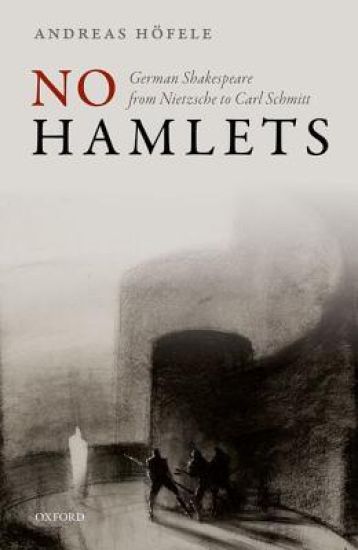
No Hamlets

No Hamlets

Andreas Höfele

Oxford University Press
2016
sidottu
No Hamlets is the first critical account of the role of Shakespeare in the intellectual tradition of the political right in Germany from the founding of the Empire in 1871 to the 'Bonn Republic' of the Cold War era. In this sustained study, Andreas Höfele begins with Friedrich Nietzsche and follows the rightist engagement with Shakespeare to the poet Stefan George and his circle, including Ernst Kantorowicz, and the literary efforts of the young Joseph Goebbels during the Weimar Republic, continuing with the Shakespeare debate in the Third Reich and its aftermath in the controversy over 'inner emigration' and concluding with Carl Schmitt's Shakespeare writings of the 1950s. Central to this enquiry is the identification of Germany and, more specifically, German intellectuals with Hamlet. The special relationship of Germany with Shakespeare found highly personal and at the same time highIy political expression in this recurring identification, and in its denial. But Hamlet is not the only Shakespearean character with strong appeal: Carl Schmitt's largely still unpublished diaries of the 1920s reveal an obsessive engagement with Othello which has never before been examined. Interest in German philosophy and political thought has increased in recent Shakespeare studies. No Hamlets brings historical depth to this international discussion. Illuminating the constellations that shaped and were shaped by specific appropriations of Shakespeare, Höfele shows how individual engagements with Shakespeare and a whole strand of Shakespeare reception were embedded in German history from the 1870s to the 1950s and eventually 1989, the year of German reunification.
A Liberal Actor in a Realist World

A Liberal Actor in a Realist World

Andreas Goldthau; Nick Sitter

Oxford University Press
2015
sidottu
Since 1992, the European Union has put liberalisation at the core of its energy policy agenda. This aspiration was very much in line with an international political economy driven by the neo-liberal (Washington) consensus. The central challenge for the EU is that the energy world has changed, while the EU has not. The rise of Asian energy consumers (China and India), more assertive energy producers (Russia), and the threat of climate change have securitized the IPE of energy, and turned it more 'realist'. The main research question is therefore: 'What does a liberal actor do in a realist world?' The overall answer as far as the EU is concerned is that it approaches energy challenges as a problem of market failure: imperfect competition on the supply side; inadequate supply of public goods on the demand side and in terms of infrastructure; and large externalities that arise both from non-energy events and from large-scale consumption of fossil fuels. A Liberal Actor in a Realist World assesses the changing nature of the global political economy of energy and the European Union's response, and the external dimension of the regulatory state. The book concludes that the EU's soft power has a hard edge, which is derived primarily from its regulatory power. This works best when it targets companies rather than governments, and it is more effective in the 'Near Abroad' than at the global level. This makes the EU emerge an actor in its own right in the global political economy of energy - a 'Regulatory Power Europe'.
Proving in the Elementary Mathematics Classroom

Proving in the Elementary Mathematics Classroom

Andreas J. Stylianides

Oxford University Press
2016
sidottu
Although proving is core to mathematics as a sense-making activity, it currently has a marginal place in elementary classrooms internationally. Blending research with practical perspectives, this book addresses what it would take to elevate the place of proving at elementary school. The book uses classroom episodes from two countries to examine different kinds of proving tasks and the proving activity they can generate in the elementary classroom. It examines further the role of teachers in mediating the relationship between proving tasks and proving activity, including major mathematical and pedagogical issues that arise for teachers as they implement each kind of proving task. In addition to its contribution to research knowledge, the book has important implications for teaching, curricular resources, and teacher education.
The Politics of Uncertainty

The Politics of Uncertainty

Andreas Schedler

Oxford University Press
2015
nidottu
Dictatorship is not what it was once. Military and single-party regimes have been withering away. Today, most dictators organize multiparty elections. The Politics of Uncertainty presents an analytical framework and empirical data that allow us to understand the distinctive political dynamics of these new electoral authoritarian regimes. It argues that all autocracies suffer from institutional uncertainties: their hold on power is never secure. They also suffer from informational uncertainties: they can never know for sure how secure they are. The author identifies these uncertainties as the central axes of regimes conflicts under dictatorship. The "politics of uncertainty" comprises the struggle between rulers and dissidents over these twin uncertainties. In electoral autocracies, it unfolds primarily as competition over electoral uncertainty. The study of electoral authoritarianism is a vibrant growth industry in political science and this book is required reading for all students of elections, authoritarianism, and democratization. Oxford Studies in Democratization is a series for scholars and students of comparative politics and related disciplines. Volumes concentrate on the comparative study of the democratization process that accompanied the decline and termination of the cold war. The geographical focus of the series is primarily Latin America, the Caribbean, Southern and Eastern Europe, and relevant experiences in Africa and Asia. The series editor is Laurence Whitehead, Senior Research Fellow, Nuffield College, University of Oxford.
Constructing Practical Reasons

Constructing Practical Reasons

Andreas Müller

Oxford University Press
2020
sidottu
Some things are reasons for us to perform certain actions. That it will spare you great pain in the future, for example, is a reason for you to go to the dentist now, and that you are already late for work is a reason for you not to read the next article in the morning paper. Why are such considerations reasons for or against certain actions? Constructivism offers an intriguing answer to this question. Its basic idea is often encapsulated in the slogan that reasons are not discovered but made by us. Andreas Müller elaborates this idea into a fully-fledged account of practical reasons, makes its theoretical commitments explicit, and defends it against some well-known objections. Constructing Practical Reasons begins with an examination of the distinctive role that reason judgements play in the process of practical reasoning. This provides the resources for an anti-representationalist conception of the nature of those judgements, according to which they are true, if they are true, not because they accurately represent certain normative facts, but because of their role in sound reasoning. On the resulting view, a consideration owes its status as a reason to the truth of the corresponding reason judgement and thus, ultimately, to the soundness of a certain episode of reasoning. Consequently, our practical reasons exhibit a kind of mind-dependence, but this does not force us to deny their objectivity.
Insiders versus Outsiders

Insiders versus Outsiders

Andreas Dür; Gemma Mateo

Oxford University Press
2016
sidottu
What explains differences in the lobbying behaviour of interest groups? And what consequences do these differences have for the access that interest groups can gain to decision-makers and the influence that they can exert on policy outcomes? Building on an unprecedented amount of empirical evidence on lobbying in Europe, this book puts forward a distinction between lobbying insiders and lobbying outsiders. Lobbying insiders, most prominently business interests, try to establish direct contacts with decision-makers, enjoy good access to executive institutions, and manage to shape policy outcomes when mobilizing the public on an issue is difficult. Lobbying outsiders, in particular citizen groups such as consumer, environmental or health non-governmental organizations, put greater emphasis on mobilizing the public or changing public attitudes, find it easier to gain access to legislative decision-makers, and have the greatest impact on outcomes on issues that are amenable to an outside lobbying campaign. The book shows that a single argument, building on group type as the main variable, can explain variation across interest groups in their choice of strategy, their access to decision-makers, and the conditions under which they can exert influence. The existence of lobbying insiders and lobbying outsiders has important implications for both our understanding of political decision-making and the normative appraisal of contemporary democracy.
Freemasonry

Freemasonry

Andreas Onnerfors

Oxford University Press
2017
nidottu
Freemasonry is one of the oldest and most widespread voluntary organisations in the world. Over the course of three centuries men (and women) have organized themselves socially and voluntarily under its name. With a strong sense of liberation, moral enlightenment, cosmopolitan openness and forward-looking philanthropy, freemasonry has attracted some of the sharpest minds in history and has created a strong platform for nascent civil societies across the globe. With the secrecy of internally communicated knowledge, the clandestine character of organization, and the enactment of rituals and the elaborate use of symbols, freemasonry has also opened up feelings of distrust, as well as allegations of secretiveness and conspiracy. This Very Short Introduction introduces the inner activities of freemasonry, and the rituals, symbols and practices. Looking at the development of the organizational structure of masonry from the local to the global level, Andreas Önnerfors considers perceptions of freemasonry from the outside world, and navigates through the prevalent fictions and conspiracy theories. He also discusses how freemasonry has from its outset struggled with issues of exclusion based upon gender, race and religion, despite promoting tolerant openness and inclusion. Finally Önnerfors shines a light on the rarely discussed but highly compelling history of female agency in masonic and para-masonic orders. ABOUT THE SERIES: The Very Short Introductions series from Oxford University Press contains hundreds of titles in almost every subject area. These pocket-sized books are the perfect way to get ahead in a new subject quickly. Our expert authors combine facts, analysis, perspective, new ideas, and enthusiasm to make interesting and challenging topics highly readable.
Lying and Insincerity

Lying and Insincerity

Andreas Stokke

Oxford University Press
2018
sidottu
Andreas Stokke presents a comprehensive study of lying and insincere language use. He investigates how lying relates to other forms of insincerity and explores the kinds of attitudes that go with insincere uses of language. Part I develops an account of insincerity as a linguistic phenomenon. Stokke provides a detailed theory of the distinction between lying and speaking insincerely, and accounts for the relationship between lying and deceiving. A novel framework of assertion underpins the analysis of various kinds of insincere speech, including false implicature and forms of misleading with presuppositions, prosodic focus, and semantic incompleteness. Part II sets out the relationship between what is communicated and the speaker's attitudes. Stokke develops the view of insincerity as a shallow phenomenon that is dependent on conscious attitudes rather than deeper motivations. The various of ways of speaking while being indifferent toward what one communicates are covered, and the phenomenon of 'bullshitting' is distinguished from lying and other forms of insincerity. Finally, an account of insincere uses of interrogative, imperative, and exclamative utterances is also given.
Magnetic Small-Angle Neutron Scattering

Magnetic Small-Angle Neutron Scattering

Andreas Michels

Oxford University Press
2021
sidottu
This monograph provides the first extensive treatment of magnetic small-angle neutron scattering (SANS). The theoretical background required to compute magnetic SANS cross sections and correlation functions related to long-wavelength magnetization structures is laid out. The concepts are scrutinized based on the discussion of experimental neutron data. Regarding prior background knowledge, some familiarity with the basic magnetic interactions and phenomena as well as scattering theory is desired. Besides exposing the different origins of magnetic SANS, and furnishing the basics of the magnetic SANS technique in early chapters, a large part of the book is devoted to a comprehensive treatment of the continuum theory of micromagnetics, as it is relevant for the study of the elastic magnetic SANS cross section. Analytical expressions for the magnetization Fourier components allow to highlight the essential features of magnetic SANS and to analyze experimental data both in reciprocal, as well as in real space. Later chapters provide an overview on the magnetic SANS of nanoparticles and so-called complex systems (e.g., ferrofluids, magnetic steels, spin glasses and amorphous magnets). It is this subfield where major progress is expected to be made in the coming years, mainly via the increased usage of numerical micromagnetic simulations (Chapter 7), which is a very promising approach for the understanding of the magnetic SANS from systems exhibiting nanoscale spin inhomogeneity.
Cryptographic Primitives in Blockchain Technology

Cryptographic Primitives in Blockchain Technology

Andreas Bolfing

Oxford University Press
2020
sidottu
Many online applications, especially in the financial industries, are running on blockchain technologies in a decentralized manner, without the use of an authoritative entity or a trusted third party. Such systems are only secured by cryptographic protocols and a consensus mechanism. As blockchain-based solutions will continue to revolutionize online applications in a growing digital market in the future, one needs to identify the principal opportunities and potential risks. Hence, it is unavoidable to learn the mathematical and cryptographic procedures behind blockchain technology in order to understand how such systems work and where the weak points are. Cryptographic Primitives in Blockchain Technology provides an introduction to the mathematical and cryptographic concepts behind blockchain technologies and shows how they are applied in blockchain-based systems. This includes an introduction to the general blockchain technology approaches that are used to build the so-called immutable ledgers, which are based on cryptographic signature schemes. As future quantum computers will break some of the current cryptographic primitive approaches, Andreas Bolfing considers their security and presents the current research results that estimate the impact on blockchain-based systems if some of the cryptographic primitive break. Based on the example of Bitcoin, he shows that weak cryptographic primitives pose a possible danger for the ledger, which can be overcome through the use of the so-called post-quantum cryptographic approaches.
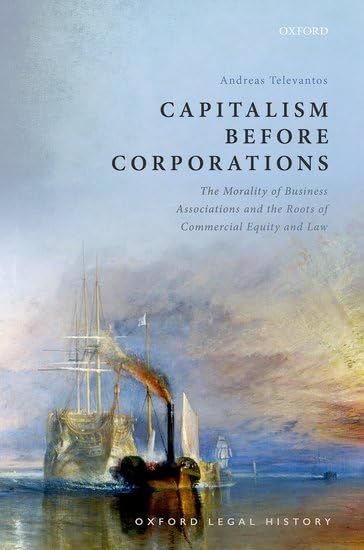
Capitalism Before Corporations

Capitalism Before Corporations

Andreas Televantos

Oxford University Press
2020
sidottu
To what extent did English law facilitate trade before the advent of general incorporation and modern securities law? This is the question at the heart of Capitalism before Corporations. It examines the extent to which legal institutions of the Regency period, especially Lord Eldon's Chancellorship, were sympathetic to the needs of merchants and willing to accommodate their changing practices and demands within established legal doctrinal frameworks and contemporary political economic thought. In so doing, this book probes at the heart of modern debates about equity, trusts, insolvency, and the justifiability of corporate privileges. Corporations are an integral part of modern life. We bank with corporations, we usually buy our groceries from them, and they provide us with most news and media. We take it for granted too that most large-scale business, and even much small-scale business, is carried out by corporations. Things were not always so. Televantos considers the Bubble Act of 1720, which criminalised the forming of corporations without a Royal Charter or Act of Parliament, its repeal in 1825, and the subsequent impact. Much of the modernisation of Britain's industry therefore took place before general incorporation was allowed. Unaided by statute, traders had to create business organisations using the basic building blocks of private law: trusts, partnership, and agency.
Capitalism Before Corporations

Capitalism Before Corporations

Andreas Televantos

Oxford University Press
2024
nidottu
To what extent did English law facilitate trade before the advent of general incorporation and modern securities law? This is the question at the heart of Capitalism before Corporations. It examines the extent to which legal institutions of the Regency period, especially Lord Eldon's Chancellorship, were sympathetic to the needs of merchants and willing to accommodate their changing practices and demands within established legal doctrinal frameworks and contemporary political economic thought. In so doing, this book probes at the heart of modern debates about equity, trusts, insolvency, and the justifiability of corporate privileges. Corporations are an integral part of modern life. We bank with corporations, we usually buy our groceries from them, and they provide us with most news and media. We take it for granted too that most large-scale business, and even much small-scale business, is carried out by corporations. Things were not always so. Televantos considers the Bubble Act of 1720, which criminalised the forming of corporations without a Royal Charter or Act of Parliament, its repeal in 1825, and the subsequent impact. Much of the modernisation of Britain's industry therefore took place before general incorporation was allowed. Unaided by statute, traders had to create business organisations using the basic building blocks of private law: trusts, partnership, and agency.