Kirjojen hintavertailu. Mukana 11 699 587 kirjaa ja 12 kauppaa.

Kirjahaku

Etsi kirjoja tekijän nimen, kirjan nimen tai ISBN:n perusteella.

1000 tulosta hakusanalla Bryan H. Suits

Travels in the Netherworld

Travels in the Netherworld

Bryan J. Cuevas

Oxford University Press Inc
2012
nidottu
In Travels in the Netherworld, Bryan J. Cuevas examines a fascinating but little-known genre of Tibetan narrative literature about the délok, ordinary men and women who claim to have died, traveled through hell, and then returned from the afterlife. These narratives enjoy audiences ranging from the most sophisticated monastic scholars to pious townsfolk, villagers, and nomads. Their accounts emphasize the universal Buddhist principles of impermanence and worldly suffering, the fluctuations of karma, and the feasibility of obtaining a favorable rebirth through virtue and merit. Providing a clear, detailed analysis of four vivid return-from-death tales, including the stories of a Tibetan housewife, a lama, a young noble woman, and a Buddhist monk, Cuevas argues that these narratives express ideas about death and the afterlife that held wide currency among all classes of faithful Buddhists in Tibet. Relying on a diversity of traditional Tibetan sources, Buddhist canonical scriptures, scholastic textbooks, ritual and meditation manuals, and medical treatises, in addition to the délok works themselves, Cuevas surveys a broad range of popular Tibetan Buddhist ideas about death and dying. He explores beliefs about the vulnerability of the soul and its journey beyond death, karmic retribution and the terrors of hell, the nature of demons and demonic possession, ghosts, and reanimated corpses. Cuevas argues that these extraordinary accounts exhibit flexibility between social and religious categories that are conventionally polarized and concludes that, contrary to the accepted wisdom, such rigid divisions as elite and folk, monastic and lay religion are not sufficiently representative of traditional Tibetan Buddhism on the ground. This study offers innovative perspectives on popular religion in Tibet and fills a gap in an important field of Tibetan literature.

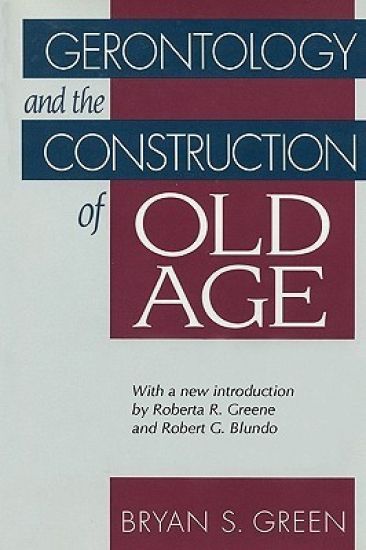
Gerontology and the Construction of Old Age

Gerontology and the Construction of Old Age

Bryan Green

AldineTransaction
1993
sidottu
Although attitudes toward the aged and their care are inherent in any society, gerontology itself is a relatively recent field of study and practice. Gerontology and the Construction of Old Age applies the methods of discourse analysis and textual analysis to texts and documents in this newly evolved and eclectic fi eld. Green explores and identifies the literary methods and discursive regularities through which aging and the aged have been made into objects of study and treatment, and which together form a mode of knowledge production that will infl uence future texts in the field.Because such formats of representation limit rational diagnoses of problems and rational courses of ameliorative action, policy implications in the fi eld of gerontology are a major interest of this study. Another interest is methodological. Within the broader constructionist approach to social reality, Green takes the position of constitutive realism: the notion that social reality is linguistically constructed, primarily in speech and writing.The book's two aims are to describe analytically the fi eld of gerontology. The field is important both for its growing academic presence and for its practical eff ects on discourse and policy concerning old age. It also hopes to help develop possibilities of inquiry associated with the linguistic, literary, and rhetorical turns of social science in recent years. Gerontology and the Construction of Old Age is a substantive investigation, at considerable theoretical depth, of gerontology itself, as well as a methodological treatise with broader implications for social science as it focuses upon the discourse of various professional fields.
Gerontology and the Construction of Old Age

Gerontology and the Construction of Old Age

Bryan Green

AldineTransaction
2009
nidottu
Although attitudes toward the aged and their care are inherent in any society, gerontology itself is a relatively recent field of study and practice. Gerontology and the Construction of Old Age applies the methods of discourse analysis and textual analysis to texts and documents in this newly evolved and eclectic fi eld. Green explores and identifies the literary methods and discursive regularities through which aging and the aged have been made into objects of study and treatment, and which together form a mode of knowledge production that will infl uence future texts in the field.Because such formats of representation limit rational diagnoses of problems and rational courses of ameliorative action, policy implications in the fi eld of gerontology are a major interest of this study. Another interest is methodological. Within the broader constructionist approach to social reality, Green takes the position of "constitutive realism": the notion that social reality is linguistically constructed, primarily in speech and writing.The book's two aims are to describe analytically the fi eld of gerontology. The field is important both for its growing academic presence and for its practical eff ects on discourse and policy concerning old age. It also hopes to help develop possibilities of inquiry associated with the linguistic, literary, and rhetorical turns of social science in recent years. Gerontology and the Construction of Old Age is a substantive investigation, at considerable theoretical depth, of gerontology itself, as well as a methodological treatise with broader implications for social science as it focuses upon the discourse of various professional fields.
Grandville Bete Noire

Grandville Bete Noire

Bryan Talbot

Vintage
2012
sidottu
At Toad Hall, lair of multibillionaire. Baron Aristotle Krapaud, a cabal of industrialists and fat cats plot the violent overthrow of the French state by the intervention of horribly beweaponed automaton soldiers. Meanwhile, the brutal murder of a famous Parisian artist, mysteriously stabbed to death in his locked and guarded studio.
Red Virgin and the Vision of Utopia

Red Virgin and the Vision of Utopia

Bryan Talbot; Mary Talbot

Vintage Publishing
2016
sidottu
Set against the background of violence and state repression in a turbulent period of French history, The Red Virgin and the Vision of Utopia chronicles the incredible and outrageous life of Louise Michel, the revolutionary feminist dubbed â??The Red Virgin of Montmartreâ??.
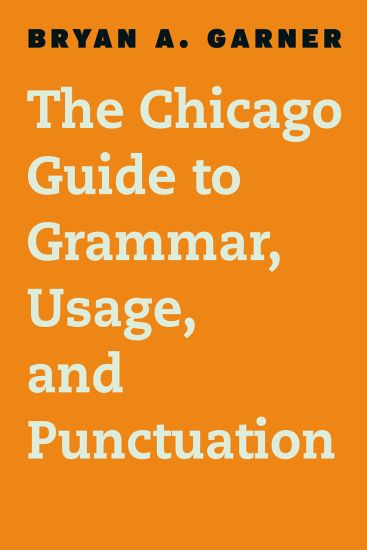
The Chicago Guide to Grammar, Usage, and Punctuation

The Chicago Guide to Grammar, Usage, and Punctuation

Bryan A. Garner

University of Chicago Press
2016
sidottu
Few people can write with as much authority on the English language as Bryan A. Garner. The author of "The" "Chicago Manual of Style" s popular Grammar and Usage chapter, Garner is adept at explaining the vagaries of English with absolute precision and utmost clarity. With "The Chicago Guide to English Grammar, Usage, and Punctuation," he has written the definitive guide for writers who want their prose to be both memorable and correct. Throughout the book Garner describes standard literary English the forms that mark writers and speakers as educated users of the language. He also offers historical context for understanding the development of these forms. The section on grammar explains how the canonical parts of speech came to be identified, while the section on syntax covers the nuances of sentence patterns as well as both traditional sentence diagramming and transformational grammar. The usage section offers an unprecedented trove of empirical evidence in the form of Google Ngrams, diagrams that illustrate the changing prevalence of specific terms over decades and even centuries of English literature. The book also covers punctuation and word formation, concluding with an exhaustive glossary of grammatical terms and a bibliography of suggested further reading and references. "The Chicago Guide to English Grammar, Usage, and Punctuation "is a magisterial work, the culmination of Garner s life-long study of the English language. The result is a landmark resource that will offer clear guidelines to students, writers, and editors alike"
Sustainable Values, Sustainable Change

Sustainable Values, Sustainable Change

Bryan G. Norton

University of Chicago Press
2015
sidottu
Sustainability is a nearly ubiquitous concept today, but can we ever imagine what it would be like for humans to live sustainably on the earth? No, says Bryan G. Norton in Sustainable Values, Sustainable Change. One of the most trafficked terms in the press, on university campuses, and in the corridors of government, sustainability has risen to prominence as a buzzword before the many parties laying claim to it have come close to agreeing how to define it. But the term's political currency urgently demands that we develop an understanding of this elusive concept. While economists, philosophers, and ecologists argue about what in nature is valuable, and why, Norton here offers an action-oriented, pragmatic response to the disconnect between public and academic discourse around sustainability. Looking to the arenas in which decisions are made-and the problems that are driving these decisions-Norton reveals that the path to sustainability cannot be guided by fixed, utopian objectives projected into the future; sustainability will instead be achieved through experimentation, incremental learning, and adaptive management. Drawing inspiration from Aldo Leopold's famed metaphor of "thinking like a mountain" for a spatially explicit, pluralistic approach to evaluating environmental change, Norton replaces theory-dependent definitions with a new decision-making process guided by deliberation and negotiation across science and philosophy, encompassing all stakeholders and activists and seeking to protect as many values as possible. Looking across scales to today's global problems, Norton urges us to learn to think like a planet.
Sustainable Values, Sustainable Change

Sustainable Values, Sustainable Change

Bryan G. Norton

University of Chicago Press
2015
nidottu
Sustainability is a nearly ubiquitous concept today, but can we ever imagine what it would be like for humans to live sustainably on the earth? No, says Bryan G. Norton in Sustainable Values, Sustainable Change. One of the most trafficked terms in the press, on university campuses, and in the corridors of government, sustainability has risen to prominence as a buzzword before the many parties laying claim to it have come close to agreeing how to define it. But the term's political currency urgently demands that we develop an understanding of this elusive concept. While economists, philosophers, and ecologists argue about what in nature is valuable, and why, Norton here offers an action-oriented, pragmatic response to the disconnect between public and academic discourse around sustainability. Looking to the arenas in which decisions are made-and the problems that are driving these decisions-Norton reveals that the path to sustainability cannot be guided by fixed, utopian objectives projected into the future; sustainability will instead be achieved through experimentation, incremental learning, and adaptive management. Drawing inspiration from Aldo Leopold's famed metaphor of "thinking like a mountain" for a spatially explicit, pluralistic approach to evaluating environmental change, Norton replaces theory-dependent definitions with a new decision-making process guided by deliberation and negotiation across science and philosophy, encompassing all stakeholders and activists and seeking to protect as many values as possible. Looking across scales to today's global problems, Norton urges us to learn to think like a planet.
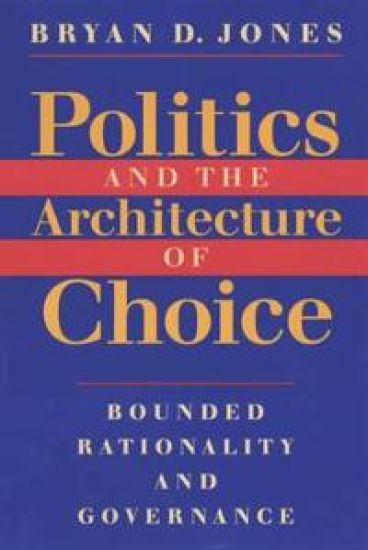
Politics and the Architecture of Choice

Politics and the Architecture of Choice

Bryan D. Jones

University of Chicago Press
2001
sidottu
This text draws on work in political science, economics, cognitive science and psychology to offer an innovative theory of how people and organizations adapt to change and why these adaptations do not always work. The author argues that our decision-making capabilities are rational and adaptive, but because our rationality is bounded and our adaptability limited, our actions are not based simply on objective information from our environments. Instead, we overemphasize some factors and neglect others, and our inherited limitations - such as short-term memory capacity - all act to affect our judgement.
Politics and the Architecture of Choice

Politics and the Architecture of Choice

Bryan D. Jones

University of Chicago Press
2001
nidottu
This text draws on work in political science, economics, cognitive science and psychology to offer an innovative theory of how people and organizations adapt to change and why these adaptations do not always work. The author argues that our decision-making capabilities are rational and adaptive, but because our rationality is bounded and our adaptability limited, our actions are not based simply on objective information from our environments. Instead, we overemphasize some factors and neglect others, and our inherited limitations - such as short-term memory capacity - all act to affect our judgement.
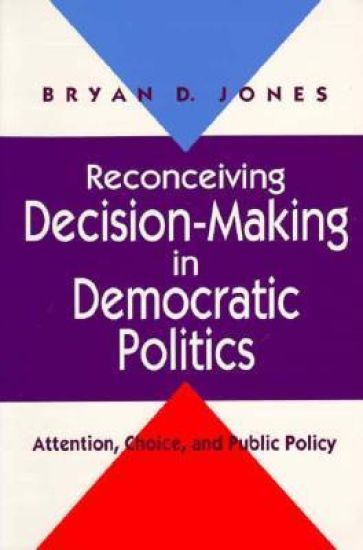
Reconceiving Decision-Making in Democratic Politics

Reconceiving Decision-Making in Democratic Politics

Bryan D. Jones

University of Chicago Press
1995
sidottu
Most models of political decision-making maintain that individual preferences remain relatively constant. Why, then, are there often sudden abrupt changes in public opinion on political issues? Or total reversals in congressional support for specific legislation, as happened with the voting on the Superconducting Supercollider? Bryan D. Jones answers these questions by connecting insights from cognitive science and rational choice theory to political life. Individuals and political systems alike, Jones argues, tend to be attentive to only one issue at a time. Using numerous examples from elections, public-opinion polls, congressional deliberations and bureaucratic decision-making, he shows how shifting attentiveness can and does alter choices and political outcomes - even when underlying preferences remain relatively fixed. An individual, for example, may initially decide to vote for a candidate because of her stand on spending, but change his vote when he learns of her position on abortion, never really balancing the two options.
Reconceiving Decision-Making in Democratic Politics

Reconceiving Decision-Making in Democratic Politics

Bryan D. Jones

University of Chicago Press
1995
nidottu
Most models of political decision-making maintain that individual preferences remain relatively constant. Why, then, are there often sudden abrupt changes in public opinion on political issues? Or total reversals in congressional support for specific legislation, as happened with the voting on the Superconducting Supercollider? Bryan D. Jones answers these questions by connecting insights from cognitive science and rational choice theory to political life. Individuals and political systems alike, Jones argues, tend to be attentive to only one issue at a time. Using numerous examples from elections, public-opinion polls, congressional deliberations and bureaucratic decision-making, he shows how shifting attentiveness can and does alter choices and political outcomes - even when underlying preferences remain relatively fixed. An individual, for example, may initially decide to vote for a candidate because of her stand on spending, but change his vote when he learns of her position on abortion, never really balancing the two options.
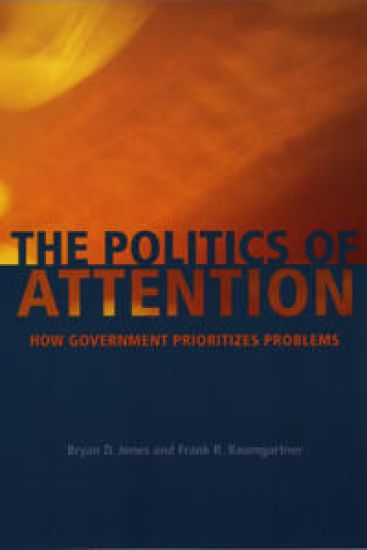
The Politics of Attention

The Politics of Attention

Bryan D. Jones; Frank R. Baumgartner

University of Chicago Press
2005
nidottu
On any given day, policymakers are required to address a multitude of problems and make decisions about a variety of issues, from the economy and education to health care and defense. This has been true for years, but until now no studies have been conducted on how politicians manage the flood of information from a wide range of sources. How do they interpret and respond to such inundation? Which issues do they pay attention to and why? Bryan D. Jones and Frank R. Baumgartner answer these questions on decision-making processes and prioritization in "The Politics of Attention". Analyzing fifty years of data, Jones and Baumgartner's book is the first study of American politics based on a new information-processing perspective. The authors bring together the allocation of attention and the operation of governing institutions into a single model that traces public policies, public and media attention to them, and governmental decisions across multiple institutions. "The Politics of Attention offers a groundbreaking approach to American politics based on the responses of policymakers to the flow of information. It asks how the system solves, or fails to solve, problems rather than looking to how individual preferences are realized through political action.
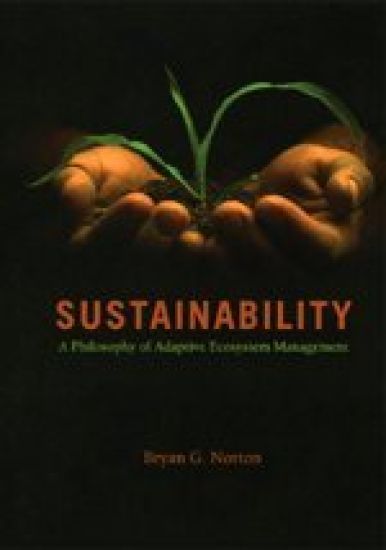
Sustainability

Sustainability

Bryan G. Norton

University of Chicago Press
2005
sidottu
While many disciplines contribute to environmental conservation, there is little successful integration of science and social values. Arguing that the central problem in conservation is a lack of effective communication, Bryan Norton shows in "Sustainability" how current linguistic resources discourage any shared, multidisciplinary public deliberation over environmental goals and policy. In response, Norton develops a new, interdisciplinary approach to defining sustainability - the corner-stone of environmental policy - using philosophical and linguistic analyses to create a nonideological vocabulary that can accommodate scientific and evaluative environmental discourse. Emphasizing cooperation and adaptation through social learning, Norton provides a practical framework that encourages an experimental approach to language clarification and problem formulation, as well as an interdisciplinary approach to creating solutions. By moving beyond the scientific arena to acknowledge the importance of public discourse, "Sustainability" offers an entirely novel approach to environmentalism.
Sustainability

Sustainability

Bryan G. Norton

University of Chicago Press
2005
nidottu
While many disciplines contribute to environmental conservation, there is little successful integration of science and social values. Arguing that the central problem in conservation is a lack of effective communication, Bryan Norton shows in "Sustainability" how current linguistic resources discourage any shared, multidisciplinary public deliberation over environmental goals and policy. In response, Norton develops a new, interdisciplinary approach to defining sustainability - the corner-stone of environmental policy - using philosophical and linguistic analyses to create a nonideological vocabulary that can accommodate scientific and evaluative environmental discourse. Emphasizing cooperation and adaptation through social learning, Norton provides a practical framework that encourages an experimental approach to language clarification and problem formulation, as well as an interdisciplinary approach to creating solutions. By moving beyond the scientific arena to acknowledge the importance of public discourse, "Sustainability" offers an entirely novel approach to environmentalism.
The Great Broadening

The Great Broadening

Bryan D Jones; Sean M Theriault; Michelle Whyman

University of Chicago Press
2019
sidottu
Beginning in the late 1950s and continuing through the 1970s, the United States experienced a vast expansion in national policy making. During this period, the federal government extended its scope into policy arenas previously left to civil society or state and local governments. With The Great Broadening, Bryan D. Jones, Sean M. Theriault, and Michelle Whyman examine in detail the causes, internal dynamics, and consequences of this extended burst of activity. They argue that the broadening of government responsibilities into new policy areas such as health care, civil rights, and gender issues and the increasing depth of existing government programs explain many of the changes in America politics since the 1970s. Increasing government attention to particular issues was motivated by activist groups. In turn, the beneficiaries of the government policies that resulted became supporters of the government’s activity, leading to the broad acceptance of its role. This broadening and deepening of government, however, produced a reaction as groups critical of its activities organized to resist and roll back its growth.
The Great Broadening

The Great Broadening

Bryan D Jones; Sean M Theriault; Michelle Whyman

University of Chicago Press
2019
pokkari
Beginning in the late 1950s and continuing through the 1970s, the United States experienced a vast expansion in national policy making. During this period, the federal government extended its scope into policy arenas previously left to civil society or state and local governments. With The Great Broadening, Bryan D. Jones, Sean M. Theriault, and Michelle Whyman examine in detail the causes, internal dynamics, and consequences of this extended burst of activity. They argue that the broadening of government responsibilities into new policy areas such as health care, civil rights, and gender issues and the increasing depth of existing government programs explain many of the changes in America politics since the 1970s. Increasing government attention to particular issues was motivated by activist groups. In turn, the beneficiaries of the government policies that resulted became supporters of the government's activity, leading to the broad acceptance of its role. This broadening and deepening of government, however, produced a reaction as groups critical of its activities organized to resist and roll back its growth.
Legal Writing in Plain English, Third Edition

Legal Writing in Plain English, Third Edition

Bryan A. Garner

THE UNIVERSITY OF CHICAGO PRESS
2023
nidottu
The leading guide to clear writing—and clear thinking—in the legal profession for more than two decades, now newly updated. Admirably clear, concise, down-to-earth, and powerful—all too often, legal writing embodies none of these qualities. Its reputation for obscurity and needless legalese is widespread. Since 2001, Bryan A. Garner’s Legal Writing in Plain English has helped address this problem by providing lawyers, judges, paralegals, law students, and legal scholars with sound advice and practical tools for improving their written work. Now the leading guide to clear writing in the field, this indispensable volume encourages legal writers to challenge conventions and offers valuable insights into the writing process: how to organize ideas, create and refine prose, and improve editing skills. Accessible and witty, Legal Writing in Plain English draws on real-life writing samples that Garner has gathered through decades of teaching experience. Trenchant advice covers all types of legal materials, from analytical and persuasive writing to legal drafting, and the book’s principles are reinforced by sets of basic, intermediate, and advanced exercises in each section. For this third edition, Garner has retained the structure of the previous versions, with updates and new material throughout. There are new sections on making your writing vivid and concrete and on using graphics to enhance your argument. The coverage and examples of key topics such as achieving parallelism, avoiding legalese, writing effective openers and summaries, and weaving quotations into your text have also been expanded. And the sample legal documents and exercises have been updated, while newly added checklists provide quick summaries of each section. Altogether, this new edition will be the most useful yet for legal professionals and students seeking to improve their prose.
Principles of Soundscape Ecology

Principles of Soundscape Ecology

Bryan C. Pijanowski

THE UNIVERSITY OF CHICAGO PRESS
2024
sidottu
From a founding figure in the field, the definitive introduction to an exciting new science. What do the sounds of a chorus of tropical birds and frogs, a clap of thunder, and a cacophony of urban traffic have in common? They are all components of a soundscape, acoustic environments that have been identified by scientists as a combination of the biophony, geophony, and anthrophony, respectively, of all of Earth’s sound sources. As sound is a ubiquitous occurrence in nature, it is actively sensed by most animals and is an important way for them to understand how their environment is changing. For humans, environmental sound is a major factor in creating a psychological sense of place, and many forms of sonic expression by people embed knowledge and culture. In this book, soundscape ecology pioneer Bryan C. Pijanowski presents the definitive text for both students and practitioners who are seeking to engage with this thrilling new field. Principles of Soundscape Ecology clearly outlines soundscape ecology’s critical foundations, key concepts, methods, and applications. Fundamentals include concise and valuable descriptions of the physics of sound as well as a thorough elucidation of all sounds that occur on Earth. Pijanowski also presents a rich overview of the ecological, sociocultural, and technical theories that support this new science, illustrating the breadth of this amazingly transdisciplinary field. In methods, he describes the principles of data mining, signal processing, and mixed methods approaches used to study soundscapes in ecological, social, or socio-ecological contexts. The final section focuses on terrestrial, aquatic, urban, and music applications, demonstrating soundscape ecology’s utility in nearly all spaces.