Kirjojen hintavertailu. Mukana 11 244 527 kirjaa ja 12 kauppaa.

Kirjahaku

Etsi kirjoja tekijän nimen, kirjan nimen tai ISBN:n perusteella.

1000 tulosta hakusanalla Kenneth Poolman

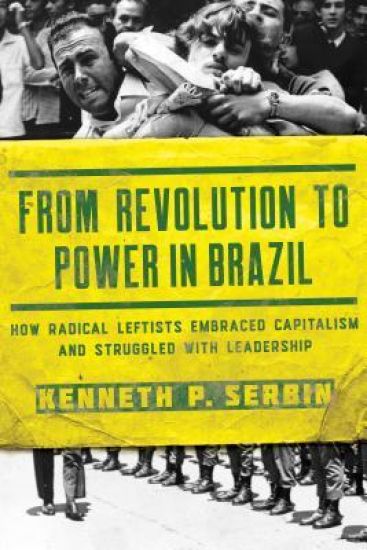
From Revolution to Power in Brazil

From Revolution to Power in Brazil

Kenneth P. Serbin

University of Notre Dame Press
2019
sidottu
From Revolution to Power in Brazil: How Radical Leftists Embraced Capitalism and Struggled with Leadership examines terrorism from a new angle. Kenneth Serbin portrays a generation of Brazilian resistance fighters and militants struggling to rebuild their lives after suffering torture and military defeat by the harsh dictatorship that took control with the support of the United States in 1964, exiting in 1985. Based on two decades of research and more than three hundred hours of interviews with former members of the revolutionary organization National Liberating Action, Serbin's is the first book to bring the story of Brazil's long night of dictatorship into the present. It explores Brazil's status as an emerging global capitalist giant and its unique contributions and challenges in the social arena. The book concludes with the rise of ex-militants to positions of power in a capitalist democracy—and how they confronted both old and new challenges posed by Brazilian society. Ultimately, Serbin explores the profound human questions of how to oppose dictatorship, revive politics in the wake of brutal repression, nurture democracy as a value, and command a capitalist system. This book will be of keen interest to business people, journalists, policy analysts, and readers with a general interest in Latin America and international affairs.
From Revolution to Power in Brazil

From Revolution to Power in Brazil

Kenneth P. Serbin

University of Notre Dame Press
2021
nidottu
From Revolution to Power in Brazil: How Radical Leftists Embraced Capitalism and Struggled with Leadership examines terrorism from a new angle. Kenneth Serbin portrays a generation of Brazilian resistance fighters and militants struggling to rebuild their lives after suffering torture and military defeat by the harsh dictatorship that took control with the support of the United States in 1964, exiting in 1985. Based on two decades of research and more than three hundred hours of interviews with former members of the revolutionary organization National Liberating Action, Serbin's is the first book to bring the story of Brazil's long night of dictatorship into the present. It explores Brazil's status as an emerging global capitalist giant and its unique contributions and challenges in the social arena. The book concludes with the rise of ex-militants to positions of power in a capitalist democracy—and how they confronted both old and new challenges posed by Brazilian society. Ultimately, Serbin explores the profound human questions of how to oppose dictatorship, revive politics in the wake of brutal repression, nurture democracy as a value, and command a capitalist system. This book will be of keen interest to business people, journalists, policy analysts, and readers with a general interest in Latin America and international affairs.
Needs of the Heart

Needs of the Heart

Kenneth P. Serbin

University of Notre Dame Press
2017
nidottu
Needs of the Heart traces five centuries of conflict and change in the life of the clergy in Brazil, home to the world's largest and arguably the most dynamic branch of the Roman Catholic Church. Serbin examines how priests participated in the colonization of Brazil, educated the elite and poor in the faith, propped up the socioeconomic status quo, and reinforced the institution of slavery, all the while living in relative freedom from church authority. Earthy men, many flouted the rule of celibacy and became embroiled in politics. Serbin also describes the conservative modernization of the clergy, effected through seminary education, in the late nineteenth and early twentieth centuries. Emphasizing discipline, the seminaries aimed to mold a new kind of priest—moral, isolated from politics and social entanglements, and, above all, obedient and celibate. However, the social, cultural, and religious upheavals of the 1960s and 1970s led students to reject the seminary. Seminarians worked to form a national union, and many left seminaries to establish greater contact with the people. The seminarians' movement sparked the practice of liberation theology; it also reflected the quest for professional and individual development, including optional celibacy. The Church responded to its seminarians' demands for personalized education by attempting to build an ambitious program in liberation psychology, a phenomenon as important as liberation theology. Seminaries necessarily dealt in the psychology of sexuality, friendship, and other basic human tendencies—what historian Marc Bloch has called the "secret needs of the heart." Serbin argues that the "needs of the heart" were a cause of the political transformation of the Brazilian Church, a transformation catalyzed by the profound identity crisis experienced by clergymen and seminarians in the 1960s and 1970s. The story of this generation of seminarians and priests is intermingled with the challenges and fears present during the repressive military dictatorship (1964 to 1985) and its aftermath. Serbin's definitive history of the Brazilian clergy combines social science research, including over one hundred interviews, with cultural and social theory and a sweeping historical perspective. Through his history of the clergy and seminaries, he provides a history of modern Brazil itself.
Adventures in Philosophy at Notre Dame

Adventures in Philosophy at Notre Dame

Kenneth M. Sayre

UNIVERSITY OF NOTRE DAME PRESS
2022
sidottu
Adventures in Philosophy at Notre Dame recounts the fascinating history of the University of Notre Dame's Department of Philosophy, chronicling the challenges, difficulties, and tensions that accompanied its transition from an obscure outpost of scholasticism in the 1940s into one of the more distinguished philosophy departments in the world today. Its author, Kenneth Sayre, who has been a faculty member for over five decades, focuses on the people of the department, describing what they were like, how they got along with each other, and how their personal predilections and ambitions affected the affairs of the department overall. The book follows the department's transition from its early Thomism to the philosophical pluralism of the 1970s, then traces its drift from pluralism to what Sayre terms "professionalism," resulting in what some perceive as a severance from its Catholic roots by the turn of the century. Each chapter includes an extensive biography of an especially prominent department member, along with biographical sketches of other philosophers arriving during the period it covers. Central to the story overall are the charismatic Irishmen Ernan McMullin and Ralph McInerny, whose interaction dominated affairs in the department in the 1960s and 1970s, and who continued to play major roles in the following decades. Philosophers throughout the English-speaking world will find Adventures in Philosophy at Notre Dame essential reading. The book will also appeal to readers interested in the history of the University of Notre Dame and of American higher education generally.
Color

Color

Kenneth A. McClane

UNIVERSITY OF NOTRE DAME PRESS
2022
sidottu
In 1991, acclaimed poet Kenneth A. McClane published Walls: Essays, 1985-1990, a volume of essays dealing with life in Harlem, the death of his alcoholic brother, and the complexities of being black and middle-class in America. Now, in Color: Essays on Race, Family, and History, McClane contributes further to his self-described "autobiographical sojourn" with a second collection of interconnected essays. In McClane's words, "All concern race, although they, like the human spirit, wildly sweep and yaw." A timely installment in our national narrative, Color is a chronicle of the black middle class, a group rarely written about with sensitivity and charity. In evocative, trenchant, and poetic prose, McClane employs the art of the memoirist to explore the political and the personal. He details the poignant narrative of racial progress as witnessed by his family during the 1950s, '60s, and '70s. We learn of his parents' difficult upbringing in Boston, where they confronted much racism; of the struggles they and McClane encountered as they became the first blacks to enter previously all-white institutions, including the oldest independent school in the United States; and of the part his parents played in the civil rights movement, working with Dr. King and others. The book ends with a tender account of his parents in the throes of Alzheimer's disease, which claimed both their lives.
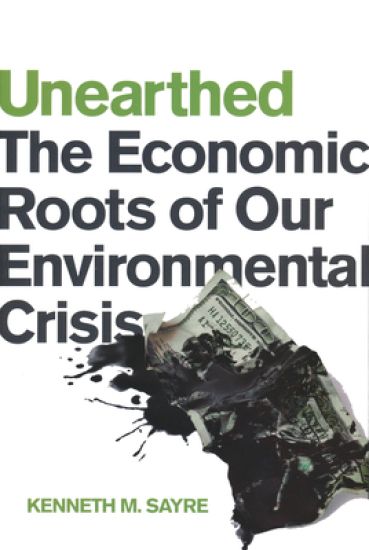
Unearthed

Unearthed

Kenneth M. Sayre

UNIVERSITY OF NOTRE DAME PRESS
2022
sidottu
In Unearthed: The Economic Roots of Our Environmental Crisis, Kenneth M. Sayre argues that the only way to resolve our current environmental crisis is to reduce our energy consumption to a level where the entropy (degraded energy and organization) produced by that consumption no longer exceeds the biosphere's ability to dispose of it. Tangible illustrations of this entropy buildup include global warming, ozone depletion, loss of species diversity, and unmanageable amounts of nonbiodegradable waste. Degradation of the biosphere is tied directly to human energy use, which has been increasing exponentially since the Industrial Revolution. Energy use, in turn, is directly correlated with economic production. Sayre shows how these three factors are invariably bound together. The unavoidable conclusion is that the only way to resolve our environmental crisis is to reverse the present pattern of growth in the world economy. Economic growth is motivated by social values. Key among them are the desire for wealth and consumer values including gratification, convenience, and acquisition of goods. Sayre maintains that economic growth can be reversed only by eliminating these social values in favor of others more conducive to environmental health. Eliminating these values will involve major changes in lifestyle within industrial societies generally. Only with such changes in lifestyle, he argues, does human society as we know it have a chance of survival. Clearly written and thoroughly documented, this book provides a comprehensive overview of our complex environmental predicament.
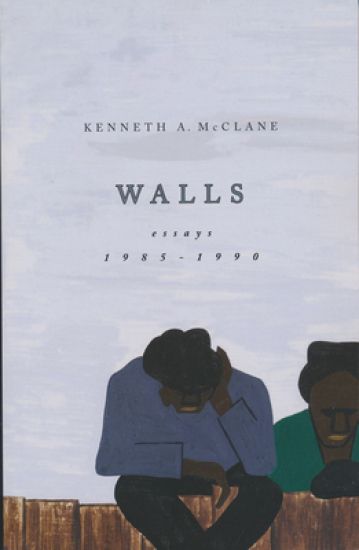
Walls

Walls

Kenneth A. McClane

UNIVERSITY OF NOTRE DAME PRESS
2022
sidottu
Walls: Essays, 1985-1990, Kenneth McClane's first book of autobiographical essays (originally published in 1991), is closely related to his second collection, Color, published by the University of Notre Dame Press in 2009. Walls is a powerful and deeply moving meditation on relationships. It begins with an essay on the death of McClane's brother, Paul, which "changed everything. Time, my work, everything found a new calculus." His brother's life and death are present in some way in all the essays that follow "A Death in the Family," as McClane tells us about giving a poetry reading in a maximum-security prison; his experience of being one of the first two African American students to attend America's oldest private school; teaching creative writing; his sister, Adrienne; a divestment protest at Cornell; and his encounters with James Baldwin. McClane has written a new preface to this paperback edition of Walls, in which he reminds us that we are inevitably interconnected: we are each other's witness.
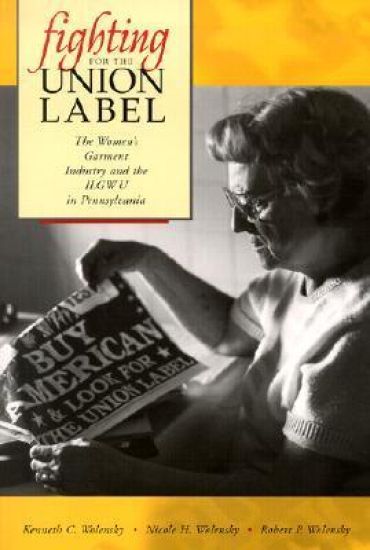
Fighting for the Union Label

Fighting for the Union Label

Kenneth C. Wolensky; Nicole H. Wolensky; Robert P. Wolensky

Pennsylvania State University Press
2002
pokkari
It is no coincidence that the garment industry gained a foothold in Pennsylvania’s hard-coal region as mines were closing or reducing operations. "Runaway" factories, especially ones from Manhattan, set up shop in mining towns where labor was plentiful and unions scarce. By the 1930s, garment factories employed thousands of wives and daughters of unemployed or underemployed coal miners in the Wyoming Valley. Organizing workers would prove difficult for the International Ladies’ Garment Workers’ Union (ILGWU). Fighting for the Union Label tells the story of how workers in the Wyoming Valley, led by Min Lurye Matheson and her husband, Bill, banded together and built one of the largest and most activist movements of garment workers in the ILGWU’s vast network. Workers’ education, political activism, a health care center, and a widely recognized chorus were among the union’s trademarks. Despite the union’s influence, however, the apparel industry migrated to the American South and then overseas in the 1970s and 1980s. Tens of thousands of workers throughout the state and nation would loose their jobs, and sweatshops would become part of the economic landscape in countries like Guatemala. The first major work on the garment industry and its workers in Pennsylvania, Fighting for the Union Label draws extensively upon the Wyoming Valley Oral History Project (co-directed by Ken and Robert Wolensky) which has collected the reminiscences of more than 325 workers, factory owners, public officials, and others. The story of the dynamic Min Matheson and the rise and fall of the garment industry provides key insights into the deindustrialization of northeastern Pennsylvania.
Democratization Without Representation

Democratization Without Representation

Kenneth C. Shadlen

Pennsylvania State University Press
2005
pokkari
When countries become more democratic, new opportunities arise for individuals and groups to participate in politics and influence the making of policy. But democratization does not ensure better representation for everyone, and indeed some sectors of society are ill-equipped to take advantage of these new opportunities. Small industry in Mexico, Kenneth Shadlen shows, is an excellent example of a sector whose representation decreased during democratization. Shadlen’s analysis focuses on the basic characteristics of small firms that complicate the process of securing representation in both authoritarian and democratic environments. He then shows how increased pluralism and electoral competition served to exacerbate the political problems facing the sector during the course of democratization in Mexico. These characteristics created problems for small firms both in acting collectively through interest associations and civil society organizations and in wielding power within political parties. The changes that democratization effected in the structure of corporatism put small industry at a significant disadvantage in the policy-making arena even while there was general agreement on the crucial importance of this sector in the new neoliberal economy, especially for generating employment. The final chapter extends the analysis by making comparisons with the experience of small industry representation in Argentina and Brazil.Shadlen uses extensive interviews and archival research to provide new evidence and insights on the difficult challenges of interest aggregation and representation for small industry. He conducted interviews with a wide range of owners and managers of small firms, state and party officials, and leaders of business associations and civil society organizations. He also did research at the National Archives in Mexico City and in the archives of the most important business organizations for small industry in the post-World War II period.
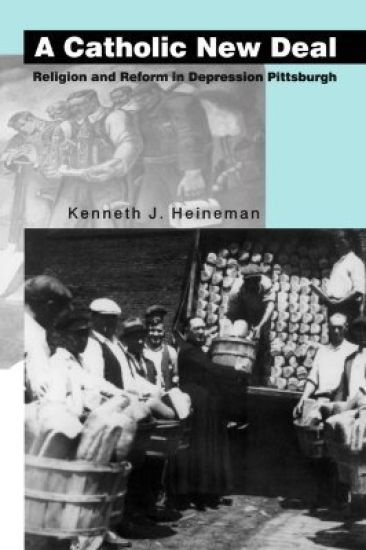
A Catholic New Deal

A Catholic New Deal

Kenneth J. Heineman

Pennsylvania State University Press
1999
pokkari
Our popular image of the era of the Great Depression is one of bread lines, labor wars, and leftist firebrands. Absent from this picture are religiously motivated social reformers, notably Catholic clergy and laity. In A Catholic New Deal, Kenneth Heineman rethinks the religious roots of labor organizing and social reform in America during the 1930s. He focuses on Pittsburgh, the leading industrial city of the time, a key center for the rise of American labor, and a critical Democratic power base, thanks in large part to Mayor David Lawrence and the Catholic vote.Despite the fact that Catholics were the core of the American industrial working class in the 1930s, historians (and many contemporary observers) have underestimated or ignored the religious component of labor activism in this era. In fact, many labor historians have argued that workers could not have formed successful industrial unions without first severing their religious ties. Heineman disputes this, arguing that there would have been no steelworkers union without Pittsburgh Catholics such as James Cox, Patrick Fagan, Carl Hensler, Phil Murray, and Charles Owen Rice. He presents a complex portrait of American Catholicism in which a large number of activist priests and laity championed a distinctly Catholic vision of social justice. This vision was anti-Communist, anti-Fascist, and anti-laissez faire. These Catholics, in turn, helped to make the Democratic Party and the CIO powerful organizations. A Catholic New Deal shows conclusively the important role that religion played in the history of organized labor in America.
The Dream of the Moving Statue

The Dream of the Moving Statue

Kenneth Gross

Pennsylvania State University Press
2006
pokkari
We live among the images we have made, and those images have an uncanny life. They seduce, challenge, trap, transform, and even kill us; they speak and remain silent. Kenneth Gross's The Dream of the Moving Statue offers a far-ranging and probing exploration of how writers, artists, and filmmakers have imagined the power and life of statues, real and metaphoric, taking up examples from antiquity to modernity, from Ovid, Michelangelo, and Shakespeare to Freud, Rilke, and Charlie Chaplin. The book is about the fate of works of art and about the fate of our fantasies, words, and bodies, about the metamorphoses they undergo in our own and others’ minds.
Looking Close and Seeing Far

Looking Close and Seeing Far

Kenneth Haltman

Pennsylvania State University Press
2008
sidottu
Picking up where Lewis and Clark had left off, the Long Expedition of 1819-20 was the first federally sponsored exploratory expedition that was accompanied by professional artists. Under the command of Major Stephen Harriman Long, artists Samuel Seymour, a Philadelphia landscape painter, and Titian Ramsay Peale, a natural historian and the son of artist-scientist and museum proprietor Charles Willson Peale, together produced more than four hundred drawings and paintings capturing the journey that extended up the Missouri River and through vast stretches of the Louisiana territory. Their work introduced American viewers to the landscapes, wildlife, and Native American inhabitants of the far West. Though widely publicized after the artists' return to Philadelphia, the works were gradually dispersed.This book unites the core body of extant paintings and drawings, providing a detailed account of the expedition through close visual readings that reveal Seymour's and Peale's complex and unique responses to the contradictory goals of their assignment.Such work is argued to have greatly influenced future artistic expression in the genres of landscape, ethnographic portraiture, and scientific illustration.Though the subject matter is linked largely to the history of "the West," both the art and the expedition itself were eastern in origin, influence, and institutional affiliation. As the leading cultural center of the time, Philadelphia gave focus to the American interest in understanding the world through both scientific and artistic forms of representation. Such a duality, Haltman argues, informed the work of Seymour and Peale, who struggled in their art to reconcile the conflict between their scientific obligations to the mission and their private imaginative and artistic ambitions.
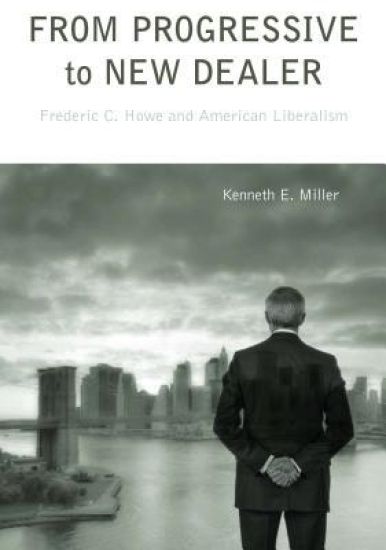
From Progressive to New Dealer

From Progressive to New Dealer

Kenneth E. Miller

Pennsylvania State University Press
2010
sidottu
A native Pennsylvanian, born in Meadville in 1867 and a graduate of Allegheny College, Frederic Howe dedicated his life early on to the cause of improving society and played a major role in many movements for progressive change from the early 1890s to the Second World War—the period that Richard Hofstadter famously dubbed the “age of reform.” Howe was a fighter against corruption and political bosses in Cleveland; a leader in Progressive politics in New York City; a spokesman for reform through numerous books and articles and as director of the Cooper Union’s People’s Institute; an ardent campaigner for “Fighting Bob” La Follette, Woodrow Wilson, Al Smith, and Franklin D. Roosevelt; a defender of immigrants and civil liberties as commissioner of immigration for the Port of New York during the First World War; and an advocate for consumers as the first consumers counsel in the New Deal. Kenneth Miller’s biography takes the reader behind the scenes and shows how “the great game of politics” was played in the age of reform.
From Progressive to New Dealer

From Progressive to New Dealer

Kenneth E. Miller

Pennsylvania State University Press
2014
pokkari
A native Pennsylvanian, born in Meadville in 1867 and a graduate of Allegheny College, Frederic Howe dedicated his life early on to the cause of improving society and played a major role in many movements for progressive change from the early 1890s to the Second World War—the period that Richard Hofstadter famously dubbed the “age of reform.” Howe was a fighter against corruption and political bosses in Cleveland; a leader in Progressive politics in New York City; a spokesman for reform through numerous books and articles and as director of the Cooper Union’s People’s Institute; an ardent campaigner for “Fighting Bob” La Follette, Woodrow Wilson, Al Smith, and Franklin D. Roosevelt; a defender of immigrants and civil liberties as commissioner of immigration for the Port of New York during the First World War; and an advocate for consumers as the first consumers counsel in the New Deal. Kenneth Miller’s biography takes the reader behind the scenes and shows how “the great game of politics” was played in the age of reform.
Hell of a Hat

Hell of a Hat

Kenneth Partridge

Pennsylvania State University Press
2021
sidottu
In the late ’90s, third-wave ska broke across the American alternative music scene like a tsunami. In sweaty clubs across the nation, kids danced themselves dehydrated to the peppy rhythms and punchy horns of bands like The Mighty Mighty Bosstones and Reel Big Fish. As ska caught fire, a swing revival brought even more sharp-dressed, brass-packing bands to national attention. Hell of a Hat dives deep into this unique musical moment. Prior to invading the Billboard charts and MTV, ska thrived from Orange County, California, to NYC, where Moon Ska Records had eager rude girls and boys snapping up every release. On the swing tip, retro pioneers like Royal Crown Revue had fans doing the jump, jive, and wail long before The Brian Setzer Orchestra resurrected the Louis Prima joint. Drawing on interviews with heavyweights like the Bosstones, Sublime, Less Than Jake, and Cherry Poppin' Daddies—as well as underground heroes like Mustard Plug, The Slackers, Hepcat, and The New Morty Show—Kenneth Partridge argues that the relative economic prosperity and general optimism of the late ’90s created the perfect environment for fast, danceable music that—with some notable exceptions—tended to avoid political commentary.An homage to a time when plaids and skankin’ were king and doing the jitterbug in your best suit was so money, Hell of a Hat is an inside look at ’90s ska, swing, and the loud noises of an era when America was dreaming and didn’t even know it.
Labor-Management Cooperation in a Public Service Industry.

Labor-Management Cooperation in a Public Service Industry.

Kenneth M. Jennings; Jay A. Smith; E C Traynham

Praeger Publishers Inc
1986
sidottu
Labor-Management Cooperation in a Public Service Industry outlines the historical aspects of labor-management cooperation and the characteristics of the transit industry which made it conducive to this cooperation. The second chapter discusses different cooperative programs such as employee input programs, safety programs, performance incentive programs, and training programs. Administrative considerations are examined in chapter three, along with the potential difficulties and calculating cost benefits. The two appendices offer a case study analysis format and quantitative assessment of four quality circles. This book contains extensive interviews with nearly seventy mass transit practitioners.
Marx and Engels on the Trade Unions

Marx and Engels on the Trade Unions

Kenneth Lapides

Praeger Publishers Inc
1986
sidottu
Virtually everything Marx and Engels ever wrote on labor strikes and trade unions has been collected in this volume for the first time. It includes vivid, often eyewitness accounts of many of the greatest strikes and labor struggles of the last century. This original and valuable collection challenges the prevailing assumption that Marx and Engels cared little for trade unions and their role in the transition to socialism or that they had little practical involvement with unions. Lapides illuminates the immense part personally played by Marx and Engels in helping to establish the modern labor movement. Covering the period 1844-1894, the book features graphic and moving portrayals of contemporary labor stuggles, candid personal views of various labor leaders, biting polemics against socialist rivals, and eloquent passages. Lapides provides an introduction that places the excerpts in historical and theoretical context.
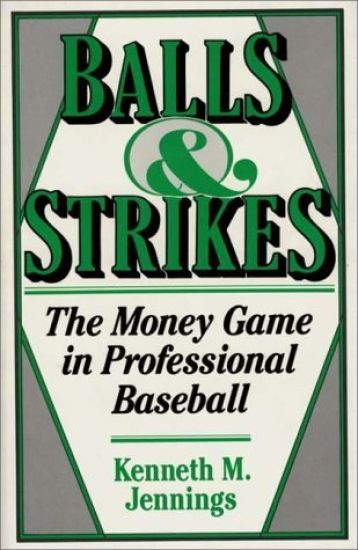
Balls and Strikes

Balls and Strikes

Kenneth M. Jennings

Praeger Publishers Inc
1990
sidottu
Impressively researched and well written, this valuable study by a business professor at the Universiy of North Florida. . . traces the erosion of the reserve clause and the rise of arbitration in salary disputes, examining the participants in negotiations--players, owners, managers, agents, even commissoners--and showing the stake each has in the money game. Many striking points are made, i.e., there is no discrimination in salaries of minority players and there is little relationship between pay and performance. Publishers Weekly Jennings . . . gives a detailed account of collective bargaining in baseball during the last 25 years, leading up to the owners' lockout this year. He discusses the participants on both sides and how disunity among the club owners has contributed to the union's ability to achieve large bargaining gains. He also deals with salary arbitration and how it has been used to settle pay disputes, noting that it can resemble 'a high-stakes crapshoot' that leaves management incapable of controlling a team's payroll costs. For aficionados of the sport, this book provides clarifying insight into the complicated issues of baseball's labor relations and offers fascinating anecdotes and a shrewd commentary on the diverse and colorful personalities involved. New York Times Book ReviewKenneth M. Jennings examines union-management relations in professional baseball, bringing together all the information the sports fan needs to follow the issues surrounding player-management arbitration in this unique industry. Covering the history of collective bargaining action in baseball from 1869 to the 1990 season, this book examines the issues that influence those high-profile player-management-owner negotiations. Balls and Strikes reveals: how in recent years the Major League Baseball Players' Association (MLBPA) has successfully parlayed owner disunity into substantial gains for its members; that baseball, in a statistical sense, surprisingly exhibits little discrimination against black and Hispanic players; how there is very little relationship between pay and performance in professional baseball. Baseball fans and sports journalists as well as professionals in management and labor relations, will find Balls and Strikes a fresh and exciting look at America's favorite pastime.Balls and Strikes presents the confrontations and relationships between players and management from the perspective of several hundred collective bargaining participants--the union and management officials who negotiate the labor agreement and the players who must approve and live with it. Kenneth M. Jennings derives his perspective from a variety of media sources, related biographies, autobiographies, and articles. The result is a highly readable book about owners, commissioners, agents, the media, manager-player relations, player pressures including drug and alcohol problems, race and ethnic issues, and player mobility and salaries. The book discusses the history of collective bargaining action in baseball from 1869 to 1966; the year Marvin Miller became president of the MLBPA, through the 1970s and Miller's successful bargaining efforts, into the 1980s and the opening of the 1990 season. Balls and Strikes discusses key participants in the collective bargaining process--owners, agents, the media, managers, and players--and concludes with a look at contemporary industrial relations issues in professional baseball: drug and alcohol abuse; racial discrimination; and the relationship between pay and performance.
The Soviet Administrative Elite

The Soviet Administrative Elite

Kenneth C. Farmer

Praeger Publishers Inc
1992
sidottu
The Soviet elite has undergone two major transformations in the twentieth century: Stalin's purges and replacement of old elite by Soviet trained proletarian modernizing managers; and, under Gorbachev, the current displacement of the modernizing managers by politicians. This book is an analytical study of the Soviet political elite as a body, from 1917 to 1990. Focusing on the changing structure of the elite , it is based partly on Kenneth C. Farmer's database consisting of biographical and career data on over 1500 high-level leaders. Farmer also synthesizes the work of four classical theorists--Gaetano Mosca, Vilfredo Pareto, Max Weber, and Alexis de Tocqueville--with more contemporary theorists. The book's unique features include its scope, the central database (the largest on which any work has been published), and its creative theoretical approach.Farmer concludes that the dismantling of the personnel selection system with competitive elections deprives the elite of the ability to reproduce itself. New voluntary associations make possible the emergence of genuine strategic elites. In examining the ramifications of this new system, this book is one of the first studies to apply a structural-anthropological theoretical framework to the phenomenon of Soviet elites. Scholars in the Soviet studies field will find this unique theoretical approach refreshing and thought provoking.
Shoreham and the Rise and Fall of the Nuclear Power Industry
This book traces the history of the nuclear power industry in the United States from the 1950s when electricity from nuclear power was expected to be too cheap to meter, to the 1990s when the nuclear power industry lies in shambles and the landscape is dotted with the billion dollar carcasses of unfinished or inoperable nuclear power plants. Using the Shoreham Nuclear Power Plant on Long Island as a case study, and reviewing the civil racketeering trial relating to that plant, McCallion details how a fatal combination of fraud, incompetence, and naivete has driven utility companies to the brink (and in some cases, beyond the brink) of bankruptcy in the vain quest for the nuclear power fix.