Kirjahaku
Etsi kirjoja tekijän nimen, kirjan nimen tai ISBN:n perusteella.
1000 tulosta hakusanalla M H Ent
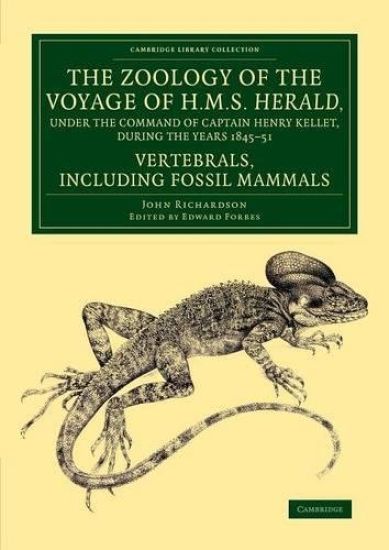
The Zoology of the Voyage of H.M.S. Herald, under the Command of Captain Henry Kellet, R.N., C.B., during the Years 1845–51
John Richardson
Cambridge University Press
2014
pokkari
Naval surgeon, Arctic explorer and natural historian, Sir John Richardson (1787–1865) published many works, several of which are reissued in the Cambridge Library Collection, notably the four-volume Fauna Boreali-Americana. At the Haslar Royal Naval Hospital, where he worked towards the end of his career, Richardson built up a library and museum that became renowned for natural history research. His published work was fuelled by his own voyages and the specimens sent back from other expeditions, as was the case for this illustrated work, completed in 1854. Richardson describes the zoological specimens collected during the 1845–51 voyage of the survey ship H.M.S. Herald, which had sailed into Arctic seas and took part in the search for Sir John Franklin. The collected fauna include fossil mammals from the ice cliffs at Eschscholtz Bay in Alaska, first discovered in 1816 by Otto von Kotzebue and his naturalists.

Narrative of the surveying voyage of H.M.S. Fly; commanded by Capt. F. P. Blackwood in Torres Strait, New Guinea, and other Islands of the Eastern Archipelago, 1842-1846, together with an excursion into the interior of the Eastern part of Java.
Joseph Beete Jukes
British Library, Historical Print Editions
2011
pokkari

The Botany Of The Voyage Of H.m.s. Sulphur. Under Captain Ed. Belcher The Botanical Descriptions By George Bentham
George Bentham
Palala Press
2018
pokkari
This work has been selected by scholars as being culturally important, and is part of the knowledge base of civilization as we know it. This work was reproduced from the original artifact, and remains as true to the original work as possible. Therefore, you will see the original copyright references, library stamps (as most of these works have been housed in our most important libraries around the world), and other notations in the work.This work is in the public domain in the United States of America, and possibly other nations. Within the United States, you may freely copy and distribute this work, as no entity (individual or corporate) has a copyright on the body of the work.As a reproduction of a historical artifact, this work may contain missing or blurred pages, poor pictures, errant marks, etc. Scholars believe, and we concur, that this work is important enough to be preserved, reproduced, and made generally available to the public. We appreciate your support of the preservation process, and thank you for being an important part of keeping this knowledge alive and relevant.

In Eastern Seas: The Commission of H.M.S Iron Duke, Flag-ship in China 1878-83
J. J. Smith
Createspace Independent Publishing Platform
2012
nidottu

Reprint of the original, first published in 1858.
Reprint of the original, first published in 1858.

The zoology of the voyage of H.M.S. Sulphur, under the command of Captain Sir Edward Belcher, during the years 1836-42
Richard Brinsley Hinds; Et Al.
Antigonos Verlag
2024
nidottu

Profil épidemioclinique des kératites au C.H.M.A
Armand Simisi Mbalanda; Nelly Kabedi
ÉDITIONS UNIVERSITAIRES EUROPÉENNES
2019
nidottu

Perfil epidemioclinico da ceratite no C.H.M.A.
Armand Simisi Mbalanda; Nelly Kabedi
Edições Nosso Conhecimento
2021
nidottu

Emma (Wisehouse Classics - With Illustrations by H.M. Brock) (2016)
Jane Austen
Wisehouse Classics
2016
pokkari
Persuasion (Wisehouse Classics - With Illustrations by H.M. Brock)
Jane Austen
Wisehouse Classics
2016
pokkari

The Zoology of the Voyage of H.M.S. Beagle, Under the Command of Captain Fitzroy, R. N., During the Years 1832 to 1836
Charles Darwin; Thomas Bell
Antigonos Verlag
2025
nidottu

The Zoology of the Voyage of H.M.S. Beagle, Under the Command of Captain Fitzroy, R. N., During the Years 1832 to 1836
Charles Darwin; George R. Waterhouse
Antigonos Verlag
2025
nidottu

The Zoology of the Voyage of H.M.S. Beagle, Under the Command of Captain Fitzroy, R. N., During the Years 1832 to 1836
Charles Darwin; Richard Owen
Antigonos Verlag
2025
nidottu

The Zoology of the Voyage of H.M.S. Beagle, Under the Command of Captain Fitzroy, R. N., During the Years 1832 to 1836
Charles Darwin; John Gould
Antigonos Verlag
2025
nidottu