Examine what Christians believe in this daily devotional on the Westminster Shorter Catechism for young adults The Westminster Shorter Catechism has guided Christians for almost 400 years. In question–and–answer format, the first thirty–eight questions summarise what the Bible says about God, and the following sixty–nine questions how Christians should live. In 66 devotions, Robert Cathcart helps teens explore each question and answer of the Westminster Shorter Catechism. Each devotional provides an explanation in clear, modern terms, along with Scripture references. There are Challenge Questions, to encourage readers to think about how that day’s question affects their own life, and a guided prayer.
The pastor who seeks to preach expositionally through Psalms faces a daunting task, for the sermon series would take several years to complete and many of the sermons would seem repetitious because of similar psalms. To respond to this challenge the author has used the book theology method to analyze the Book of Psalms into twenty-eight theological themes, providing the preacher with material for approximately a one-year series on the book. Each chapter includes a list of applicable theological propositions that can be preached or taught to contemporary audiences. Then the chapter concludes by linking the topic to New Testament passages. This monograph contains over seventy tables, mainly charting the Hebrew terms used for a particular theme. Careful textual and exegetical notes provide guidance for translation and interpretation of many verses. Furthermore, relevant Hebrew word studies inform theological understanding. Backing up the analysis are numerous references to Psalm commentaries, both classical and contemporary. ""This helpful volume provides a comprehensive summary of twenty-eight key theological themes emphasized in the book of Psalms. . . . The treatment is thorough, well organized, and not lacking in practical application. This book will be of great benefit for those who wish to preach or teach thematically and theologically through the Psalter."" --Richard A. Taylor, Senior Professor of Old Testament Studies, Dallas Theological Seminary ""Pastors and teachers need two broad categories of books in their libraries: exegetical commentaries, and works that analyze the theological messages of the biblical books. Bell's book falls into the latter category, of which there is a general paucity. Analysis is a higher-order level of reasoning, and those who do it skillfully render a remarkable service to ministers of God's word to God's people. Bell's book is a valuable asset for such ministers."" --J. Randolph Jaeggli, Bob Jones University Seminary Robert D. Bell has taught Old Testament and theology seminary courses at Bob Jones University (Greenville, South Carolina) since 1968. He retired in 2017. He is the author of The Theological Messages of the Old Testament Books (2010) and co-author of Hebrew Handbook (2007). Bell has published over 50 articles about the Old Testament in Biblical Viewpoint. He has also reviewed numerous books for this publication.
Worship in the Old Testament has been frequently misunderstood. Its rites and ceremonies are often perceived as legalistic works that were required by an angry God to gain his favor or avert his wrath. But is that really what the Bible teaches? To be sure, the LORD did institute the divine service in the Old Testament with all of its laws, rites, and ceremonies. Yet did God do this in order to be appeased or pleased by the ancient Israelites? When the priests enacted the offerings and sacrifices at the sanctuary, was it merely to do good works that God required but without meaning or purpose for his people? Was worship in the Old Testament always what the people did for the LORD or did God do anything that was beneficial to the Israelites? This book answers these questions and, furthermore, dispels the recurring misinterpretation of worship in the Old Testament. The LORD established the divine service in the Pentateuch not to receive what he demanded from the people of ancient Israel, but, on the contrary, to cleanse them from their sinful impurities, sanctify them to share in his holiness, and dwell among them with his blessing. ""Through detailed and methodical ritual analysis, Robert Macina leads his readers on an engaging tour of Israel's divine service with burnt offerings every morning and evening as prescribed and described in the Pentateuch. Macina helpfully unpacks its theological function as YHWH purifies and sanctifies his people, joining scholars of the caliber of Haran, Milgrom, and Kleinig in recovering this often-neglected yet theologically central subject of Old Testament study."" --Adam D. Hensley, Australian Lutheran College, University of Divinity ""Dr. Macina provides an exquisite analysis of neglected texts. His insightful exegesis of ritual legislation demonstrates that God instituted the daily service for the purpose of meeting his people to purify and sanctify them by the removal of their sin and the bestowal of his own holiness. This service was neither a mechanistic nor a meritorious human ritual, but the LORD's, proffering the same grace as the Divine Service in the Christian church."" --Christopher Mitchell, Saint Louis, Missouri Robert D. Macina is pastor at Risen Christ Lutheran Church in Arvada, Colorado. He studied at Clarendon College, Texas; Concordia University Texas, Austin; Concordia University Nebraska, Seward; Concordia Theological Seminary, Fort Wayne; Australian Lutheran College, Adelaide, SA; and University of Divinity, Kew, VIC, Australia. He has written articles and has taught seminary as an associated faculty. He and his wife, Tracy, have three children: Daniel, Mark, and Rebekah.
Worship in the Old Testament has been frequently misunderstood. Its rites and ceremonies are often perceived as legalistic works that were required by an angry God to gain his favor or avert his wrath. But is that really what the Bible teaches? To be sure, the LORD did institute the divine service in the Old Testament with all of its laws, rites, and ceremonies. Yet did God do this in order to be appeased or pleased by the ancient Israelites? When the priests enacted the offerings and sacrifices at the sanctuary, was it merely to do good works that God required but without meaning or purpose for his people? Was worship in the Old Testament always what the people did for the LORD or did God do anything that was beneficial to the Israelites? This book answers these questions and, furthermore, dispels the recurring misinterpretation of worship in the Old Testament. The LORD established the divine service in the Pentateuch not to receive what he demanded from the people of ancient Israel, but, on the contrary, to cleanse them from their sinful impurities, sanctify them to share in his holiness, and dwell among them with his blessing. ""Through detailed and methodical ritual analysis, Robert Macina leads his readers on an engaging tour of Israel's divine service with burnt offerings every morning and evening as prescribed and described in the Pentateuch. Macina helpfully unpacks its theological function as YHWH purifies and sanctifies his people, joining scholars of the caliber of Haran, Milgrom, and Kleinig in recovering this often-neglected yet theologically central subject of Old Testament study."" --Adam D. Hensley, Australian Lutheran College, University of Divinity ""Dr. Macina provides an exquisite analysis of neglected texts. His insightful exegesis of ritual legislation demonstrates that God instituted the daily service for the purpose of meeting his people to purify and sanctify them by the removal of their sin and the bestowal of his own holiness. This service was neither a mechanistic nor a meritorious human ritual, but the LORD's, proffering the same grace as the Divine Service in the Christian church."" --Christopher Mitchell, Saint Louis, Missouri Robert D. Macina is pastor at Risen Christ Lutheran Church in Arvada, Colorado. He studied at Clarendon College, Texas; Concordia University Texas, Austin; Concordia University Nebraska, Seward; Concordia Theological Seminary, Fort Wayne; Australian Lutheran College, Adelaide, SA; and University of Divinity, Kew, VIC, Australia. He has written articles and has taught seminary as an associated faculty. He and his wife, Tracy, have three children: Daniel, Mark, and Rebekah.
Leadership has been defined simply as the influence one has in the lives of others. However a true spiritual leader is someone whose way of life and personal character motivates others to seek significance. Spiritual leadership seeks to motivate people from the inside, by an appeal to the heart, not by external pressure or coercion. Sadly, most of today's leaders have traded away the notion of leadership by character to leadership by celebrity. Spiritual leaders are not consumed with their own success, but with the success of others. They work hard to make everyone around them successful by focusing their passion on helping those they lead to envision, embrace and enjoy the opportunities set before them. Bernard Montgomery said, "Leadership is the capacity and will to rally men and women to a common purpose, and the character which inspires confidence." Spiritual leaders of this kind therefore demonstrate to those around them that the interests of others are what most occupies their heart. This type of leadership is really found in the scriptures as fathering. Fathering empowers the person in the position of leadership to succeed because people trust him with their futures. If he is surrounded with gifted, capable, diligent, and effective people who are truly devoted to him and his leadership-it is because he has gained their trust. In this book we will seek to understand how Jesus took His pattern of "taking, blessing, breaking and giving bread" and used it as an example of how coaching, mentoring and fathering should be done. This pattern, I believe, is all about every believer being born a spiritual son, growing and maturing as a son and then becoming a spiritual father (1 John 2:13-14) and learning to be a father to others.
" La philosophie des sciences a totalement modifi ses points de vue, en France, dans les dix derni res ann es du XIXe si cle. Je voudrais montrer la tr s grande importance de ce mouvement d'id es et faire saisir quelles pourront en tre les lointaines cons quences..."
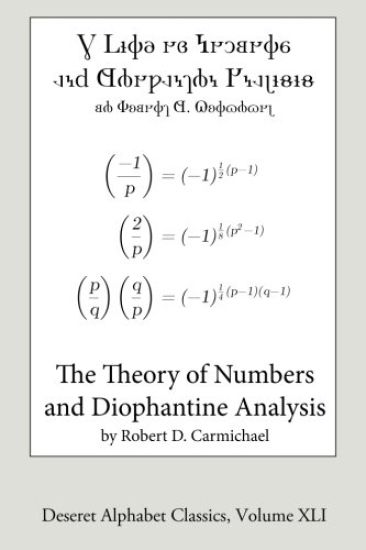
Robert D. Carmichael (1879-1967) was an American mathematician. Carmichael is known for his research number theory and the study of the prime numbers. Among other discoveries, he identified the first composite number to satisfy the Fermat primality test (561). Such numbers are now called Carmichael numbers in his honor. Early in his career, he wrote two elementary texts on number theory, The Theory of Numbers and Diophantine Analysis. These cover such topics as prime numbers, quadratic residues, and Fermat's Last Theorem. They require little more than high school algebra, and their clear style makes them excellent introductions to an important branch of modern mathematics. This book is in the Deseret Alphabet, a phonetic alphabet for writing English developed in the mid-19th century at the University of Deseret (now the University of Utah).