This "vivid and compelling account" (The Wall Street Journal) opens not only the inner workings of one of physics' greatest minds, but also a view into an extraordinary friendship and the human capacity to overcome insurmountable challenges. A BEST SCIENCE BOOK OF THE YEAR (The Telegraph, The Guardian)A BEST BOOK OF THE YEAR (New Statesmen) One of the most influential physicists of our time, Stephen Hawking changed our understanding of the cosmos. Recalling his nearly two decades as Hawking's collaborator and friend, Leonard Mlodinow brings this complex man into focus in an inspiring and deeply intimate portrayal. We meet Hawking the genius, who explores the mysteries of the universe; Hawking the colleague, who's able to communicate at only six words per minute but who punctuates his conversations with humor; and Hawking the friend, who can convey volumes with a frown, a smile, or simply a raised eyebrow. Mlodinow puts us in the room as Hawking indulges his passion for wine and curry, confides his feelings on love, death, and disability, and brilliantly grapples with the deepest questions of philosophy and science. This moving account of a friendship offers us invaluable lessons from one of physics' greatest practitioners about life, the universe, and the ability to overcome daunting obstacles.
The Red Badge of Courage is a war novel by American author Stephen Crane (1871-1900). Taking place during the American Civil War, the story is about a young private of the Union Army, Henry Fleming, who flees from the field of battle. Overcome with shame, he longs for a wound, a "red badge of courage," to counteract his cowardice. When his regiment once again faces the enemy, Henry acts as standard-bearer, who carries a flag. Although Crane was born after the war, and had not at the time experienced battle first-hand, the novel is known for its realism. He began writing what would become his second novel in 1894, using various contemporary and written accounts (such as those published previously by Century Magazine) as inspiration. It is believed that he based the fictional battle on that of Chancellorsville; he may also have interviewed veterans of the 124th New York Volunteer Infantry Regiment, commonly known as the Orange Blossoms. Initially shortened and serialized in newspapers in December 1894, the novel was published in full in October 1895. A longer version of the work, based on Crane's original manuscript, was published in 1983. The novel is known for its distinctive style, which includes realistic battle sequences as well as the repeated use of color imagery, and ironic tone. Separating itself from a traditional war narrative, Crane's story reflects the inner experience of its protagonist (a soldier fleeing from combat) rather than the external world around him. Also notable for its use of what Crane called a "psychological portrayal of fear", the novel's allegorical and symbolic qualities are often debated by critics. Several of the themes that the story explores are maturation, heroism, cowardice, and the indifference of nature. The Red Badge of Courage garnered widespread acclaim, what H. G. Wells called "an orgy of praise", shortly after its publication, making Crane an instant celebrity at the age of twenty-four. The novel and its author did have their initial detractors, however, including author and veteran Ambrose Bierce. Adapted several times for the screen, the novel became a bestseller. It has never been out of print and is now thought to be Crane's most important work and a major American text..................... Stephen Crane (November 1, 1871 - June 5, 1900) was an American poet, novelist, and short story writer. Prolific throughout his short life, he wrote notable works in the Realist tradition as well as early examples of American Naturalism and Impressionism. He is recognized by modern critics as one of the most innovative writers of his generation. The ninth surviving child of Protestant Methodist parents, Crane began writing at the age of four and had published several articles by the age of 16. Having little interest in university studies though he was active in a fraternity, he left Syracuse University in 1891 to work as a reporter and writer. Crane's first novel was the 1893 Bowery tale Maggie: A Girl of the Streets, generally considered by critics to be the first work of American literary Naturalism. He won international acclaim in 1895 for his Civil War novel The Red Badge of Courage, which he wrote without having any battle experience. In 1896, Crane endured a highly publicized scandal after appearing as a witness in the trial of a suspected prostitute, an acquaintance named Dora Clark. Late that year he accepted an offer to travel to Cuba as a war correspondent. As he waited in Jacksonville, Florida for passage, he met Cora Taylor, with whom he began a lasting relationship. En route to Cuba, Crane's vessel the SS Commodore sank off the coast of Florida, leaving him and others adrift for 30 hours in a dinghy. Crane described the ordeal in "The Open Boat". During the final years of his life, he covered conflicts in Greece (accompanied by Cora, recognized as the first woman war correspondent) and later lived in England with her.....
Stephen Crane (November 1, 1871 - June 5, 1900) was an American poet, novelist, and short story writer. Prolific throughout his short life, he wrote notable works in the Realist tradition as well as early examples of American Naturalism and Impressionism. He is recognized by modern critics as one of the most innovative writers of his generation. The ninth surviving child of Protestant Methodist parents, Crane began writing at the age of four and had published several articles by the age of 16. Having little interest in university studies though he was active in a fraternity, he left Syracuse University in 1891 to work as a reporter and writer. Crane's first novel was the 1893 Bowery tale Maggie: A Girl of the Streets, generally considered by critics to be the first work of American literary Naturalism. He won international acclaim in 1895 for his Civil War novel The Red Badge of Courage, which he wrote without having any battle experience. In 1896, Crane endured a highly publicized scandal after appearing as a witness in the trial of a suspected prostitute, an acquaintance named Dora Clark. Late that year he accepted an offer to travel to Cuba as a war correspondent. As he waited in Jacksonville, Florida for passage, he met Cora Taylor, with whom he began a lasting relationship. En route to Cuba, Crane's vessel the SS Commodore sank off the coast of Florida, leaving him and others adrift for 30 hours in a dinghy. 1] Crane described the ordeal in "The Open Boat". During the final years of his life, he covered conflicts in Greece (accompanied by Cora, recognized as the first woman war correspondent) and later lived in England with her. He was befriended by writers such as Joseph Conrad and H. G. Wells. Plagued by financial difficulties and ill health, Crane died of tuberculosis in a Black Forest sanatorium in Germany at the age of 28. At the time of his death, Crane was considered an important figure in American literature. After he was nearly forgotten for two decades, critics revived interest in his life and work. Crane's writing is characterized by vivid intensity, distinctive dialects, and irony. Common themes involve fear, spiritual crises and social isolation. Although recognized primarily for The Red Badge of Courage, which has become an American classic, Crane is also known for his poetry, journalism, and short stories such as "The Open Boat", "The Blue Hotel", "The Bride Comes to Yellow Sky", and The Monster. His writing made a deep impression on 20th-century writers, most prominent among them Ernest Hemingway, and is thought to have inspired the Modernists and the Imagists.
Stephen Archer was a stationer, bookseller, and newsmonger in one of the suburbs of London. The newspapers hung in a sort of rack at his door, as if for the convenience of the public to help themselves in passing. On his counter lay penny weeklies and books coming out in parts, amongst which the Family Herald was in force, and the London Journal not to be found. I had occasion once to try the extent of his stock, for I required a good many copies of one of Shakspere's plays-at a penny, if I could find such. He shook his head, and told me he could not encourage the sale of such productions. This pleased me; for, although it was of little consequence what he thought concerning Shakspere, it was of the utmost import that he should prefer principle to pence. So I loitered in the shop, looking for something to buy; but there was nothing in the way of literature: his whole stock, as far as I could see, consisted of little religious volumes of gay binding and inferior print; he had nothing even from the Halifax press.
Amanda Minnie Douglas (July 14, 1831 - July 18, 1916) was an American writer of adult and juvenile fiction. She was probably best remembered by young readers of her day for the Little Girl and Helen Grant series published over the decades flanking the turn of the twentieth century.Born in New York City, the eldest daughter of John Douglas and Elizabeth Horton was raised in the city of her birth with the exception of several years spent on a farm near Poughkeepsie, New York. She studied art design at the City Institute of New York City for a time before circumstances forced her to fall back on her greater talent as a writer to help support her family. In 1853, Douglas and her family moved from New York City to Newark, New Jersey, where she would remain a resident for the balance of her life.Douglas began by submitting short stories and poems to local publications. In time her stories appeared in editions of The New York Ledger, Saturday Evening Post and the Lady's Friend Magazine. Her first novel, In Trust, was published in 1866 and sold some 20,000 copies. Learning from this first experience, Douglas made sure to retain the copyrights on all of her future works. She would go on to publish at least a novel a year until her retirement in 1913
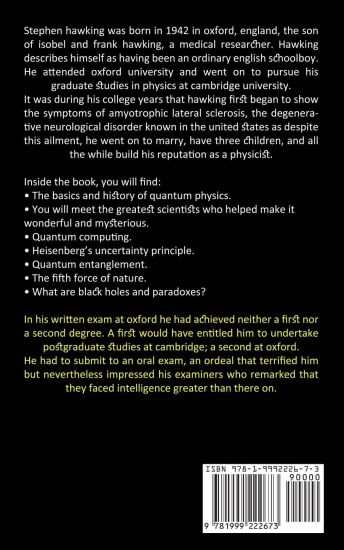
Stephen Hawking was an English theoretical physicist, cosmologist, author, and Director of Research at the Centre for Theoretical Cosmology within the University of Cambridge. His scientific works included a collaboration with Roger Penrose on gravitational singularity theorems in the framework of general relativity and the theoretical prediction that black holes emit radiation, often called Hawking radiation. Hawking was the first to set out a theory of cosmology explained by a union of the general theory of relativity and quantum mechanics. He was a vigorous supporter of the many-worlds interpretation of quantum mechanics. Hawking was a Fellow of the Royal Society (FRS), a lifetime member of the Pontifical Academy of Sciences, and a recipient of the Presidential Medal of Freedom, the highest civilian award in the United States. In 2002, Hawking was ranked number 25 in the BBC's poll of the 100 Greatest Britons. He was the Lucasian Professor of Mathematics at the University of Cambridge between 1979 and 2009 and achieved commercial success with works of popular science in which he discusses his own theories and cosmology in general. His book A Brief History of Time appeared on the British Sunday Times best-seller list for a record-breaking 237 weeks. Hawking had a rare early-onset slow-progressing form of motor neurone disease (also known as amyotrophic lateral sclerosis "ALS" or Lou Gehrig's disease) that gradually paralysed him over the decades. Even after the loss of his speech, he was still able to communicate through a speech-generating device, initially through use of a hand-held switch, and eventually by using a single cheek muscle.
This volume aims to make Stephen of Pisa and Antioch’s work on the celestial sciences accessible to a wider readership, providing not just the text but a translation and introduction as well. The edition is based on the only known manuscript of the Liber Mamonis, MS Cambrai, Médiathèque d’Agglomération, A 930. It is split into two parts: the first provides an extensive introduction to Stephen and his work, while the second features the edition and translation. A comprehensive glossary and collection of photographs of plates are also included.
This volume aims to make Stephen of Pisa and Antioch’s work on the celestial sciences accessible to a wider readership, providing not just the text but a translation and introduction as well. The edition is based on the only known manuscript of the Liber Mamonis, MS Cambrai, Médiathèque d’Agglomération, A 930. It is split into two parts: the first provides an extensive introduction to Stephen and his work, while the second features the edition and translation. A comprehensive glossary and collection of photographs of plates are also included.
Buildings by the London architect Stephen Taylor use their powerfully innovative nature to smoothly integrate themselves into the surroundings, thereby becoming a valuable part of the London environment. At the same time, the form, materials and details of the buildings are reduced to produce a meditative, consistent character.
"Apologies" is the first monograph on Berlin-based artist Stephen G. Rhodes (born 1977), looking at works from the last ten years. Rhodes' multimedia installations are often based on American cultural references such as the "Uncle Remus" stories that he politicizes through references to slavery.
Life of Stephen A. Douglas - United States Senator from Illinois is an unchanged, high-quality reprint of the original edition of 1860. Hansebooks is editor of the literature on different topic areas such as research and science, travel and expeditions, cooking and nutrition, medicine, and other genres. As a publisher we focus on the preservation of historical literature. Many works of historical writers and scientists are available today as antiques only. Hansebooks newly publishes these books and contributes to the preservation of literature which has become rare and historical knowledge for the future.