Kirjojen hintavertailu. Mukana 11 342 296 kirjaa ja 12 kauppaa.

Kirjahaku

Etsi kirjoja tekijän nimen, kirjan nimen tai ISBN:n perusteella.

135 tulosta hakusanalla "Solid-State Physics"

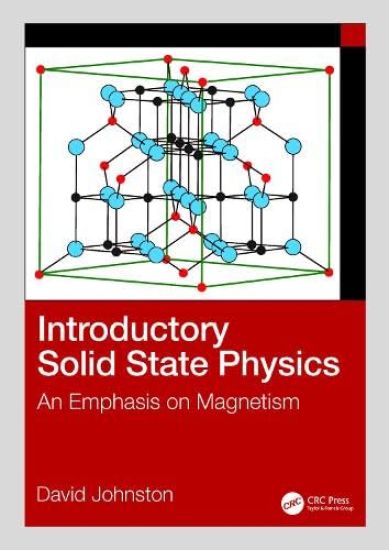
Introductory Solid State Physics

Introductory Solid State Physics

David C. Johnston

TAYLOR FRANCIS LTD
2025
sidottu
Introductory Solid State Physics: An Emphasis on Magnetism acts as a supplement to students tackling solid state physics at both the undergraduate and graduate level. The BCS theory of superconductivity is not included in undergraduate-level books, because the theory is derived at the graduate level. However, this book uses the equations derived by BCS to calculate the thermodynamic properties of superconductors such as the temperature dependence of the heat capacity using techniques accessible to undergraduates. Also covering topics such as wave diffraction, the essentials of thermodynamics, statistical mechanics and local-moment magnetism, it is useful for those studying solid state physics at any level.Key Features:Includes the BCS theory of superconductivityProvides material that is accessible to students at all levelsApproaches the subject with a particular emphasis on magnetism
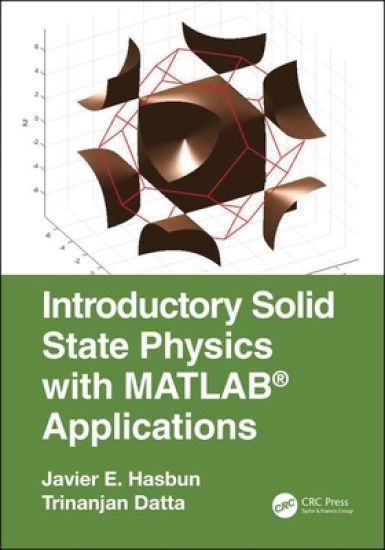
Introductory Solid State Physics with MATLAB Applications

Introductory Solid State Physics with MATLAB Applications

Javier E. Hasbun; Trinanjan Datta

CRC Press Inc
2019
sidottu
Solid state physics, the study and prediction of the fundamental physical properties of materials, forms the backbone of modern materials science and has many technological applications. The unique feature of this text is the MATLAB®-based computational approach with several numerical techniques and simulation methods included. This is highly effective in addressing the need for visualization and a direct hands-on approach in learning the theoretical concepts of solid state physics. The code is freely available to all textbook users.Additional Features:Uses the pedagogical tools of computational physics that have become important in enhancing physics teaching of advanced subjects such as solid state physicsAdds visualization and simulation to the subject in a way that enables students to participate actively in a hand-on approachCovers the basic concepts of solid state physics and provides students with a deeper understanding of the subject matterProvides unique example exercises throughout the textObtains mathematical analytical solutionsCarries out illustrations of important formulae results using programming scripts that students can run on their own and reproduce graphs and/or simulationsHelps students visualize solid state processes and apply certain numerical techniques using MATLAB®, making the process of learning solid state physics much more effectiveReinforces the examples discussed within the chapters through the use of end-of-chapter exercisesIncludes simple analytical and numerical examples to more challenging ones, as well as computational problems with the opportunity to run codes, create new ones, or modify existing ones to solve problems or reproduce certain results
Applied Solid State Physics

Applied Solid State Physics

W. Low

Springer-Verlag New York Inc.
2012
nidottu
This book is a collection of a set of lectures sponsored by the Bathsheva de Rothschild Seminars. It deals with different aspects of applied physics which are an outgrowth of fundamental research. The courses were given by experts engaged in their respective fields. These review articles are intended to fill a gap between the many research papers that are appearing today in pure science on one hand, and in applied science on the other hand. It is a bridge between these two. It aims at the specialist in applied physics, chemistry and engineering, working in these specialized fields, as well as at the graduate student, interested in solid solid state physics, chemistry and electrical engineering. While this book contains a range of different topics, there is an under­ lying logic in the choice of the subject material. The first three articles, by Drs. Giordmaine, Friesem and Porto, deal with modern applied optics, which arise to a large extent from the availability of coherent and powerful laser sources. Two articles deal with materials, in particular that of Dr. Chalmers on the theory and principle of solidification and that of Dr. Laudise on the techniques of crystal growth. The last three articles, by Drs. Matthias, Doyle and Prince, are concerned with the use of materials in fields of superconductivity, computer storage and semi­ conductor photovoltaic effects. Dr. Rose gives a definitive review on human and electronic vision, an out-growth of life-long activity in this field.
Computational Solid State Physics

Computational Solid State Physics

Springer-Verlag New York Inc.
2012
nidottu
During the past 20 years, solid state physics has become one of the major branches of physics. 1-2 Today over one-third of all scientific articles published in physics deal with solid state 3 topics. During the last two decades, there has also been ra~id growth of scientific computation in a wide variety of fields. -5 The combination of solid state physics and comp~tation may be termed computational solid state physics. This emerging field is distin­ guished from theoretical solid state physics only to the extent that electronic computers rather than slide rules or backs of envelopes are used to solve numerical or logical problems, test scientific hypotheses, and discover the essential physical content of formal mathematical theories. Papers in computational solid state physics are widely scatter­ ed in the literature. They can be found in the traditional physics journals and review series, such as The Physical Review and Solid State Physics; in more specialized publications, such as Journal of Computational Physics, Computer Physics Communications, and Methods in Computational Physics; and in the proceedings of a number of re­ 6 9 cent conferences and seminar courses. - Plans for holding an International Symposium on Computational Solid State Physics in early October 1971 were formulated by Dr.
Introductory Solid State Physics, Third Edition

Introductory Solid State Physics, Third Edition

Colin Inglefield; Marcus C. Newton

Productivity Press
2026
nidottu
Myers’ much beloved introduction to solid state physics has been thoroughly updated while retaining its benchmark accessibility to anyone with minimal background. The conceptual framework is presented with real world applications, and modern experimental approaches are given sufficient attention. Extensive updates to sections on semiconductors, dielectric media, superconductivity, and surface techniques are included, in addition to a new chapter on disordered and amorphous materials, and computational exercises.
Molecular Solid State Physics

Molecular Solid State Physics

George G. Hall

Springer-Verlag Berlin and Heidelberg GmbH Co. K
1991
nidottu
This book originated from a course which I developed for the Master's degree course in Molecular Engineering in Kyoto University. Most of the students had degrees in Chemistry and a limited experience of Physics and Mathematics. Since research in Molecular Engineering requires knowledge of some applications of solid state physics which are not treated in conventional physics texts it was necessary to devise a course which would build on their chemical background and enable them to read the contemporary literature of relevance to their research. I hope that this book will be found useful as a text for other advanced courses on material science for chemists. Molecular Engineering is concerned with the design and construction, at the molecular level, of materials which can fulfil specific functions. Thus the study of the forces between molecules and the influence of molecular shapes and electrostatic features on molecular properties are important. The mechanisms whereby, in the solid state, these produce cooperative effects, catalytic effects and abnormal electrical effects must be understood, at least qualitatively. The aim of this book has been to give insight into the mechanisms whereby molecules influence one another when they are close together.
Quantum Solid-State Physics

Quantum Solid-State Physics

Serghey V. Vonsovsky; Mikhail I. Katsnelson

Springer-Verlag Berlin and Heidelberg GmbH Co. K
2012
nidottu
This book treats the major problems of the quantum physics of solids, ranging from fundamental concepts to topical issues. Rather than use a deductive method of exposition, the authors consider and analyze simple empirically established properties of solids and employ more complicated models only as the need arises. Detailed treatment is given of classical problems such as chemical bonding in crystals, the one-dimensional Schrödinger equation with a periodic potential, the metal-insulator criterion, and the quantum theory of band electron motion in external fields. Consideration is also given to topical problems such as neutron scattering by the crystal lattice, plasma and Fermi liquid effects, the theory of disordered systems, and the polaron. The reader is expected to know only the fundamentals of quantum mechanics and statistical physics. Compared with the Russian edition (Nauka, Moscow 1983), the book has been substantially revised and enlarged, new sections have been written and recent results have been incorporated.
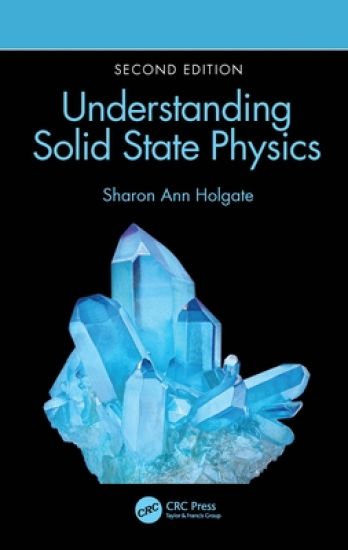
Understanding Solid State Physics

Understanding Solid State Physics

Jacques Cazaux

Pan Stanford Publishing Pte Ltd
2016
sidottu
The correlation between the microscopic composition of solids and their macroscopic (electrical, optical, thermal) properties is the goal of solid state physics. This book is the deeply revised version of the French book Initiation à la physique du solide: exercices comméntes avec rappels de cours, written more than 20 years ago. It has five sections that start with a brief textbook introduction followed by exercises, problems with solutions, and comments and that are concluded with questions. It presents a quasi-systematic investigation of the influence of dimensionality changes, from 1D to 3D, via surfaces and 2D quantum wells, on the physical properties of solids. The aim of this book is to teach solid state physics through the use of problems and solutions giving orders of magnitude and answers to simple questions of this field. The numerous comments and problems in the book are inspired from some Nobel Prize–winning research in physics, such as neutron diffraction (1994), quantum Hall effect (1985), semiconducting heterostructures (1973), and tunnel microscope (1986), superconductivity (1987). The book will be helpful for undergraduate- and graduate-level students of solid state physics and chemistry and researchers in physics, chemistry, and materials science.
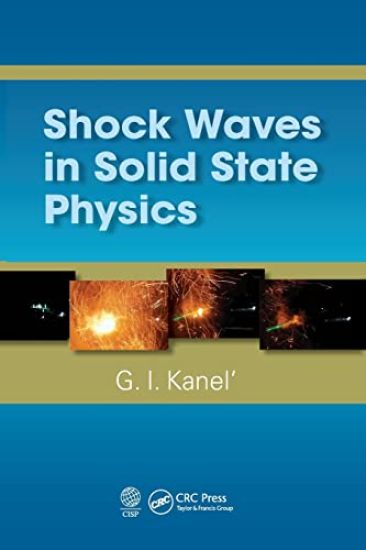
Shock Waves in Solid State Physics
Methods and the latest results of experimental studies of the strength properties, polymorphism and metastable states of materials and substances with extremely short durations of shock-wave action are presented. The author provides a comprehensive and theoretical description of specific features of the dynamics of elastoplastic shock compression waves in relaxing media. The presentation is preceded by a detailed description of the theoretical foundations of the method and a brief discussion of the basic methods of generating and diagnosing shock waves in solids.Key Selling Features:Addresses dynamic elastic-plastic response, spallation, and shock-induced phase transformation.Provides a centralized presentation of topics of interest to the shock physics communityPresents new data on the mechanism and basic patterns of sub-microsecond polymorphic transformations and phase transitions.Investigates destruction waves in shock-compressed glasses.Analyzes the behavior of highly hard brittle materials under shock-wave loading and ways to diagnose fracture.
Introduction to Solid State Physics

Introduction to Solid State Physics

Charles Kittel

John Wiley Sons Inc
2004
sidottu
Since the publication of the first edition over 50 years ago, Introduction to Solid State Physics has been the standard solid state physics text for physics students. The author's goal from the beginning has been to write a book that is accessible to undergraduates and consistently teachable. The emphasis in the book has always been on physics rather than formal mathematics. With each new edition, the author has attempted to add important new developments in the field without sacrificing the book's accessibility and teachability. A very important chapter on nanophysics has been written by an active worker in the field. This field is the liveliest addition to solid state science during the past ten years The text uses the simplifications made possible by the wide availability of computer technology. Searches using keywords on a search engine (such as Google) easily generate many fresh and useful references
Elements of Solid State Physics

Elements of Solid State Physics

Michael N. Rudden; John Wilson

John Wiley Sons Inc
1993
nidottu
Elements of Solid State Physics Second Edition M. N. Rudden and J. Wilson University of Northumbria at Newcastle, Newcastle upon Tyne, UK This textbook provides a basic introduction to the principles of solid state physics and semiconductor devices and will prove essential for first and second year students of physics, materials science and electrical/electronic engineering courses. It assumes no prior knowledge of quantum or statistical mechanics and relies on simple models to illustrate the physical principles. However, the opportunity has been taken in this edition to extend the concept of energy bands to a consideration of E—k curves, and certain new material has been added, notably relating to superconductivity and optoelectronic devices, including lasers, following significant developments in these areas. Elements of Solid State Physics, Second Edition, presents the student with an essentially non-mathematical approach to the subject. Arranged in a logical sequence with many clear illustrations, each chapter has a number of worked examples and discussion points, as well as questions and answers. Readers of this fully revised and updated edition will receive a thorough grounding in the principles of solid state physics and should have sufficient knowledge about modern electronic devices to proceed to more advanced texts in this area. Main Contents: Some Aspects of Modern Physics; Structure of Crystalline Solids; Theories of Conduction and Magnetism; Energy Bands in Solids; Quantum Theory of Conduction; Semiconductor Devices.
Simulations for Solid State Physics Paperback without CD-ROM

Simulations for Solid State Physics Paperback without CD-ROM

Robert H. Silsbee; Joerg Draeger

Cambridge University Press
1997
pokkari
This new and exciting interactive resource centers around fourteen high quality computer simulations covering essential topics in solid state physics. The simulations cover x-ray diffraction, phonons, electron states and dynamics, semiconductors, magnetism, and dislocations. Users can vary different characteristics and immediately see the results in animations and graphical displays. The companion book is essential for effective use of the simulations. It guides the user through hundreds of exercises and examples, illustrates fundamental physical principles, and contains notes on the relevant physics. This paperback (without CD-ROM) is intended for students who have access to the simulations on a local area network. This package provides an interactive resource for those studying solid state physics at advanced undergraduate or graduate level. It will also be of interest and value to researchers in physics, materials science, electrical engineering, chemistry and chemical engineering.
Shock Waves in Solid State Physics

Shock Waves in Solid State Physics

G.I. Kanel'

TAYLOR FRANCIS LTD
2021
nidottu
Methods and the latest results of experimental studies of the strength properties, polymorphism and metastable states of materials and substances with extremely short durations of shock-wave action are presented. The author provides a comprehensive and theoretical description of specific features of the dynamics of elastoplastic shock compression waves in relaxing media. The presentation is preceded by a detailed description of the theoretical foundations of the method and a brief discussion of the basic methods of generating and diagnosing shock waves in solids.Key Selling Features:Addresses dynamic elastic-plastic response, spallation, and shock-induced phase transformation.Provides a centralized presentation of topics of interest to the shock physics communityPresents new data on the mechanism and basic patterns of sub-microsecond polymorphic transformations and phase transitions.Investigates destruction waves in shock-compressed glasses.Analyzes the behavior of highly hard brittle materials under shock-wave loading and ways to diagnose fracture.
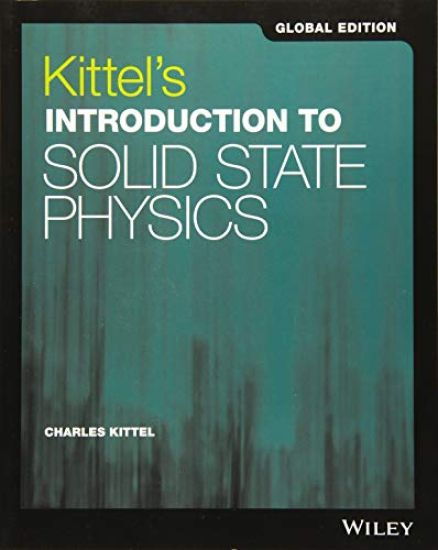
Kittel's Introduction to Solid State Physics, Global Edition
Kittel’s Introduction to Solid State Physics, Global Edition, has been the standard solid state physics text for physics majors since the publication of its first edition over 60 years ago. The emphasis in the book has always been on physics rather than formal mathematics. This book is written with the goal that it is accessible to undergraduate students and consistently teachable. With each new edition, the author has attempted to add important new developments in the field without impacting its inherent content coverage. This Global Edition offers the advantage of expanded end-of-chapter problem sets.
Introduction to Applied Solid State Physics

Introduction to Applied Solid State Physics

R. Dalven

Springer-Verlag New York Inc.
2012
nidottu
In addition to the topics discussed in the First Edition, this Second Edition contains introductory treatments of superconducting materials and of ferromagnetism. I think the book is now more balanced because it is divided perhaps 60% - 40% between devices (of all kinds) and materials (of all kinds). For the physicist interested in solid state applications, I suggest that this ratio is reasonable. I have also rewritten a number of sections in the interest of (hopefully) increased clarity. The aims remain those stated in the Preface to the First Edition; the book is a survey of the physics of a number of solid state devices and ma­ terials. Since my object is a discussion of the basic ideas in a number of fields, I have not tried to present the "state of the art," especially in semi­ conductor devices. Applied solid state physics is too vast and rapidly changing to cover completely, and there are many references available to recent developments. For these reasons, I have not treated a number of interesting areas. Among the lacunae are superiattices, heterostructures, compound semiconductor devices, ballistic transistors, integrated optics, and light wave communications. (Suggested references to those subjects are given in an appendix. ) I have tried to cover some of the recent revolutionary developments in superconducting materials.
Introduction to Applied Solid State Physics

Introduction to Applied Solid State Physics

Richard Dalven

Springer-Verlag New York Inc.
2013
nidottu
The aim of this book is a discussion, at the introductory level, of some applications of solid state physics. The book evolved from notes written for a course offered three times in the Department of Physics of the University of California at Berkeley. The objects of the course were (a) to broaden the knowledge of graduate students in physics, especially those in solid state physics; (b) to provide a useful course covering the physics of a variety of solid state devices for students in several areas of physics; (c) to indicate some areas of research in applied solid state physics. To achieve these ends, this book is designed to be a survey of the physics of a number of solid state devices. As the italics indicate, the key words in this description are physics and survey. Physics is a key word because the book stresses the basic qualitative physics of the applications, in enough depth to explain the essentials of how a device works but not deeply enough to allow the reader to design one. The question emphasized is how the solid state physics of the application results in the basic useful property of the device. An example is how the physics of the tunnel diode results in a negative dynamic resistance. Specific circuit applications of devices are mentioned, but not emphasized, since expositions are available in the elec­ trical engineering textbooks given as references.
Nonlinear Waves in Solid State Physics

Nonlinear Waves in Solid State Physics

Springer-Verlag New York Inc.
2012
nidottu
This book is based on the contributions to the 17th International School of Materials Sci­ ence and Technology, entitled Nonlinear Waves in Solid State Physics. This was held as a NATO Advanced Study Institute at the Ettore Majorana Centre in Erice, Sicily between the st th 1 and 15 July 1989, and attracted almost 100 participants from over 20 different countries. The book covers the fundamental properties of nonlinear waves in solid state materials, dealing with both theory and experiment. The aim is to emphasise the methods underpinning the important new developments in this area. The material is organised into subject areas that can broadly be classified into the following groups: the theory of nonlinear surface and guided waves in self-focusing magnetic and non-magnetic materials; nonlinear effects at in­ terfaces; nonlinear acoustoelectronic and surface acoustic waves; Lagrangian and Hamiltonian formulations of nonlinear problems; nonlinear effects in optical fibres; resonance phenomena; and nonlinear integrated optics. The chapters have been grouped together according to these classifications as closely as possible, but it should be borne in mind that although there is much overlap of ideas, each chapter is essentially independent of the others. We would like to acknowledge the sponsorship of the NATO Scientific Affairs Division, the European Physical Society, the National Science Foundation of the USA, the European Research Office, the Italian Ministry of Education, the Italian Ministry of Scientific and Technological Research, the Sicilian Regional Government and the Ugo Bordoni Foundation.