Kirjojen hintavertailu. Mukana 11 627 220 kirjaa ja 12 kauppaa.

Kirjahaku

Etsi kirjoja tekijän nimen, kirjan nimen tai ISBN:n perusteella.

884 tulosta hakusanalla Appian

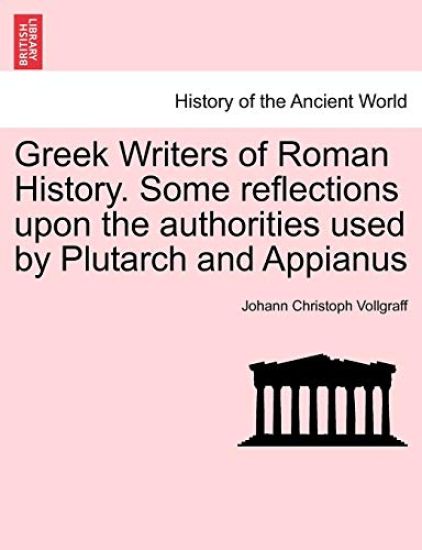
Greek Writers of Roman History. Some Reflections Upon the Authorities Used by Plutarch and Appianus

Greek Writers of Roman History. Some Reflections Upon the Authorities Used by Plutarch and Appianus

Johann Christoph Vollgraff

British Library, Historical Print Editions
2011
pokkari
Title: Greek Writers of Roman History. Some reflections upon the authorities used by Plutarch and Appianus.Publisher: British Library, Historical Print EditionsThe British Library is the national library of the United Kingdom. It is one of the world's largest research libraries holding over 150 million items in all known languages and formats: books, journals, newspapers, sound recordings, patents, maps, stamps, prints and much more. Its collections include around 14 million books, along with substantial additional collections of manuscripts and historical items dating back as far as 300 BC.The HISTORY OF THE ANCIENT WORLD collection includes books from the British Library digitised by Microsoft. Titles in this series include lectures, compiled sketches, and chronological discourses on Greece, Rome, and other early European and African civilisations. The collection also has a selection of physical and classical geography texts. ++++The below data was compiled from various identification fields in the bibliographic record of this title. This data is provided as an additional tool in helping to insure edition identification: ++++ British Library Vollgraff, Johann Christoph; 1880. 113 p.; 8 . 9041.c.23.
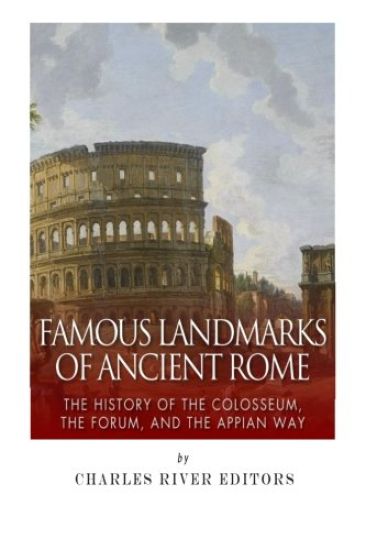
Famous Landmarks of Ancient Rome: The History of the Colosseum, the Forum, and the Appian Way
*Includes pictures *Includes accounts of the landmarks written by ancient Romans *Includes bibliographies for further reading *Includes a table of contents The Roman Empire is the most famous in history, and the center of the far-reaching empire's activities was located in the Forum, a low area between the Capitoline and Palatine hills in Rome. The topography held a great deal of significance for Romans, and consequently so many layers of myth were laid on top of the landscape and buildings that it is difficult to separate legend from actual historical fact. As a low-lying area near the Tiber river, the Forum was subject to much flooding, and even into the 20th century, the Forum area could flood upwards of over 40 feet above sea level. This would factor significantly in the imagination of Romans, who later ascribed the flooding with saving the city's founders, Romulus and Remus, from execution. However, in the 8th and 7th centuries B.C., this did not make for a good area for construction. Previous generations of excavators have concluded that in the beginning, there were waddle and daub huts in the Forum, as indicated by remains of organic food material, fragments of daub, and evidence of post holes dug in the ground for these structures. However, a recent environmental study has shown that such structures could not survive the flooding that was endemic to the Forum, suggesting that it took a few hundred years (during the period of the Roman kings) for the Romans to move up to 20,000 square meters of earth in order to reclaim land in the Forum, and a gravel pavement was placed on top of the landfill. If true, this project shows a high degree of organization and central planning. When the Colosseum was built in the late 1st century A.D., the Romans, a people known for their architectural acumen, managed to amaze themselves. Martial, a Roman poet writing during the inauguration of the Colosseum, clearly believed the Colosseum was so grand a monument that it was even greater than the other Wonders of the Ancient World, which had been written about and visited endlessly by the Romans and Greeks in antiquity. Indeed, although the Wonders were wondrous to behold, the Colosseum was a spectacular achievement in architecture, something new and innovative, and therefore an amazing "Wonder" in its own way. The Colosseum was designed to be both a symbol and show of strength by the famous Flavian emperors, most notably Vespasian and his sons Titus and Domitian. Vespasian had started the construction of the Colosseum shortly after becoming emperor in 69 A.D., but he died before he could present any spectacles in his giant amphitheatre. That honor went to his son Titus, who celebrated the inaugural opening in 80 A.D. with 100 days of games, despite the fact that the Colosseum was not completely finished. When his brother Domitian came to power in 81 A.D., he finished the amphitheatre, but not without making some changes to the overall design. By the time it was truly finished, the Colosseum stood about 150 feet tall, with the oval in the center stretching nearly two football fields long and over 500 feet across. The Colosseum is a large stadium even by today's standards, and its great size conveys the power of the empire as it dominates the landscape and towers over nearby buildings. The modern world has the ancient Romans to thank for the origins of many modern technologies, conveniences, and ideas such as running water, baths, and republican style government, but roads are another influence the Romans have had on the modern world that are often taken for granted. Although Roman roads may not have attained the glamorous status of other inventions, their influence is just as profound; roads provide essential communication and transport lines for any country - they are the veins and arteries that move the life-blood of trade and peoples that make a country thrive.
The Civil Wars

The Civil Wars

Appian

Penguin Classics
1996
pokkari
Taken from Appian's Roman History, the five books collected here form the sole surviving continuous historical narrative of the era between 133-35 BC - a time of anarchy and instability for the Roman Empire. A masterly account of a turbulent epoch, they describe the Catiline conspiracy; the rise and fall of the First Triumvirate; the murder of Julius Caesar; the formation of the Second Triumvirate by Antonius, Octavian, and Lepidus; and brutal civil war. A compelling depiction of the decline of the Roman state into brutality and violence, The Civil Wars portrays political discontent, selfishness and the struggle for power - a struggle that was to culminate in a titanic battle for mastery over the Roman Empire, and the defeat of Antony and Cleopatra by Octavian in 31 BC
Roman History, Volume I

Roman History, Volume I

Appian

Harvard University Press
2019
sidottu
Rome’s foreign wars, nation by nation.Appian (Appianus) is among our principal sources for the history of the Roman Republic, particularly in the second and first centuries BC, and sometimes our only source, as for the Third Punic War and the destruction of Carthage. Born circa AD 95, Appian was an Alexandrian official at ease in the highest political and literary circles who later became a Roman citizen and advocate. He apparently received equestrian rank, for in his later years he was offered a procuratorship. He died during the reign of Antoninus Pius (emperor 138–161).Appian’s theme is the process by which the Roman Empire achieved its contemporary prosperity, and his unique method is to trace in individual books the story of each nation’s wars with Rome up through her own civil wars. Although this triumph of “harmony and monarchy” was achieved through characteristic Roman virtues, Appian is unusually objective about Rome’s shortcomings along the way. His history is particularly strong on financial and economic matters, and on the operations of warfare and diplomacy.Of the work’s original twenty-four books, only the Preface and Books 6–9 and 11–17 are preserved complete or nearly so: those on the Spanish, Hannibalic, African, Illyrian, Syrian, and Mithridatic wars, and five books on the civil wars.This edition of Appian replaces the original Loeb edition by Horace White and adds the fragments, as well as his letter to Fronto.
Roman History, Volume II

Roman History, Volume II

Appian

Harvard University Press
2019
sidottu
Rome’s foreign wars, nation by nation.Appian (Appianus) is among our principal sources for the history of the Roman Republic, particularly in the second and first centuries BC, and sometimes our only source, as for the Third Punic War and the destruction of Carthage. Born circa AD 95, Appian was an Alexandrian official at ease in the highest political and literary circles who later became a Roman citizen and advocate. He apparently received equestrian rank, for in his later years he was offered a procuratorship. He died during the reign of Antoninus Pius (emperor 138–161).Appian’s theme is the process by which the Roman Empire achieved its contemporary prosperity, and his unique method is to trace in individual books the story of each nation’s wars with Rome up through her own civil wars. Although this triumph of “harmony and monarchy” was achieved through characteristic Roman virtues, Appian is unusually objective about Rome’s shortcomings along the way. His history is particularly strong on financial and economic matters, and on the operations of warfare and diplomacy.Of the work’s original twenty-four books, only the Preface and Books 6–9 and 11–17 are preserved complete or nearly so: those on the Spanish, Hannibalic, African, Illyrian, Syrian, and Mithridatic wars, and five books on the civil wars.This edition of Appian replaces the original Loeb edition by Horace White and adds the fragments, as well as his letter to Fronto.
Roman History, Volume III

Roman History, Volume III

Appian

Loeb Classical Library
2019
sidottu
Rome’s foreign wars, nation by nation.Appian (Appianus) is among our principal sources for the history of the Roman Republic, particularly in the second and first centuries BC, and sometimes our only source, as for the Third Punic War and the destruction of Carthage. Born circa AD 95, Appian was an Alexandrian official at ease in the highest political and literary circles who later became a Roman citizen and advocate. He apparently received equestrian rank, for in his later years he was offered a procuratorship. He died during the reign of Antoninus Pius (emperor 138–161).Appian’s theme is the process by which the Roman Empire achieved its contemporary prosperity, and his unique method is to trace in individual books the story of each nation’s wars with Rome up through her own civil wars. Although this triumph of “harmony and monarchy” was achieved through characteristic Roman virtues, Appian is unusually objective about Rome’s shortcomings along the way. His history is particularly strong on financial and economic matters, and on the operations of warfare and diplomacy.Of the work’s original twenty-four books, only the Preface and Books 6–9 and 11–17 are preserved complete or nearly so: those on the Spanish, Hannibalic, African, Illyrian, Syrian, and Mithridatic wars, and five books on the civil wars.This edition of Appian replaces the original Loeb edition by Horace White and adds the fragments, as well as his letter to Fronto.
Roman History, Volume IV

Roman History, Volume IV

Appian

Harvard University Press
2020
sidottu
Rome’s internal conflicts, from the Gracchi to the Empire.Appian (Appianus) is among our principal sources for the history of the Roman Republic, particularly in the second and first centuries BC, and sometimes our only source, as for the Third Punic War and the destruction of Carthage. Born circa AD 95, Appian was an Alexandrian official at ease in the highest political and literary circles who later became a Roman citizen and advocate. He apparently received equestrian rank, for in his later years he was offered a procuratorship. He died during the reign of Antoninus Pius (emperor 138–161).Appian’s theme is the process by which the Roman Empire achieved its contemporary prosperity, and his unique method is to trace in individual books the story of each nation’s wars with Rome up through her own civil wars. Although this triumph of “harmony and monarchy” was achieved through characteristic Roman virtues, Appian is unusually objective about Rome’s shortcomings along the way. His history is particularly strong on financial and economic matters, and on the operations of warfare and diplomacy.Of the work’s original twenty-four books, only the Preface and Books 6–9 and 11–17 are preserved complete or nearly so: those on the Spanish, Hannibalic, African, Illyrian, Syrian, and Mithridatic wars, and five books on the civil wars.This edition of Appian replaces the original Loeb edition by Horace White and adds the fragments, as well as his letter to Fronto.