Kirjojen hintavertailu. Mukana 12 390 323 kirjaa ja 12 kauppaa.

Kirjahaku

Etsi kirjoja tekijän nimen, kirjan nimen tai ISBN:n perusteella.

1000 tulosta hakusanalla Austin Smith

Broadway Swings

Broadway Swings

J. Austin Eyer; Lyndy Franklin Smith

Methuen Drama
2015
nidottu
In this textbook for performers, the position of a Swing—an Understudy for the Ensemble—on Broadway is examined from every angle, showing just how vital Swings are to the success of any musical theatre production.Authors J. Austin Eyer and Lyndy Franklin Smith draw on their own experiences as performers, and gather first-hand stories from other Swings about the glories and hardships of their industry. The book features interviews with over 100 Broadway pros—Swing veterans, Stage Managers, Casting Directors, Choreographers, and Directors—including Rob Ashford, Susan Stroman, Jerry Mitchell, Larry Fuller, Tony Stevens, Beverley Randolph, and Frank DiLella.Broadway Swings is the ideal guide for anyone considering a career in this most unique of positions, or anyone curious about what really goes on, behind-the- scenes, in a long-running show.

Best Practices at Tier 3, Secondary: (a Response to Intervention Guide to Implementing Tier 3 Teaching Strategies)
Confidently support the students who struggle most. Written for secondary educators, this practical resource details how to provide intensive interventions at Tier 3 of the RTI at Work(TM) process. Rely on the book's toolkit of best practices and easy-to-use strategies to help you and your team drive sustainable learning improvement and success at all secondary grade levels across the curriculum. Use this resource to meet the needs of students who have fallen the furthest behind in the classroom: Discover fundamental practices and tools to support students through a schoolwide, collaborative RTI at Work process. Understand the role of teams, specifically the leadership and intervention teams, in effectively implementing the RTI at Work process at Tier 3. Learn how to design and deliver assessments and instruction while utilizing best practices of a multitiered system of support (MTSS). Examine the importance of teaching essential academic and social behaviors, and obtain strategies for delivering intensive behavior interventions at Tier 3. Gain activities and tools to apply in the classroom and further student learning. Contents: Introduction Chapter 1: The Purpose and Power of Tier 3 Intensive Interventions Chapter 2: The Need for Collective Commitment and Responsibility Chapter 3: Collaborative Team Structures at Tier 3 Chapter 4: Tier 3 Design to Ensure High Levels of Learning Chapter 5: Convergent Assessment at Tier 3 Chapter 6: Behavior Supports at Tier 3 Chapter 7: Academic Instruction at Tier 3 Chapter 8: Personalized Learning for Teams Epilogue: Final Thoughts Appendix: Resources and Tools References and Resources Index
Best Practices at Tier 3 [elementary]: Intensive Interventions for Remediation, Elementary (an Rti Model Guide for Implementing Tier 3 Interventions i
Meet the needs of students who have fallen the furthest behind. Created for grade K-5 educators, this guide details how to implement intensive interventions at Tier 3 of the RTI at Work(TM) process. Discover practices and strategies to intervene successfully when students struggle with core content, as well as with foundational skills from previous school years. The RTI at Work(TM) inverted pyramid is designed to continually focus a school's collective attention and resources to a single point: the individual child. TIER 1 A coherent and viable core curriculum that embeds ongoing monitoring for all students TIER 2 Immediate and targeted interventions systematically applied and monitored for any students not achieving TIER 3 Intensive interventions focused on closing gaps Use this guide to improve your school so students receive the support they need to learn at the highest levels: Study the critical elements of the RTI at Work(TM) process. Understand the role of teams, specifically the leadership and intervention teams, in implementing Tier 3 interventions. Learn how to collaboratively design and deliver instruction to students needing intensive intervention with a multitiered system of support (MTSS). Examine the role of assessment at Tier 3 and discover strategies for using assessment data to monitor learning. Acquire best practices for delivering intensive behavior interventions according to the RTI model. Contents: Introduction Chapter 1: The Power and Purpose of Tier 3 Interventions Chapter 2: The Need for Collective Responsibility Chapter 3: Collaborative Team Structures at Tier 3 Chapter 4: Tier 3 Design to Ensure High Levels of Learning Chapter 5: Convergent Assessment for Targeting at Tier 3 Chapter 6: Behavior Supports at Tier 3 Chapter 7: Academic Instruction at Tier 3 Chapter 8: Personalized Learning for Teams Final Thoughts Appendix: Resources and Tools References and Resources Index
Improving Precommissioning Assignments and Readiness on the U.S. Coast Guard Offshore Patrol Cutter

Improving Precommissioning Assignments and Readiness on the U.S. Coast Guard Offshore Patrol Cutter

Jennifer Lamping Lewis; Aaron C Davenport; Brynn Tannehill; Austin Lewis; James V Marrone; Victoria M Smith; Barbara Bicksler

RAND Corporation
2023
pokkari
Researchers identified approaches the U.S. Coast Guard could take to improve crew satisfaction with precommissioning assignments on offshore patrol cutters and overall fleet readiness. They evaluated the options using five criteria: crew satisfaction, crew preparation and knowledge retention, timeliness, feasibility, and cost.
HTML5 Game Development Insights

HTML5 Game Development Insights

Colt McAnlis; Peter Lubbers; Brandon Jones; Andrzej Mazur; Sean Bennett; Bruno Garcia; Shun Lin; Ivan Popelyshev; Jon Howard; Ian Ballantyne; Takuo Kihira; Jesse Freeman; Tyler Smith; Don Olmstead; Jason Gauci; John McCutchan; Chad Austin; Mario Andres Pagella; Florian dErfurth; Duncan Tebbs

APress
2014
nidottu
HTML5 Game Development Insights is a from-the-trenches collection of tips, tricks, hacks, and advice straight from professional HTML5 game developers. The 24 chapters here include unique, cutting edge, and essential techniques for creating and optimizing modern HTML5 games. You will learn things such as using the Gamepad API, real-time networking, getting 60fps full screen HTML5 games on mobile, using languages such as Dart and TypeScript, and tips for streamlining and automating your workflow. Game development is a complex topic, but you don't need to reinvent the wheel. HTML5 Game Development Insights will teach you how the pros do it.The book is comprised of six main sections: Performance; Game Media: Sound and Rendering; Networking, Load Times, and Assets; Mobile Techniques and Advice; Cross-Language JavaScript; Tools and Useful Libraries. Within each of these sections, you will find tips that will help you work faster and more efficiently and achieve better results.Presented as a series of short chapters from various professionals in the HTML5 gaming industry, all of the source code for each article is included and can be used by advanced programmers immediately.
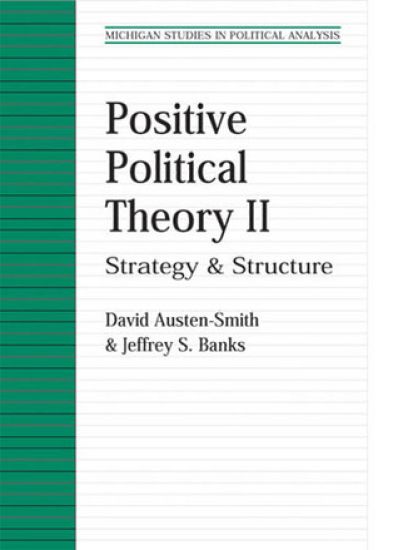
Positive Political Theory II

Positive Political Theory II

David Austen-Smith; Jeffrey S. Banks

The University of Michigan Press
2005
nidottu
“A major piece of work . . . a classic. There is noother book like it.”—Norman Schofield, Washington University“The authors succeed brilliantly in tackling a largenumber of important questions concerning theinteraction among voters and elected representativesin the political arena, using a common, rigorouslanguage.”—Antonio Merlo, University of PennsylvaniaPositive Political Theory II: Strategy and Structureis the second volume in Jeffrey Banks and DavidAusten-Smith’s monumental study of the linksbetween individual preferences and collective choice.The book focuses on representative systems, includingboth elections and legislative decision-makingprocesses, clearly connecting individual preferences tocollective outcomes. This book is not a survey. Rather,it is the coherent, cumulative result of the authors’brilliant efforts to indirectly connect preferences tocollective choice through strategic behaviors such asagenda-selection and voting.The book will be an invaluable reference and teachingtool for economists and political scientists, and anessential companion to any scholar interested in thelatest theoretical advances in positive political theory.
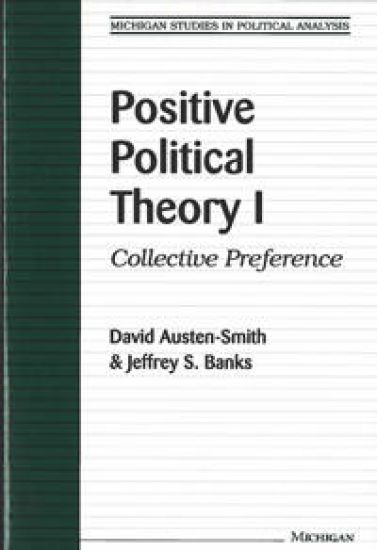
Positive Political Theory I

Positive Political Theory I

David Austen-Smith; Jeffrey S. Banks

The University of Michigan Press
2000
nidottu
Positive Political Theory I is concerned with the formal theory of preference aggregation for collective choice. The theory is developed as generally as possible, covering classes of aggregation methods that include such well-known examples as majority and unanimity rule and focusing in particular on the extent to which any aggregation method is assured to yield a set of "best" alternatives. The book is intended both as a contribution to the theory of collective choice and a pedagogic tool.Austen-Smith and Banks have made the exposition both rigorous and accessible to people with some technical background (e.g., a course in multivariate calculus). The intended readership ranges from more technically-oriented graduate students and specialists to those students in economics and political science interested less in the technical aspects of the results than in the depth, scope, and importance of the theoretical advances in positive political theory."This is a stunning book. Austen-Smith and Banks have a deep understanding of the material, and their text gives a powerfully unified and coherent perspective on a vast literature. The exposition is clear-eyed and efficient but never humdrum. Even those familiar with the subject will find trenchant remarks and fresh insights every few pages. Anyone with an interest in contemporary liberal democratic theory will want this book on the shelf." --Christopher Achen, University of MichiganDavid Austen-Smith is Professor of Political Science, Professor of Economics, and Professor of Management and Strategy, Northwestern University. Jeffrey S. Banks is Professor of Political Science, California Institute of Technology.
Positive Political Theory II

Positive Political Theory II

David Austen-Smith; Jeffrey S. Banks

The University of Michigan Press
2005
sidottu
“A major piece of work . . . a classic. There is noother book like it.”—Norman Schofield, Washington University“The authors succeed brilliantly in tackling a largenumber of important questions concerning theinteraction among voters and elected representativesin the political arena, using a common, rigorouslanguage.”—Antonio Merlo, University of PennsylvaniaPositive Political Theory II: Strategy and Structureis the second volume in Jeffrey Banks and DavidAusten-Smith’s monumental study of the linksbetween individual preferences and collective choice.The book focuses on representative systems, includingboth elections and legislative decision-makingprocesses, clearly connecting individual preferences tocollective outcomes. This book is not a survey. Rather,it is the coherent, cumulative result of the authors’brilliant efforts to indirectly connect preferences tocollective choice through strategic behaviors such asagenda-selection and voting.The book will be an invaluable reference and teachingtool for economists and political scientists, and anessential companion to any scholar interested in thelatest theoretical advances in positive political theory.
Positive Political Theory I

Positive Political Theory I

David Austen-Smith; Jeffrey S. Banks

The University of Michigan Press
1998
sidottu
Positive Political Theory I is concerned with the formal theory of preference aggregation for collective choice. The theory is developed as generally as possible, covering classes of aggregation methods that include such well-known examples as majority and unanimity rule and focusing in particular on the extent to which any aggregation method is assured to yield a set of "best" alternatives. The book is intended both as a contribution to the theory of collective choice and a pedagogic tool.Austen-Smith and Banks have made the exposition both rigorous and accessible to people with some technical background (e.g., a course in multivariate calculus). The intended readership ranges from more technically-oriented graduate students and specialists to those students in economics and political science interested less in the technical aspects of the results than in the depth, scope, and importance of the theoretical advances in positive political theory."This is a stunning book. Austen-Smith and Banks have a deep understanding of the material, and their text gives a powerfully unified and coherent perspective on a vast literature. The exposition is clear-eyed and efficient but never humdrum. Even those familiar with the subject will find trenchant remarks and fresh insights every few pages. Anyone with an interest in contemporary liberal democratic theory will want this book on the shelf." --Christopher Achen, University of MichiganDavid Austen-Smith is Professor of Political Science, Professor of Economics, and Professor of Management and Strategy, Northwestern University. Jeffrey S. Banks is Professor of Political Science, California Institute of Technology.
The Edge of the Field

The Edge of the Field

Austine Royer Smith

Litfire Publishing, LLC
2018
pokkari
The Edge Of The Field is based on my personal experiences of "gleaning and gathering after the Reapers and Gleaners at the edge of the Field." The Harvest is great and enormous. Not only is there a need for "Ruths" to glean and gather after the Reapers and Gleaners in the Fields, there are times that we are called on immediately and urgently for a specific purpose that needs attention right then.
Reading Jane Austen After Reading Charlotte Smith

Reading Jane Austen After Reading Charlotte Smith

Jacqueline M. Labbe

Springer Nature Switzerland AG
2020
sidottu
This book explores what it means to read the six major works of Jane Austen, inlight of the ten major works of fiction by Charlotte Smith. It proposes that Smithhad a deep and lasting impact on Austen, but this is not an influence study. Instead,it argues for the possibility that two authors who never met could between themwrite something into being, both responding to and creating a novelistic zeitgeist.This, the book argues, can be called co-writing. This book will appeal to studentsand scholars of the novel, of women’s writing, and of Smith and Austen specifically.
Reading Jane Austen After Reading Charlotte Smith

Reading Jane Austen After Reading Charlotte Smith

Jacqueline M. Labbe

Springer Nature Switzerland AG
2021
nidottu
This book explores what it means to read the six major works of Jane Austen, inlight of the ten major works of fiction by Charlotte Smith. It proposes that Smithhad a deep and lasting impact on Austen, but this is not an influence study. Instead,it argues for the possibility that two authors who never met could between themwrite something into being, both responding to and creating a novelistic zeitgeist.This, the book argues, can be called co-writing. This book will appeal to studentsand scholars of the novel, of women’s writing, and of Smith and Austen specifically.
Jane Austen's Guide to Life

Jane Austen's Guide to Life

Lori Smith

Globe Pequot Press
2014
pokkari
Jane Austen's Guide to Life playfully and poignantly examines Austen's life and novels for the timeless advice that still applies for today's women. Austen may not understand texting or tweeting or platform heels, but as an astute student of human nature, she can surely teach us an awful lot about ourselves--and we might just be surprised by what she has to say.
Satisfaction: A Jane Austen Card Game

Satisfaction: A Jane Austen Card Game

Tori Smith; Rook Liu; Zach Jones

Clarkson Potter Publishers
2026
muu
Play your cards right and you'll make the most advantageous matches in this fun Jane Austen-inspired twist on the classic card game, bridge. Celebrate the world of Jane Austen with Satisfaction, an easy-to-learn game for ages 12+ with a bespoke deck of cards that feature characters and settings from Austen's beloved novels. Win tricks to fill your dance card and try to successfully matchmake characters from Emma, Sense and Sensibility, Pride and Prejudice, and more Each round, players set a trump suit and then take turns playing cards, hoping to have the highest value on the table. Like in traditional bridge, the highest value wins the trick. But in Satisfaction you can also win points for successfully playing the matching romantic partner to a character already on the table. If Elizabeth Bennet has been played, another player can put down Mr. Darcy and earn both players an additional point. The player with the most tricks and successful romances at the end will win the game. But beware of bad suitors, meddlesome family members, and prying neighbors who may seek to undo your attempts to win. With simple rules and a host of beloved characters from Austen's novels, you'll have the most delightful time at the county ball as everyone tries to demand Satisfaction.
The Jane Austen Writers' Club

The Jane Austen Writers' Club

Rebecca Smith

Bloomsbury Publishing PLC
2017
nidottu
‘Winning and beguiling ... Smith shares Jane Austen’s clarity and gentle irony’ IndependentJane Austen is one of the most beloved writers in the literary canon. Her novels changed the landscape of fiction for ever, and her books remain as fresh, entertaining and witty as the day they were first published. Bursting with useful exercises, beautiful illustrations and enlightening quotations from Austen’s novels and letters, this book will teach you her tips, tricks and methods, including: * Her foolproof guide to plotting a novel * The best ways to introduce, establish and develop characters * Her secret for building suspense * How to write sparkling dialogue * Using irony, ekphrasis and other clever devices * How best to live the writer’s life These techniques have been tried and tested by Rebecca Smith, who is none other than Jane Austen’s five-times-great-niece. The author of five books, she teaches creative writing at the University of Southampton and has been Writer in Residence at Jane Austen’s House Museum