Kirjojen hintavertailu. Mukana 11 244 527 kirjaa ja 12 kauppaa.

Kirjahaku

Etsi kirjoja tekijän nimen, kirjan nimen tai ISBN:n perusteella.

1000 tulosta hakusanalla Benjamin Doth

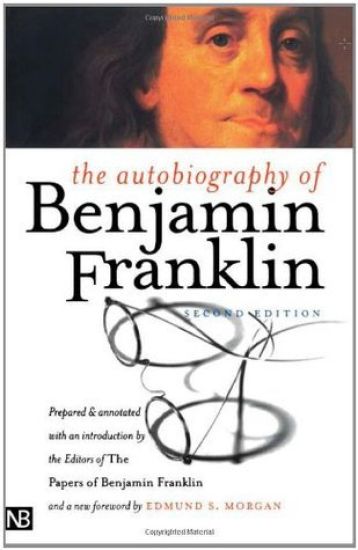
The Autobiography of Benjamin Franklin

The Autobiography of Benjamin Franklin

Benjamin Franklin

Yale University Press
2003
pokkari
The authoritative edition of Franklin’s autobiography, with a foreword by the eminent Franklin scholar Edmund S. Morgan “The best and most beautiful edition [of the Autobiography].”—J. H. Plumb, New York Review of Books “Among the many editions available—read Yale’s. Its text is the most reliable (the Franklin papers are at Yale) and its supplementary material is uniformly useful.”—Jonathan Yardley, Washington Post A classic of eighteenth-century American history and literature, Benjamin Franklin’s Autobiography has had an influence perhaps unequaled by any other book by an American writer. Written ostensibly as a letter to his son William, Franklin’s Autobiography offers his reflections on philosophy and religion, politics, war, education, material success, and the status of women. Prepared by the editors of The Papers of Benjamin Franklin, this definitive edition is drawn with scrupulous care from the original manuscript in Franklin’s handwriting, now in the Henry E. Huntington Library and Art Gallery. The introduction by Leonard W. Labaree places the autobiography in literary and historical contexts. In a new foreword, eminent Franklin scholar Edmund S. Morgan writes about Franklin’s dual allegiance as an American and a subject of an English king—and his emergence as a leader of the American Revolution. This edition also includes biographical notes, a chronology of Franklin’s life, and an updated bibliography.
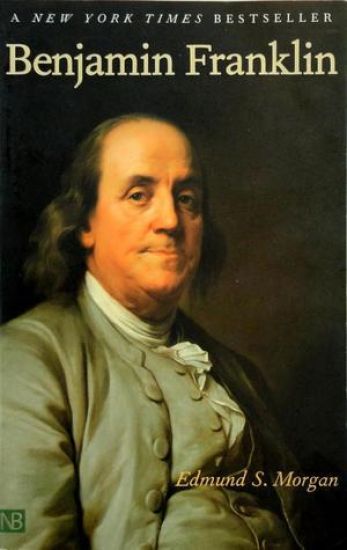
Benjamin Franklin

Benjamin Franklin

Edmund S. Morgan

Yale University Press
2003
pokkari
• A New York Times Bestseller • A Finalist for a National Book Critics Circle Award in Biography Benjamin Franklin is perhaps the most remarkable figure in American history; the greatest statesman of his age, he played a pivotal role in the formation of the American republic. He was also a pioneering scientist, a bestselling author, the country’s first postmaster general, a printer, a bon vivant, a diplomat, a ladies’ man, and a moralist--and the most prominent celebrity of the eighteenth century. Franklin was, however, a man of vast contradictions, as Edmund Morgan demonstrates in this brilliant biography. Written by one of our greatest historians, Benjamin Franklin offers a provocative portrait of America’s most extraordinary patriot.
The Papers of Benjamin Franklin, Complete Set

The Papers of Benjamin Franklin, Complete Set

Benjamin Franklin

Yale University Press
2015
sidottu
The Papers of Benjamin Franklin is a collaborative undertaking by a team of scholars at Yale University to collect, edit, and publish all of the writings and papers of one of America's most remarkable founding fathers and indeed one of the most extraordinary people this nation has ever produced.To celebrate the 300th anniversary of Benjamin Franklin's birth, Yale University Press is offering all currently available volumes (1 through 37) of The Papers of Benjamin Franklin at the special price of $2,450 — a 30% savings from $3,515, the price of the set when volumes are purchased individually. This special offer will only be available until January 17, 2007.
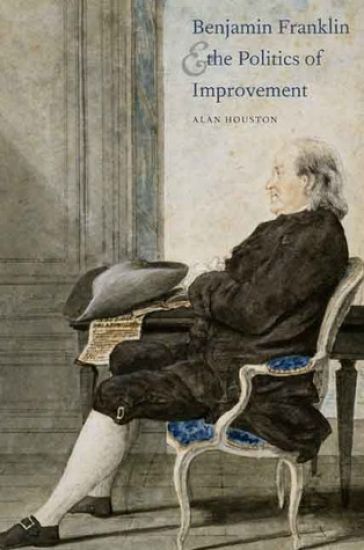
Benjamin Franklin and the Politics of Improvement

Benjamin Franklin and the Politics of Improvement

Alan Houston

Yale University Press
2009
sidottu
This fascinating book explores Benjamin Franklin’s social and political thought. Although Franklin is often considered “the first American,” his intellectual world was cosmopolitan. An active participant in eighteenth-century Atlantic debates over the modern commercial republic, Franklin combined abstract analyses with practical proposals. Houston treats Franklin as shrewd, creative, and engaged—a lively thinker who joined both learned controversies and political conflicts at home and abroad. Drawing on meticulous archival research, Houston examines such tantalizing themes as trade and commerce, voluntary associations and civic militias, population growth and immigration policy, political union and electoral institutions, freedom and slavery. In each case, he shows how Franklin urged the improvement of self and society. Engagingly written and richly illustrated, this book provides a compelling portrait of Franklin, a fresh perspective on American identity, and a vital account of what it means to be practical.
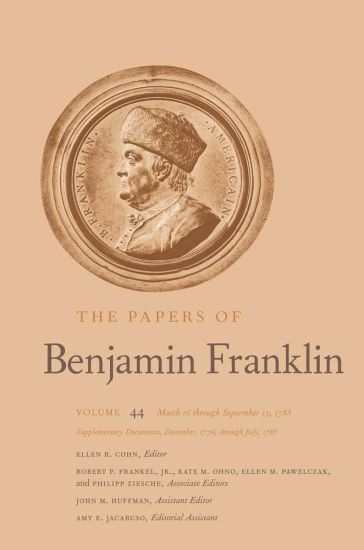
The Papers of Benjamin Franklin

The Papers of Benjamin Franklin

Benjamin Franklin

YALE UNIVERSITY PRESS
2024
sidottu
This volume in the venerable Papers of Benjamin Franklin covers March 16 through September 12, 1785, Franklin’s final days as minister to France and his voyage home This volume covers Franklin’s final months as minister to France and his voyage back to America. He received his long-awaited permission from Congress to return home; accepted the king’s parting gift of a miniature portrait surrounded by diamonds; settled his accounts; and arranged passage for himself and his two grandsons on a ship bound from England to Philadelphia. Franklin instructed the French government on the culinary uses of maize and wrote a lengthy “eye-witness” account of China that includes directions for making tofu. His last public act in France was signing the Prussian-American Treaty of Commerce, which contained three unprecedented articles: the two he wrote in 1782 guaranteeing protections during wartime for noncombatants, and a third guaranteeing humane treatment for prisoners of war. On the English coast, Franklin met with his Loyalist son William and witnessed William’s signing over his American property to his son William Temple Franklin. Aboard the London Packet, Franklin wrote three scientific papers, including the copiously illustrated “Maritime Observations.” His original line drawings are reproduced here for the first time. The volume ends with an appendix containing supplementary documents from the French mission.
Benjamin Britten

Benjamin Britten

Stewart R. Craggs

Greenwood Press
2001
sidottu
Benjamin Britten was arguably the greatest English composer of his time. His music crossed boundaries of genre and form to include opera, ballet, orchestral and chamber music, and film and incidental music. The result of twenty years of research, ^IBenjamin Britten^R provides up-to-date and comprehensive details about Britten's life and music, including works, performances, and recordings--an effort never before undertaken. Certain to be of use to any scholar of British music or 20th century composition, this reference work is an invaluable addition to the literature on this important artist. Following a brief biography of the subject, author Stewart Craggs provides a complete list of works and performances, arranged by genre; a discography, and an annotated bibliography. Rounding out the volume are two lists of compositions, one arranged alphabetically and the other chronologically, and a general index.
Benjamin Rush, M.D.

Benjamin Rush, M.D.

Claire G Fox; Gordon Miller; Jacquelyn Miller

Greenwood Press
1996
sidottu
Benjamin Rush (1746-1813) exerted a remarkably wide-ranging influence on the medical, political, and social life of the emerging American nation. He fulfilled the multiple roles of first American professor of chemistry, signer of the Declaration of Independence, foremost American physician, father of American psychiatry, pioneer abolitionist, educator, advocate of temperance, and proponent of prison reform. The success of these endeavors rested largely on the strength and size of his literary output, which was unparalleled by any of the other founding fathers. This bibliographic guide is the only work to identify all of Rush's published writings as well as hundreds of writings about him.The Introduction surveys Rush's published writings on a variety of topics and places them in their late 18th and early 19th century context. Part one provides a comprehensive chronological listing of Rush's published works, including articles, pamphlets, and books in all their editions. Part one also includes comments from Rush scholars on the nature and significance of many of the works, along with references to contemporary reviews. Extensive cross-references show the relationship between documents. Aids to locating the documents in their original, reprinted, and microtext forms are also provided. Part two lists over 500 publications about Rush and his role in American history. The work includes a title and general index to part one and an author and general index to part two.
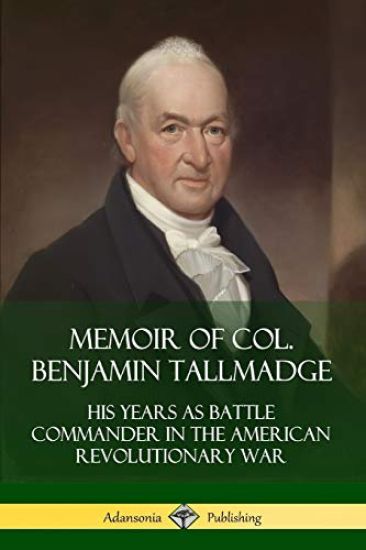
Memoir of Col. Benjamin Tallmadge: His Years as Battle Commander in the American Revolutionary War
Benjamin Tallmadge narrates his time spent as a military officer during the American Revolutionary War, detailing his roles as both commander and intelligence gatherer.Renowned for his successes during the American Revolution, Benjamin Tallmadge commences these memoirs with a brief family history. After this short introduction, he immediately describes his military training and deployment, and the witnessing of his first battle close to New York City. Stricken and steeled by the carnage of war, the young Tallmadge expresses his wish to see the Revolution to its very end.Upon demonstrating a keen sense of tactics, and mounting a successful raid wherein the supplies and premises of an enemy force were burned by Tallmadge and his fellow operatives, George Washington praised the officer's abilities. Throughout the conflict, Tallmadge proved an able spymaster; heading up the Culper Ring, a network of agents whose information in and around the New York area would prove extremely valuable to the war effort.
Memoir of Col. Benjamin Tallmadge: His Years as Battle Commander in the American Revolutionary War (Hardcover)
Benjamin Tallmadge narrates his time spent as a military officer during the American Revolutionary War, detailing his roles as both commander and intelligence gatherer.Renowned for his successes during the American Revolution, Benjamin Tallmadge commences these memoirs with a brief family history. After this short introduction, he immediately describes his military training and deployment, and the witnessing of his first battle close to New York City. Stricken and steeled by the carnage of war, the young Tallmadge expresses his wish to see the Revolution to its very end.Upon demonstrating a keen sense of tactics, and mounting a successful raid wherein the supplies and premises of an enemy force were burned by Tallmadge and his fellow operatives, George Washington praised the officer's abilities. Throughout the conflict, Tallmadge proved an able spymaster; heading up the Culper Ring, a network of agents whose information in and around the New York area would prove extremely valuable to the war effort.
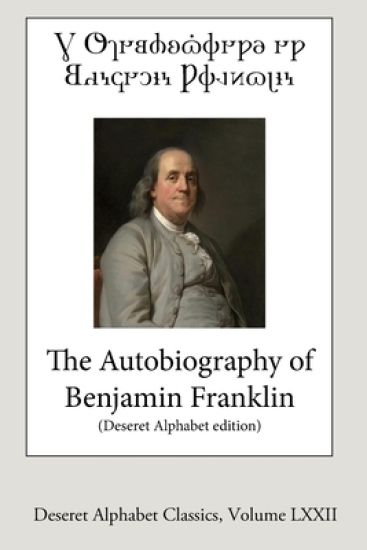
The Autobiography of Benjamin Franklin (Deseret Alphabet edition)
Benjamin Franklin (1705/1706-1790) was an American polymath and politician. He is is among the most important of America's Founding Fathers. Franklin was the first American scientist to be treated seriously by Europeans and becamea a Fellow of the Royal Society in 1756. His inventions and civic contributions are innumerable. Franklin made his fortune as a printer and newspaper publisher, but then used it to benefit the people at large.Franklin's Autobiography is a compilation of four documents written between 1771 and his death. It covers his life through 1757. Famous for its easy-going style, it is among the most remarkable rags-to-riches stories in all literature. Humble and honest, it recounts the hard work, determination, and continual self-improvement that made his success possible.This book is in the Deseret Alphabet, a phonetic alphabet for writing English developed in the mid-19th century at the University of Deseret (now the University of Utah).
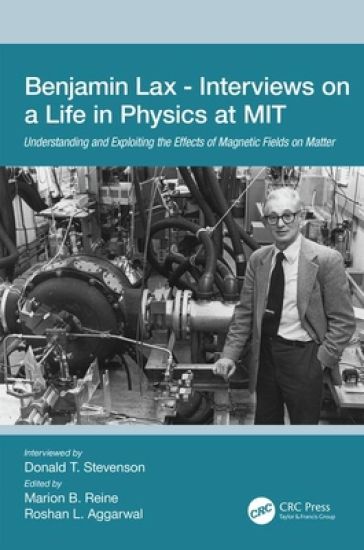
Benjamin Lax - Interviews on a Life in Physics at MIT
This book covers the life and 60-year career of Prof. Benjamin Lax (1915-2015), a preeminent physicist at the Massachusetts Institute of Technology (MIT), who played major roles in the development and applications of solid state and plasma physics.In an extensive series of autobiographical interviews, Lax describes the challenges he overcame, the opportunities he embraced, and the many outstanding research physicists he recruited, mentored, and interacted with. He includes both personal and professional reminiscences.Lax begins with his earliest memories of his childhood in Hungary. He recalls the immigration of his family to America and his education in New York City. He describes his Army service as a Radar Officer at the MIT Radiation Laboratory during World War II. He covers his graduate education in physics at MIT, and his building up the semiconductor and ferrite research groups at MIT Lincoln Laboratory in the 1950s. He describes the origins and accomplishments of the MIT Francis Bitter National Magnet Laboratory, of which he was the founding Director, and recalls his tenure as professor in the MIT physics department.Features: Provides a valuable insight into a 60-year career in physics at one of the world’s major research universities, the Massachusetts Institute of Technology Explores the organization, funding, and conduct of solid state physics research in the second half of the twentieth century Includes a complete bibliography of Lax’s publications in an online supplement
Benjamin Lax - Interviews on a Life in Physics at MIT
This book covers the life and 60-year career of Prof. Benjamin Lax (1915-2015), a preeminent physicist at the Massachusetts Institute of Technology (MIT), who played major roles in the development and applications of solid state and plasma physics.In an extensive series of autobiographical interviews, Lax describes the challenges he overcame, the opportunities he embraced, and the many outstanding research physicists he recruited, mentored, and interacted with. He includes both personal and professional reminiscences.Lax begins with his earliest memories of his childhood in Hungary. He recalls the immigration of his family to America and his education in New York City. He describes his Army service as a Radar Officer at the MIT Radiation Laboratory during World War II. He covers his graduate education in physics at MIT, and his building up the semiconductor and ferrite research groups at MIT Lincoln Laboratory in the 1950s. He describes the origins and accomplishments of the MIT Francis Bitter National Magnet Laboratory, of which he was the founding Director, and recalls his tenure as professor in the MIT physics department.Features: Provides a valuable insight into a 60-year career in physics at one of the world’s major research universities, the Massachusetts Institute of Technology Explores the organization, funding, and conduct of solid state physics research in the second half of the twentieth century Includes a complete bibliography of Lax’s publications in an online supplement
Benjamin, Adorno, and the Experience of Literature
This collection features original essays that examine Walter Benjamin’s and Theodor Adorno’s essays and correspondence on literature. Taken together, the essays present the view that these two monumental figures of 20th-century philosophy were not simply philosophers who wrote about literature, but that they developed their philosophies in and through their encounters with literature.Benjamin, Adorno, and the Experience of Literature is divided into three thematic sections. The first section contains essays that directly demonstrate the ways in which literature enriched the thinking of Benjamin and Adorno. It explores themes that are recognized to be central to their thinking—mimesis, the critique of historical progress, and the loss and recovery of experience—through their readings of literary authors such as Baudelaire, Beckett, and Proust. The second section continues the trajectory of the first by bringing together four essays on Benjamin’s and Adorno’s reading of Kafka, whose work helped them develop a distinctive critique of and response to capitalism. The third and final section focuses more intently on the question of what it means to gain authentically critical insight into a literary work. The essays examine Benjamin’s response to specific figures, including Georg Büchner, Robert Walser, and Julien Green, whose work he sees as neglected, undigested, or misunderstood.This book offers a unique examination of two pivotal 20th-century philosophers through the lens of their shared experiences with literature. It will appeal to a wide range of scholars across philosophy, literature, and German studies.
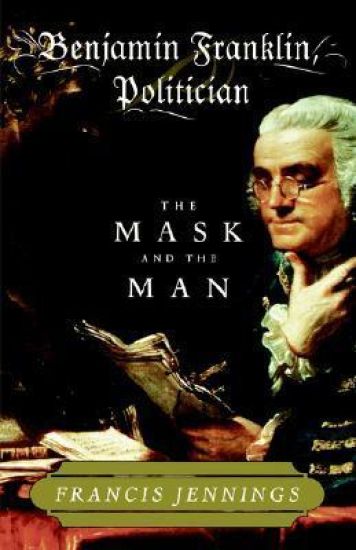
Benjamin Franklin, Politician

Benjamin Franklin, Politician

Francis Jennings

WW Norton Co
1997
sidottu
A distinguished historian of early America sees Franklin's influence on the course of the revolutionary movement in a new light. Benjamin Franklin was a man of genius and enormous ego, smart enough not to flaunt his superiority but to let others proclaim it. To understand him and his role in great events, one must realize the omnipresence of this ego, and the extent to which he mirrored the feelings of other colonial Pennsylvanians. With this in mind, Francis Jennings sets forth some new ideas about Franklin as the "first American." In so doing, he provides a new view of the beginnings of the American Revolution in Franklin's struggle against William Penn. By striving against Penn's feudal lordship (and therefore against King George) Franklin became master of the Pennsylvania assembly. It was in this role that he suggested a meeting of the Continental Congress which, as Jennings notes, flies in the face of historical opinion which suggests that Boston patriots had to drag Pennsylvanians into the revolution. Franklin's autobiography omits discussion of his heroic struggle against Penn and, in so doing, robs history of his true role in the making of the new country. It is through an accurate accounting of what Franklin did, not what he said he did in his autobiography (which Jennings likens to a campaign speech), that we understand the author's use of the term "first American."
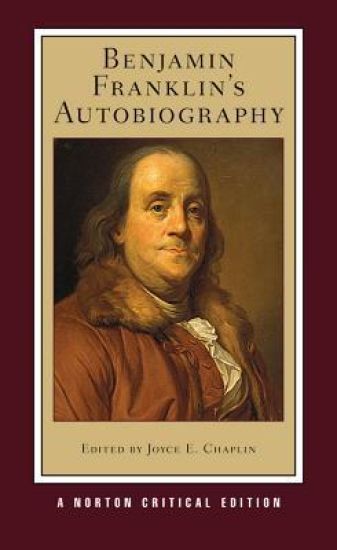
Benjamin Franklin's Autobiography

Benjamin Franklin's Autobiography

Benjamin Franklin

WW Norton Co
2012
nidottu
Written during the most eventful years of Benjamin Franklin's life (1771–90), the Autobiography is one of the most influential memoirs in history. This newly edited Norton Critical Edition includes an introduction that explains the history of the Autobiography within the larger history of the life-writing genre as well as within the history of celebrity. The text is accompanied by new and expanded explanatory annotations and by a map, an illustration, and six facsimiles. “Contexts” presents a broader view of Franklin’s life with a journal entry from a 1726 voyage, correspondence, a Poor Richard piece on ambition and fame, Franklin’s views on self-improvement, and his last will (and codicil). “Criticism” draws on a wealth of material that reflects both the wide range of Franklin’s achievements and the global impact of his life and memoirs. New international voices in “Contemporary Opinions” include Immanuel Kant, Honoré Gabriel Riqueti, Comte de Mirabeau, José Antonio de Alzate y Ramírez, and José Francisco Correia da Serra. “Nineteenth-Century Opinions” includes Humphry Davy on Franklin’s discovery of electricity as well as Empress Shoken of Japan’s Franklin-inspired poem. Finally, “Modern Opinions” reprints important pieces: I. B. Cohen on Franklin and the Autobiography's importance to science; Michael Warner’s theoretical interpretation of the practices of writing and printing and what they tell us about Franklin; and Peter Stallybrass’s insightful and engaging history-of-the-book perspective on Franklin’s writing generally and the Autobiography specifically. A Chronology of Franklin’s life, a Selected Bibliography, and an Index are also included.
Benjamin Constant

Benjamin Constant

Dennis Wood

Routledge
1993
sidottu
`For forty years I have defended the same principle: freedom in everything, in religion, in philosophy, in literature, in industry, in politics - and by freedom I mean the triumph of the individual.' Constant thus summarized his beliefs at the end of his life. A political theorist and a passionate defender of individual liberty, he was also the author of one of the greatest French novels of psychological insight, Adolphe. In a major new biography Dennis Wood traces the development of Constant as a writer centrally preoccupied with the problematics of freedom, not only in the fields of politics and religious belief but also in his own troubled relationship with several women.