

Kirjahaku
Etsi kirjoja tekijän nimen, kirjan nimen tai ISBN:n perusteella.
1000 tulosta hakusanalla Benjamin R Curtis


JIHAD VS. MCWORLD is an essential text for anyone who wants to understand the challenges facing us after the tragic events of September 11, 2001 and in light of the current conflict in the Middle East. In a groundbreaking work, political scientist Benjamin R. Barber offers a penetrating analysis of the central conflict of our times: consumerist capitalism versus religious and tribal fundamentalism. These diametrically opposed but intertwined forces are tearing apart - and bringing together - the world as we know it, undermining democracy and the nation-state on which it depends. On the one hand, capitalism on the global level is rapidly dissolving the social and economic barriers between nations, transforming the world's diverse populations into a blandly uniform market. On the other hand, ethnic, religious, and racial hatreds are fragmenting the political landscape into smaller and smaller tribal units. JIHAD VS. MCWORLD is the term that Barber has coined to describe the powerful and paradoxical interdependence of these forces. In this important book, now more timely than ever before, he explores the alarming repercussions of this potent dialectic and in his new introduction sketches a democratic response to terrorism.



An Introduction to the Philosophy of Religion
Benjamin R. Tilghman
Blackwell Publishers
1993
sidottu
This book is written for those coming to philosophy for the first time. It explains the nature of philosophical inquiry and discusses traditional philosophical questions about the existence of God, miracles, creationism, the truth of the Bible, science, and the problem of evil. The argument of the book suggests that the attempt to find historical and scientific proof for religious beliefs is bound to fail and so is the attempt to disprove religion by scientific and historical evidence. The view that religion is best understood as a way of life and not in competition with science at all is illustated by examples from literature and the visual arts.

The Description for this book, The Conquest of Politics: Liberal Philosophy in Democratic Times, will be forthcoming.

Benjamin Barber is one of America's preeminent political theorists. He has been a significant voice in the continuing debate about the nature and role of democracy in the contemporary world. A Passion for Democracy collects twenty of his most important writings on American democracy. Together they refine his distinctive position in democratic theory. Barber's conception of "strong democracy" contrasts with traditional concepts of "liberal democracy," especially in its emphasis on citizen participation in central issues of public debate. These essays critique the "thin representation" of liberal democracy and buttress the arguments presented in Barber's twelve books, most recently in his well-received Jihad vs. McWorld: How Globalism and Tribalism Are Re-shaping the World. In these pieces, Barber argues for participatory democracy without dependence on abstract metaphysical foundations, and he stresses the relationship among democracy and civil society, civic education, and culture. A Passion for Democracy is divided into four sections. In the first, "American Theory: Democracy, Liberalism, and Rights," Barber addresses issues of ongoing relevance to today's debates about the roots of participatory democracy, including individualism vs. community, the importance of consent, and the irrelevance of Marxism. Essays in the second section, "American Practice: Leadership, Citizenship, and Censorship" provide a "strong democracy" critique of American democratic practice. "Education for Democracy: Civic Education, Service, and Citizenship" applies Barber's theories to three related topics and includes his much-discussed essay "America Skips School." The final section, "Democracy and Technology: Endless Frontier or End of Democracy?" provides glimpses into a future that technology alone cannot secure for democracy. In his preface, Barber writes: "In these essays ...I have been hard on my country. Like most ardent democrats, I want more for it than it has achieved, despite the fact that it has achieved more than most people have dared to want." This wide-ranging collection displays not only his passion for democracy, but also his unique perspective on issues of abiding importance for the democratic process.
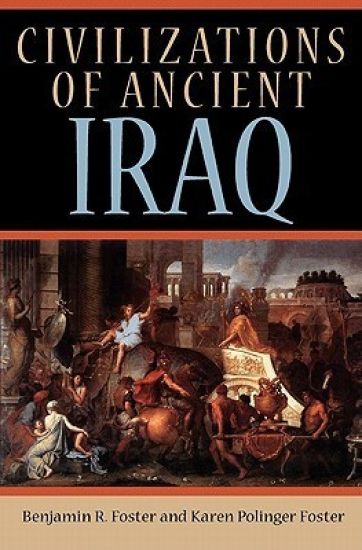
Civilizations of Ancient Iraq
Benjamin R. Foster; Karen Polinger Foster
Princeton University Press
2011
pokkari
In Civilizations of Ancient Iraq, Benjamin and Karen Foster tell the fascinating story of ancient Mesopotamia from the earliest settlements ten thousand years ago to the Arab conquest in the seventh century. Accessible and concise, this is the most up-to-date and authoritative book on the subject. With illustrations of important works of art and architecture in every chapter, the narrative traces the rise and fall of successive civilizations and peoples in Iraq over the course of millennia--from the Sumerians, Babylonians, and Assyrians to the Persians, Seleucids, Parthians, and Sassanians. Ancient Iraq was home to remarkable achievements. One of the birthplaces of civilization, it saw the world's earliest cities and empires, writing and literature, science and mathematics, monumental art, and innumerable other innovations. Civilizations of Ancient Iraq gives special attention to these milestones, as well as to political, social, and economic history. And because archaeology is the source of almost everything we know about ancient Iraq, the book includes an epilogue on the discovery and fate of its antiquities. Compelling and timely, Civilizations of Ancient Iraq is an essential guide to understanding Mesopotamia's central role in the development of human culture.

Switzerland today is faced with a profound dilemma--its village life is dying, a casualty of the collision between communal norms and the need for national survival in an industrial, urbanizing world. Benjamin Barber traces the origins and evolution of communal liberty in the group of alpine villages that make up modern Canton Graubunden, and recreates their poignant thousand-year struggle to maintain this tradition in the face of a hostile environment, hierarchical feudal institutions, and European power polities. Originally published in 1974. The Princeton Legacy Library uses the latest print-on-demand technology to again make available previously out-of-print books from the distinguished backlist of Princeton University Press. These editions preserve the original texts of these important books while presenting them in durable paperback and hardcover editions. The goal of the Princeton Legacy Library is to vastly increase access to the rich scholarly heritage found in the thousands of books published by Princeton University Press since its founding in 1905.

Switzerland today is faced with a profound dilemma--its village life is dying, a casualty of the collision between communal norms and the need for national survival in an industrial, urbanizing world. Benjamin Barber traces the origins and evolution of communal liberty in the group of alpine villages that make up modern Canton Graubunden, and recreates their poignant thousand-year struggle to maintain this tradition in the face of a hostile environment, hierarchical feudal institutions, and European power polities. Originally published in 1974. The Princeton Legacy Library uses the latest print-on-demand technology to again make available previously out-of-print books from the distinguished backlist of Princeton University Press. These editions preserve the original texts of these important books while presenting them in durable paperback and hardcover editions. The goal of the Princeton Legacy Library is to vastly increase access to the rich scholarly heritage found in the thousands of books published by Princeton University Press since its founding in 1905.

Education for Democracy
Benjamin R Barber; Richard M Battistoni
Kendall/Hunt Publishing Co ,U.S.
2014
nidottu

George Henry White
Benjamin R. Justesen; G. K. Butterfield
Louisiana State University Press
2012
nidottu
Although he was one of the most important African American political leaders during the last decade of the nineteenth century, George Henry White has been one of the least remembered. A North Carolina representative from 1897 to 1901, White was the last man of his race to serve in the Congress during the post-Reconstruction period, and his departure left a void that would go unfilled for nearly thirty years. At once the most acclaimed and reviled symbol of the freed slaves whose cause he heralded, White remains today largely a footnote to history. In this exhaustively researched biography, Benjamin R. Justesen rescues from obscurity the fascinating story of this compelling figure's life and accomplishments.The mixed-race son of a free turpentine farmer, White became a teacher, lawyer, and prosecutor in rural North Carolina. From these modest beginnings he rose in 1896 to become the only black member of the House of Representatives and perhaps the most nationally visible African American politician of his time. White was outspoken in his challenge to racial injustice, but, as Justesen shows, he was no militant racial extremist as antagonistic white democrats charged. His plea was always for simple justice in a nation whose democratic principles he passionately loved. A conservative by philosophy, he was a dedicated Republican to the end. After he retired from Congress, he remained active in the fight against racial discrimination, working with national leaderas of both races, from Booker T. Washington to the founders of the NAACP. Through judicious use of public documents, White's speeches, newspapers, letters, and secondary sources, Justesen creates an authoritative and balanced portrait of this complex man and proves him to be a much more effective leader than previously believed.
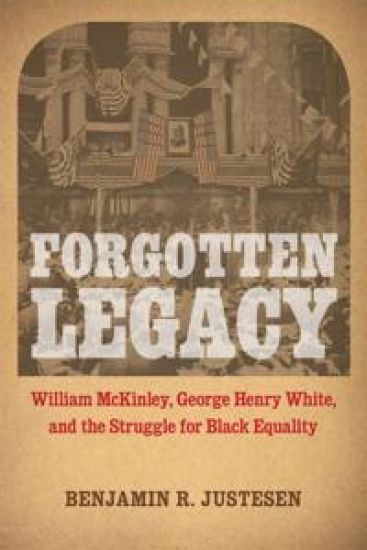
In Forgotten Legacy, Benjamin R. Justesen reveals a previously unexamined facet of William McKinley's presidency: an ongoing dedication to the advancement of African Americans, including their appointment to significant roles in the federal government and the safeguarding of their rights as U.S. citizens. During the first two years of his administration, McKinley named nearly as many African Americans to federal office as all his predecessors combined. He also acted on many fronts to stiffen federal penalties for participation in lynch mobs and to support measures promoting racial tolerance. Indeed, Justesen's work suggests that McKinley might well be considered the first ""civil rights president,"" especially when compared to his next five successors in office. Nonetheless, historians have long minimized, trivialized, or overlooked McKinley's cooperative relationships with prominent African American leaders, including George Henry White, the nation's only black congressman between 1897 and 1901. Justesen contends that this conventional, one-sided portrait of McKinley is at best incomplete and misleading, and often severely distorts the historical record. A Civil War veteran and the child of abolitionist parents, the twenty-fifth president committed himself to advocating for equity for America's black citizens. Justesen uses White's parallel efforts in and outside of Congress as the primary lens through which to view the McKinley administration's accomplishments in racial advancement. He focuses on McKinley's regular meetings with a small and mostly unheralded group of African American advisers and his enduring relationship with leaders of the new National Afro-American Council. His nomination of black U.S. postmasters, consuls, midlevel agency appointees, military officers, and some high-level officials including U.S. ministers to Haiti and Liberia serves as perhaps the most visible example of the president's work in this area. Only months before his assassination in 1901, McKinley toured the South, visiting African American colleges to praise black achievements and encourage a spirit of optimism among his audiences. Although McKinley succumbed to political pressure and failed to promote equality and civil rights as much as he had initially hoped, Justesen shows that his efforts proved far more significant than previously thought, and were halted only by his untimely death.

A whimsical pairing of lively and colorful illustrations with the lyrics to this classic Christmas song.

The authors estimate marriage and marital dissolution trends from 1996 to 2005, and the effects of recent deployments on risk of ending a marriage. Marital dissolution rates across services and components are currently similar to those seen in 1996, when the demands on the military were measurably lower. Service members who were deployed had a lower risk of subsequently ending their marriages than those who did not deploy or deployed fewer days.

This book addresses the challenge of education for citizenship at a specific, concrete level. It offers examples of efforts to create among our students a new set of what Tocqueville called mores or culturally defining 'habits of the heart' which will enhance citizenship, foster a sense of connectedness to a community stretching beyond the university, and ultimately, support the practices, basic values, and institutions necessary for the democratic process.


Formal and Informal Work Group Relationships With Performance
Benjamin R Knost
Hutson Street Press
2025
sidottu
Formal and Informal Work Group Relationships With Performance
Benjamin R Knost
Hutson Street Press
2025
pokkari