Kirjojen hintavertailu. Mukana 11 342 296 kirjaa ja 12 kauppaa.

Kirjahaku

Etsi kirjoja tekijän nimen, kirjan nimen tai ISBN:n perusteella.

1000 tulosta hakusanalla Benjamin Rush

An Address to the Inhabitants of the British Settlements, on the Slavery of the Negroes in America. A Vindication of the Address, ""Slavery not Forbidden in Scripture; or, A Defence of the West India Planters."" The Second Edition
The 18th century was a wealth of knowledge, exploration and rapidly growing technology and expanding record-keeping made possible by advances in the printing press. In its determination to preserve the century of revolution, Gale initiated a revolution of its own: digitization of epic proportions to preserve these invaluable works in the largest archive of its kind. Now for the first time these high-quality digital copies of original 18th century manuscripts are available in print, making them highly accessible to libraries, undergraduate students, and independent scholars.Delve into what it was like to live during the eighteenth century by reading the first-hand accounts of everyday people, including city dwellers and farmers, businessmen and bankers, artisans and merchants, artists and their patrons, politicians and their constituents. Original texts make the American, French, and Industrial revolutions vividly contemporary.++++The below data was compiled from various identification fields in the bibliographic record of this title. This data is provided as an additional tool in helping to insure edition identification: ++++British LibraryW005141Attributed to Benjamin Rush in the Dictionary of American biography. Edition statement transposed; precedes "To which is added .." on title page. "A vindication of the address, to the inhabitants of the British settlements, on the slavery of the NegroesPhiladelphia: Printed and sold by John Dunlap, M, DCC, LXXIII. 1773] 2],28, 2],54p.; 8
An Oration, Delivered February 4, 1774, Before the American Philosophical Society, Held at Philadelphia. Containing, an Enquiry Into the Natural History of Medicine Among the Indians in North-America
The 18th century was a wealth of knowledge, exploration and rapidly growing technology and expanding record-keeping made possible by advances in the printing press. In its determination to preserve the century of revolution, Gale initiated a revolution of its own: digitization of epic proportions to preserve these invaluable works in the largest archive of its kind. Now for the first time these high-quality digital copies of original 18th century manuscripts are available in print, making them highly accessible to libraries, undergraduate students, and independent scholars.Medical theory and practice of the 1700s developed rapidly, as is evidenced by the extensive collection, which includes descriptions of diseases, their conditions, and treatments. Books on science and technology, agriculture, military technology, natural philosophy, even cookbooks, are all contained here.++++The below data was compiled from various identification fields in the bibliographic record of this title. This data is provided as an additional tool in helping to insure edition identification: ++++British LibraryW006693Dedicated to Dr. Richard Huck.Philadelphia: Printed by Joseph Crukshank in Market-Street, between Second and Third Streets, 1774]. 118p.; 8
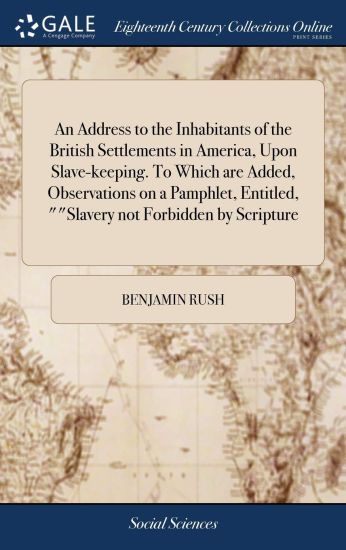
An Address to the Inhabitants of the British Settlements in America, Upon Slave-keeping. To Which are Added, Observations on a Pamphlet, Entitled, ""Slavery not Forbidden by Scripture
The 18th century was a wealth of knowledge, exploration and rapidly growing technology and expanding record-keeping made possible by advances in the printing press. In its determination to preserve the century of revolution, Gale initiated a revolution of its own: digitization of epic proportions to preserve these invaluable works in the largest archive of its kind. Now for the first time these high-quality digital copies of original 18th century manuscripts are available in print, making them highly accessible to libraries, undergraduate students, and independent scholars.Delve into what it was like to live during the eighteenth century by reading the first-hand accounts of everyday people, including city dwellers and farmers, businessmen and bankers, artisans and merchants, artists and their patrons, politicians and their constituents. Original texts make the American, French, and Industrial revolutions vividly contemporary.++++The below data was compiled from various identification fields in the bibliographic record of this title. This data is provided as an additional tool in helping to insure edition identification: ++++Library of CongressW005140Attributed to Benjamin Rush in the Dictionary of American biography. Edition statement transposed; precedes "To which are added .." on title page. "A vindication of the address, to the inhabitants of the British settlements, on the slavery of the Negroes in America, in answer to a pamphlet entitled, "Slavery not forbidden by Scripture; or A defence of the West-India planters from the aspersions thrown out against them b the author of the Address. .. By a Pennsylvanian. .."--54 p. at end, with separate title page and pagination but continuous registration.Philadelphia: Printed and sold by John Dunlap, M, DCC, LXXIII. 1773]. 2],28, 2],54p.; 8
Medical Inquiries And Observations Upon The Diseases Of The Mind
Medical Inquiries and Observations Upon the Diseases of the Mind is a book written by Benjamin Rush, a physician and signer of the Declaration of Independence. The book was first published in 1812 and is considered one of the earliest works on the subject of mental illness in the United States.In the book, Rush discusses various mental illnesses, including melancholy, mania, and dementia. He also explores the causes of these illnesses and proposes treatments, including bloodletting, purging, and the use of tranquilizers.Rush's approach to mental illness was influenced by the medical practices of his time, which focused on the physical rather than the psychological aspects of the condition. However, he was also a proponent of humane treatment for the mentally ill and advocated for the establishment of institutions dedicated to their care.Medical Inquiries and Observations Upon the Diseases of the Mind was a groundbreaking work that helped to establish the field of psychiatry in the United States. It remains a valuable resource for historians, medical professionals, and anyone interested in the history of mental illness treatment.This Is A New Release Of The Original 1812 Edition.This scarce antiquarian book is a facsimile reprint of the old original and may contain some imperfections such as library marks and notations. Because we believe this work is culturally important, we have made it available as part of our commitment for protecting, preserving, and promoting the world's literature in affordable, high quality, modern editions, that are true to their original work.
Medical Inquiries and Observations upon the Diseases of the Mind
This early work attempts to describe and categorize mental illnesses; first published in 1812, it predates the establishment of psychology and psychiatry as formal fields of medicine.The author notes a variety of correlations in those who suffer from mental illness; their lifestyles and professions, and whether they are related to those with similar ailments. He concisely observes how manias - then a general term for madness - manifest. The symptoms of various kinds of illness, and their effects on memory, behavior, physical condition and personality, are listed. Most of the terminology and suggestions for treatment are outdated and obsolete, but carry historic value in showing how the earliest treatments were administered to those incapacitated by diseases of the mind.Benjamin Rush was a Founding Father who held the role of Surgeon General in the United States. He was a bold and pioneering researcher and practitioner of medicine, with his attempts to understand mental maladies applauded during and after his death. At a time when the mentally stricken were confined to asylums, often in degrading and inhumane conditions, Rush's researches and learning represented a significant evolution in the field. Considered a symbol of the medical Enlightenment, in the modern day Rush is termed the 'father of American psychiatry'.