Kirjojen hintavertailu. Mukana 11 244 527 kirjaa ja 12 kauppaa.

Kirjahaku

Etsi kirjoja tekijän nimen, kirjan nimen tai ISBN:n perusteella.

1000 tulosta hakusanalla Bertrand

Memoirs of Bertrand Barère

Memoirs of Bertrand Barère

Bertrand Barère

Hutson Street Press
2025
nidottu
Discover the inner workings of the French Revolution through the eyes of one of its key figures in "Memoirs of Bertrand Bar re, Chairman of the Committee of Public Safety During the Revolution, Volume 1." This historical autobiography offers a unique perspective on the tumultuous events that shaped France and the world. Bertrand Bar re, a prominent figure during the Reign of Terror, provides a detailed account of his involvement in the Committee of Public Safety, shedding light on the decisions and motivations behind the revolutionary government's actions. Readers gain insight into the political climate, the key players, and the intense debates that defined this pivotal period in history. This volume offers invaluable primary source material for historians, students, and anyone interested in the French Revolution. Experience history firsthand through the words of a man who was at the heart of it all. This work has been selected by scholars as being culturally important, and is part of the knowledge base of civilization as we know it. This work was reproduced from the original artifact, and remains as true to the original work as possible. Therefore, you will see the original copyright references, library stamps (as most of these works have been housed in our most important libraries around the world), and other notations in the work. This work is in the public domain in the United States of America, and possibly other nations. Within the United States, you may freely copy and distribute this work, as no entity (individual or corporate) has a copyright on the body of the work. As a reproduction of a historical artifact, this work may contain missing or blurred pages, poor pictures, errant marks, etc. Scholars believe, and we concur, that this work is important enough to be preserved, reproduced, and made generally available to the public. We appreciate your support of the preservation process, and thank you for being an important part of keeping this knowledge alive and relevant.
Bertrand’s Paradox and the Principle of Indifference
Events between which we have no epistemic reason to discriminate have equal epistemic probabilities. Bertrand’s chord paradox, however, appears to show this to be false, and thereby poses a general threat to probabilities for continuum sized state spaces. Articulating the nature of such spaces involves some deep mathematics and that is perhaps why the recent literature on Bertrand’s Paradox has been almost entirely from mathematicians and physicists, who have often deployed elegant mathematics of considerable sophistication. At the same time, the philosophy of probability has been left out. In particular, left out entirely are the philosophical ground of the principle of indifference, the nature of the principle itself, the stringent constraint this places on the mathematical representation of the principle needed for its application to continuum sized event spaces, and what these entail for rigour in developing the paradox itself. This book puts the philosophy and its entailments back in and in so doing casts a new light on the paradox, giving original analyses of the paradox, its possible solutions, the source of the paradox, the philosophical errors we make in attempting to solve it and what the paradox proves for the philosophy of probability. The book finishes with the author’s proposed solution—a solution in the spirit of Bertrand’s, indeed—in which an epistemic principle more general than the principle of indifference offers a principled restriction of the domain of the principle of indifference.Bertrand's Paradox and the Principle of Indifference will appeal to scholars and advanced students working in the philosophy of mathematics, epistemology, philosophy of science, probability theory and mathematical physics.
Bertrand’s Paradox and the Principle of Indifference
Events between which we have no epistemic reason to discriminate have equal epistemic probabilities. Bertrand’s chord paradox, however, appears to show this to be false, and thereby poses a general threat to probabilities for continuum sized state spaces. Articulating the nature of such spaces involves some deep mathematics and that is perhaps why the recent literature on Bertrand’s Paradox has been almost entirely from mathematicians and physicists, who have often deployed elegant mathematics of considerable sophistication. At the same time, the philosophy of probability has been left out. In particular, left out entirely are the philosophical ground of the principle of indifference, the nature of the principle itself, the stringent constraint this places on the mathematical representation of the principle needed for its application to continuum sized event spaces, and what these entail for rigour in developing the paradox itself. This book puts the philosophy and its entailments back in and in so doing casts a new light on the paradox, giving original analyses of the paradox, its possible solutions, the source of the paradox, the philosophical errors we make in attempting to solve it and what the paradox proves for the philosophy of probability. The book finishes with the author’s proposed solution—a solution in the spirit of Bertrand’s, indeed—in which an epistemic principle more general than the principle of indifference offers a principled restriction of the domain of the principle of indifference.Bertrand's Paradox and the Principle of Indifference will appeal to scholars and advanced students working in the philosophy of mathematics, epistemology, philosophy of science, probability theory and mathematical physics.
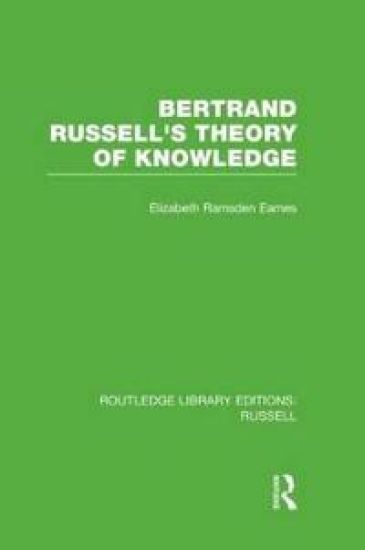
Bertrand Russell's Theory of Knowledge

Bertrand Russell's Theory of Knowledge

Elizabeth Ramsden Eames

Routledge
2014
nidottu
When future generations come to analyze and survey twentieth-century philosophy as a whole, Bertrand Russell’s logic and theory of knowledge is assured a place of prime importance. Yet until this book was first published in 1969 no comprehensive treatment of his epistemology had appeared. Commentators on twentieth-century philosophy at the time assumed that Russell’s important contributions to the theory of knowledge were made before 1921. This book challenges that assumption and draws attention to features of Russell’s later work which were overlooked.The analysis starts with Russell’s earliest views and moves from book to book and article to article through his enormous span of writing on the problems and theory of knowledge. The changes in ideas as he developed the theory are traced, and the study culminates in a statement of his latest views. His work is seen in a continuity in which the changes were part of the development of his mature thought, and the total evaluation and interpretation clarify many of the common misunderstandings of his philosophy.This is naturally of interest to all philosophers, and for students this is the answer to inevitable questions on the nature of Russell’s ideas and their evolution.
Bertrand Russell: A Life

Bertrand Russell: A Life

Herbert Gottschalk

Routledge
2014
nidottu
Bertrand Russell’s eminence of intellect and person has long been unassailable. Besides his distinction as mathematician and philosopher, and a vast output of books, articles, lectures and talks on most aspects of the human condition, there is his continuing concern for day-to-day political issues, his championing of individual freedom and his readiness to stand for a cause to the point of imprisonment. To have distilled the essence of his ninety-odd years into this little book is itself quite an achievement. Originally published in 1962, it has been called a ‘pocket guide to greatness’ and forms a useful complement to the longer and slightly earlier study by Alan Wood’s The Passionate Sceptic.
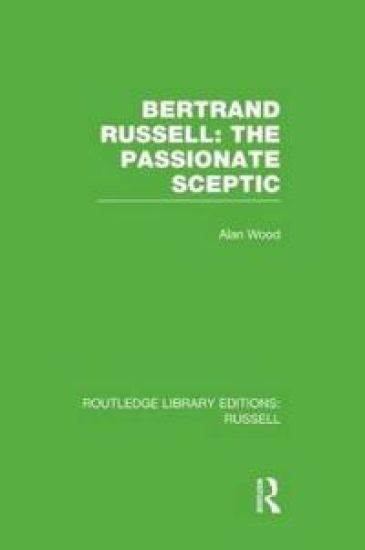
Bertrand Russell: The Passionate Sceptic
‘Fascinating’, ‘brilliant’, ‘oddly moving’, ‘a warm human picture’ – this biography was enthusiastically received when it came out in 1957. And no wonder. It is not only the lively story of a distinguished man but a lucid account of his work and its significance. The author, who was himself a philosopher and journalist, has followed the bright thread of Russell’s personality with affectionate insight, from the three-day-old baby who looked about him ‘in a very energetic way’, and the boy who jibbed at taking Euclid on trust, through the many turns of his life, to the undimmed octogenarian, still questioning and still deeply concerned. The subject is a great one and the biographer has matched it.
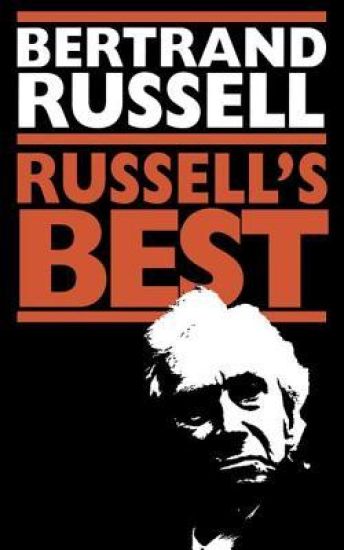
Bertrand Russell's Best

Bertrand Russell's Best

Bertrand Russell

Routledge
2015
sidottu
First published in 1981. This collection includes a careful selection of some of the wittiest and most pungent of Russell's writings, that are instructive and delightful, both for the philosopher and the layman. The reader will gain an appreciation of the serious thought and keen humour of Russell's writings as well as understand why Russell has been both an influential and controversial figure for more than half a century.
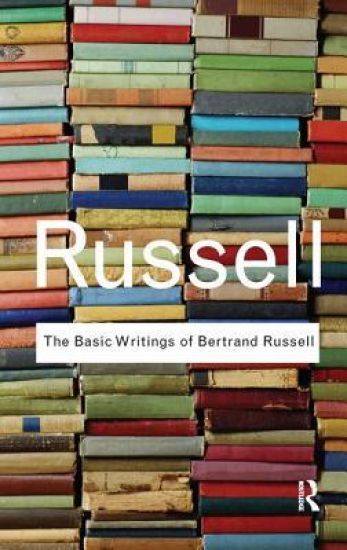
The Basic Writings of Bertrand Russell

The Basic Writings of Bertrand Russell

Bertrand Russell

Routledge
2017
sidottu
Few philosophers have had a more profound influence on the course of modern philosophy than Bertrand Russell. The Basic Writings of Bertrand Russell is a comprehensive anthology of Russell‘s most definitive essays written between 1903 and 1959. First published in 1961, this remarkable collection is a testament to a philosopher whom many consider to be one of the most influential thinkers of the twentieth century. This is an essential introduction to the brilliance of Bertrand Russell.
Bertrand Russell on Modality and Logical Relevance
First published in 1999, this volume re-examines Bertrand Russell’s views on modal logic and logical relevance, arguing that Russell does in fact accommodate modality and modal logic. The author, Jan Dejnožka, draws together Russell’s comments and perspectives from throughout his canon in order to demonstrate a coherent view on logical modality and logical relevance. To achieve this, Dejnožka explores questions including whether Russell has a possible worlds logic, Rescher’s case against Russell, Russell’s three levels of modality and the motives and origins of Russell’s theory of modality.
Bertrand Russell on Modality and Logical Relevance
First published in 1999, this volume re-examines Bertrand Russell’s views on modal logic and logical relevance, arguing that Russell does in fact accommodate modality and modal logic. The author, Jan Dejnožka, draws together Russell’s comments and perspectives from throughout his canon in order to demonstrate a coherent view on logical modality and logical relevance. To achieve this, Dejnožka explores questions including whether Russell has a possible worlds logic, Rescher’s case against Russell, Russell’s three levels of modality and the motives and origins of Russell’s theory of modality.
Bertrand Russell and the Nature of Propositions
Bertrand Russell and the Nature of Propositions offers the first book-length defence of the Multiple Relation Theory of Judgement (MRTJ). Although the theory was much maligned by Wittgenstein and ultimately rejected by Russell himself, Lebens shows that it provides a rich and insightful way to understand the nature of propositional content. In Part I, Lebens charts the trajectory of Russell’s thought before he adopted the MRTJ. Part II reviews the historical story of the theory: What led Russell to deny the existence of propositions altogether? Why did the theory keep evolving throughout its short life? What role did G. F. Stout play in the evolution of the theory? What was Wittgenstein’s concern with the theory, and, if we can’t know what his concern was exactly, then what are the best contending hypotheses? And why did Russell give the theory up? In Part III, Lebens makes the case that Russell’s concerns with the theory weren’t worth its rejection. Moreover, he argues that the MRTJ does most of what we could want from an account of propositions at little philosophical cost.This book bridges the history of early analytic philosophy with work in contemporary philosophy of language. It advances a bold reading of the theory of descriptions and offers a new understanding of the role of Stout and the representation concern in the evolution of the MRTJ. It also makes a decisive contribution to philosophy of language by demonstrating the viability of a no-proposition theory of propositions.