Kirjojen hintavertailu. Mukana 11 342 296 kirjaa ja 12 kauppaa.

Kirjahaku

Etsi kirjoja tekijän nimen, kirjan nimen tai ISBN:n perusteella.

1000 tulosta hakusanalla Blake Butler

Blake and the New Age (Routledge Revivals)
First published in 1979, this is a very welcome reissue of Kathleen Raine's seminal study of William Blake - England’s only prophet. He challenged with extraordinary vigour the premises which now underline much of Western civilization, hitting hard at the ideas of a naive materialist philosophy which, even in his own day, was already eating at the roots of English national life. In his insistence that ‘mental things are alone real’, Blake was ahead of his time. Materialist views are now challenged from various quarters; the depth psychologies of Freud and Jung, the study of Far Easter religion and philosophy, the reappraisal of myth and folk lore, the wealth of psychical research have all prepared the way for an understanding of Blake’s thought. We are ready to acknowledge that in attacking ‘the sickness of Albion’ Blake penetrated to the inner worlds of man and explored them in a way that is quite unique.Dr Raine, who has made a long study of Blake’s sources, presents him as a lonely powerful genius who stands within the spiritual tradition of Sophia Perennis, ‘the Everlasting Gospel’. From the standpoint of this great human Norm, our immediate past described by W.B. Yeats as ‘the three provincial centuries’, is a tragic deviation; catastrophic, as Blake believed, in its spiritual and material consequences. Only now do we possess the necessary knowledge to understand William Blake and the ever-growing number of people who turn to him surely justifies his faith in the eternal truths he strove to communicate.
Blake and the New Age (Routledge Revivals)
First published in 1979, this is a very welcome reissue of Kathleen Raine's seminal study of William Blake - England’s only prophet. He challenged with extraordinary vigour the premises which now underline much of Western civilization, hitting hard at the ideas of a naive materialist philosophy which, even in his own day, was already eating at the roots of English national life. In his insistence that ‘mental things are alone real’, Blake was ahead of his time. Materialist views are now challenged from various quarters; the depth psychologies of Freud and Jung, the study of Far Easter religion and philosophy, the reappraisal of myth and folk lore, the wealth of psychical research have all prepared the way for an understanding of Blake’s thought. We are ready to acknowledge that in attacking ‘the sickness of Albion’ Blake penetrated to the inner worlds of man and explored them in a way that is quite unique.Dr Raine, who has made a long study of Blake’s sources, presents him as a lonely powerful genius who stands within the spiritual tradition of Sophia Perennis, ‘the Everlasting Gospel’. From the standpoint of this great human Norm, our immediate past described by W.B. Yeats as ‘the three provincial centuries’, is a tragic deviation; catastrophic, as Blake believed, in its spiritual and material consequences. Only now do we possess the necessary knowledge to understand William Blake and the ever-growing number of people who turn to him surely justifies his faith in the eternal truths he strove to communicate.
Blake's Human Form Divine

Blake's Human Form Divine

Ann K. Mellor

University of California Press
2022
pokkari
In Blake’s Human Form Divine, the profound interplay between philosophy and stylistic principles in William Blake’s work comes to life. This study delves into Blake’s evolving perception of "form," focusing on its dual role as a philosophical concept and a defining feature of his visual-verbal art. Through detailed analysis, the book explores a central paradox in Blake’s creative journey: his simultaneous rejection of form as a constraining "Urizenic tyranny" and his reliance on bounded, outlined forms in his artwork. By 1795, Blake grappled with the dilemma of expressing divinity and imaginative freedom within the constraints of mortal, finite forms, a conflict central to both his artistic and philosophical pursuits. The study illuminates Blake’s struggle to reconcile these opposing forces, charting his journey through the interplay of visual style and poetic vision. Blake’s stylistic roots in the late eighteenth-century neoclassical idiom of romantic classicism provide the backdrop for this exploration. Characterized by clear outlines, linear rhythms, and idealized human forms, this style shaped Blake’s early illuminated works, such as Songs of Innocence, which reflect a harmonious, self-contained vision of human divinity. However, as his philosophical outlook shifted toward a critique of reason’s dominance in society, Blake began to question the aesthetic and philosophical implications of bounded form. This internal conflict between his artistic reliance on romantic classicism and his philosophical denunciation of reason’s constraints culminated in iconic works like The Ancient of Days. Through a nuanced analysis of Blake’s poetry and visual art, this book examines how he sought to transcend these tensions, offering fresh insights into the evolution of his radical imagination. This title is part of UC Press's Voices Revived program, which commemorates University of California Press’s mission to seek out and cultivate the brightest minds and give them voice, reach, and impact. Drawing on a backlist dating to 1893, Voices Revived makes high-quality, peer-reviewed scholarship accessible once again using print-on-demand technology. This title was originally published in 1974.
Blake's Human Form Divine

Blake's Human Form Divine

Ann K. Mellor

University of California Press
2022
sidottu
In Blake’s Human Form Divine, the profound interplay between philosophy and stylistic principles in William Blake’s work comes to life. This study delves into Blake’s evolving perception of "form," focusing on its dual role as a philosophical concept and a defining feature of his visual-verbal art. Through detailed analysis, the book explores a central paradox in Blake’s creative journey: his simultaneous rejection of form as a constraining "Urizenic tyranny" and his reliance on bounded, outlined forms in his artwork. By 1795, Blake grappled with the dilemma of expressing divinity and imaginative freedom within the constraints of mortal, finite forms, a conflict central to both his artistic and philosophical pursuits. The study illuminates Blake’s struggle to reconcile these opposing forces, charting his journey through the interplay of visual style and poetic vision. Blake’s stylistic roots in the late eighteenth-century neoclassical idiom of romantic classicism provide the backdrop for this exploration. Characterized by clear outlines, linear rhythms, and idealized human forms, this style shaped Blake’s early illuminated works, such as Songs of Innocence, which reflect a harmonious, self-contained vision of human divinity. However, as his philosophical outlook shifted toward a critique of reason’s dominance in society, Blake began to question the aesthetic and philosophical implications of bounded form. This internal conflict between his artistic reliance on romantic classicism and his philosophical denunciation of reason’s constraints culminated in iconic works like The Ancient of Days. Through a nuanced analysis of Blake’s poetry and visual art, this book examines how he sought to transcend these tensions, offering fresh insights into the evolution of his radical imagination. This title is part of UC Press's Voices Revived program, which commemorates University of California Press’s mission to seek out and cultivate the brightest minds and give them voice, reach, and impact. Drawing on a backlist dating to 1893, Voices Revived makes high-quality, peer-reviewed scholarship accessible once again using print-on-demand technology. This title was originally published in 1974.
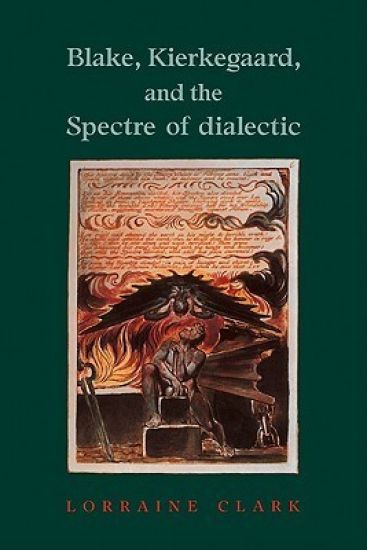
Blake, Kierkegaard, and the Spectre of Dialectic

Blake, Kierkegaard, and the Spectre of Dialectic

Lorraine Clark

Cambridge University Press
2009
pokkari
Blake's late prophecies, The Four Zoas, Milton and Jerusalem, feature a conflict between the poet-prophet Los and a Spectre embodying all he most opposes: intellectual scepticism, religious despair and a systematic philosophical logic of contraries, which is for Blake an abstraction from, and negation of, his ideal of 'life'. In this 1991 book, Lorraine Clark traces the analogy between Blake's Spectre and Soren Kierkegaard's concept of 'dread', whose spirit of negation and irony he seeks to conquer, in both its philosophical and aesthetic manifestations. Using Kierkegaard's philosophy to illuminate Blake's prophecies, Lorraine Clark shows these concepts to offer the basis for a profound critique both of romanticism, as it has come to be identified with the spirit of dialectic, and of the postmodern irony which it has spawned. Their attempt to rescue an ideal of life from its abstraction within idealist dialectics is itself deeply romantic, and offers a dramatisation of tensions - between scepticism and affirmation, religion and nihilism, philosophy and poetry - central to our understanding of romanticism.
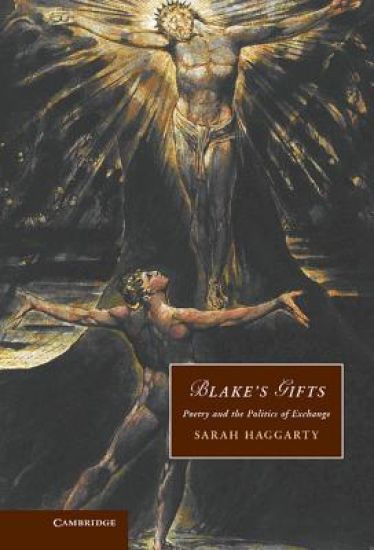
Blake's Gifts

Blake's Gifts

Sarah Haggarty

Cambridge University Press
2010
sidottu
The idea of the gift, in contrast to concepts of commercial exchange or the exercise of self-interest at the expense of social ties, is integral to the ways in which William Blake thought about his art, and the production and dissemination of his work. Sarah Haggarty offers a sophisticated and thorough account of the idea of the gift in Blake's writing and designs, examining both the theoretical implications of the term, and the way it plays out in specific textual and visual contexts within Blake's works. Elegantly written, thoughtful and closely argued, this book explores particular passages with great dexterity and in a style that enables the reader to participate in the experience of discovering the significance of 'the gift' for understanding Blake's work.
Blake's Contrary States

Blake's Contrary States

Bill Gillham

Cambridge University Press
2010
pokkari
In a fresh examination of Blake's Songs of Innocence and Experience, poems which often seem strangely contradictory, Dr Gillham suggests that Blake is not stating his own thoughts and feelings but presenting 'dramatic' statements; he projects himself into other points of view, thus exploring possible states of being and feeling in which spiritual energy expresses itself. Certain eighteenth-century theories of the mind are examines, explaining the mind in terms of self-interest. Blake included this view in his vision of 'Experience'. The poems suggest, and explore the possibility that such a view, while true of the mind in one state, is not true of it in another. This other state, 'Innocence', is more outgoing, more responsible and more self-aware. The two states lead to quite different moral, religious and political beliefs, though they can use the same terms in doing so. Dr Gillham shows that poems seemingly in conflict can be seen from a consistent point of view.
Blake, Kierkegaard, and the Spectre of Dialectic

Blake, Kierkegaard, and the Spectre of Dialectic

Lorraine Clark

Cambridge University Press
1991
sidottu
Blake's late prophecies, The Four Zoas, Milton and Jerusalem, feature a conflict between the poet-prophet Los and a Spectre embodying all he most opposes: intellectual scepticism, religious despair and a systematic philosophical logic of contraries, which is for Blake an abstraction from, and negation of, his ideal of 'life'. In this 1991 book, Lorraine Clark traces the analogy between Blake's Spectre and Soren Kierkegaard's concept of 'dread', whose spirit of negation and irony he seeks to conquer, in both its philosophical and aesthetic manifestations. Using Kierkegaard's philosophy to illuminate Blake's prophecies, Lorraine Clark shows these concepts to offer the basis for a profound critique both of romanticism, as it has come to be identified with the spirit of dialectic, and of the postmodern irony which it has spawned. Their attempt to rescue an ideal of life from its abstraction within idealist dialectics is itself deeply romantic, and offers a dramatisation of tensions - between scepticism and affirmation, religion and nihilism, philosophy and poetry - central to our understanding of romanticism.
Blake, Sexuality and Bourgeois Politeness

Blake, Sexuality and Bourgeois Politeness

Susan Matthews

Cambridge University Press
2011
sidottu
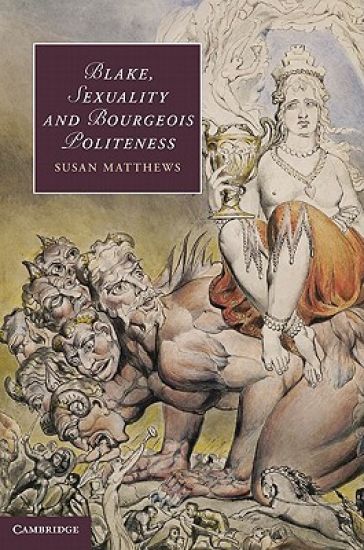
Recent criticism has often overlooked William Blake's relationship to the bourgeois culture of sentimentalism, focusing instead on his association with the radical London underworld of revolutionaries, artisans and plebeian dissenters. By removing Blake from their company and reading him instead through the polite world he knew well, Susan Matthews sets out to give us a new Blake, as well as a new angle onto the conflicted development of a bourgeois culture in the late eighteenth century which was in the process of redefining the role and meaning of sexuality. With imaginative use of personalities, texts and images taken from an original range of archival material, Matthews returns to the Age of Sensibility and finds within its changing landscape answers to some of the crucial questions that remain about an artist and writer whose work continues to challenge scholars and critics today.
Blake; or, The Huts of America

Blake; or, The Huts of America

Martin R. Delany

Harvard University Press
2017
nidottu
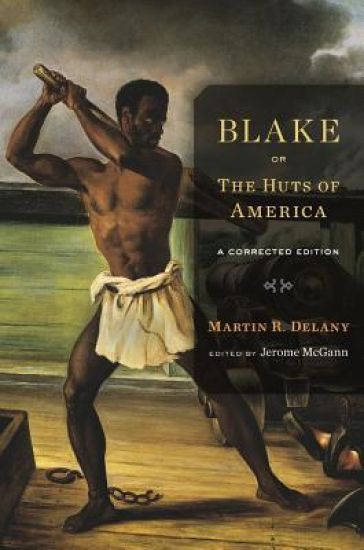
Martin R. Delany’s Blake (1859, 1861–1862) is one of the most important African American—and indeed American—works of fiction of the nineteenth century. It tells the story of Henry Blake’s escape from a southern plantation and his subsequent travels across the United States, into Canada, and to Africa and Cuba. His mission is to unite the black populations of the American Atlantic regions, both free and slave, in the struggle for freedom, whether through insurrection or through emigration and the creation of an independent black state. Blake is a rhetorical masterpiece, all the more strange and mysterious for remaining incomplete, breaking off before its final scene.This edition of Blake, prepared by textual scholar Jerome McGann, offers the first correct printing of the work in book form. It establishes an accurate text, supplies contextual notes and commentaries, and presents an authoritative account of the work’s composition and publication history. In a lively introduction, McGann argues that Delany employs the resources of fiction to develop a critical account of the interconnected structure of racist power as it operated throughout the American Atlantic. He likens Blake to Upton Sinclair’s The Jungle, in its willful determination to transform a living and terrible present.Blake; or, The Huts of America: A Corrected Edition will be used in undergraduate and graduate classes on the history of African American fiction, on the history of the American novel, and on black cultural studies. General readers will welcome as well the first reliable edition of Delany’s fiction.
Blake: Poems: Edited by Peter Washington

Blake: Poems: Edited by Peter Washington

William Blake

Everyman's Library
1994
sidottu
This gorgeous hardcover volume collects the most essential poems of William Blake and demonstrates the enduring brilliance of his work.William Blake is one of England's most fascinating writers; he was not only a groundbreaking poet, but also a painter, engraver, radical, and mystic. Although Blake was dismissed as an eccentric by his contemporaries, his powerful and richly symbolic poetry has been a fertile source of inspiration to the many writers and artists who have followed in his footsteps. Blake: Poems contains a wide selection of Blake's work, including Songs of Innocence, Songs of Experience, poems from Blake's Ms. book, poems from The Prophetic Books, and an index of first lines. Everyman's Library pursues the highest production standards, printing on acid-free cream-colored paper, with full-cloth cases with two-color foil stamping, decorative endpapers, silk ribbon markers, European-style half-round spines, and a jewel-toned jacket.
Blake and Antiquity

Blake and Antiquity

Kathleen Raine

PRINCETON UNIVERSITY PRESS
2023
pokkari
The classic book on William Blake as prophet of the New AgeWilliam Blake (1757–1827) inhabited a remarkable inner world, one that he brought vividly to life in his poetry, painting, and printmaking. Blake and Antiquity situates this brilliant and enigmatic artist within the Western esoteric canon, revealing his indebtedness to Neoplatonism, the Gnostics, alchemy, and astrology. In this book, Kathleen Raine demonstrates how Blake rejected conventional orthodoxy and went in search among the occult traditions of antiquity for symbols that might expand the mind’s awareness into a spiritual state where space, time, and even death are transcended.
Blake's Composite Art

Blake's Composite Art

W.J.T. Mitchell

Princeton University Press
2019
pokkari
Can poem and picture collaborate successfully in a composite art of text and design? Or does one art inevitably dominate the other? W.J.T. Mitchell maintains that Blake's illuminated poems are an exception to Suzanne Langer's claim that "there are no happy marriages in art—only successful rape." Drawing on over one hundred reproductions of Blake's pictures, this book shows that neither the graphic nor the poetic aspect of his composite art consistently predominates: their relationship is more like an energetic rivalry, a dialogue between vigorously independent modes of expression. W.J.T. Mitchell is Professor of English and Art and Design at the University of Chicago and editor of Critical Inquiry.Originally published in 1978.The Princeton Legacy Library uses the latest print-on-demand technology to again make available previously out-of-print books from the distinguished backlist of Princeton University Press. These editions preserve the original texts of these important books while presenting them in durable paperback and hardcover editions. The goal of the Princeton Legacy Library is to vastly increase access to the rich scholarly heritage found in the thousands of books published by Princeton University Press since its founding in 1905.
Blake's Visionary Forms Dramatic

Blake's Visionary Forms Dramatic

David V. Erdman; John E. Grant

Princeton University Press
2017
pokkari
The twenty contributors to this volume offer a new perspective on the relationship between Blake's poetry and his visionary forms. Their illustrated discussions explore and debate the nature of Blake's mixed art and the energetic interaction of text and design. Originally published in 1971. The Princeton Legacy Library uses the latest print-on-demand technology to again make available previously out-of-print books from the distinguished backlist of Princeton University Press. These editions preserve the original texts of these important books while presenting them in durable paperback and hardcover editions. The goal of the Princeton Legacy Library is to vastly increase access to the rich scholarly heritage found in the thousands of books published by Princeton University Press since its founding in 1905.
Blake and the Assimilation of Chaos

Blake and the Assimilation of Chaos

Christine Gallant

Princeton University Press
2015
pokkari
In all of his works Blake struggled with the question of how chaos can be assimilated into imaginative order. Blake's own answer changed in the course of his poetic career. Christine Gallant contends that during the ten year period of composition of Blake's first comprehensive epic, The Four Zoas, Blake's myth expanded from a closed, static system to an open, dynamic process. She further argues that it is only through attention to the changing pattern of Jungian archetypes in the poem that one can discern this profound change. Using the depth psychology of Jung, Professor Gallant presents a comprehensive interpretation of Blake's poetry from his early "Lambeth" prophecies to his mature works, The Four Zoas, Milton, and Jerusalem. She offers a Jungian critical approach that respects the work's autonomy, but still suggests how literature is an ongoing imaginative experience in which archetypal symbols affect their literary contexts. What interests the author is the function that the very process of mythmaking had for Blake. Professor Gallant finds that the metaphysical opposition between God and Satan in Blake's earlier work gradually evolves into an interplay of these powers in the later works. The quality of Chaos changes for Blake from something unknown and feared, contrary to Order, to something intimately known and embraced. Originally published in 1979. The Princeton Legacy Library uses the latest print-on-demand technology to again make available previously out-of-print books from the distinguished backlist of Princeton University Press. These editions preserve the original texts of these important books while presenting them in durable paperback and hardcover editions. The goal of the Princeton Legacy Library is to vastly increase access to the rich scholarly heritage found in the thousands of books published by Princeton University Press since its founding in 1905.
Blake and the Assimilation of Chaos

Blake and the Assimilation of Chaos

Christine Gallant

Princeton University Press
2016
sidottu
In all of his works Blake struggled with the question of how chaos can be assimilated into imaginative order. Blake's own answer changed in the course of his poetic career. Christine Gallant contends that during the ten year period of composition of Blake's first comprehensive epic, The Four Zoas, Blake's myth expanded from a closed, static system to an open, dynamic process. She further argues that it is only through attention to the changing pattern of Jungian archetypes in the poem that one can discern this profound change. Using the depth psychology of Jung, Professor Gallant presents a comprehensive interpretation of Blake's poetry from his early "Lambeth" prophecies to his mature works, The Four Zoas, Milton, and Jerusalem. She offers a Jungian critical approach that respects the work's autonomy, but still suggests how literature is an ongoing imaginative experience in which archetypal symbols affect their literary contexts. What interests the author is the function that the very process of mythmaking had for Blake. Professor Gallant finds that the metaphysical opposition between God and Satan in Blake's earlier work gradually evolves into an interplay of these powers in the later works. The quality of Chaos changes for Blake from something unknown and feared, contrary to Order, to something intimately known and embraced. Originally published in 1979. The Princeton Legacy Library uses the latest print-on-demand technology to again make available previously out-of-print books from the distinguished backlist of Princeton University Press. These editions preserve the original texts of these important books while presenting them in durable paperback and hardcover editions. The goal of the Princeton Legacy Library is to vastly increase access to the rich scholarly heritage found in the thousands of books published by Princeton University Press since its founding in 1905.
Blake's Visionary Forms Dramatic

Blake's Visionary Forms Dramatic

David V. Erdman; John E. Grant

Princeton University Press
2017
sidottu
The twenty contributors to this volume offer a new perspective on the relationship between Blake's poetry and his visionary forms. Their illustrated discussions explore and debate the nature of Blake's mixed art and the energetic interaction of text and design. Originally published in 1971. The Princeton Legacy Library uses the latest print-on-demand technology to again make available previously out-of-print books from the distinguished backlist of Princeton University Press. These editions preserve the original texts of these important books while presenting them in durable paperback and hardcover editions. The goal of the Princeton Legacy Library is to vastly increase access to the rich scholarly heritage found in the thousands of books published by Princeton University Press since its founding in 1905.