Kirjojen hintavertailu. Mukana 12 414 773 kirjaa ja 12 kauppaa.

Kirjahaku

Etsi kirjoja tekijän nimen, kirjan nimen tai ISBN:n perusteella.

1000 tulosta hakusanalla Bruce D. Tate

Optimization in Economics and Finance

Optimization in Economics and Finance

Bruce D. Craven; Sardar M. N. Islam

Springer-Verlag New York Inc.
2011
nidottu
Many optimization questions arise in economics and finance; an important example of this is the society's choice of the optimum state of the economy (the social choice problem). Optimization in Economics and Finance extends and improves the usual optimization techniques, in a form that may be adopted for modeling social choice problems. Problems discussed include: when is an optimum reached; when is it unique; relaxation of the conventional convex (or concave) assumptions on an economic model; associated mathematical concepts such as invex and quasimax; multiobjective optimal control models; and related computational methods and programs. These techniques are applied to economic growth models (including small stochastic perturbations), finance and financial investment models (and the interaction between financial and production variables), modeling sustainability over long time horizons, boundary (transversality) conditions, and models with several conflicting objectives. Although the applications are general and illustrative, the models in this book provide examples of possible models for a society's social choice for an allocation that maximizes welfare and utilization of resources. As well as using existing computer programs for optimization of models, a new computer program, named SCOM, is presented in this book for computing social choice models by optimal control.

Qualitative Process Theory Using Linguistic Variables

Qualitative Process Theory Using Linguistic Variables

Bruce D'Ambrosio

Springer-Verlag New York Inc.
2012
nidottu
8. 5 Summary In this chapter we have identified three basic patterns of influences that lead to ambiguity in the QP analysis of the basic active furnace state. We have then shown how modification of these patterns, by adding equilibrium values and sensitivity annotations on influence arcs, could permit resolu­ tion of the ambiguities. Finally, we have described in detail the extensions needed to the basic influence resolution algorithm in QP theory to oper­ ate on these extended descriptions. We have also shown that the modified influence resolution algorithm corrects an error in Forbus' original method for combining influences. We have then presented an extended example in which introduction of equilibrium assumptions eliminates all ambigu­ ity in the influence resolution deduction. In the next chapter we extend these techniques further, by developing a qualitative perturbation analysis technique that permits us to answer "what ir' control questions; then we extend this technique to obtain quantitative, as well as qualitative, effects of hypothetical control actions. 8.
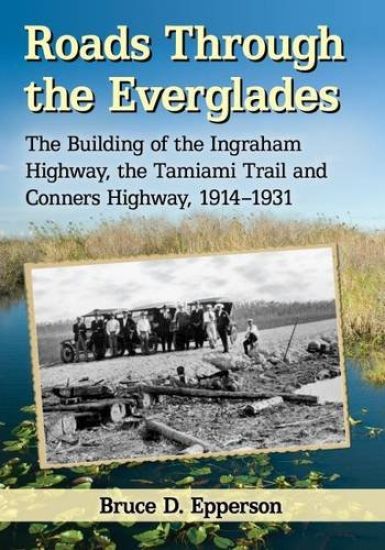
Roads Through the Everglades

Roads Through the Everglades

Bruce D. Epperson

McFarland Co Inc
2016
pokkari
In 1915, the road system in south Florida had changed little since before the Civil War. Travelling from Miami to Ft. Myers meant going through Orlando, 250 miles north of Miami. Within 15 years, three highways were dredged and blasted through the Everglades: Ingraham Highway from Homestead, 25 miles south of Miami, to Flamingo on the tip of the peninsula; Tamiami Trail from Miami to Tampa; and Conners Highway from West Palm Beach to Okeechobee City. In 1916, Florida's road commission spent $967. In 1928 it spent $6.8 million. Tamiami Trail, originally projected to cost $500,000, eventually required $11 million. These roads were made possible by the 1920s Florida land boom, the advent of gasoline and diesel-powered equipment to replace animal and steam-powered implements, and the creation of a highway funding system based on fuel taxes. This book tells the story of the finance and technology of the first modern highways in the South.
The Moulton Bicycle

The Moulton Bicycle

Bruce D. Epperson

McFarland Co Inc
2018
pokkari
In 1963, British inventor Alex Moulton (1920-2012) introduced an innovative compact bicycle. Architectural Review editor Reyner Banham (1922-1988) predicted it would give rise to "a new class of cyclists," young urbanites riding by choice, not necessity. Forced to sell his firm in 1967, Moulton returned in the 1980s with an even more radical model, the AM--his acclaim among technology and design historians owed much to Banham's writings. The AM's price tag (some models cost many thousands of dollars) has inspired tech-savvy cyclists to create "hot rod" compact bikes from Moulton-inspired "shopper" cycles of the 1970s--a trend also foreseen by Banham, who considered hot rod culture the "folk art of the mechanical era." The author traces the intertwined lives of two unusually creative men who had an extraordinary impact on each others' careers, despite having met only a few times.
Draining the Swamp, Southern Style

Draining the Swamp, Southern Style

Bruce D. Epperson

McFarland Co Inc
2021
pokkari
In 1912, a Congressional committee met to investigate allegations that the Secretary of Agriculture had suppressed a report by J. O. Wright on drainage in the Florida Everglades. The following seven months of committee hearings uncovered a veritable horror-show of corruption, self-dealing, misuse of government personnel and property for private gain, the tarring of reputations in order to protect high-level officials, and outright blackmail within the Department of Agriculture and the state governments of Florida and North Carolina. The "Wright Report Incident" is most commonly understood in its connection to the Everglades, and few histories have included its effects on the North Carolina Pocosin wetland and other coastal plain swamps. This book seeks fills that gap. It details the timeline, intricate politics, and webs of corruption that make up the story of the Wright Incident and, specifically, its connection to land management practices in coastal North Carolina that continue to impact the industries of the state almost 100 years later.
Immigration

Immigration

Bruce D Thatcher

Createspace Independent Publishing Platform
2012
pokkari
From 1789 to 1965, most Americans were generally satisfied with United States' immigration policy. But that changed in 1965 when Congress and the President, against the will of the people, began re-writing the immigration laws. America is still living with the cascading consequences because, as Meyer Burstein observed more than 20 years ago, immigration mistakes are big mistakes. They don't go away. They only get bigger.IMMIGRATION: How to Avoid its Perils and Make it Work is not about building better fences. It's about building better policies. It shows policy makers, pundits and laymen the underlying flaws in our immigration policy, and it presents a clear guide for reform.In this second book of his History Speaks Today series, Bruce Thatcher presents a meticulously researched survey of immigration policies used since 1790 by Australia, Canada, France, Mexico, Palestine, Singapore and the United States. Some have been very successful, and others have led to serious problems ... even disaster. Thatcher shows that the problems of America's present flawed policy are not rooted in illegal immigration (which is a problem), but rather in failure to follow the three simple rules for successful immigration policy.1.Clearly define the few (2-4) long-term national interests that are to guide immigration policy. (Six contradictory interests attempt to guide our present policy.)2.Design immigration laws, regulations and practices to sharply focus on the guiding interests. (Ours are fraught with inconsistencies, contradictions and service to special interests.)3.Ensure that immigrants assimilate into American society as rapidly as possible. Assimilation proceeds most effectively with educated immigrants who are fluent in English, here legally and intend to stay. (Present policy brings in and abets vast numbers who are uneducated, not English-literate, and who don't abandon former loyalties.)In IMMIGRATION, Thatcher argues that comprehensive reform is needed now to stop the cascading and permanent harm flowing from current policy. We must begin serious discussion of national interests to guide immigration policy for decades to come, policy that must include provisions to correct the most serious present flaws.-The maximum number of immigrants must become meaningful and managed.-America need not recruit or encourage anyone to immigrate, but we must not discourage desirable persons. Let the market work -A streamlined temporary/guest worker program is necessary to fill shortages.-The presence of undesirable aliens must be brought and held to very small numbers through effective border control and enforcement, free from political expediency.-Additional restrictions must apply to immigrant visa applicants: (1) denial of visas to persons who follow precepts of radical Islam -Salafiyyah, Wahhabism, violent jihad or Sharia law; (2) applicants must demonstrate general literacy appropriate for their age; and (3) applicants must be appropriately fluent in English.IMMIGRATION shows that the flow of unplanned elements into America is unrelenting. It makes clear that we must bypass the rhetorical diversion of illegal immigration and address overall immigration reform ... now
The Soul of Judaism

The Soul of Judaism

Bruce D. Haynes

New York University Press
2018
sidottu
A glimpse into the diverse stories of Black Jews in the United States What makes a Jew? This book traces the history of Jews of African descent in America and the counter-narratives they have put forward as they stake their claims to Jewishness. The Soul of Judaism offers the first exploration of the full diversity of Black Jews, including bi-racial Jews of both matrilineal and patrilineal descent; adoptees; black converts to Judaism; and Black Hebrews and Israelites, who trace their Jewish roots to Africa and challenge the dominant western paradigm of Jews as white and of European descent. Blending historical analysis and oral history, Haynes showcases the lives of Black Jews within the Orthodox, Conservative, Reconstruction and Reform movements, as well as the religious approaches that push the boundaries of the common forms of Judaism we know today. He illuminates how in the quest to claim whiteness, American Jews of European descent gained the freedom to express their identity fluidly while African Americans have continued to be seen as a fixed racial group. This book demonstrates that racial ascription has been shaping Jewish selfhood for centuries. Pushing us to reassess the boundaries between race and ethnicity, it offers insight into how Black Jewish individuals strive to assert their dual identities and find acceptance within their respective communities. Putting to rest the simplistic notion that Jews are white and that Black Jews are therefore a contradiction, the volume argues that we can no longer pigeonhole Black Hebrews and Israelites as exotic, militant, and nationalistic sects outside the boundaries of mainstream Jewish thought and community life. The volume spurs us to consider the significance of the growing population of self-identified Black Jews and its implications for the future of American Jewry.
Resurrection Logic

Resurrection Logic

Bruce D. Chilton

Baylor University Press
2019
sidottu
Death does not speak the final word. Resurrection does. Christianity stands or falls with this central confession: God raised Jesus from the dead.Bruce Chilton investigates the Easter event of Jesus in Resurrection Logic. He undertakes his close reading of the New Testament texts without privileging the exact nature of the resurrection, but rather begins by situating his study of the resurrection in the context of Sumerian, Egyptian, Greek, and Syrian conceptions of the afterlife. He then identifies Jewish monotheistic affirmations of bodily resurrection in the Second Temple period as the most immediate context for early Christian claims. Chilton surveys first-generation accounts of Jesus' resurrection and finds a pluriform - and even at times seemingly contradictory - range of testimony from Jesus' first followers. This diversity, as Chilton demonstrates, prompted early Christianity to interpret the resurrection traditions by means of prophecy and coordinated narrative.In the end, Chilton points to how the differing conceptions of the ways that God governs the world produced distinct understandings - or ""sciences"" - of the Easter event. Each understanding contained its own internal logic, which contributed to the collective witness of the early church handed down through the canonical text. In doing so, Chilton reveals the full tapestry of perspectives held together by the common-thread confession of Jesus' ongoing life and victory over death.
Aramaic Jesus

Aramaic Jesus

Bruce D. Chilton

Baylor University Press
2025
sidottu
Aramaic, one of the great international languages of antiquity, left an indelible mark on the New Testament. Jesus and his first followers knew it because for centuries Aramaic had been a primary means of communication in the Middle East, and it remained current long after their time. Usage of Aramaic within Jesus' movement, initially with or without recourse to other languages, helped provide the fledgling community with a cultural as well as linguistic identity. Precise examples of the words of Jesus' teaching in Aramaic, reinforced by portrayals of him among Aramaic speakers, are explicit in the Gospels. Whatever other language choices he may have made, the Greek Gospels portray him as employing Aramaic as his medium of teaching. Bruce Chilton's Aramaic Jesus is a groundbreaking study in pursuit of this "Aramaic Jesus," a pursuit that requires awareness of the kind of Aramaic in play. In the past, sorting out dialects and types of Aramaic relied on sources composed well after the time of the New Testament; this work factors in analysis of the Dead Sea Scrolls and related materials to access forms of Aramaic current during the first century CE. Since the depiction of Jesus in the Gospels involves various intersections with Aramaic, tracing the impact of Aramaic in the depiction of Jesus within the New Testament entails several investigative categories: specific cases in which Aramaic is identifiably transliterated within the Greek Gospels; analysis that accounts for the cultural settings of Aramaic through the technique of retroversion (involving translation back into Aramaic); and assessment of noticeable overlaps between the New Testament and contemporaneous Aramaic literature, where thematic emphases emerge that relate Jesus' movement to Second Temple Judaism. The writings we call the Gospels involved transitions from the au/orality of Jesus and his movement to reliance upon writing, and from their language(s) to written Koine Greek. Those shifts involved an increasing resort to narrative and literary conventions. The extent to which Aramaic is a factor within this process is uncharted, and this volume clarifies the issues that are in play. Chilton's analysis illuminates the Aramaic Jesus and the people and processes that conveyed his memory.