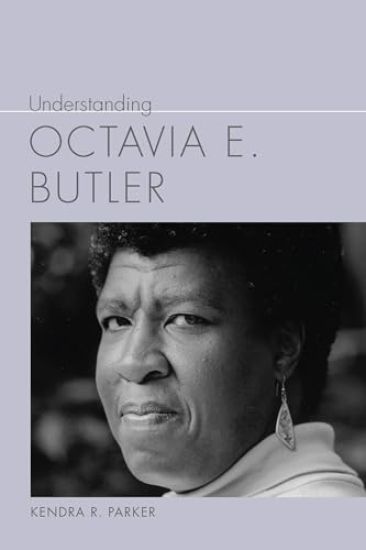
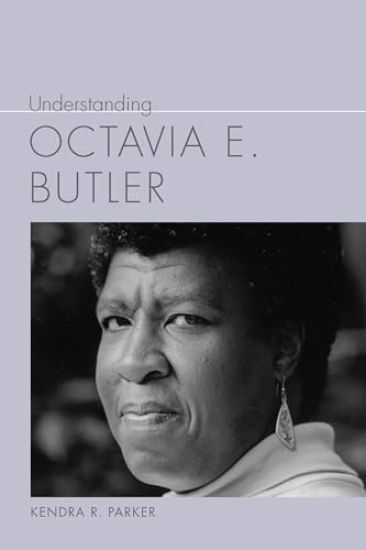
New insights into the work of an acclaimed science fiction author Octavia E. Butler (1947–2006), a pioneer of science fiction and foremother of Afrofuturism, is among the most influential science fiction writers of all time. Her work blurs the boundaries of commercial genres, exploring themes of race, gender and sexuality, religion, politics, and environment. A recipient of the MacArthur "Genius Grant" and PEN America Lifetime Achievement Award, Butler is best known for her novels Kindred (1979), Parable of the Sower (1993), and Fledgling (2005). In Understanding Octavia E. Butler, Kendra R. Parker surveys Butler's life, career, and major works, highlighting her ongoing interest in Black peoples' pasts, presents, and futures. After a biographical introduction, Parker evaluates Butler's career chronologically and thematically, with chapters covering her engagement with the African American literary tradition, her romance novels, and her nonfiction.
New insights into the work of an acclaimed science fiction author Octavia E. Butler (1947–2006), a pioneer of science fiction and foremother of Afrofuturism, is among the most influential science fiction writers of all time. Her work blurs the boundaries of commercial genres, exploring themes of race, gender and sexuality, religion, politics, and environment. A recipient of the MacArthur "Genius Grant" and PEN America Lifetime Achievement Award, Butler is best known for her novels Kindred (1979), Parable of the Sower (1993), and Fledgling (2005). In Understanding Octavia E. Butler, Kendra R. Parker surveys Butler's life, career, and major works, highlighting her ongoing interest in Black peoples' pasts, presents, and futures. After a biographical introduction, Parker evaluates Butler's career chronologically and thematically, with chapters covering her engagement with the African American literary tradition, her romance novels, and her nonfiction.
Este livro cont m um breve ensaio que se debru a sobre o questionamento da raz o que rege e fundamenta a identidade de g nero, com base no pensamento da fil sofa Judith Butler.
Human Contradictions in Octavia Butler’s Work continues the critical discussions of Butler’s work by offering a variety of theoretical perspectives and approaches to Butler’s text. This collection contains original essays that engage Butler’s series (Seed to Harvest, Xenogenesis, Parables), her stand-alone novels (Kindred and Fledgling), and her short stories. The essays explore new facets of Butler’s work and its relevance to philosophy, sociology, anthropology, psychology, cultural studies, ethnic studies, women’s studies, religious studies, American studies, and U.S. history. The volume establishes new ways of reading this seminal figure in African American literature, science fiction, feminism, and popular culture.
Human Contradictions in Octavia Butler’s Work continues the critical discussions of Butler’s work by offering a variety of theoretical perspectives and approaches to Butler’s text. This collection contains original essays that engage Butler’s series (Seed to Harvest, Xenogenesis, Parables), her stand-alone novels (Kindred and Fledgling), and her short stories. The essays explore new facets of Butler’s work and its relevance to philosophy, sociology, anthropology, psychology, cultural studies, ethnic studies, women’s studies, religious studies, American studies, and U.S. history. The volume establishes new ways of reading this seminal figure in African American literature, science fiction, feminism, and popular culture.
Octavia E. Butler is widely recognized today as one of the most important figures in contemporary science fiction. Bringing together leading and emerging scholars and covering Butler’s complete works from the bestselling novel Kindred, to her short stories and major novel sequences Patternmaster, Xenogenesis and The Parables, this is the most comprehensive Companion to Butler scholarship available today. The Bloomsbury Handbook to Octavia E. Butler covers the full range of contemporary scholarly themes and approaches to the author’s work, including: · Cyborgs and the posthuman · Race and African American history · Afrofuturism · Gender and sexuality · New perspectives from Religious Studies, the Environmental Humanities and Disability Studies · New discoveries from the Butler archives at the Huntington Library The book includes a comprehensive bibliography of works by Butler and secondary scholarship on her work as well as an afterword by the novelist Tananarive Due.
Octavia E. Butler's works of science fiction invite readers to consider the structures of power in society and to ask what it means to be human. Butler addresses social justice issues such as poverty, racism, and violence against women and connects the history of slavery in the United States with speculation on a biologically altered future world.The first section of this volume, "Materials," lists secondary sources and interviews with Butler and suggests texts that instructors might pair with her works. Essays in the second section, "Approaches," situate Butler in science fiction, modernism, and Afrofuturism and provide interdisciplinary approaches from political science, philosophy, art, and digital humanities. The Contributors present strategies for teaching Butler in literature courses as well as courses designed for adult learners, presecondary teachers, and students at historically black colleges and universities.
Rites of Passage, Liminality, and Community in Octavia E. Butler’s Science Fiction Novels explores the ways in which Octavia Butler’s liminal protagonists undergo ritualized transformations while in exile from their home communities. During this process, they engage in psychological, physical, political, and social transitions through what Victor Turner and Makhail Bakhtin describe as carnivalesque identities. Using postcolonial, feminist, anti-capitalist, and African American theorists, Lin Knutson examines how Butler’s imagined genesis and history carry echoes of American history, slave history, debt slavery, and colonization.
This book has been considered by academicians and scholars of great significance and value to literature. This forms a part of the knowledge base for future generations. We have represented this book in the same form as it was first published. Hence any marks seen are left intentionally to preserve its true nature.







![Voyage D'Une Famille Autour Du Monde ... Traduit de L'Anglais Par J. Butler ... [Abridged.] Deuxie Me E Dition.](/covers/9781249003908.jpg)



![Two Months in the Confederate States, Including a Visit to New Orleans Under the Domination of General Butler. by an English Merchant [I.E. - Corsom].](/covers/9781241339371.jpg)


