In paperback for the first time, the detailed general index to the authoritative English-language edition of Jung's works This general index to the Collected Works of C. G. Jung is exceptionally comprehensive, indexing down to paragraph numbers. Some particularly important subjects are treated in subindexes, including alchemy, animals, the Bible, colors, Freud, Jung, and numbers. This is an essential reference tool for serious students of Jung.
In paperback for the first time, an authoritative collection of Jung's writings on analytical psychology, including Synchronicity The Structure and Dynamics of the Psyche features a selection of Jung's writings, ranging over four decades of his career, that illustrate the development of the conceptual foundations of analytical psychology. These pieces span the period from Jung's break with Freud and the psychoanalytical school, when Jung began formulating his own theories, to the 1950s, when he published an account of his controversial theory of synchronicity. The contents are: On Psychic Energy - The Transcendent Function - A Review of the Complex Theory - The Significance of Constitution and Heredity in Psychology - Psychological Factors Determining Human Behavior - Instinct and the Unconscious - The Structure of the Psyche - On the Nature of the Psyche - General Aspects of Dream Psychology - On the Nature of Dreams - The Psychological Foundation of Belief in Spirits - Spirit and Life - Basic Postulates of Analytical Psychology - Analytical Psychology and Weltanschauung - The Real and the Surreal - The Stages of Life - The Soul and Death - Synchronicity: An Acausal Connecting Principle - On Synchronicity
In paperback for the first time, the authoritative edition of the revealing lectures Jung delivered during medical school In 1895, after enrolling in the medical school of Basel University, Jung became a member of the Zofingia Society, a student fraternity to which he delivered five lectures over the next four years. Anticipating and illuminating his mature interest in empirical psychology, spiritualism, the occult, and the metaphysical, these talks confirm that Freudian psychoanalysis was a diversion in Jung's intellectual development.
C. G. Jung has been and continues to be a pervasive yet often unacknowledged presence in twentieth-century art and intellectual life. This timely volume is the first comprehensive attempt to assess this presence and to demonstrate Jung's far-reaching cultural impact. The distinguished contributors represent a number of views, from traditional Jungian to the most contemporary post-Jungian stances, including feminist, non-Jungian, and anti-Jungian positions. Jung, as seen in this volume, addresses a wide range of contemporary issues related to creativity, gender, religion, popular culture, and hermeneutics. The essays reveal dimensions of his work that extend far beyond psychoanalytical theory and that show his hermeneutics to be a much more subtle and sophisticated methodology than previously allowed by his critics. This methodology appears, in fact, to have anticipated significant aspects of contemporary critical principles and practice. The contributors to the volume were among the participants in a major international conference sponsored by Hofstra University and the C. G. Jung Foundation of New York, held in 1986 at Hofstra University.They include Thomas Belmonte, Robert Bly, Joseph Campbell, Edward S. Casey, Stanley Diamond, Jean Erdman, Leslie Fiedler, James Hillman, Paul Kugler, Ibram Lassaw, Neil Levine, David L. Miller, Lucio Pozzi, Gilles Quispel, Robert Richenburg, Carol Schreier Rupprecht, Andrew Samuels, Harold Schechter, and June Singer. Originally published in 1990. The Princeton Legacy Library uses the latest print-on-demand technology to again make available previously out-of-print books from the distinguished backlist of Princeton University Press. These editions preserve the original texts of these important books while presenting them in durable paperback and hardcover editions. The goal of the Princeton Legacy Library is to vastly increase access to the rich scholarly heritage found in the thousands of books published by Princeton University Press since its founding in 1905.
This one-volume edition allows the general reader to appreciate Jung's ideas and personality, as they reveal themselves in his comments to his colleagues and to those who approached him with genuine problems of their own, as well as in his communication with personal friends. The correspondence supplies a variety of insights into the genesis of Jung's theories and a running commentary on their development. Originally published in 1984. The Princeton Legacy Library uses the latest print-on-demand technology to again make available previously out-of-print books from the distinguished backlist of Princeton University Press. These editions preserve the original texts of these important books while presenting them in durable paperback and hardcover editions. The goal of the Princeton Legacy Library is to vastly increase access to the rich scholarly heritage found in the thousands of books published by Princeton University Press since its founding in 1905.
This one-volume edition allows the general reader to appreciate Jung's ideas and personality, as they reveal themselves in his comments to his colleagues and to those who approached him with genuine problems of their own, as well as in his communication with personal friends. The correspondence supplies a variety of insights into the genesis of Jung's theories and a running commentary on their development. Originally published in 1984. The Princeton Legacy Library uses the latest print-on-demand technology to again make available previously out-of-print books from the distinguished backlist of Princeton University Press. These editions preserve the original texts of these important books while presenting them in durable paperback and hardcover editions. The goal of the Princeton Legacy Library is to vastly increase access to the rich scholarly heritage found in the thousands of books published by Princeton University Press since its founding in 1905.
C. G. Jung and the Dead: Visions, Active Imagination and the Unconscious Terrain offers an in-depth look at Jung’s encounters with the dead, moving beyond a symbolic understanding to consider these figures a literal presence in the psyche. Stephani L. Stephens explores Jung’s personal experiences, demonstrating his skill at visioning in all its forms as well as detailing the nature of the dead.This unique study is the first to follow the narrative thread of the dead from Memories, Dreams, Reflections into The Red Book, assessing Jung’s thoughts on their presence, his obligations to them, and their role in his psychological model. It offers the opportunity to examine this previously neglected theme unfolding during Jung’s period of intense confrontation with the unconscious, and to understand active imagination as Jung’s principle method of managing that unconscious content. As well as detailed analysis of Jung’s own work, the book includes a timeline of key events and case material.C. G. Jung and the Dead will offer academics and students of Jungian and post-Jungian studies, the history of psychology, Western esoteric history and gnostic and visionary traditions a new perspective on Jung’s work. It will also be of great interest to Jungian analysts and psychotherapists, analytical psychologists and practitioners of other psychological disciplines interested in Jungian ideas.
C. G. Jung and the Dead: Visions, Active Imagination and the Unconscious Terrain offers an in-depth look at Jung’s encounters with the dead, moving beyond a symbolic understanding to consider these figures a literal presence in the psyche. Stephani L. Stephens explores Jung’s personal experiences, demonstrating his skill at visioning in all its forms as well as detailing the nature of the dead.This unique study is the first to follow the narrative thread of the dead from Memories, Dreams, Reflections into The Red Book, assessing Jung’s thoughts on their presence, his obligations to them, and their role in his psychological model. It offers the opportunity to examine this previously neglected theme unfolding during Jung’s period of intense confrontation with the unconscious, and to understand active imagination as Jung’s principle method of managing that unconscious content. As well as detailed analysis of Jung’s own work, the book includes a timeline of key events and case material.C. G. Jung and the Dead will offer academics and students of Jungian and post-Jungian studies, the history of psychology, Western esoteric history and gnostic and visionary traditions a new perspective on Jung’s work. It will also be of great interest to Jungian analysts and psychotherapists, analytical psychologists and practitioners of other psychological disciplines interested in Jungian ideas.
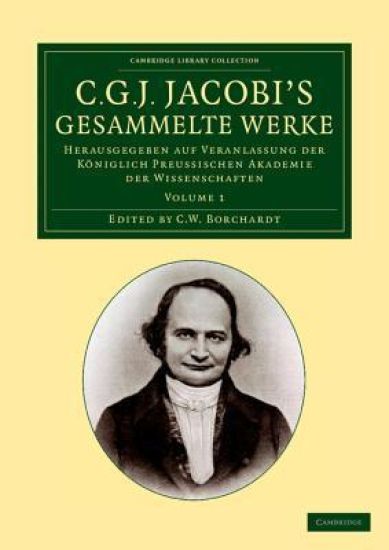
One of the greatest mathematicians of the nineteenth century, Carl Gustav Jacob Jacobi (1804–51) burst into the limelight with his redevelopment, together with Niels Henrik Abel (1802–29), of the theory of elliptic functions. His pioneering work was characterised by the variety of problems tackled and the power of the tools used to tackle them. His lasting influence on rational mechanics, number theory, partial differential equations, complex variable theory and computation is marked by the number of fundamental concepts that bear his name (the Jacobian, the Jacobi sum and the Jacobi symbol, among others). His collected works, comprising treatises, letters and papers written in German, Latin and French, were published in eight volumes between 1881 and 1891. Edited by fellow German mathematician Carl Wilhelm Borchardt (1817–80), Volume 1 appeared in 1881.
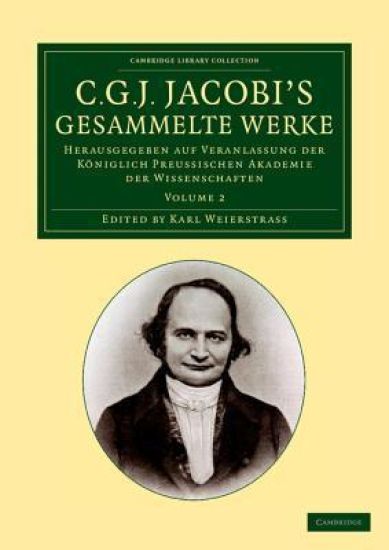
One of the greatest mathematicians of the nineteenth century, Carl Gustav Jacob Jacobi (1804–51) burst into the limelight with his redevelopment, together with Niels Henrik Abel (1802–29), of the theory of elliptic functions. His pioneering work was characterised by the variety of problems tackled and the power of the tools used to tackle them. His lasting influence on rational mechanics, number theory, partial differential equations, complex variable theory and computation is marked by the number of fundamental concepts that bear his name (the Jacobian, the Jacobi sum and the Jacobi symbol, among others). His collected works, comprising treatises, letters and papers written in German, Latin and French, were published in eight volumes between 1881 and 1891. Edited by fellow German mathematician Karl Weierstrass (1815–97), Volume 2 appeared in 1882.
One of the greatest mathematicians of the nineteenth century, Carl Gustav Jacob Jacobi (1804–51) burst into the limelight with his redevelopment, together with Niels Henrik Abel (1802–29), of the theory of elliptic functions. His pioneering work was characterised by the variety of problems tackled and the power of the tools used to tackle them. His lasting influence on rational mechanics, number theory, partial differential equations, complex variable theory and computation is marked by the number of fundamental concepts that bear his name (the Jacobian, the Jacobi sum and the Jacobi symbol, among others). His collected works, comprising treatises, letters and papers written in German, Latin and French, were published in eight volumes between 1881 and 1891. Edited by fellow German mathematician Karl Weierstrass (1815–97), Volume 3 appeared in 1884.
One of the greatest mathematicians of the nineteenth century, Carl Gustav Jacob Jacobi (1804–51) burst into the limelight with his redevelopment, together with Niels Henrik Abel (1802–29), of the theory of elliptic functions. His pioneering work was characterised by the variety of problems tackled and the power of the tools used to tackle them. His lasting influence on rational mechanics, number theory, partial differential equations, complex variable theory and computation is marked by the number of fundamental concepts that bear his name (the Jacobian, the Jacobi sum and the Jacobi symbol, among others). His collected works, comprising treatises, letters and papers written in German, Latin and French, were published in eight volumes between 1881 and 1891. Edited by fellow German mathematician Karl Weierstrass (1815–97), Volume 4 appeared in 1886.
One of the greatest mathematicians of the nineteenth century, Carl Gustav Jacob Jacobi (1804–51) burst into the limelight with his redevelopment, together with Niels Henrik Abel (1802–29), of the theory of elliptic functions. His pioneering work was characterised by the variety of problems tackled and the power of the tools used to tackle them. His lasting influence on rational mechanics, number theory, partial differential equations, complex variable theory and computation is marked by the number of fundamental concepts that bear his name (the Jacobian, the Jacobi sum and the Jacobi symbol, among others). His collected works, comprising treatises, letters and papers written in German, Latin and French, were published in eight volumes between 1881 and 1891. Edited by fellow German mathematician Karl Weierstrass (1815–97), Volume 5 appeared in 1890.
One of the greatest mathematicians of the nineteenth century, Carl Gustav Jacob Jacobi (1804–51) burst into the limelight with his redevelopment, together with Niels Henrik Abel (1802–29), of the theory of elliptic functions. His pioneering work was characterised by the variety of problems tackled and the power of the tools used to tackle them. His lasting influence on rational mechanics, number theory, partial differential equations, complex variable theory and computation is marked by the number of fundamental concepts that bear his name (the Jacobian, the Jacobi sum and the Jacobi symbol, among others). His collected works, comprising treatises, letters and papers written in German, Latin and French, were published in eight volumes between 1881 and 1891. Edited by fellow German mathematician Karl Weierstrass (1815–97), Volume 6 appeared in 1891.
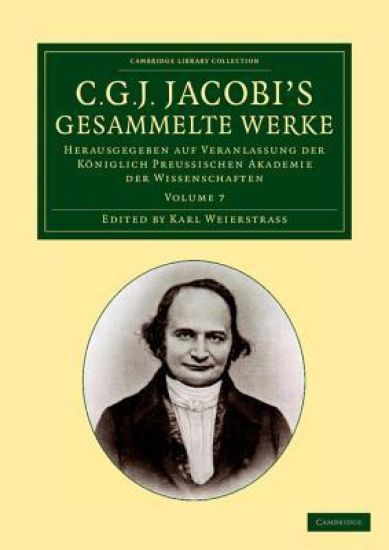
One of the greatest mathematicians of the nineteenth century, Carl Gustav Jacob Jacobi (1804–51) burst into the limelight with his redevelopment, together with Niels Henrik Abel (1802–29), of the theory of elliptic functions. His pioneering work was characterised by the variety of problems tackled and the power of the tools used to tackle them. His lasting influence on rational mechanics, number theory, partial differential equations, complex variable theory and computation is marked by the number of fundamental concepts that bear his name (the Jacobian, the Jacobi sum and the Jacobi symbol, among others). His collected works, comprising treatises, letters and papers written in German, Latin and French, were published in eight volumes between 1881 and 1891. Edited by fellow German mathematician Karl Weierstrass (1815–97), Volume 7 appeared in 1891.