Kirjojen hintavertailu. Mukana 11 516 317 kirjaa ja 12 kauppaa.

Kirjahaku

Etsi kirjoja tekijän nimen, kirjan nimen tai ISBN:n perusteella.

1000 tulosta hakusanalla Carroy

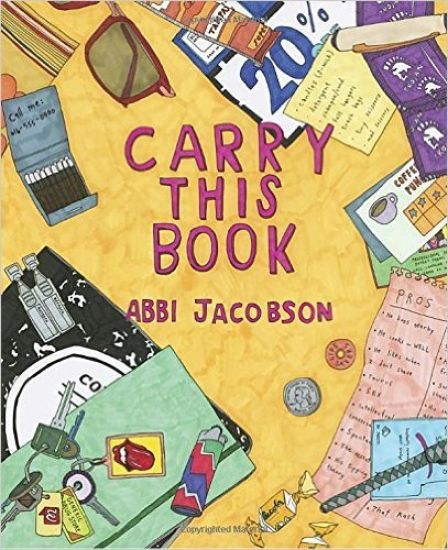
Carry This Book

Carry This Book

Prentice Hall Press
2016
sidottu
NEW YORK TIMES BESTSELLER From the mind of Broad City's Abbi Jacobson, author of I Might Regret This, a wonderfully weird and weirdly wonderful illustrated look at the world around us--all through the framework of what we carry. "Jacobson's art is warm, textured, and carefully composed, a little bit Maira Kalman and a little bit Roz Chast. It's also genuinely funny." --Vox With bright, quirky, and colorful line drawings, Jacobson brings to life actual and imagined items found in the pockets and purses, bags and glove compartments of real and fantastical people--whether it's the contents of Oprah's favorite purse, Amelia Earhart's pencil case, or Bernie Madoff's suitcase. How many self-tanning lotions are in Donald Trump's weekender? What's inside Martha Stewart's hand-knit fanny pack? What kind of protein bars does Michelle Obama hide in her tiny clutch at the White House Correspondents' Dinner? An instant New York Times bestseller, Carry This Book provides a humorous and insightful look into how the things we carry around every day make up who we are.

Carrot on a Stick

Carrot on a Stick

Billy Jones

Xlibris Us
2000
sidottu
For over two million miles and the better part of twenty-five years, I rode around. All those years, I never knew what it was I wanted to do when I grew up, so I didn't. When I was young, big trucks and the call of the open road were all I could hear. It always seemed as if the pot of gold at the end of the rainbow was just beyond the next horizon. I chased many dreams over the years, but none of them were ever to be mine. A dream can never be yours if it isn't really yours to begin with. Eventually I stopped dreaming, and it was then I died. There were several long, hard years that I thought I served no purpose except to take up space. I'm not going to tell you here all the stories about broken hearts and dreams long since lost. We've all experienced heartaches and disillusionment to some degree, and it would serve no purpose to go into detail here. I'll only say that sooner or later we all have to get over it. I started writing in nineteen-ninety-six as a means to work out the pain of a broken heart and hoped to write songs, as music is one of my greatest passions, second only to beautiful women, of course. It didn't take me long to figure out that there are too many angst-filled poets in the world writing more gloom and despair than we'll ever want to read, so I asked God to let me write something funny. He did. I began sharing my songs and poetry with friends who encouraged me to write more. My telephone rang all the time with people wanting to hear my latest musings, so I joyfully complied with their wishes. Soon I was reading in church, at coffee houses and even in bars. Everywhere I went, even at work, people wanted to hear my poetry. It wasn't long before I figured out that while all of this was fun, it was really a waste of time. I needed to write a book, and write a book I did. In the last three years I have finished ten books, am working on ten more, and if you are reading this, then I have published my first book, CARROT ON A STICK. All of this from a guy who had a perfect "D" average in English class and never learned to type. I guess that accounts for the bad grammar and errors in punctuation, but I think you'll get the point anyway. Is something dangling here?
Carrot on a Stick

Carrot on a Stick

Billy Jones

Xlibris Us
2000
pokkari
For over two million miles and the better part of twenty-five years, I rode around. All those years, I never knew what it was I wanted to do when I grew up, so I didn't. When I was young, big trucks and the call of the open road were all I could hear. It always seemed as if the pot of gold at the end of the rainbow was just beyond the next horizon. I chased many dreams over the years, but none of them were ever to be mine. A dream can never be yours if it isn't really yours to begin with. Eventually I stopped dreaming, and it was then I died. There were several long, hard years that I thought I served no purpose except to take up space. I'm not going to tell you here all the stories about broken hearts and dreams long since lost. We've all experienced heartaches and disillusionment to some degree, and it would serve no purpose to go into detail here. I'll only say that sooner or later we all have to get over it. I started writing in nineteen-ninety-six as a means to work out the pain of a broken heart and hoped to write songs, as music is one of my greatest passions, second only to beautiful women, of course. It didn't take me long to figure out that there are too many angst-filled poets in the world writing more gloom and despair than we'll ever want to read, so I asked God to let me write something funny. He did. I began sharing my songs and poetry with friends who encouraged me to write more. My telephone rang all the time with people wanting to hear my latest musings, so I joyfully complied with their wishes. Soon I was reading in church, at coffee houses and even in bars. Everywhere I went, even at work, people wanted to hear my poetry. It wasn't long before I figured out that while all of this was fun, it was really a waste of time. I needed to write a book, and write a book I did. In the last three years I have finished ten books, am working on ten more, and if you are reading this, then I have published my first book, CARROT ON A STICK. All of this from a guy who had a perfect "D" average in English class and never learned to type. I guess that accounts for the bad grammar and errors in punctuation, but I think you'll get the point anyway. Is something dangling here?
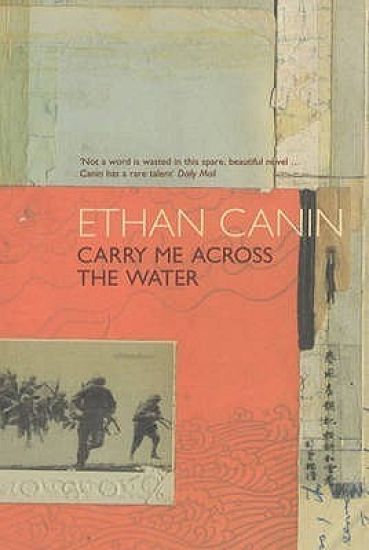
Carry Me Across the Water

Carry Me Across the Water

Ethan Canin

Bloomsbury Publishing PLC
2002
pokkari
"Take the advice of no one," young August Kleinman is told by his mother, as around them the Nazi party is rising to power. With these words to guide him, August escapes to America, where he builds a fortune, a family and a life. But August must face the sins of his life and seek atonement.
Carroll Shelby

Carroll Shelby

Rinsey Mills; Edsel B. Ford

Motorbooks International
2020
pokkari
Written with Carroll Shelby's full collaboration and with a foreword by Edsel B. Ford II, the great-grandson of Henry Ford, this is the definitive record of America's preeminent twentieth century sports car builder and racer—now in paperback. It was motoring author Rinsey Mills' passion for AC cars and motorsports history that led to his first meeting with Carroll Shelby. His suggestion that they should collaborate in order to create an accurate record of Shelby's life and achievements at first was rebuffed but later taken up with enthusiasm. This authorized biography is the result.Carroll Shelby: The Authorized Biography was a long time in the making, as Mills left no stone unturned in his quest to produce the complete study of Shelby's remarkable life. He carried out extensive research and conducted numerous interviews, fully capturing the narrative of Carroll Shelby within and outside of the automotive racing world, including his:Childhood in TexasWartime service with the Army Air ForcePostwar entrepreneurshipEarliest race wins in 1952Legendary 1959 victory at the 24 Hours of Le MansMonumental release of the first Cobra and the formation of Shelby American in 1962Historical partnership with Ford that would last for decadesPersonal interests and travelsPresent-day legacyFascinating photographs from Shelby's personal collection complete a book whose original hardcover edition was published mere weeks before his passing, making Carroll Shelby: The Authorized Biographya magnificent and lasting tribute to one of the greatest automotive figures of the twentieth century.
Carry Me Crystals—Chakra Clearing & Oracle Card Deck

Carry Me Crystals—Chakra Clearing & Oracle Card Deck

Joanie Eisinger; Elizabeth Jarvis; Peter Jarvis

RED Feather
2016
muu
44 crystal cards with channeled messages to carry with you, along with a Chakra clearing guide. "Gems are precious and each one can assist you on a spectacular journey to enlightenment."— Yeshua. What if you didn’t have access to the crystal you wanted to work with? Through the power of intention and the creative use of thoughts and words, these 44 colorful and powerful crystal cards can remedy this for you. Using your intention, carrying a crystal card is like carrying the physical gemstone. The cards also give a crystal description and provide sound meaning and advice channeled by Yeshua (Jesus). The workbook describes how one can use crystal cards for empowerment, personal growth, and the attainment of peace in one’s life through the clearing of chakras. This deck and guide can also be used as an oracle and is intended for the layperson through the seasoned healer. Includes cards and book.
Carrot Cards

Carrot Cards

K. Meriwether Baxter

Schiffer Publishing Ltd
2018
muu
The bunnies of old believed in free will and knew that as long as you could choose which way to hop, the future would remain undecided. Now you can use good old rabbit wisdom to look at your tomorrow or to solve the situations you have today! These 54 gentle-spirited black-and-white illustrations will take you through the mystical burrow to find possibilities in the present, or you can sniff the supernatural winds for hints of what’s to come. You can even visit the psychic meadow to find answers to questions you have right now. Simple instructions are easy-to-read and quick-like-a-bunny to master. This sweet deck also introduces a new and fun game, Nose Bonk!, where only one bunny can win, but everyone can jump! Appropriate for all ages, it’s time to hop up to your good fortune!
Carrots, Sticks and Sermons

Carrots, Sticks and Sermons

John McCormick

Transaction Publishers
2003
nidottu
The literature on policy strategies, instruments, and styles is impressive. Still, a complex variety of theoretical and conceptual approaches and analytical tools hamper a good overview. Carrots, Sticks, and Sermons proposes such a framework for the field and clearly shows how public policy instruments are classified, packaged, and chosen, while highlighting the role evaluation plays in the instruments-choice process.Carrots, Sticks, and Sermons offers a comprehensive analysis of categories and typologies of policy instruments. It classifies sticks, carrots, and sermons - or, more specifically, regulation, economic means, and information. Readers are offered a comparative perspective of evaluation practice in foreign contexts. Special attention is paid to the examples of Sweden, the Netherlands, Belgium, England, Canada, the United States, and the Republic of Korea. As such, this volume crosses language barriers that stand in the way of dispersing research results among the international community of theoreticians and practitioners. As nations become increasingly interdependent, problems of implementation and evaluation of policy choices will become issues of increasing gravity.Carrots, Sticks, and Sermons provides insights into the traditional and current practice of policy and program evaluation in various contexts. The book's theory of comparative public policy will produce understanding and guidance in designing better policies. It will be of wide interest to those in the fields of public policy, particularly policy design, policy implementation, policy evaluation, comparative politics, and economics.
Carrying the Banner of Freedom

Carrying the Banner of Freedom

David Grus

HIPPOCRENE BOOKS INC.,U.S.
2025
pokkari
A fascinating exploration of a little-known subject--the government-in-exile of Poland which existed in London for over 50 years.In the wake of the German and Soviet invasions in September 1939, the Republic of Poland’s government re-established itself abroad, first in France, then in the United Kingdom, where it functioned until the fall of communism in Poland. It never surrendered to the Germans, nor did it accept the communist government imposed by the Soviet Union. Despite diplomatic and financial pressures, the exiles maintained a government consisting of a president, prime minister, council of ministers, national council, judiciary, and treasury, and they regularly conducted elections. Throughout its existence it remained a constant reminder of Poland’s plight during and after the war. This book provides an English language history of Poland’s Government-in-Exile from its creation in 1939 through the dissolution of the last of its bodies in 1991, focusing on its relations with wartime allies, its loss of recognition in 1945, its postwar mission, relevance, and international reach, and its legacy in post-communist Poland. It explores internal conflicts and divisions in the exile community, the Government-in-Exile’s advocacy for Poland throughout the Cold War, and its extensive support for the opposition in Poland.
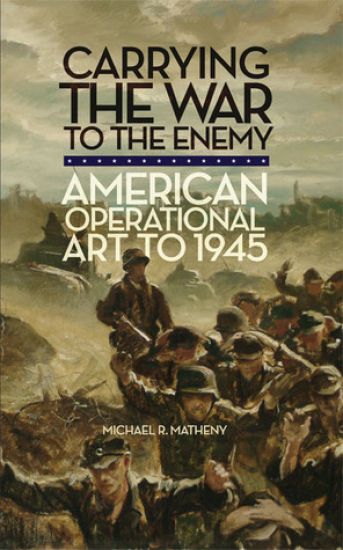
Carrying the War to the Enemy

Carrying the War to the Enemy

Michael R. Matheny

University of Oklahoma Press
2012
nidottu
Military commanders turn tactics into strategic victory by means of ""operational art,"" the knowledge and creative imagination commanders and staff employ in designing, synchronizing, and conducting battles and major operations to achieve strategic goals. Until now, historians of military theory have generally agreed that modern operational art developed between the first and second world wars, not in the United States but in Germany and the Soviet Union, whose armies were supposedly the innovators and greatest practitioners of operational art. Some have even claimed that U.S. forces struggled in World War II because their commanders had no systematic understanding of operational art.Michael R. Matheny believes previous studies have not appreciated the evolution of U.S. military thinking at the operational level. Although they may rightly point to the U.S. Army's failure to modernize or develop a sophisticated combined arms doctrine during the interwar years, they focus too much on technology or tactical doctrine. In his revealing account, Matheny shows that it was at the operational level, particularly in mounting joint and combined operations, that senior American commanders excelled - and laid a foundation for their country's victory in World War II.Matheny draws on archival materials from military educational institutions, planning documents, and operational records of World War II campaigns. Examining in detail the development of American operational art as land, sea, and air power matured in the twentieth century, he shows that, contrary to conventional wisdom, U.S. war colleges educated and trained commanders during the interwar years specifically for the operational art they employed in World War II.After 1945, in the face of nuclear warfare, the American military largely abandoned operational art. But since the Vietnam War, U.S. commanders have found operational art increasingly important as they pursue modern global and expeditionary warfare requiring coordination among multiple service branches and the forces of allied countries.
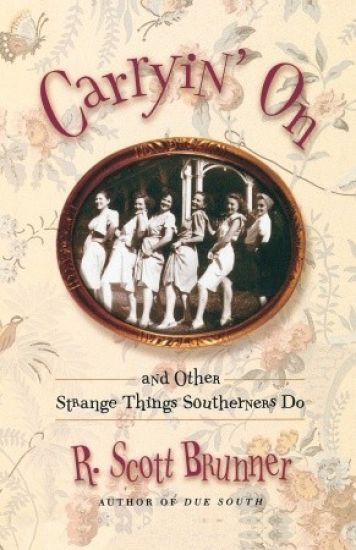
Carryin' On

Carryin' On

R. Scott Brunner

Random House Trade Paperbacks
2001
pokkari
Pat Conroy said that R. Scott Brunner's Due South "delivers the goods and delivers them Southern fried"; Rick Bragg said that Brunner "writes like people down here talk, with beauty." Carryin' On more than delivers on the promise of its predecessor, with more of the disarming and hilarious insights that made Due South an instant classic. Here are the essays like "Common Is as Common Does" (what kind of behavior is just plain tacky, and what isn't), "Tastes Like Summer" (a beautiful meditation on bean poles), "Real Southern Places" (a wry look at Steve Wynn's attempt to create a southern resort), "Paschal's" (a paean to a haven of classic southern culinary comfort -- in the middle of the Atlanta airport), and "The Last Time I Saw Parrish (a fond ode to his grandparent's Alabama hometown). Carryin' On celebrates culture, the food, the eccentricities, the habits, the language, the spirit, the talk -- the overall carryin' on that makes the American South a magical place. From the Hardcover edition.
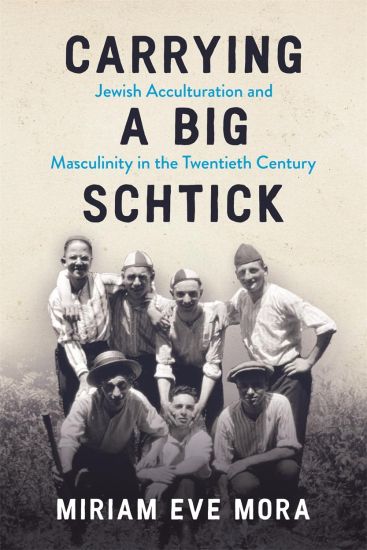
Carrying a Big Schtick

Carrying a Big Schtick

Miriam Eve Mora

WAYNE STATE UNIVERSITY PRESS
2024
nidottu
Jewish masculinity as a diverse set of adaptive reactions to masculine hegemony and the political, religious, and social realities of American Jews throughout the twentieth century.For twentieth-century Jewish immigrants and their children attempting to gain full access to American society, performative masculinity was a tool of acculturation. However, as scholar Miriam Eve Mora demonstrates, this performance is consistently challenged by American mainstream society that holds Jewish men outside of the American ideal of masculinity. Depicted as weak, effeminate, cowardly, gentle, bookish, or conflict-averse, Jewish men have been ascribed these qualities by outside forces, but some have also intentionally subscribed themselves to masculinities at odds with the American mainstream. Carrying a Big Schtick dissects notions of Jewish masculinity and its perception and practice in America in the twentieth century through the lenses of immigration and cultural history. Tracing Jewish masculinity through major themes and events including both World Wars, the Holocaust, American Zionism, Israeli statehood, and the Six-Day War, this work establishes that the struggle of this process can shed light on the changing dynamics in religious, social, and economic American Jewish life.
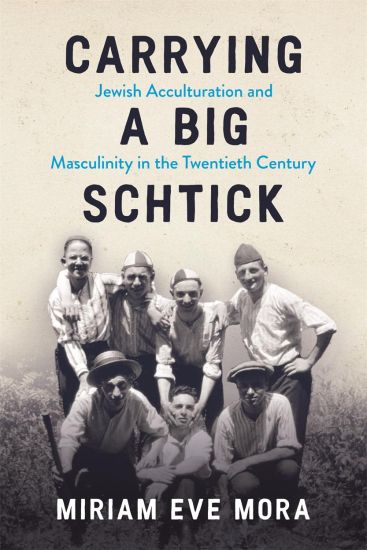
Carrying a Big Schtick

Carrying a Big Schtick

Miriam Eve Mora

WAYNE STATE UNIVERSITY PRESS
2024
sidottu
Jewish masculinity as a diverse set of adaptive reactions to masculine hegemony and the political, religious, and social realities of American Jews throughout the twentieth century.For twentieth-century Jewish immigrants and their children attempting to gain full access to American society, performative masculinity was a tool of acculturation. However, as scholar Miriam Eve Mora demonstrates, this performance is consistently challenged by American mainstream society that holds Jewish men outside of the American ideal of masculinity. Depicted as weak, effeminate, cowardly, gentle, bookish, or conflict-averse, Jewish men have been ascribed these qualities by outside forces, but some have also intentionally subscribed themselves to masculinities at odds with the American mainstream. Carrying a Big Schtick dissects notions of Jewish masculinity and its perception and practice in America in the twentieth century through the lenses of immigration and cultural history. Tracing Jewish masculinity through major themes and events including both World Wars, the Holocaust, American Zionism, Israeli statehood, and the Six-Day War, this work establishes that the struggle of this process can shed light on the changing dynamics in religious, social, and economic American Jewish life.
Carryin' on in the Lesbian and Gay South
To date, lesbian and gay history has focused largely on the East and West coasts, and on urban settings such as New York and San Francisco. The American South, on the other hand, identified with religion, traditional gender roles, and cultural conservatism, has escaped attention. Southerners celebrate their past; lesbians and gays celebrate their new-found visibility; historians celebrate the South?yet rarely have the three crossed paths. John Howard's groundbreaking anthology casts its net widely, examining lesbian and gay experiences in Mississippi, South Carolina, Georgia, Florida, Louisiana, and Tennessee. James Schnur, by virtue of a Freedom of Information Act query, sheds light on the sinister machinations of the Johns Committee, whose clandestine duty it was to ferret out suspected homosexuals during the McCarthy years. In his essay on the great Southern writer William Alexander Percy, William Armstrong Percy provides tangible evidence that Southern citizens, historians, and archivists have long sought to repress or obscure certain individuals within what C. Vann Woodward described as the perverse section. Moving chronologically through America's past, from the antebellum and postbellum periods, through the Jim Crow era and the Cold War, to the present, this volume introduces an important new framework to the field of lesbian and gay history?that of regional history.
Carryin' on in the Lesbian and Gay South
To date, lesbian and gay history has focused largely on the East and West coasts, and on urban settings such as New York and San Francisco. The American South, on the other hand, identified with religion, traditional gender roles, and cultural conservatism, has escaped attention. Southerners celebrate their past; lesbians and gays celebrate their new-found visibility; historians celebrate the South?yet rarely have the three crossed paths. John Howard's groundbreaking anthology casts its net widely, examining lesbian and gay experiences in Mississippi, South Carolina, Georgia, Florida, Louisiana, and Tennessee. James Schnur, by virtue of a Freedom of Information Act query, sheds light on the sinister machinations of the Johns Committee, whose clandestine duty it was to ferret out suspected homosexuals during the McCarthy years. In his essay on the great Southern writer William Alexander Percy, William Armstrong Percy provides tangible evidence that Southern citizens, historians, and archivists have long sought to repress or obscure certain individuals within what C. Vann Woodward described as the perverse section. Moving chronologically through America's past, from the antebellum and postbellum periods, through the Jim Crow era and the Cold War, to the present, this volume introduces an important new framework to the field of lesbian and gay history?that of regional history.
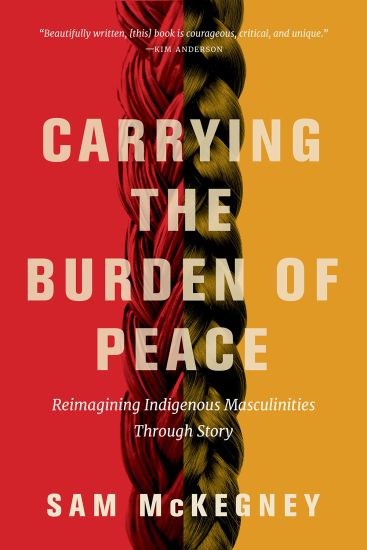
Carrying the Burden of Peace

Carrying the Burden of Peace

Sam McKegney

University of Arizona Press
2021
nidottu
Can a critical examination of Indigenous masculinities be an honor song--one that celebrates, rather than pathologizes; one that seeks diversity and strength; one that overturns heteropatriarchy without centering settler colonialism? Can a critical examination of Indigenous masculinities even be creative, inclusive, erotic? Sam McKegney answers affirmatively. Countering the perception that masculinity has been so contaminated as to be irredeemable, the book explores Indigenous literary art for understandings of masculinity that exceed the impoverished inheritance of colonialism. Carrying the Burden of Peace weaves together stories of Indigenous life, love, eroticism, pain, and joy to map the contours of diverse, empowered, and non-dominant Indigenous masculinities. It is from here that a more balanced world may be pursued.
Carry It On

Carry It On

Susan Youngblood Ashmore

University of Georgia Press
2008
pokkari
Carry It On is an in-depth study of how the local struggle for equality in Alabama fared in the wake of new federal laws—the Civil Rights Act, the Economic Opportunity Act, and the Voting Rights Act. Susan Youngblood Ashmore provides a sharper definition to changes set in motion by the fall of legal segregation. She focuses her detailed story on the Alabama Black Belt and on the local projects funded by the Office of Economic Opportunity (OEO), the federal agency that supported programs in a variety of cities and towns in Alabama. Black Belt activists who used OEO funds understood that the structural underpinnings of poverty were key components of white supremacy, says Ashmore. They were motivated not only to end poverty but also to force local governments to comply with new federal legislation aimed at achieving racial equality on a number of fronts.Ashmore looks closely at the interactions among local activists, elected officials, businesspeople, landowners, bureaucrats, and others who were involved in or affected by OEO projects. Carry It On offers a nuanced picture of the OEO, an agency too broadly criticized; a new look at the rise of southern Black Power; and a compelling portrait of local citizens struggling for control over their own lives. Ashmore provides a more complete understanding of how southerners worked to define for themselves how freedom would come during the years shaped by the civil rights movement and the war on poverty.