Kirjojen hintavertailu. Mukana 12 435 434 kirjaa ja 12 kauppaa.

Kirjahaku

Etsi kirjoja tekijän nimen, kirjan nimen tai ISBN:n perusteella.

1000 tulosta hakusanalla Charles F. T. Drake

Narrative of the Second Arctic Expedition Made by Charles F. Hall

Narrative of the Second Arctic Expedition Made by Charles F. Hall

Charles Francis Hall

Cambridge University Press
2014
pokkari
The American explorer Charles Francis Hall (1821–71) made two voyages to the Arctic to determine the fate of Sir John Franklin's lost expedition. While there, he lived with Inuit, learning their language and adopting their way of life. Edited after his death and published in 1879, this account of his second expedition, from 1864 to 1869, brings the conditions he endured vividly to life. Two punishing sledge journeys to King William Island revealed evidence of Franklin's encampment there, but also the stark fact that rumours of survivors were unfounded. The work, which contains a number of fine engravings and maps, also includes appendices presenting Hall's detailed scientific observations and notes of his conversations with the Inuit, which disclosed evidence of cannibalism among Franklin's crew. Based on his earlier expedition, Hall's Life with the Esquimaux (1864) is also reissued in this series.
Narrative of the Second Arctic Expedition Made by Charles F. Hall

Narrative of the Second Arctic Expedition Made by Charles F. Hall

Charles Francis Hall; Joseph Everett Nourse; Navy United States

Hansebooks
2017
pokkari
Narrative of the Second Arctic Expedition Made by Charles F. Hall is an unchanged, high-quality reprint of the original edition of 1879. Hansebooks is editor of the literature on different topic areas such as research and science, travel and expeditions, cooking and nutrition, medicine, and other genres. As a publisher we focus on the preservation of historical literature. Many works of historical writers and scientists are available today as antiques only. Hansebooks newly publishes these books and contributes to the preservation of literature which has become rare and historical knowledge for the future.
North American Trees: Guide to Charles F. Millspaugh Hall

North American Trees: Guide to Charles F. Millspaugh Hall

Field Museum of Natural History; Samuel J. (Samuel James) 188 Record

Hassell Street Press
2021
sidottu
This work has been selected by scholars as being culturally important and is part of the knowledge base of civilization as we know it.This work is in the public domain in the United States of America, and possibly other nations. Within the United States, you may freely copy and distribute this work, as no entity (individual or corporate) has a copyright on the body of the work.Scholars believe, and we concur, that this work is important enough to be preserved, reproduced, and made generally available to the public. To ensure a quality reading experience, this work has been proofread and republished using a format that seamlessly blends the original graphical elements with text in an easy-to-read typeface.We appreciate your support of the preservation process, and thank you for being an important part of keeping this knowledge alive and relevant.
The Civil War Letters of Colonel Charles F. Johnson, Invalid Corps
Chronicles the untold story of disabled combat veterans who continued to serve in the Union Army; Organized in May 1863 to meet the Union Army's growing manpower needs, the Invalid Corps - later renamed the Veteran Reserve Corps - was a unique military unit. With more than twenty-four regiments of troops, nearly all of them men disabled by illness or combat wounds, it was at one point twice as large as the entire pre-war United States Army. During four years of service its troops enforced the draft, guarded prisoners and vital outposts, protected rail lines and supply depots, and served as military police in cities all across the country. Members of the Corps escorted President Lincoln's body home to Illinois, and after the war its officers formed the nucleus of the new Freedman's Bureau. This volume brings together some 150 letters written by Colonel Charles F. Johnson, an officer who served with the 18th Veteran Reserve Corps after sustaining debilitating wounds during the Seven Day's Battles in June 1862. Edited with an introduction by Fred Pelka, the letters describe the day-to-day circumstances of ""The Cripple Brigade,"" as it was derisively called, as well as guerrilla warfare in Missouri, combat in Virginia, and barracks life in Washington, D.C. Johnson was a keen observer of his nation at war, and his correspondence with his wife Mary is by turns literate and comic, objective and personal. In his introduction and annotations, Pelka provides a detailed history of the Invalid Corps and explores the experience of disability in nineteenth-century America. He looks at how the nation responded to the sudden appearance of tens of thousands of newly disabled young men, and traces how members of the Invalid Corps fought not only to restore the Union but also to retain their dignity as Americans and as human beings.
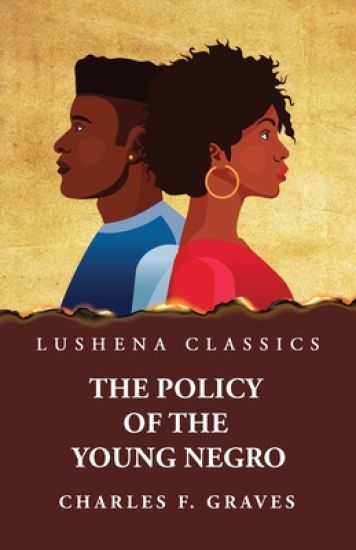
The Policy of the Young Negro by Charles F. Graves
But with reference to the policy of the young American Negro there is very n ucl idle and even sometinme erroneous specul tion. He is perhaps not thoroughly known by his critics, not even by those who touch his life in various ways for me cenary pur poses. The real life and policy of the young Negro must be unselfishly embraced, free from the bane of prejudice and all of is nu holy and corrupting influences. And it is with this purpose in view that we desire to candidly lay before you the policy of the young Negro. From the foregoing it is not strange then that his acts, feelings andyearnings should crystalize into a policy distinctly his own and yet tempered by all of the old time savory influences that hover around the faithful fathers and mothers of the days of slavery. And too it is just to the American people of which he forms a part that his policy be known and made bare before them.In the first place let us qualify the young Negro as that class, which is twang in years, who knows nothing of the clllolls require ments of bondage, that class though old in age, yet fresh and rich in thought and material, that class which is meeting the requirements of all thoughtful and sane people, that class which is filling. The schools with patient and diligent students the churches with devout and humble worship ers, the home with neat efficient and industri ous inmates, that class which is reaching out into the business, financial and the com mercial world endeavoring to find standing room, that class which is inhabiting the lands and preparing a permanent place of resi dence for himself and his kind, that class of Negroes who go through life with his head high up and his heart swelling with the patri otic blood in it conscious of the fact that God made him to be a man.
The Policy of the Young Negro by Charles F. Graves
But with reference to the policy of the young American Negro there is very n ucl idle and even sometinme erroneous specul tion. He is perhaps not thoroughly known by his critics, not even by those who touch his life in various ways for me cenary pur poses. The real life and policy of the young Negro must be unselfishly embraced, free from the bane of prejudice and all of is nu holy and corrupting influences. And it is with this purpose in view that we desire to candidly lay before you the policy of the young Negro. From the foregoing it is not strange then that his acts, feelings andyearnings should crystalize into a policy distinctly his own and yet tempered by all of the old time savory influences that hover around the faithful fathers and mothers of the days of slavery. And too it is just to the American people of which he forms a part that his policy be known and made bare before them.In the first place let us qualify the young Negro as that class, which is twang in years, who knows nothing of the clllolls require ments of bondage, that class though old in age, yet fresh and rich in thought and material, that class which is meeting the requirements of all thoughtful and sane people, that class which is filling. The schools with patient and diligent students the churches with devout and humble worship ers, the home with neat efficient and industri ous inmates, that class which is reaching out into the business, financial and the com mercial world endeavoring to find standing room, that class which is inhabiting the lands and preparing a permanent place of resi dence for himself and his kind, that class of Negroes who go through life with his head high up and his heart swelling with the patri otic blood in it conscious of the fact that God made him to be a man.