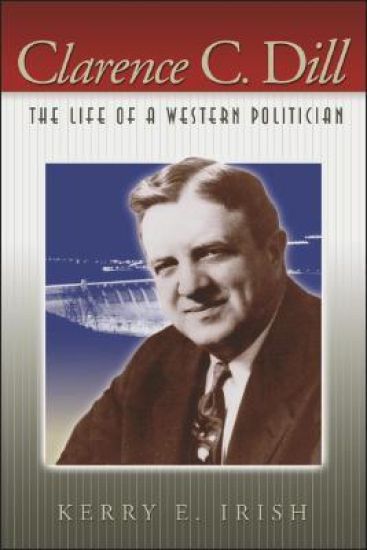
Born into a poor Ohio farm family in 1884, Clarence C. Dill immigrated as a young man to Spokane, Washington. There, despite being a virtual stranger, a political newcomer, and a Democrat in a Republican stronghold, he won election as Washington's Fifth District Representative to Congress. Reelected in 1916 as a Woodrow Wilson progressive, Dill opposed American entry into World War I. Voters promptly removed him from office in 1918--his political career apparently ended.But in 1922, Dill upset popular Republican Senator Miles Poindexter. In the Senate, he championed regulatory control of radio broadcasting and led Congress in drafting the Radio Act of 1927 and the Federal Communications Act of 1934. At the same time, Dill was befriended by Franklin Roosevelt, becoming one of the President's early Senate allies. Dill effectively lobbied Roosevelt to authorize the Grand Coulee Dam on the Columbia River.Just as mysteriously as when he first entered politics, Dill retired in 1934 at the height of his prestige. This first-ever biography reveals Dill's deserved place as one of the Northwest's most influential political leaders.
"A finger smashed in a car door and a missed geology examination at the University of Utah led Wallace Stegner to a special assignment about Clarence E. Dutton, thence to John Wesley Powell, and finally in 1954 to publication of what is arguably the single best nonfiction book dealing with the American West. "Beyond the Hundredth Meridian" remains in print fifty-two years after its initial appearance. Not many books have survived that length of time and thrived, despite competing works on the same subject. This combination of biography, history, and environmental primer written with the flair and the technical skill of a novelist who could masterfully evoke scenes and sustain a gripping factual narrative sprang from "Clarence Edward Dutton: An Appraisal." Seldom has such a classic book had such a humble beginning. Stegner was a young English instructor at the University of Utah when he produced the Dutton essay. He was ambitious and desperate for recognition, a raise (he was earning $1,700 a year), and steady employment in the Depression years. The essay contains hints, in terms of style and content, of what Stegner would eventually produce. "Dutton" was Stegner s first published work of nonfiction, and it is fair to say that it lead him, in conjunction with Bernard DeVoto s prodding, to the subject of conservation." from the foreword "Clarence Edward Dutton: An Appraisal" was first published by the University of Utah in 1936 and has since become a rarity on the antiquarian book market. It is reproduced in facsimile for this edition."
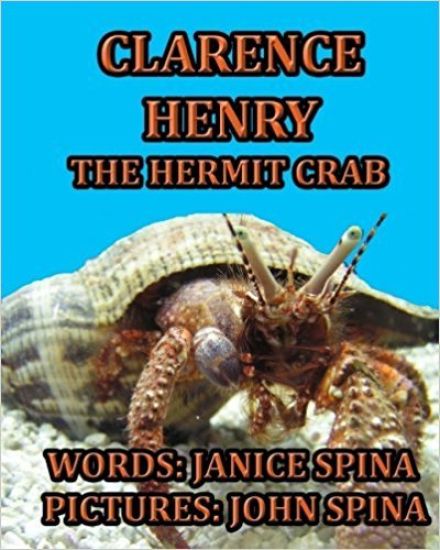
Clarence Henry is different from other hermit crabs. He came to his new home minus one claw and a leg. He needs to protect himself until he can grow new appendages. Will Clarence Henry be able to meet the challenges in his new water world?Clarence Henry was a real aquatic hermit crab who lived in a saltwater fish tank in our home. We watched him interact with the other creatures in the tank.He was resilient, intelligent, and a joy to have as a pet. We took some photos of him as he grew his claw and leg and changed shells.We shared these photos and facts about hermit crabs in the back of the book. I hope you will enjoy them. This book would make a wonderful resource for classrooms.
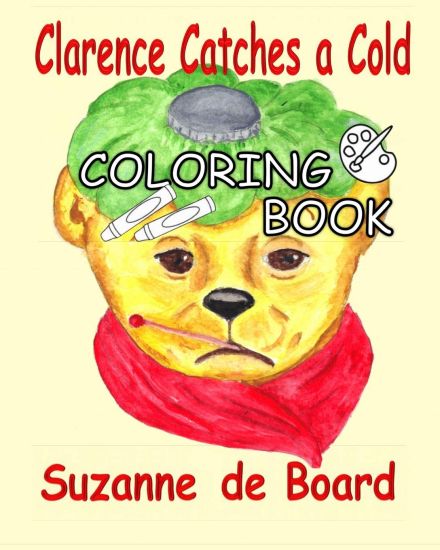
Clarence Catches a Cold is a coloring book, a companion book to the Picture book by the same name - Clarence Catches a Cold. There are plenty of pictures to color, as well as many pencil puzzles, and other activities, for children of all ages.to do.
In this illuminating and comprehensive account, Talbot C. Imlay chronicles the life of Clarence Streit and his Atlantic federal union movement in the Unites States during and following the Second World War. The first book to detail Streit's life, work and significance, it reveals the importance of public political cultures in shaping US foreign relations. In 1939, Streit published Union Now which proposed a federation of the North Atlantic democracies modelled on the US Constitution. The buzz created led Streit to leave his position at The New York Times and devote himself to promoting the union. Over the next quarter of a century, Streit worked to promote a new public political culture, employing a variety of strategies to gain visibility and political legitimacy for his project and for federalist frameworks. In doing so, Streit helped shape wartime debates on the nature of the post-war international order and of transatlantic relations.
In this illuminating and comprehensive account, Talbot C. Imlay chronicles the life of Clarence Streit and his Atlantic federal union movement in the Unites States during and following the Second World War. The first book to detail Streit's life, work and significance, it reveals the importance of public political cultures in shaping US foreign relations. In 1939, Streit published Union Now which proposed a federation of the North Atlantic democracies modelled on the US Constitution. The buzz created led Streit to leave his position at The New York Times and devote himself to promoting the union. Over the next quarter of a century, Streit worked to promote a new public political culture, employing a variety of strategies to gain visibility and political legitimacy for his project and for federalist frameworks. In doing so, Streit helped shape wartime debates on the nature of the post-war international order and of transatlantic relations.
This work has been selected by scholars as being culturally important and is part of the knowledge base of civilization as we know it.This work is in the public domain in the United States of America, and possibly other nations. Within the United States, you may freely copy and distribute this work, as no entity (individual or corporate) has a copyright on the body of the work.Scholars believe, and we concur, that this work is important enough to be preserved, reproduced, and made generally available to the public. To ensure a quality reading experience, this work has been proofread and republished using a format that seamlessly blends the original graphical elements with text in an easy-to-read typeface.We appreciate your support of the preservation process, and thank you for being an important part of keeping this knowledge alive and relevant.
This work has been selected by scholars as being culturally important and is part of the knowledge base of civilization as we know it.This work is in the public domain in the United States of America, and possibly other nations. Within the United States, you may freely copy and distribute this work, as no entity (individual or corporate) has a copyright on the body of the work.Scholars believe, and we concur, that this work is important enough to be preserved, reproduced, and made generally available to the public. To ensure a quality reading experience, this work has been proofread and republished using a format that seamlessly blends the original graphical elements with text in an easy-to-read typeface.We appreciate your support of the preservation process, and thank you for being an important part of keeping this knowledge alive and relevant.
Clarence is a perennial undergrad and a proud member of the varsity golf team. But when his poor grades catch up to him, his spot on the team hangs in jeopardy. In a desperate attempt to boost his GPA, Clarence signs up for the only class still available: Women's Studies.When his frat boy friends hear of this, they propose a tantalizing wager involving Clarence's female classmates, and give him a daunting task to be completed by the end of the semester. Clarence foolishly accepts, turning his Women's Studies class into a high-stakes battlefield. A story rich in ridiculousness, the Cooper Sisters promise you will be mightily entertained or just constantly triggered.
Clarence Christopher Purdy is quite a remarkable cat. He seems to understand everything you say. That can be a good thing or not so good a thing, but it makes life at the Purdy's quite interesting, especially when Clarence takes things into his own paws
Clarence Christopher Purdy is quite a remarkable cat. He seems to understand everything you say. That can be a good thing or not so good a thing, but it makes life at the Purdy's quite interesting, especially when Clarence takes things into his own paws
Title: Clarence Leighton; or The Outcast; a novel.Publisher: British Library, Historical Print EditionsThe British Library is the national library of the United Kingdom. It is one of the world's largest research libraries holding over 150 million items in all known languages and formats: books, journals, newspapers, sound recordings, patents, maps, stamps, prints and much more. Its collections include around 14 million books, along with substantial additional collections of manuscripts and historical items dating back as far as 300 BC.The FICTION & PROSE LITERATURE collection includes books from the British Library digitised by Microsoft. The collection provides readers with a perspective of the world from some of the 18th and 19th century's most talented writers. Written for a range of audiences, these works are a treasure for any curious reader looking to see the world through the eyes of ages past. Beyond the main body of works the collection also includes song-books, comedy, and works of satire. ++++The below data was compiled from various identification fields in the bibliographic record of this title. This data is provided as an additional tool in helping to insure edition identification: ++++ British Library Sanders, F. H.; 1851. 12 . 12624.e.5.
The Wisdom of Clarence Darrow is a book that collects the most profound and insightful quotes and speeches from the renowned American lawyer and civil libertarian, Clarence Darrow. Darrow was a prominent figure in the early 20th century, known for his defense of controversial clients and his advocacy for social justice causes such as labor rights, civil rights, and the abolition of the death penalty.The book is a compilation of Darrow's most famous speeches and writings, covering a wide range of topics such as politics, religion, ethics, and law. The collection includes excerpts from his famous defense of Leopold and Loeb, his speeches on the Scopes Monkey Trial, and his writings on the injustice of the criminal justice system.The book is organized thematically, with each chapter focusing on a particular aspect of Darrow's philosophy. The chapters cover topics such as freedom, justice, morality, and the role of the individual in society. Each quote or speech is accompanied by a brief introduction that provides context and background information.Overall, The Wisdom of Clarence Darrow is a thought-provoking and inspiring collection of the words of one of America's most influential thinkers and advocates for social justice. It is a must-read for anyone interested in the history of American law and politics, as well as those who seek to better understand the enduring legacy of Clarence Darrow.This scarce antiquarian book is a facsimile reprint of the old original and may contain some imperfections such as library marks and notations. Because we believe this work is culturally important, we have made it available as part of our commitment for protecting, preserving, and promoting the world's literature in affordable, high quality, modern editions, that are true to their original work.