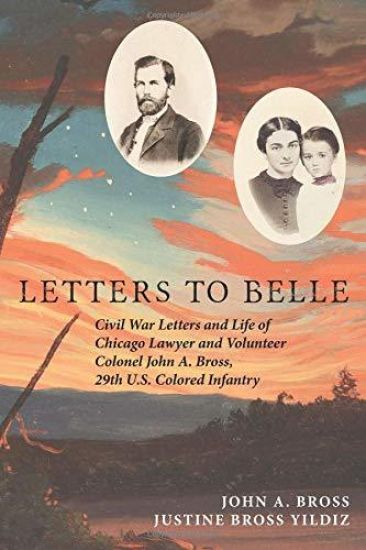
Civil War letters and life of Colonel John A. Bross, a Chicago lawyer, married with a child, who volunteered in 1862 as an officer in the Army of the Cumberland, fought at the battles of Perryville, Stones River, and Chickamauga, then raised the only African-American regiment from Illinois and was killed leading his troops at the Battle of the Crater on July 30, 1864. His letters describe daily life in the army as well as scenes of battle, and glow with love for his wife Belle and his little boy Mason. The biography describes life in the rapidly growing Chicago of the 1850s and gives details of Lincoln's election campaigns of 1858 and 1860, in which John and his brother William (an owner of the Chicago Tribune) played a prominent role. The biography also provides a narrative of the military campaigns in which he was engaged.
KIRKUS REVIEWS' BEST BOOKS OF 2018In 1815, a 5-year-old girl searches for Utopia in a post-Napoleonic Europe.The girl, an abandoned love child, finds and then loses her beloved father. Will they ever find each other again? A touching tale of heartache told through a child's eyes with truth, love and a bit of magic.Sofia-Elisabete, the illegitimate child of Colonel Fitzwilliam, is a five-year-old firecracker with a true heart, an irrepressible spirit and a passion to be the best drummer girl. An inquisitive child, she senses the dark secrets surrounding her mysterious beginnings as a foundling in Portugal and the strange goings on in the tangled-up world of her troubled father, who adores her while harboring a great affection for someone called Mr. O.P. Umm.Who is the enchanting Do a Marisa, who lures Sofia-Elisabete away in a search of the perfect world in the moon? Heartsick at being separated from her father, Sofia-Elisabete embarks on an odyssey in a post-Napoleonic continent in the company of Do a Marisa and her ragtag retinue, determined to find the utopia on the moon-a magical place where no one is ever sick or sad-and which she fervently believes will cure her father's bouts with melancholy. Will Sofia-Elisabete's childish innocence survive this emotional journey to find the perfect moon world?I, Sofia-Elisabete, in part, reimagines the life and destiny of Colonel Fitzwilliam, the curiously evasive and opaque character in Jane Austen's Pride and Prejudice.Sofia-Elisabete StoriesI, Sofia-Elisabete, Love Child of Colonel Fitzwilliam - Searching for Utopia in the aftermath of the Napoleonic Wars. A Kirkus Reviews' Best Books of 2018.Twelfth-Night Cake & the Rosings Ghost - Clashing with Lady Catherine of Rosings Park. Finalist, 2018 Wishing Shelf Book Awards.Only Sofia-Elisabete - Trusting love and her healing power. A Kirkus Reviews' Best Books of 2021, and B.R.A.G. Medallion honoree.My Cousin Darcy - Teaming up with her cousin Darcy to save her father's honor. Winner, Silver Medal, Audiobook, 2023 Wishing Shelf Book Awards; B.R.A.G. Medallion honoree.Something About Lizzy - Discovering the Darcy family secrets post-Pride and Prejudice. Grand Prize, 2024 Chanticleer International Book Awards, Shorts (Novellas, Collections, Essays); B.R.A.G. Medallion Honoree.
William Makepeace Thackeray ( 18 July 1811 - 24 December 1863) was an English novelist of the 19th century. He is famous for his satirical works, particularly Vanity Fair, a panoramic portrait of English society. Thackeray, an only child, was born in Calcutta, British India, where his father, Richmond Thackeray (1 September 1781 - 13 September 1815), was secretary to the Board of Revenue in the British East India Company. His mother, Anne Becher (1792-1864), was the second daughter of Harriet Becher and John Harman Becher, who was also a secretary (writer) for the East India Company.Richmond died in 1815, which caused Anne to send her son to England in 1816, while she remained in British India. The ship on which he travelled made a short stopover at St. Helena, where the imprisoned Napoleon was pointed out to him. Once in England he was educated at schools in Southampton and Chiswick, and then at Charterhouse School, where he became a close friend of John Leech. Thackeray disliked Charterhouse, and parodied it in his fiction as "Slaughterhouse". Nevertheless, Thackeray was honoured in the Charterhouse Chapel with a monument after his death. Illness in his last year there, during which he reportedly grew to his full height of six foot three, postponed his matriculation at Trinity College, Cambridge, until February 1829.Never too keen on academic studies, Thackeray left Cambridge in 1830, but some of his earliest published writing appeared in two university periodicals, The Snob and The Gownsman. Thackeray then travelled for some time on the continent, visiting Paris and Weimar, where he met Goethe. He returned to England and began to study law at the Middle Temple, but soon gave that up. On reaching the age of 21 he came into his inheritance from his father, but he squandered much of it on gambling and on funding two unsuccessful newspapers, The National Standard and The Constitutional, for which he had hoped to write. He also lost a good part of his fortune in the collapse of two Indian banks. Forced to consider a profession to support himself, he turned first to art, which he studied in Paris, but did not pursue it, except in later years as the illustrator of some of his own novels and other writings.Thackeray's years of semi-idleness ended after he married, on 20 August 1836, Isabella Gethin Shawe (1816-1893), second daughter of Isabella Creagh Shawe and Matthew Shawe, a colonel who had died after distinguished service, primarily in India. The Thackerays had three children, all girls: Anne Isabella (1837-1919), Jane (who died at eight months old) and Harriet Marian (1840-1875), who married Sir Leslie Stephen, editor, biographer and philosopher. Thackeray now began "writing for his life", as he put it, turning to journalism in an effort to support his young family. He primarily worked for Fraser's Magazine, a sharp-witted and sharp-tongued conservative publication for which he produced art criticism, short fictional sketches, and two longer fictional works, Catherine and The Luck of Barry Lyndon. Between 1837 and 1840 he also reviewed books for The Times. 4] He was also a regular contributor to The Morning Chronicle and The Foreign Quarterly Review. Later, through his connection to the illustrator John Leech, he began writing for the newly created magazine Punch, in which he published The Snob Papers, later collected as The Book of Snobs. This work popularised the modern meaning of the word "snob".Thackeray was a regular contributor to Punch between 1843 and 1854. George Louis Palmella Busson du Maurier (6 March 1834 - 8 October 1896) was a Franco-British cartoonist and author, known for his cartoons in Punch and for his novel Trilby. He was the father of actor Sir Gerald du Maurier and grandfather of writers Angela du Maurier and Dame Daphne du Maurier. He was also the father of Sylvia Llewelyn Davies and grandfather of the five boys who inspired J.M. Barrie's Peter Pan.
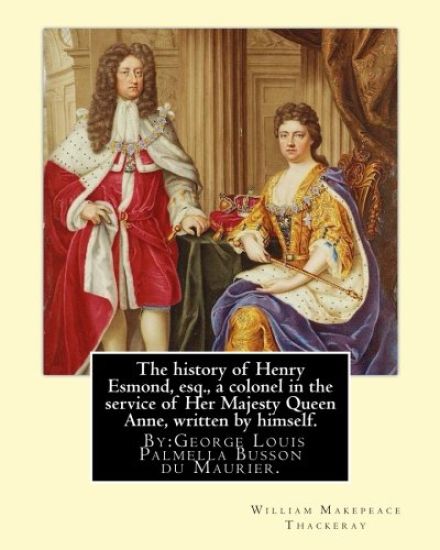
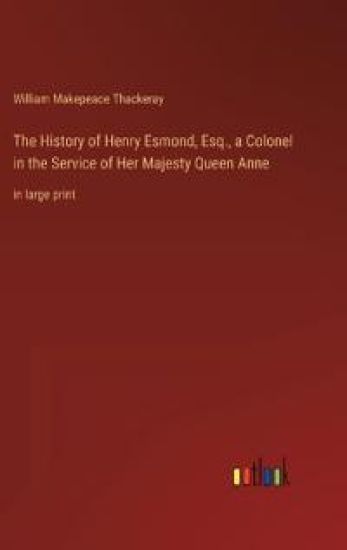
The History of Henry Esmond, Esq., a Colonel in the Service of Her Majesty Queen Anne' is a historical novel written by William Makepeace Thackeray. The book is set in the early 18th century and follows the life of Henry Esmond, a young Englishman who finds himself entangled in the political and social intricacies of the era. Narrated in the first person by Esmond himself, the novel explores his journey from his childhood as an orphan to his rise as a military officer in the service of Queen Anne. Esmond becomes embroiled in the turbulent events surrounding the succession to the English throne and the political maneuverings of the time. This novel is renowned for its detailed historical accuracy and vivid depiction of the period, immersing readers in the customs, politics, and social norms of 18th-century England.
The History of Henry Esmond, Esq., a Colonel in the Service of Her Majesty Queen Anne' Volume 2 is the continuation of the historical novel written by William Makepeace Thackeray. In Volume 2, Esmond's story takes a more personal turn as he becomes entangled in a web of romantic entanglements and family drama. The author delves into Esmond's relationships with the women in his life, including his love interest Lady Castlewood and her daughter, Beatrix. Esmond finds himself torn between duty and desire, loyalty and self-interest, as he grapples with the choices that will shape his future. Thackeray's skillful blend of historical events and fictional narrative continues in this volume, capturing the essence of the era with meticulous detail and insightful commentary. The novel explores themes of love, honor, social class, and the complexities of human nature, all against the backdrop of political intrigue and societal expectations.
The History of Henry Esmond, Esq., a Colonel in the Service of Her Majesty Queen Anne Vol 3 is the third and final volume of William Makepeace Thackeray's historical novel. The book tells the story of Henry Esmond, a colonel in the service of Queen Anne of England. In Volume 3, Henry continues his service to the queen, and he also finds love with Beatrix, the daughter of his enemy, Lord Castlewood. However, their love is forbidden, and they must keep their relationship a secret. Henry is also forced to confront his past, and he must come to terms with the death of his father and the betrayal of his friends. In the end, Henry finds redemption and happiness, and he learns that love is the most important thing in life. This book is a classic of English literature and a beautifully written novel that tells a story of love, loss, and redemption. The book is a must-read for anyone who enjoys historical fiction or classic literature.