

Kirjahaku
Etsi kirjoja tekijän nimen, kirjan nimen tai ISBN:n perusteella.
1000 tulosta hakusanalla Cook Elizabeth

The Best of The Amish Cook: Volume 1, 1991 - 1996
Elizabeth Coblentz
Createspace Independent Publishing Platform
2012
nidottu

The new book of cookery or every woman a perfect cook
Price Elizabeth; Edward Hailstone
Hansebooks
2016
pokkari

In Let’s Cook! you’ll learn how to cook simple and nutritious meals—with recipes using all the MyPlate food groups. Gain confidence in the kitchen and build self-worth! Designed by and for adults with intellectual disability, Let’s Cook! promotes and reinforces life skills for independent living. Let’s Cook! can help you: Create healthy meals.Control carbs, calories, and salt.Follow food and kitchen safety.Eat well, today and every day! Inside Let’s Cook! you’ll find: More than 50 healthy “I can cook” recipes in large print are written at an early elementary reading level.An easy-to-follow recipe style sets forth What I Need, What I Use, What I Do.Color photos showcase each recipe.Step-by-step preparations take the guesswork out of cooking.Complete nutrient information is included for each recipe.

Royal Elizabeths: the Romance of Five Princesses, 1464-1840
E. Thornton (Elsie Thornton) 1. Cook
Hassell Street Press
2021
sidottu
This work has been selected by scholars as being culturally important and is part of the knowledge base of civilization as we know it.This work is in the public domain in the United States of America, and possibly other nations. Within the United States, you may freely copy and distribute this work, as no entity (individual or corporate) has a copyright on the body of the work.Scholars believe, and we concur, that this work is important enough to be preserved, reproduced, and made generally available to the public. To ensure a quality reading experience, this work has been proofread and republished using a format that seamlessly blends the original graphical elements with text in an easy-to-read typeface.We appreciate your support of the preservation process, and thank you for being an important part of keeping this knowledge alive and relevant.

Royal Elizabeths: the Romance of Five Princesses, 1464-1840
E. Thornton (Elsie Thornton) 1. Cook
Hassell Street Press
2021
nidottu
The Presentation of Time in the Elizabethan Drama
Mable Buland; Albert S. (EDT) Cook
Kessinger Pub
2006
pokkari

The Poetical Works Of Mary Howitt, Eliza Cook And L. E. L.
Mary Howitt; Eliza Cook; Letitia Elizabeth Landon
Kessinger Pub
2007
pokkari

The Poetical Works Of Mary Howitt, Eliza Cook And L. E. L. (1853)
Mary Howitt; Eliza Cook; Letitia Elizabeth Landon
KESSINGER PUBLISHING, LLC
2008
sidottu

Family Activism in the Aftermath of Fatal Violence explores how family and family activism work at the intersection of personal and public troubles and considers what influence family testimonies of fatal violence can have on matters of crime, justice, and punishment.The problem of fatal violence represents one end of a long continuum of violence that marks society, the effects of which endure in families and friends connected through ties of kinship, identity and social bonds. The aftermath of fatal violence can therefore be an intensely personal encounter which confronts families with disorder and uncertainty. Nevertheless, bereaved families are often found at the forefront of efforts to expose injustice, rouse public consciousness, and drive forward social change that seeks to prevent violence from happening again. This book draws upon ethnographic research with those bereaved by gun violence who became involved in family activism in the context of fatal violence: namely, the attempts by bereaved families to manage their experiences of violent death through public expressions of grief and become proxies for wider debates on social injustice. This is an ever more pressing issue in a landscape which increasingly sees the delegation of responsibility to families and communities that are left to deal with the aftermath of violence.An accessible and compelling read, this book will appeal to students and scholars of criminology, sociology, cultural studies, and all those interested in learning more about the after-effects of fatal violence.

Family Activism in the Aftermath of Fatal Violence
Elizabeth A. Cook
TAYLOR FRANCIS LTD
2022
nidottu
Family Activism in the Aftermath of Fatal Violence explores how family and family activism work at the intersection of personal and public troubles and considers what influence family testimonies of fatal violence can have on matters of crime, justice, and punishment.The problem of fatal violence represents one end of a long continuum of violence that marks society, the effects of which endure in families and friends connected through ties of kinship, identity and social bonds. The aftermath of fatal violence can therefore be an intensely personal encounter which confronts families with disorder and uncertainty. Nevertheless, bereaved families are often found at the forefront of efforts to expose injustice, rouse public consciousness, and drive forward social change that seeks to prevent violence from happening again. This book draws upon ethnographic research with those bereaved by gun violence who became involved in family activism in the context of fatal violence: namely, the attempts by bereaved families to manage their experiences of violent death through public expressions of grief and become proxies for wider debates on social injustice. This is an ever more pressing issue in a landscape which increasingly sees the delegation of responsibility to families and communities that are left to deal with the aftermath of violence.An accessible and compelling read, this book will appeal to students and scholars of criminology, sociology, cultural studies, and all those interested in learning more about the after-effects of fatal violence.

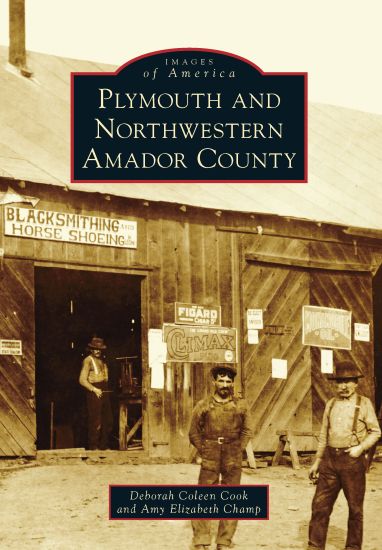
Plymouth and Northwestern Amador County
Deborah Coleen Cook; Amy Elizabeth Champ
Arcadia Publishing (SC)
2022
nidottu
In Plymouth and Northwestern Amador County mother and daughter authors Deborah Coleen Cook and Amy Elizabeth Champ present a look into the chronological past of the region from the native Miwok people to the 21st century with photographs gleaned from local families and historic repositories. Situated near the Sierra Nevada foothills in the northwestern region of Amador County is the small town of Plymouth. This hamlet, and other surrounding towns such as Drytown, Fiddletown, and River Pines, have been home to farmers, ranchers, and merchants since the early days of the California Gold Rush. Plymouth, known to be the gateway to the world-famous Shenandoah Valley wine country, is a thriving community with a hometown feel. History lives here, from the aged buildings along Main Street to the ruins of the Plymouth-Consolidated Mine, one of the largest gold producers in California. Cook, a retired historic archaeologist and former Amador County archivist, spent much of her professional career studying the history of Amador County and is a former longtime resident of Plymouth. Champ has been a resident of Plymouth since obtaining her doctoral degree at the University of California at Davis. She currently teaches in Amador County.

Goethe's Mother
Catharine Elizabeth Goethe; Alfred S. (TRN) Gibbs; Clarence Cook
Kessinger Pub
2006
pokkari

Evidence-based Therapeutic Massage
Elizabeth A. Holey; Eileen M. Cook
Churchill Livingstone
2010
nidottu
Now in its third edition, this practical clinical guide for both students and practitioners is further strengthened by the addition of online video clips which demonstrate how to apply a range of massage techniques. The text's research-base and references are fully updated, aiming to provide the reader with the most pertinent evidence to support the use of massage for particular injuries and conditions. New, improved and expanded chapter on Massage in Sport, including section on athletes with disabilities. Written by a sports specialist physiotherapist with experience of working with national teams at world and Olympic level Expanded chapters on Relaxation Massage (formerly Sedative Massage) & Reflex Therapies (formerly Specialized Techniques) Case studies throughout the chapters Evolve Resources - use your unique PIN code to access video clips of tutorials and demonstrations of massage techniques as identified in the book

Ensuring Mission Assurance While Conducting Rapid Space Acquisition
Cynthia R Cook; Éder Sousa; Yool Kim; Megan McKernan; Yuliya Shokh; Sydne J Newberry; Kelly Elizabeth Eusebi; Lindsay Rand
RAND Corporation
2023
pokkari
As the U.S. Space Force (USSF) pursues rapid acquisition of warfighting capabilities, a key question is whether the streamlining techniques being used to get new space systems to operators quickly create mission assurance vulnerabilities. The authors of this report examine the techniques being used to accelerate USSF acquisition, the risks associated with them, their potential impact on mission assurance, and the possible mitigations.
Promoting Equity and Justice Through Pedagogical Partnership
Alise de Bie; Elizabeth Marquis; Alison Cook-Sather; Leslie Luqueño
Stylus Publishing
2021
sidottu
Faculty and staff in higher education are looking for ways to address the deep inequity and systemic racism that pervade our colleges and universities. Pedagogical partnership can be a powerful tool to enhance equity, inclusion, and justice in our classrooms and curricula. These partnerships create opportunities for students from underrepresented and equity-seeking groups to collaborate with faculty and staff to revise and reinvent pedagogies, assessments, and course designs, positioning equity and justice as core educational aims. When students have a seat at the table, previously unheard voices are amplified, and diversity and difference introduce essential perspectives that are too often overlooked.In particular, the book contributes to the literature on pedagogical partnership and equity in education by integrating theory, synthesizing research, and providing concrete examples of the ways partnership can contribute to more equitable educational systems. At the same time, the authors acknowledge that partnership can only realize its full potential to redress harms and promote equity and justice when thoughtfully enacted. This book is a resource that will inspire and challenge a wide variety of higher education faculty and staff and contribute to advancing both practice and research on the potential of student-faculty pedagogical partnerships. Presenting a conceptual framework for understanding the various epistemological, affective, and ontological harms that face students from equity-seeking groups in postsecondary education, Promoting Equity and Justice Through Pedagogical Partnership applies this conceptual framework to current literature in partnerships, highlighting the promise of partnership as the way to redress these harms. The authors ground both the conceptual framework and the literature review by offering two case studies of pedagogical partnership in practice. They then explore the complexities raised by their framework, including the conditions under which partnerships themselves may risk reproducing epistemic, affective, or ontological harms. Applying the framework in this way allows them to propose strategies that make it more likely for these mediations to be successful. Finally, the authors focus on the future of pedagogical partnership and share their perspectives on new directions for inquiry and practice. After summarizing the overarching themes developed throughout the book, the authors leave the reader with a set of questions and recommendations for further inquiry and discussion.A Series on Engaged Learning and Teaching Book. Visit the books’ companion website, hosted by the Center for Engaged Learning, for book resources.

Promoting Equity and Justice Through Pedagogical Partnership
Alise de Bie; Elizabeth Marquis; Alison Cook-Sather; Leslie Luqueño
Stylus Publishing
2021
nidottu
Faculty and staff in higher education are looking for ways to address the deep inequity and systemic racism that pervade our colleges and universities. Pedagogical partnership can be a powerful tool to enhance equity, inclusion, and justice in our classrooms and curricula. These partnerships create opportunities for students from underrepresented and equity-seeking groups to collaborate with faculty and staff to revise and reinvent pedagogies, assessments, and course designs, positioning equity and justice as core educational aims. When students have a seat at the table, previously unheard voices are amplified, and diversity and difference introduce essential perspectives that are too often overlooked.In particular, the book contributes to the literature on pedagogical partnership and equity in education by integrating theory, synthesizing research, and providing concrete examples of the ways partnership can contribute to more equitable educational systems. At the same time, the authors acknowledge that partnership can only realize its full potential to redress harms and promote equity and justice when thoughtfully enacted. This book is a resource that will inspire and challenge a wide variety of higher education faculty and staff and contribute to advancing both practice and research on the potential of student-faculty pedagogical partnerships. Presenting a conceptual framework for understanding the various epistemological, affective, and ontological harms that face students from equity-seeking groups in postsecondary education, Promoting Equity and Justice Through Pedagogical Partnership applies this conceptual framework to current literature in partnerships, highlighting the promise of partnership as the way to redress these harms. The authors ground both the conceptual framework and the literature review by offering two case studies of pedagogical partnership in practice. They then explore the complexities raised by their framework, including the conditions under which partnerships themselves may risk reproducing epistemic, affective, or ontological harms. Applying the framework in this way allows them to propose strategies that make it more likely for these mediations to be successful. Finally, the authors focus on the future of pedagogical partnership and share their perspectives on new directions for inquiry and practice. After summarizing the overarching themes developed throughout the book, the authors leave the reader with a set of questions and recommendations for further inquiry and discussion.A Series on Engaged Learning and Teaching Book. Visit the books’ companion website, hosted by the Center for Engaged Learning, for book resources.

Secession Winter
Robert J. Cook; William L. Barney; Elizabeth R. Varon
Johns Hopkins University Press
2013
sidottu
Politicians and opinion leaders on both sides of the Mason-Dixon line struggled to formulate coherent responses to the secession of the deep South states. The Confederate attack on Fort Sumter in mid-April 1861 triggered civil war and the loss of four upper South states from the Union. The essays by three senior historians in "Secession Winter" explore the robust debates that preceded these events. For five months in the winter of 1860-1861, Americans did not know for certain that civil war was upon them. Some hoped for a compromise; others wanted a fight. Many struggled to understand what was happening to their country. Robert J. Cook, William L. Barney, and Elizabeth R. Varon take approaches to this period that combine political, economic, and social-cultural lines of analysis. Rather than focus on whether civil war was inevitable, they look at the political process of secession and find multiple internal divisions-political parties, whites and nonwhites, elites and masses, men and women. Even individual northerners and southerners suffered inner conflicts. The authors include the voices of Unionists and Whig party moderates who had much to lose and upcountry folk who owned no slaves and did not particularly like those who did. Barney contends that white southerners were driven to secede by anxiety and guilt over slavery. Varon takes a new look at Robert E. Lee's decision to join the Confederacy. Cook argues that both northern and southern politicians claimed the rightness of their cause by constructing selective narratives of historical grievances. "Secession Winter" explores the fact of contingency and reminds readers and students that nothing was foreordained.

Secession Winter
Robert J. Cook; William L. Barney; Elizabeth R. Varon
Johns Hopkins University Press
2013
pokkari
Politicians and opinion leaders on both sides of the Mason-Dixon line struggled to formulate coherent responses to the secession of the deep South states. The Confederate attack on Fort Sumter in mid-April 1861 triggered civil war and the loss of four upper South states from the Union. The essays by three senior historians in "Secession Winter" explore the robust debates that preceded these events. For five months in the winter of 1860-1861, Americans did not know for certain that civil war was upon them. Some hoped for a compromise; others wanted a fight. Many struggled to understand what was happening to their country. Robert J. Cook, William L. Barney, and Elizabeth R. Varon take approaches to this period that combine political, economic, and social-cultural lines of analysis. Rather than focus on whether civil war was inevitable, they look at the political process of secession and find multiple internal divisions-political parties, whites and nonwhites, elites and masses, men and women. Even individual northerners and southerners suffered inner conflicts. The authors include the voices of Unionists and Whig party moderates who had much to lose and upcountry folk who owned no slaves and did not particularly like those who did. Barney contends that white southerners were driven to secede by anxiety and guilt over slavery. Varon takes a new look at Robert E. Lee's decision to join the Confederacy. Cook argues that both northern and southern politicians claimed the rightness of their cause by constructing selective narratives of historical grievances. "Secession Winter" explores the fact of contingency and reminds readers and students that nothing was foreordained.