

Kirjahaku
Etsi kirjoja tekijän nimen, kirjan nimen tai ISBN:n perusteella.
1000 tulosta hakusanalla Daniel Freedman


Key to the work of Lucas Maassen is a process of validation through perception. To what extent are aspects of scale and matter fundamental to determine and pronounce typological objects? In a highly playful manner, Maassen manipulates the parameters of conceiving objects; deriving from recognisable functionality into a fictional realm of attributed economic value as limited or as matter, both effectively qualitative realities, he qualitatively measures these up to apparent conditions of the imaginary. _x000D__x000D_Utilising exclusive materials and technologies, a secondary layer of tension of conceiving objects arises. A toy chair made of pure gold, poured out of one bar of gold, raises the question of its value: emotional vs. real value. Likewise, a chair created by a Focus Electron Beam (FEB), results in a chair so small that even a regular microscope cannot reveal this seat. This chair is a leap of faith into technological authorship. Our day-to-day empirical reality is just not good enough to capture these objects. To what extent is technological culture able to transmit empirical experiences to our mindset? And moreover, our cultural tradition tells us that a chair has four legs but what happens when these notions are being challenged by a non-empirical, technological order?_x000D__x000D_Measuring up chairs to the extent that they seem to generate a life of their own; through a character derived from inner qualities beyond any man-conceived sphere, Maassen creates an imaginative order. _x000D__x000D_The publication of Lucas Maassen features texts by Sonquis Moreno, writer/editor on design in various forms, and Freek Lomme, curator/writer and director of Onomatopee. Moreno lively portrays Maassen’s ’design act’ in its sphere of being, while Lomme playfully levels up the scope of his work to some ontological and empirical parameters. Furthermore, some processes and hypotheses hit the light within this publication!
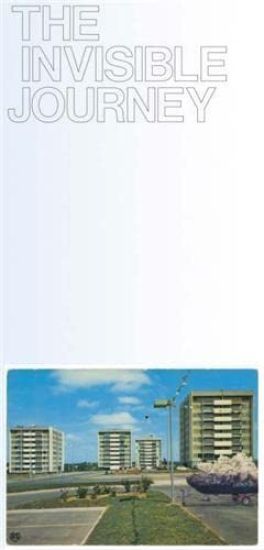
In 2021, invited by the French artist Thomas Mailaender for a residency at Tuba Club in the Calanques National Park in southern Marseille, Julien Berthier took an old boat and topped it with a calanque-inspired slab of rock sculpted in the same resin as the boat’s hull. Once placed in the water, the work became practically invisible and gave the installation its title. Continuing his reflections on landscape, Berthier’s book “The Invisible Journey” incorporates the rock-boat across a set of postcards, in the same manner: both visible and invisible. Low tech by choice, Berthier cut out images of the boat manually, then glue them directly to the postcards. The rock-boat thus embarks on a tour of various places and eras, accompanying the travel accounts of strangers.
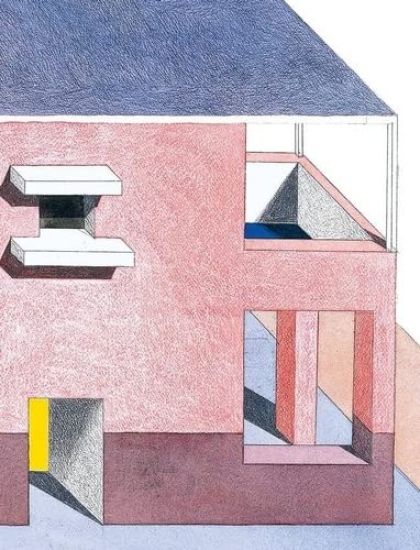
Ettore Sottsass (1917–2007) was an architect and designer, labeled the godfather of Italian design. Born in Austria and based in Milan, Sottsass studied architecture at the Politecnico di Torino in Turin. After spending most of World War II in a concentration camp in Yugoslavia, Sottsass returned to Italy, where he set up his studio. ?? In 1958, he was hired as a design consultant for the Olivetti company, a position he held for more than 20 years. While there, he produced many designs, including the Elea 9003 computer and the red plastic Valentine portable typewriter. His aim was to produce objects that went beyond typical consumerist products. ?? As Sottsass distanced himself from pure functionalism, he started experimenting with designs that had social and historical components. During this time, Sottsass became a leading figure in the Radical-Design movement. In 1981, Sottsass led a group of designers who came to be known as the Memphis group. This group experimented with colors and materials, creating multifunctional pieces and breaking with convention. Their new materials included neon, unusual finishes, and patterned plastic laminates. After Memphis, Sottsass continued to produce provocative work, constantly challenging the accepted practices of the day. He also established the architectural firm Sottsass Associati, with the aim of producing large-scale designs. ?? Sottsass’s work has been the subject of retrospective exhibitions at the Centre Pompidou in Paris, the Los Angeles County Museum of Art, and the Design Museum in London, among others. His numerous awards included the title of Office of the Ordre des Arts et des Lettres of the French Republic in 1992, an honorary degree from the Rhode Island School of Design in 1993 an Honorary Doctor of the Royal College of Art in London in 1996, an Oribe Award in Japan in 1997, and a Sir Misha Black Award in 1999.

Ralph Johnson of Perkins + Will
Friedman Daniel S.; El-Khoury Rodolphe; Thomas Fisher
Oscar Riera Ojeda Publishers Limited
2013
nidottu
The work of Chicago architect Ralph Johnson explores the use of restrained modernism to enrich and clarify complex programmatic buildings with intriguing assemblies that reveal their functions and hierarchical relationships. Mr. Johnson’s goal is to form, through the social art of architecture, an urban environment of buildings that are good civic neighbours as well as distinguished citizens. The projects in this book, both built and unbuilt, represent his concern for humanistic values and emphasis on process rather than preconceived product, allowing the work to respond to diverse cultures and urban conditions. Mr. Johnson is a Principal and the Design Director at Perkins+Will. The book includes essays by Rodolphe el- Khoury, Daniel Friedman and Thomas Fisher.

County Commission, Hale County, Alabama, Et Al., Appellants, V. United States. U.S. Supreme Court Transcript of Record with Supporting Pleadings
W McLean Pitts; Daniel M Friedman
Gale, U.S. Supreme Court Records
2011
pokkari

Daniel Tiger makes a new friend in this charming new 8x8 storybook based on a popular episode of Daniel Tiger's Neighborhood" Daniel and Miss Elaina are visiting Prince Wednesday's castle for a play date. When they arrive they are so excited to meet a new friend--Prince Wednesday's cousin, Chrissie Daniel has so much fun playing with his new friend Then he notices that Chrissie wears braces on her legs to help her walk. Even though Chrissie may walk differently than Daniel, she loves the color red and playing pretend just as much as he does Daniel is thrilled to make a wonderful new friend This delightful story is perfect for helping little ones understand that despite small differences, anyone can become a new friend (c) 2015 The Fred Rogers Company

The Freedmen During The First And Second Centuries Of The Roman Empire (1914)
Daniel Dupre Smith
KESSINGER PUBLISHING, LLC
2010
pokkari


Daniel Waldo Field: Impressions of Those Who Know Him
Ralph Freeman Paulding
Literary Licensing, LLC
2013
nidottu

Daniel Waldo Field and D.W. Field Park: A History
Ralph Freeman Paulding
Createspace Independent Publishing Platform
2014
nidottu

The Freedmen During the First and Second Centuries of the Roman Empire...
Daniel Dupre Smith
Nabu Press
2012
pokkari



A new generation of children love Daniel Tiger's Neighborhood, inspired by the classic series Mister Rogers' Neighborhood In this adorable touch-and-feel storybook, Daniel Tiger picks out his clothes for the day Whether it's bedtime or playtime, a sunny day or a rainy day, Daniel Tiger loves getting dressed With interesting textures to touch and feel, little ones will help Daniel get dressed for the day. (c) 2015 The Fred Rogers Company

Music and the Plain Man: The Freeman, V7, No. 169, June 13, 1923
Daniel Gregory Mason
Literary Licensing, LLC
2012
nidottu

The Slaves of Central Fairfield County: The Journey from Slave to Freeman in Nineteenth-Century Connecticut
Daniel Cruson
History Press Library Editions
2007
sidottu
Much attention has been given to the Northern response to the South s peculiar institution of slavery. While the details of anti-slavery activity are well known, the other side of history is neglected: the enslavement, mistreatment and subjugation of slaves who lived and toiled in Northern states. In this ground-breaking book on the slaves of Fairfield County, historian Dan Cruson reveals the harsh reality of slavery in the North that existed alongside anti-slavery activity by presenting a comprehensive picture of rural slavery in 18th and early 19th century Connecticut. From the framework of everyday life including the slave-master relationship, housing and dress, to the role of slaves and free blacks in the Revolution that hastened the demise of slavery in Connecticut, Cruson s accessible and intriguing rendering of slave life in central Fairfield County will fascinate and inform readers. Utilizing local slave archaeology, Cruson presents exciting recent discoveries that shed light on African American spiritual practices. He goes on to tackle the complicated issue of the anti-slavery activity, discussing the problems with the abolition movement in Fairfield County in the 1830s and 1840s and questioning prevalent local folklore about the Underground Railroad."