First Published in 1997. Many able children are underachieving in schools because teacher and parents are failing to identify and therefore adequately provide for their special needs. This second, updated edition of Challenge of the Able Child will assist teachers in becoming more patient and observant in the classroom so that they can accurately define their objectives in providing for these children. Above all, this book aims to help teachers and parents discover the excitement, challenge and pleasure of teaching able children and helping them achieve their potential. The education of able children has moved on considerably since the first edition and this is reflected in the text with update and additions in computer technology, new resources and an expanded bibliography.
The Challenge of Islam to Christians is David Pawson's most important and perhaps his most sobering - prophetic message to date. Moral decline and erosion of a sense of ultimate truth have created a spiritual vacuum in the United Kingdom. Pawson believes Islam is better equipped than the Church to move into that gap and it is far more likely to become the country's dominant religion in the future.This book unpacks and explains the background behind Pawson's claims. and - crucially - sets out a positive blueprint for the Church's response. Christians must rediscover and demonstrate to society the three qualities that make Christianity unique: Reality. Relationship and Righteousness. This book is essential reading for all Christians.
The latest addition to the 'Lives of the Artists' series: highly readable short biographies of the world's greatest artistsDavid Hockney is the most famous living British artist. And he is arguably one of the more famous American artists as well. Emerging from the north of England in the 1960s, he made quite a splash in Swinging London as a portaitist, and went on to make a even bigger splash in Los Angeles when he moved there in the 1970s. His figurative paintings of the 1970s and 1980s captured the zeitgeist of West Coast living, while he also explored new avenues by constructing mosaics out of polaroids. By the beginning of the millennium, he returned to his Yorkshire roots, embarking on a new period of painting. This came to an end with the death by misadventure in his home of a young studio assistant in 2013. He went 'home' to LA and has in the intervening years begun a new period of contemplative portraiture.
The math challenge curriculum textbook series is designed to help students learn the fundamental mathematical concepts and practice their in-depth problem solving skills with selected exercise problems. Ideally, these textbooks are used together with Areteem Institute's corresponding courses, either taken as live classes or as self-paced classes. According to the experience levels of the students in mathematics, the following courses are offered: Fun Math Problem Solving for Elementary School (grades 3-5)Algebra Readiness (grade 5; preparing for middle school)Math Challenge I-A Series (grades 6-8; intro to problem solving)Math Challenge I-B Series (grades 6-8; intro to math contests e.g. AMC 8, ZIML Div M)Math Challenge I-C Series (grades 6-8; topics bridging middle and high schools)Math Challenge II-A Series (grades 9+ or younger students preparing for AMC 10)Math Challenge II-B Series (grades 9+ or younger students preparing for AMC 12)Math Challenge III Series (preparing for AIME, ZIML Varsity, or equivalent contests)Math Challenge IV Series (Math Olympiad level problem solving)These courses are designed and developed by educational experts and industry professionals to bring real world applications into the STEM education. These programs are ideal for students who wish to win in Math Competitions (AMC, AIME, USAMO, IMO, ARML, MathCounts, Math League, Math Olympiad, ZIML, etc.), Science Fairs (County Science Fairs, State Science Fairs, national programs like Intel Science and Engineering Fair, etc.) and Science Olympiad, or purely want to enrich their academic lives by taking more challenges and developing outstanding analytical, logical thinking and creative problem solving skills.Math Challenge I-A is an introductory level course for 6-8 grade students who have little or no experience in in-depth problem solving nor math competitions. Students learn skills to apply the concepts they learn in school math classes into problem solving. Content includes pre-algebra, fundamental geometry, counting and probability, and basic number theory. Students develop skills in creative thinking, logical reasoning, analytical and problem solving skills. Students are exposed to beginning contests such as AMC 8, MathCounts, Math Olympiads for Elementary and Middle School (MOEMS), and Zoom International Math League (ZIML) Division M.The course is divided into four terms: Summer, covering Pre-Algebra and Word ProblemsFall, covering GeometryWinter, covering CombinatoricsSpring, covering Number TheoryThe book contains course materials for Math Challenge I-A: Pre-Algebra and Word Problems.We recommend that students take all four terms. Each of the individual terms is self-contained and does not depend on other terms, so they do not need to be taken in order, and students can take single terms if they want to focus on specific topics.Students can sign up for the live online or self-paced course at https: //classes.areteem.org
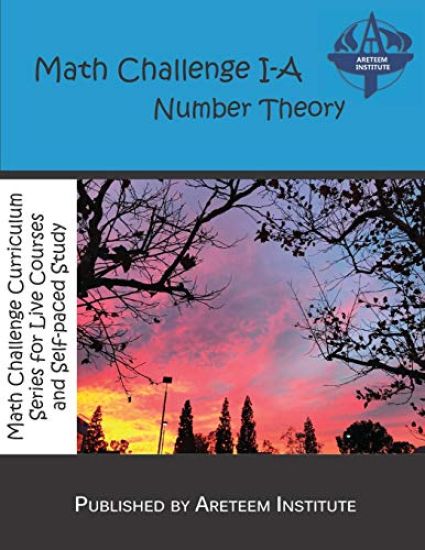
The math challenge curriculum textbook series is designed to help students learn the fundamental mathematical concepts and practice their in-depth problem solving skills with selected exercise problems. Ideally, these textbooks are used together with Areteem Institute's corresponding courses, either taken as live classes or as self-paced classes. According to the experience levels of the students in mathematics, the following courses are offered: Fun Math Problem Solving for Elementary School (grades 3-5)Algebra Readiness (grade 5; preparing for middle school)Math Challenge I-A Series (grades 6-8; intro to problem solving)Math Challenge I-B Series (grades 6-8; intro to math contests e.g. AMC 8, ZIML Div M)Math Challenge I-C Series (grades 6-8; topics bridging middle and high schools)Math Challenge II-A Series (grades 9+ or younger students preparing for AMC 10)Math Challenge II-B Series (grades 9+ or younger students preparing for AMC 12)Math Challenge III Series (preparing for AIME, ZIML Varsity, or equivalent contests)Math Challenge IV Series (Math Olympiad level problem solving)These courses are designed and developed by educational experts and industry professionals to bring real world applications into the STEM education. These programs are ideal for students who wish to win in Math Competitions (AMC, AIME, USAMO, IMO, ARML, MathCounts, Math League, Math Olympiad, ZIML, etc.), Science Fairs (County Science Fairs, State Science Fairs, national programs like Intel Science and Engineering Fair, etc.) and Science Olympiad, or purely want to enrich their academic lives by taking more challenges and developing outstanding analytical, logical thinking and creative problem solving skills.Math Challenge I-A is an introductory level course for 6-8 grade students who have little or no experience in in-depth problem solving nor math competitions. Students learn skills to apply the concepts they learn in school math classes into problem solving. Content includes pre-algebra, fundamental geometry, counting and probability, and basic number theory. Students develop skills in creative thinking, logical reasoning, analytical and problem solving skills. Students are exposed to beginning contests such as AMC 8, MathCounts, Math Olympiads for Elementary and Middle School (MOEMS), and Zoom International Math League (ZIML) Division M.The course is divided into four terms: Summer, covering Pre-Algebra and Word ProblemsFall, covering GeometryWinter, covering CombinatoricsSpring, covering Number TheoryThe book contains course materials for Math Challenge I-A: Number Theory.We recommend that students take all four terms. Each of the individual terms is self-contained and does not depend on other terms, so they do not need to be taken in order, and students can take single terms if they want to focus on specific topics.Students can sign up for the live online or self-paced course at https: //classes.areteem.org.
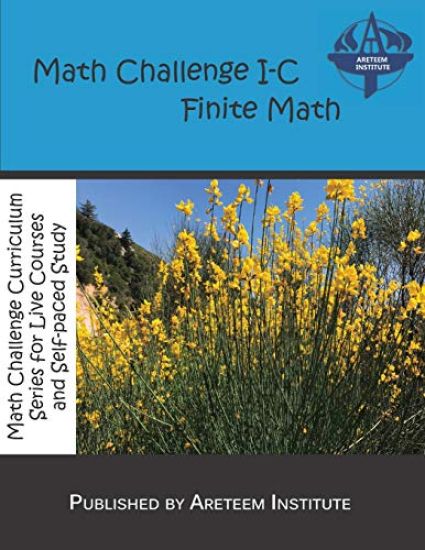
The math challenge curriculum textbook series is designed to help students learn the fundamental mathematical concepts and practice their in-depth problem solving skills with selected exercise problems. Ideally, these textbooks are used together with Areteem Institute's corresponding courses, either taken as live classes or as self-paced classes. According to the experience levels of the students in mathematics, the following courses are offered: Fun Math Problem Solving for Elementary School (grades 3-5)Algebra Readiness (grade 5; preparing for middle school)Math Challenge I-A Series (grades 6-8; intro to problem solving)Math Challenge I-B Series (grades 6-8; intro to math contests e.g. AMC 8, ZIML Div M)Math Challenge I-C Series (grades 6-8; topics bridging middle and high schools)Math Challenge II-A Series (grades 9+ or younger students preparing for AMC 10)Math Challenge II-B Series (grades 9+ or younger students preparing for AMC 12)Math Challenge III Series (preparing for AIME, ZIML Varsity, or equivalent contests)Math Challenge IV Series (Math Olympiad level problem solving)These courses are designed and developed by educational experts and industry professionals to bring real world applications into the STEM education. These programs are ideal for students who wish to win in Math Competitions (AMC, AIME, USAMO, IMO, ARML, MathCounts, Math League, Math Olympiad, ZIML, etc.), Science Fairs (County Science Fairs, State Science Fairs, national programs like Intel Science and Engineering Fair, etc.) and Science Olympiad, or purely want to enrich their academic lives by taking more challenges and developing outstanding analytical, logical thinking and creative problem solving skills.Math Challenge I-C is a four-part course designed to bridge the middle school and high school math materials. For students who participate in the American Math Competitions (AMC), there is a big gap in both the fundamental math concepts and the problem-solving techniques involved between the AMC 8 and AMC 10 contests. This course is developed to help students transition smoothly from middle school to high school, and prepare them for high school math competitions including the AMC 10 \& 12, ARML, and ZIML. The full course covers topics and introductory problem solving in algebra, geometry, and finite math. Algebraic topics include linear equations, systems of equations and inequalities, exponents and radicals, factoring polynomials, and solving quadratic equations. Geometric topics include angles in triangles, quadrilaterals, and polygons, congruent and similar polygons, calculating area, and algebraic geometry. Topics in finite math include logic, introductory number theory, and an introduction to probability and statistics. These topics serve as the fundamental knowledge needed for a more advanced problem solving course such as Math Challenge II-A.The course is divided into four terms: Summer, covering AlgebraFall, covering covering additional topics in AlgebraWinter, covering GeometrySpring, covering Finite MathThe book contains course materials for Math Challenge I-C: Additional topics in Algebra.We recommend that students take all four terms starting with the Summer, but students with the required background are welcome to join for later terms in the course, or select suitable terms for self-paced study.Students can sign up for the live online or self-paced course at https: //classes.areteem.org.
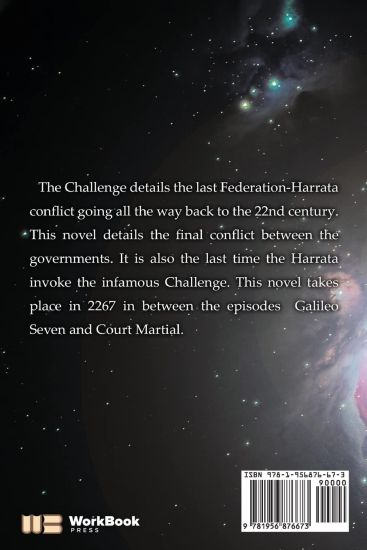
The Challenge details the last Federation-Harrata conflict going all the way back to the 22nd century. This novel details the final conflict between the governments. It is also the last time the Harrata invoke the infamous Challenge. This novel takes place in 2267 in between the episodes Galileo Seven and Court Martial.
The Challenge details the last Federation-Harrata conflict going all the way back to the 22nd century. This novel details the final conflict between the governments. It is also the last time the Harrata invoke the infamous Challenge. This novel takes place in 2267 in between the episodes Galileo Seven and Court Martial.
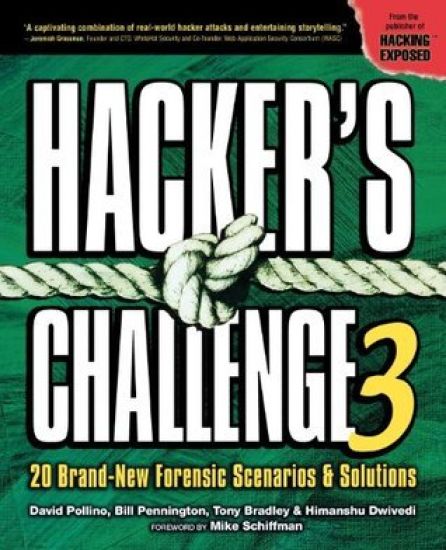
Publisher's Note: Products purchased from Third Party sellers are not guaranteed by the publisher for quality, authenticity, or access to any online entitlements included with the product.The stories about phishing attacks against banks are so true-to-life, it’s chilling.” --Joel Dubin, CISSP, Microsoft MVP in SecurityEvery day, hackers are devising new ways to break into your network. Do you have what it takes to stop them? Find out in Hacker’s Challenge 3. Inside, top-tier security experts offer 20 brand-new, real-world network security incidents to test your computer forensics and response skills. All the latest hot-button topics are covered, including phishing and pharming scams, internal corporate hacking, Cisco IOS, wireless, iSCSI storage, VoIP, Windows, Mac OS X, and UNIX/Linux hacks, and much more. Each challenge includes a detailed explanation of the incident--how the break-in was detected, evidence and clues, technical background such as log files and network maps, and a series of questions for you to solve. In Part II, you’ll get a detailed analysis of how the experts solved each incident.
Rhyme's Challenge offers a concise, pithy primer to hip-hop poetics while presenting a spirited defense of rhyme in contemporary American poetry. David Caplan's stylish study examines hip-hop's central but supposedly outmoded verbal technique: rhyme. At a time when print-based poets generally dismiss formal rhyme as old-fashioned and bookish, hip-hop artists deftly deploy it as a way to capture the contemporary moment. Rhyme accommodates and colorfully chronicles the most conspicuous conditions and symbols of contemporary society: its products, technologies, and personalities. Ranging from Shakespeare and Wordsworth, to Eminem and Jay-Z, David Caplan's study demonstrates the continuing relevance of rhyme to poetry--and everyday life.
Rhyme's Challenge offers a concise, pithy primer to hip-hop poetics while presenting a spirited defense of rhyme in contemporary American poetry. David Caplan's stylish study examines hip-hop's central but supposedly outmoded verbal technique: rhyme. At a time when print-based poets generally dismiss formal rhyme as old-fashioned and bookish, hip-hop artists deftly deploy it as a way to capture the contemporary moment. Rhyme accommodates and colorfully chronicles the most conspicuous conditions and symbols of contemporary society: its products, technologies, and personalities. Ranging from Shakespeare and Wordsworth to Eminem and Jay-Z, David Caplan's study demonstrates the continuing relevance of rhyme to poetry-and everyday life.
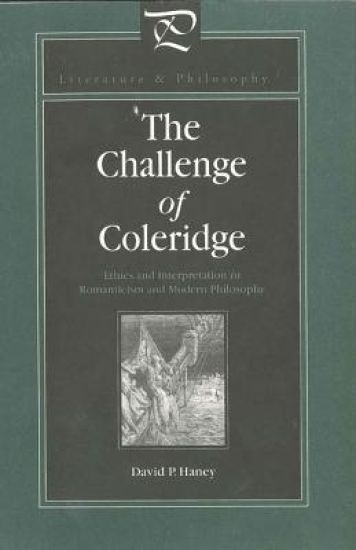
Interweaving past and present texts, The Challenge of Coleridge engages the British Romantic poet, critic, and philosopher Samuel Taylor Coleridge in a "conversation" (in Hans-Georg Gadamer’s sense) with philosophical thinkers today who share his interest in the relationship of interpretation to ethics and whose ideas can be both illuminated and challenged by Coleridge’s insights into and struggles with this relationship.In his philosophy, poetry, theology, and personal life, Coleridge revealed his concern with this issue, as it manifests itself in the relation between technical and ethical discourse, between fact and value, between self and other, and in the ethical function of aesthetic experience and the role of love in interpretation and ethical action.Relying on Gadamer’s hermeneutics to supply a framework for his approach, Haney connects Coleridge’s ideas with, among others, Emmanuel Levinas’s other-oriented notion of ethical subjectivity, Paul Ricoeur’s view about the other’s implication in the self, reinterpretations of Greek drama by Bernard Williams and Martha Nussbaum, and Gianni Vattimo's post-Nietzschean hermeneutics.Coleridge is treated not as a product of Romantic ideology to be deconstructed from a modern perspective, but as a writer who offers a "challenge" to our modern tendency to compartmentalize interpretive issues as a concern for literary theorists and ethical issues as a concern for philosophers. Looking at the two together, Haney shows through his reading of Coleridge, can enrich our understanding of both.
Problem-based learning is a way of constructing and teaching courses using problems as the stimulus and focus for student activity. This edition looks at the topic in the light of changes since the first edition (1991). There are new chapters on the impact of PBL, and inquiry and action learning.
In 1975, Indonesian forces overran East Timor, just days after it declared independence from Portugal. Canadian officials knew the invasion was coming and endorsed Indonesian rule in the ensuing occupation. Challenge the Strong Wind recounts the evolution of Canadian government policy toward East Timor from 1975 to its 1999 independence vote. During this time, Canadian civil society groups and NGOs worked in support of Timorese independence activists by promoting an alternative Canadian foreign policy that focused on self-determination and human rights. After following the lead of key pro-Indonesian allies in the 1970s and '80s, Ottawa eventually yielded to pressure from these NGOs and pushed like-minded countries to join it in supporting Timorese self-rule. David Webster draws on previously untapped government and non-government archival sources to demonstrate that a clear-eyed view of international history must include both state and non-state perspectives. The East Timor conflict serves as a model of multilevel dialogue, citizen diplomacy, and novel approaches to resolving complex disputes.
In 1975, Indonesian forces overran East Timor, just days after it declared independence from Portugal. Canadian officials knew the invasion was coming and endorsed Indonesian rule in the ensuing occupation. Challenge the Strong Wind recounts the evolution of Canadian government policy toward East Timor from 1975 to its 1999 independence vote. During this time, Canadian civil society groups and NGOs worked in support of Timorese independence activists by promoting an alternative Canadian foreign policy that focused on self-determination and human rights. After following the lead of key pro-Indonesian allies in the 1970s and '80s, Ottawa eventually yielded to pressure from these NGOs and pushed like-minded countries to join it in supporting Timorese self-rule. David Webster draws on previously untapped government and non-government archival sources to demonstrate that a clear-eyed view of international history must include both state and non-state perspectives. The East Timor conflict serves as a model of multilevel dialogue, citizen diplomacy, and novel approaches to resolving complex disputes.