Kirjojen hintavertailu. Mukana 12 479 154 kirjaa ja 12 kauppaa.

Kirjahaku

Etsi kirjoja tekijän nimen, kirjan nimen tai ISBN:n perusteella.

1000 tulosta hakusanalla David F. Hendry

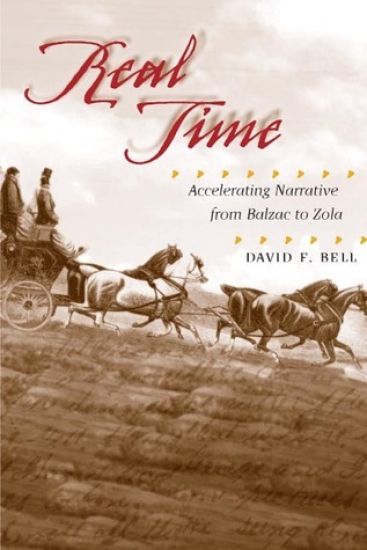
Real Time

Real Time

David F. Bell

University of Illinois Press
2003
sidottu
In Real Time David F. Bell explores the decisive impact the accelerated movement of people and information had on the fictions of four giants of French realism--Balzac, Stendhal, Dumas, and Zola. Nineteenth-century technological advances radically altered the infrastructure of France, changing the ways ordinary citizens–-and literary characters--viewed time, space, distance, and speed. The most influential of these advances included the improvement of the stagecoach, the growth of road and canal networks leading to the advent of the railway, and the increasing use of mail, and of the optical telegraph. Citing examples from a wide range of novels and stories, Bell demonstrates the numerous ways in which these trends of acceleration became not just literary devices and themes but also structuring principles of the novels themselves. Beginning with both the provincial and the Parisian communications networks of Balzac, Bell proceeds to discuss the roles of horses and optical telegraphs in Stendhal and the importance of domination of communication channels to the characters of Dumas, whose Count of Monte-Cristo might be seen as the ultimate fictional master of this accelerated culture. Finally, Bell analyzes the cinematic vision created by the arrival of the railroad, as depicted by Zola in La Bète Humaine.

Crashing the Old Boys' Network

Crashing the Old Boys' Network

David F. Salter

Praeger Publishers Inc
1996
sidottu
Crashing the Old Boys' Network is the first book to examine the intense, and sometimes hostile, debate about Title IX and its application to girls and women in all areas of athletics. The facts and figures are highlighted by spirited commentary from Billie Jean King, Donna Lopiano, Pat Summitt, Chris Berman, and many others. By using the commentary of well-known personalities and experts in a variety of relevant disciplines, this book uncovers the roots of this controversy at all levels of athletics. While many believe Title IX and gender equity to be applicable only to intercollegiate athletics, its reach touches girls in high school athletics as well. While not protected by Federal law, girls in youth sports, women in professional sports, and women in the sports media also suffer the negative effects of gender discrimination.While detailing many personal accounts and documenting a host of legal battles, the greatest value in this book lies in the successful examples it provides. Many opponents proclaim Title IX to be a grim reaper for football and men's basketball. The author provides examples demonstrating how Title IX and gender equity can be achieved with rational, well-designed plans of action.
Meeting God in John

Meeting God in John

David F. Ford

SPCK PUBLISHING
2025
pokkari
Whether you are completely new to John's Gospel or have read it many times before, Meeting God in John will help you see the Fourth Gospel with fresh eyes and better understand its essential meaning and purpose. David ford, one of the world's most widely respected theologians and author of Theology - A Very short Introduction and The Gospel of John - A Theological Commentary, offers an accessible introduction to the main message of John's Gospel. Powerful and absorbing, it is packed full of compelling observations about the personality and impact of Jesus, both in the first century and today. Meeting God in John explores what the Gospel teaches us about the revelation of God in the person of Jesus Christ. Essential reading for anyone wanting to understand the gospel message better, it will leave you with a new appreciation of and enthusiasm for the riches of John's writing, and the desire to return to it over and over again. Its straightforward, enlightening approach also makes it eminently helpful for new Christians just starting out on their faith journey. Each chapter includes questions for reflection or discussion, making Meeting God in John a perfect book for Bible study both for individuals and small groups. With a focus on the Passion narrative, it is also ideal for use as a Lent devotional. Simple yet profound, Meeting God in John is an invitation to anyone wanting to deepen their understanding of the Gospel of John and through it to meet the God who is revealed in Jesus Christ. Contents Part 1 Lent 1 The Big Picture—Meaning, Love, Jesus [Mainly, Prologue] 2 Identity—Who are you? [Mainly, John 4:1-42, Jesus and Samaritan Woman] 3 Desire—What are you looking for? [Mainly, John 6, Feeding of 5000 + discourse] 4 Home—Where are you staying? [Mainly, John 15:1-17 Parable of the Vine] 5 Glory—Meeting God in John [Mainly, John 12:27-28 &17:20-26 on Glory and Love] Part 2 The Hour Happens 6 Thursday—Loving Utterly, Intimately, Vulnerably, Mutually [Mainly, John 13] 7 Friday—Jesus Dies [Mainly, John 18-19] 8 Sunday—Jesus is Alive [Mainly, John 20] Part 3 The Ongoing Drama—Jesus Happening in the Twenty-first Century 9 Christian Essentials Now: Learning, Praying, Loving [Mainly, John 13-17, 21]
Petroleum Politics and the Texas Railroad Commission

Petroleum Politics and the Texas Railroad Commission

David F. Prindle

University of Texas Press
1981
pokkari
The single most important domestic source of oil and gas is managed by the Texas Railroad Commission. As a result, the Commission has for decades exerted a profound influence on United States and world energy policy. This influence may even increase with the recent decision to remove price controls on oil and gas. Commission decisions determine where and when oil and gas wells are drilled, how much can be produced from them, and how the products can be transported. Since the 1930s the Commission has heavily influenced both the supply and the price of petroleum in the rest of the country simply because Texas provides such a large proportion of the United States' petroleum. As might be expected with the management of resources worth billions of dollars, the Railroad Commission has been an arena of intense political maneuvering. David Prindle examines in detail seven policymaking episodes, covering five decades of the Commission's history. He recounts the economic and political cleavages arising from clashes of interest, the efforts of individuals and organizations to exert influence, the motives and methods underlying the policy choices of the Commissioners, and the political and economic consequences of those choices, both for Texas and for the rest of the country. This detailed look at the Railroad Commission and the politics of petroleum in Texas will be of interest to the general public and all those involved in the oil and gas industry. Scholars and students in the field of policy studies, especially energy policy, will find this book to be an invaluable guide to an important sector of the American petroleum industry.
The Fishermen's Frontier

The Fishermen's Frontier

David F. Arnold; William Cronon

University of Washington Press
2011
pokkari
In The Fishermen's Frontier, David Arnold examines the economic, social, cultural, and political context in which salmon have been harvested in southeast Alaska over the past 250 years. He starts with the aboriginal fishery, in which Native fishers lived in close connection with salmon ecosystems and developed rituals and lifeways that reflected their intimacy.The transformation of the salmon fishery in southeastern Alaska from an aboriginal resource to an industrial commodity has been fraught with historical ironies. Tribal peoples -- usually considered egalitarian and communal in nature -- managed their fisheries with a strict notion of property rights, while Euro-Americans -- so vested in the notion of property and ownership -- established a common-property fishery when they arrived in the late nineteenth century. In the twentieth century, federal conservation officials tried to rationalize the fishery by "improving" upon nature and promoting economic efficiency, but their uncritical embrace of scientific planning and their disregard for local knowledge degraded salmon habitat and encouraged a backlash from small-boat fishermen, who clung to their "irrational" ways. Meanwhile, Indian and white commercial fishermen engaged in identical labors, but established vastly different work cultures and identities based on competing notions of work and nature.Arnold concludes with a sobering analysis of the threats to present-day fishing cultures by forces beyond their control. However, the salmon fishery in southeastern Alaska is still very much alive, entangling salmon, fishermen, industrialists, scientists, and consumers in a living web of biological and human activity that has continued for thousands of years.
An Enduring Legacy

An Enduring Legacy

David F. Martin

University of Washington Press
2012
pokkari
One of the state's oldest arts organizations, Women Painters of Washington was founded in 1930 with the aim of overcoming limitations faced by women artists. Over its 75-year history, the group has counted among its members talented artists of national prominence whose stories have not been widely shared, until now.From founding members' early efforts to support fellow women artists, to contemporary members' cultural exchanges and international exhibitions, David F. Martin tells the story of Women Painters of Washington. He examines members' artistic achievements and the recognition they received in the national and international art worlds. In addition, a selection of works by current WPW members demonstrates the organization's continued vitality. Abundant color plates clearly illustrate the talent and innovation of these artists.
The Politics of Glamour

The Politics of Glamour

David F. Prindle

University of Wisconsin Press
1988
nidottu
Rarely are the off-screen lives of actors examined for evidence of deep thinking or good citizenship. Still more rarely do the internal workings of labor unions attract public scrutiny. Nevertheless, as David Prindle shows in his examination of democracy in the Screen Actors Guild, this actors union has for over 50 years been an arena for idealistic, yet intense and hardboiled political maneuvering. In The Politics of Glamour, readers become aware of the seriousness and political commitment displayed by people whom the general public has generally admired more for their artistic skills. After reading this account of politics among America s screen royalty, no one could wonder about where Ronald Reagan, a former SAG president, received his political training. Besides analyzing the politics of SAG, however, the author follows a good story wherever it leads. The reader can expect to learn something about the political economy of Hollywood and the American labor movement, the value of celebrity within the acting community, the impact of technological change, and even a bit of gossip."
The Making of an American High School

The Making of an American High School

David F. Labaree

Yale University Press
1992
pokkari
How have the educational goals of American public high schools changed over time? What can the experiences of one secondary school tell us about the problems they all face today? This book provides an analytical history of the origins and development of Central High School, the first high school in Philadelphia and a model for many subsequent institutions. Using Central as a case study, David F. Labaree argues that the American public high school can be viewed as the product of both democratic politics and capitalist markets: although it was originally intended to produce informed citizens for the new republic, the high school, with its meritocratic emphasis, instead became a vehicle for conferring status on the select group that was educated there. The struggle between these two goals—one leading to political equality and the other reinforcing economic inequality—has characterized its history ever since, says Labaree. According to Labaree, Central was founded as a selective middle-class school with broad moral and political aims. However, the school’s success in providing advantages for its graduates led, during the 1880s, to growing public demand for secondary education. The resulting rapid expansion of Centrals’ enrollment and the establishment of other public high schools eventually undermined the selectivity that had made its credentials so valuable and enabled it to flourish. This in turn spurred the school to protect its credentials by introducing tracking, with a new dual curriculum for college-bound and non college-bound students. Labaree contends that this compromise between access and exclusivity does not work: it fails to serve the public interest because of the attenuation of the school’s democratic goals, and it fails to serve private interests because of the declining value of the credentials it bestows. In order to achieve its original democratic goals, he argues, the public high school must abandon its longstanding links to the market.
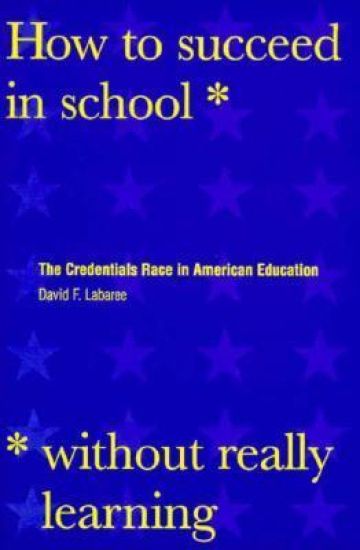
How to Succeed in School Without Really Learning

How to Succeed in School Without Really Learning

David F. Labaree

Yale University Press
1999
pokkari
Getting ahead and getting an education are inseparable in the minds of most Americans. David Labaree argues, however, that the connection between schooling and social mobility may be doing more harm than good, for the pursuit of educational credentials has come to take precedence over the acquisition of knowledge. Labaree examines the competing intellectual and ideological traditions that have fought for dominance in our public schools from the nineteenth century to the present. He claims that by thinking of education primarily as the route to individual advancement, we are defining it as a private good—a means of gaining a competitive advantage over other people. He endorses an alternative vision, one that sees education as a public good, providing society with benefits that can be collectively shared—for example, by producing citizens who are politically responsible and workers who are economically productive. He points out that when education is seen primarily as a private consumer good, a number of consequences follow. Formal characteristics of schooling—grades, credits, and degrees—come to assume greater weight than substantive characteristics, such as actually learning something. Grading becomes more important for its social consequences than for its pedagogical uses. For these and other reasons, the pursuit of certification and degrees takes precedence over the goals of learning, and the private benefits of schooling take precedence over its democratic and civic functions.
The Trouble with Ed Schools

The Trouble with Ed Schools

David F. Labaree

Yale University Press
2006
pokkari
American schools of education get little respect. They are portrayed as intellectual wastelands, as impractical and irrelevant, as the root cause of bad teaching and inadequate learning. In this book a sociologist and historian of education examines the historical developments and contemporary factors that have resulted in the unenviable status of ed schools, offering valuable insights into the problems of these beleaguered institutions. David F. Labaree explains how the poor reputation of the ed school has had important repercussions, shaping the quality of its programs, its recruitment, and the public response to the knowledge it offers. He notes the special problems faced by ed schools as they prepare teachers and produce research and researchers. And he looks at the consequences of the ed school’s attachment to educational progressivism. Throughout these discussions, Labaree maintains an ambivalent position about education schools—admiring their dedication and critiquing their mediocrity, their romantic rhetoric, and their compliant attitudes.
Social Cognitive Psychology

Social Cognitive Psychology

David F. Barone; James E. Maddux; C. R. Snyder

Kluwer Academic/Plenum Publishers
1997
sidottu
Social Cognitive Psychology is the first text to provide comprehensive coverage of the field, including thorough discussions of its historical foundations cross-referenced with significant recent developments. Highlights include ;the discipline's origins in pragmatic philosophy and the need for a second social psychology; the contributions of cognition, affect, and direct perception to social knowing, and the development of positive and negative self theories in social context. This valuable reference contains comprehensive chapter summaries, lists of key terms and concepts, and graphs of processing models from various theories.
Social Cognitive Psychology

Social Cognitive Psychology

David F. Barone; James E. Maddux; C. R. Snyder

Kluwer Academic/Plenum Publishers
1997
nidottu
A pragmatic social cognitive psychology covers a lot of territory, mostly in personality and social psychology but also in clinical, counseling, and school psychologies. It spans a topic construed as an experimental study of mechanisms by its natural science wing and as a study of cultural interactions by its social science wing. To learn about it, one should visit laboratories, field study settings, and clinics, and one should read widely. If one adds the fourth dimen­ sion, time, one should visit the archives too. To survey such a diverse field, it is common to offer an edited book with a resulting loss in integration. This book is coauthored by a social personality psychologist with historical interests (DFB: Parts I, II, and IV) in collaboration with two social clinical psychologists (CRS and JEM: Parts III and V). We frequently cross-reference between chapters to aid integration without duplication. To achieve the kind of diversity our subject matter represents, we build each chapter anew to reflect the emphasis of its content area. Some chapters are more historical, some more theoretical, some more empirical, and some more applied. All the chapters reflect the following positions.
Daily Life of Pirates

Daily Life of Pirates

David F. Marley

Greenwood Press
2012
sidottu
Drawing on new research, this fascinating volume looks behind the myths to offer detailed insights into the real lives and activities of pirates—for better or worse—during the golden age of piracy in the Caribbean, from the mid-17th century to 1720.Over the past decade, research in Spanish, French, and Dutch archives, as well as in traditional English repositories, has resulted in a clearer picture of the activities and lives of the pirates who roamed the seas during the "Golden Age of Piracy" from 1650 to 1720. That is the picture shared in Daily Life of Pirates. The book describes how pirates actually lived, touching on their food and drink, their hideouts, and their humor. It also examines their ships, weapons and seamanship, their plunder—and their use of torture. The book's detailed coverage is made possible by newly uncovered interrogations of pirates and by official depositions given by their victims, both of which provide insights that go well beyond simple recountings of famous exploits. The result is a tantalizing, true picture of pirates' daily lives that reveals many surprising facts, such as the reality that most of their time was spent upon land as actual piracy was a seasonal occupation.
Decolonization and the State in Kenya

Decolonization and the State in Kenya

David F. Gordon

Routledge
2019
sidottu
In this book the author examines the efforts of the colonial regime to shape the process of decolonization in Kenya from the end of World War II until independence in 1963, focusing on the conflict between the state’s two imperatives–promoting economic development and establishing and maintaining control. Dr. Gordon reviews the different political strategies devised by senior colonial officials in response to the growing socioeconomic and political tensions within Kenya and to the evolving guidelines emanating from London. He looks at how these strategic assumptions affected the policies the colonial regime attempted to implement in the areas of land and agriculture, labor and industrial relations, and the development of African trade. He challenges the view that the colonial regime effectively dominated and determined the direction of decolonization and concludes by relating the findings of the Kenyan case to wider debates about the meaning of decolonization in Africa.
Discovering Artificial Economics

Discovering Artificial Economics

David F. Batten

Routledge
2019
sidottu
I’Ve live in an astornshingly complex world, Yet what we do in our everyday lives seems simple enough. Most of us conform to society’s rules, pursue familiar strategies, and achieve reasonably predictable outcomes. In our role as economic agents, we simply peddle our wares and earn our daily bread as best we can.So where on earth does this astonishing complexity come from? Much of it is ubiquitous in nature, to be sure, but part of it lies within and between us. Part of it comes from those games of interaction that humans play—games against nature, games against each other, games of competition, games of cooperation. In bygone eras, people simply hunted and gathered to come up with dinner. Today you can find theoretical economists scratching mysterious equations on whiteboards (not even blackboards) and getting paid to do this. In the modern economy, most of us make our living in a niche created for us by what others do. Because we’ve become more dependent on each other, our economy as a whole has become more strongly interactive.
Agroclimate Information For Development

Agroclimate Information For Development

David F. Cusack

TAYLOR FRANCIS LTD
2021
sidottu
Agroclimatology is the science of those climatic or weather factors important to agriculture. Climate is generally thought as an uncontrollable factor, and this book provides an understanding of the agroclimatic system and its influences on the failure or success of agricultural development activities; looking at misunderstandings and the value of research into this area
Interaction in the Thai Bureaucracy: Structure, Culture, and Social Exchange
Presenting the results of seventeen months of field research, conducted entirely in the Thai language, this study describes and compares the patterns of social exchange of two groups of Thai officials: district-level bureaucrats and physicians in a provincial hospital. Dr. Haas uses a unique combination of anthropological field data and survey research. He is the first to thoroughly describe the effects of the government's counterinsurgency efforts on the behavior of local officials and on their relations with villagers and provincial merchants; his chapters on physicians contain one of the few published discussions of the meaning of professionalism in non-Western societies, as well as the only field study available of an Asian medical institution.
Decolonization And The State In Kenya

Decolonization And The State In Kenya

David F. Gordon

Routledge
2020
nidottu
This book examines the efforts of the colonial regime to shape the process of decolonization in Kenya from the end of World War II until independence in 1963. It focuses on the conflict between the state's two imperatives: promoting economic development and establishing and maintaining control.